
Clarity in roles and responsibilities is not just a necessity in the evolving landscape of project management but the backbone of successful project execution. Amidst a myriad of tools and techniques available to project managers, the RACI Matrix stands out as a beacon of structure and efficiency. This matrix, a powerhouse of simplicity and effectiveness, has become a linchpin in the strategic planning and operational phases of projects across various industries.
Let’s explore the top ten advantages that make the RACI Matrix an indispensable tool for modern project managers.
What is a RACI Matrix?
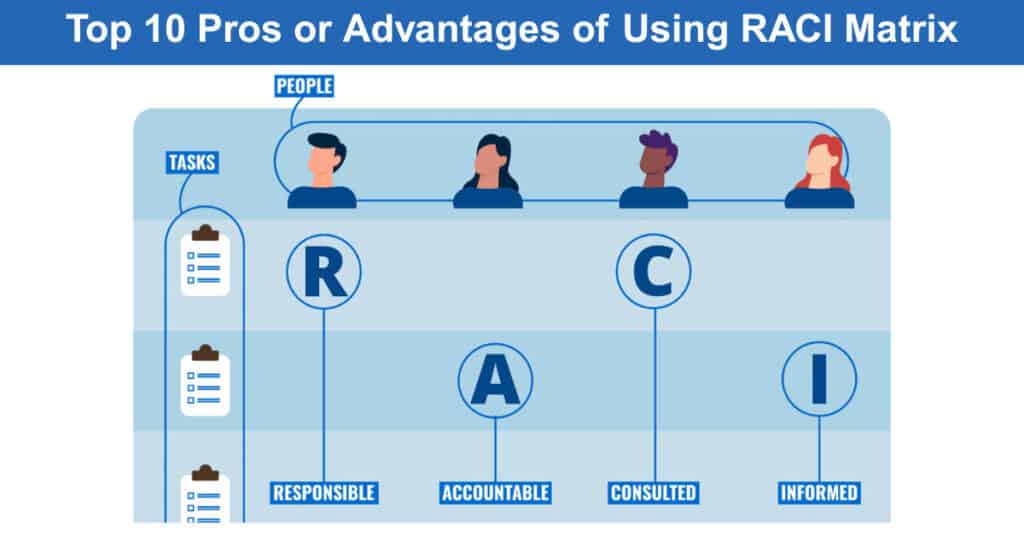
The RACI Matrix, an acronym for Responsible, Accountable, Consulted, and Informed, is a versatile tool used in project management to assign and display responsibilities of individuals or job roles in projects, processes, or tasks. It’s a form of responsibility assignment matrix that simplifies the tracking of roles and responsibilities, making it easier to manage complex projects and processes.
- Responsible (R): These are the individuals or teams who do the work. They are tasked with executing the task or decision.
- Accountable (A): This role is often held by a project manager or team leader. It’s the “answerable” person for the work’s completion and is the final decision-maker.
- Consulted (C): These are the subject matter experts who provide input, guidance, and advice. Their opinions are sought to ensure informed decisions and actions.
- Informed (I): These individuals need to be kept in the loop about progress and decisions. They are not directly involved in the task but must be updated on outcomes and developments.
The RACI Matrix clarifies who is doing what, reducing confusion and aligning all team members with their roles and responsibilities. This clarity enhances coordination, improves communication, and leads to more efficient and effective project management.
Top 10 Pros or Advantages of Using the RACI Matrix
Clarity in roles and responsibilities is essential for smooth project execution, and the RACI Matrix provides a simple, visual way to assign who is Responsible, Accountable, Consulted, and Informed for each task. These ten advantages highlight how using a RACI Matrix improves communication, decision-making, and team accountability across projects of any size.
1. Clarity in Roles and Responsibilities
The primary advantage of the RACI Matrix is the clarity it brings to roles and responsibilities within a project. By clearly defining who is responsible, accountable, consulted, and informed for each task, it eliminates ambiguities and misunderstandings that could lead to project delays. This clarity ensures that every team member knows their specific roles and the extent of their involvement in different aspects of the project. Such a well-defined structure not only enhances individual performance but also streamlines team collaboration.
To break it down further, clarity through RACI also:
- Prevents “too many cooks in the kitchen” scenarios.
- Reduces the likelihood of duplicated work or missed tasks.
- Encourages ownership—everyone understands their role in the larger mission.
- Improves onboarding for new members who can quickly grasp the team structure.
2. Enhanced Accountability
A RACI Matrix fosters a culture of accountability in project management. Explicitly stating who is accountable for each task or decision ensures that there is always a clear point of responsibility. This heightened accountability leads to more responsible behavior among team members, as they are aware that their performance and decisions have a direct impact on the project’s success.
It also helps in the quick resolution of issues, as it is clear who should be approached for decision-making. Accountability breeds trust — when people know who owns each outcome, performance naturally improves.
This sense of ownership translates into several tangible benefits:
- Reduces the “blame game” when problems arise.
- Encourages proactive problem-solving.
- Builds transparency—managers can easily trace decision history.
- Helps evaluate performance based on clearly defined ownership.
3. Improved Communication
The RACI Matrix serves as a communication tool, ensuring that all stakeholders are kept in the loop at the appropriate level of involvement. It defines who needs to be consulted and who should be informed, streamlining communication processes. This improves overall efficiency by reducing unnecessary meetings and ensuring relevant information is shared with the right people at the right time. When communication flows through clear channels, project momentum increases, and collaboration improves across departments.
Clearer communication through RACI leads to:
- Preventing communication overload by identifying who really needs updates.
- Keeping external stakeholders informed without overwhelming them with details.
- Strengthening cross-functional coordination.
- Promoting better documentation of progress and feedback loops.
4. Efficient Decision Making
With clearly assigned responsibilities and accountabilities, decision-making becomes more straightforward and efficient. The RACI Matrix eliminates confusion over who has the authority to make decisions, thereby speeding up the process. This efficiency is crucial in maintaining project momentum and meeting critical deadlines. It prevents decision paralysis — a common issue in complex teams where everyone wants a say but no one feels empowered to act.
In practical terms, this clarity helps teams:
- Reduce project slowdowns caused by approval bottlenecks.
- Encourage timely action, especially in high-stakes environments.
- Help leadership delegate authority without losing oversight.
- Promote confidence among decision-makers by defining their scope of authority.
5. Reduction in Overlaps and Gaps
By delineating roles and responsibilities, the RACI Matrix helps identify and eliminate overlaps and gaps in responsibilities. This ensures that tasks are not duplicated and that all critical aspects of the project are covered. It also helps in resource optimization as it prevents overburdening some team members while others are underutilized. Balanced workload distribution is key to long-term project health and morale.
This structured approach leads to:
- Preventing wasted resources and double effort on similar tasks.
- Revealing hidden inefficiencies in the organizational structure.
- Encouraging fair workload allocation.
- Enabling early identification of unassigned or forgotten tasks.
6. Enhances Team Collaboration
The RACI Matrix fosters a collaborative team environment. By clarifying roles, it helps team members understand how their work fits into the larger picture and how they need to collaborate with others. This understanding is critical for teamwork and helps in building a cohesive and effective team. When each person sees how their output connects to others, collaboration becomes purposeful and aligned.
A well-implemented RACI model strengthens teamwork by:
- Reducing friction between departments by clarifying shared responsibilities.
- Building interdependence and respect among cross-functional roles.
- Strengthening unity by connecting individual contributions to project success.
- Creating opportunities for mentorship and knowledge sharing.
7. Facilitates Conflict Resolution
In any project, conflicts can arise due to ambiguity in roles and responsibilities. The RACI Matrix helps minimize such conflicts by providing a clear framework of who is responsible for what. When conflicts do arise, the matrix acts as a reference point to quickly clarify and resolve them. Teams can revisit the chart to understand original agreements rather than resorting to finger-pointing or emotional arguments.
This clarity supports conflict resolution by:
- Reducing interpersonal friction caused by overlapping duties.
- Providing an objective tool to settle disputes logically, not emotionally.
- Helping management mediate conflicts with documented clarity.
- Reinforcing trust among team members through a transparent structure.
8. Streamlines Work Processes
The RACI Matrix streamlines work processes by providing a structured approach to task assignment and management. This structure helps in organizing tasks more efficiently and ensures that the project progresses smoothly without unnecessary hiccups. It also creates a rhythm of accountability and communication, enabling smoother transitions between phases and teams. When combined with modern project tools, RACI becomes a powerful workflow enabler.
In practice, a streamlined RACI process offers:
- Easy integration with tools like Asana, Trello, or ClickUp for real-time visibility.
- A repeatable model for future projects.
- Simplified reporting and tracking of progress.
- Reduced administrative overhead and confusion.
9. Flexibility and Scalability
The RACI Matrix is a flexible tool that can be adapted to various project sizes and complexities. It can be scaled up or down depending on the project’s requirements, making it a versatile tool for project managers. Whether managing a five-person startup project or a multi-department corporate initiative, the RACI framework remains relevant. It’s customizable and can evolve alongside organizational growth.
Its adaptability brings several practical advantages:
- Works equally well for traditional, Agile, or hybrid methodologies.
- Can be adjusted as roles evolve throughout the project lifecycle.
- Serves as a universal language for distributed or global teams.
- Enables scalability without losing structure.
10. Continuous Improvement
Finally, the RACI Matrix facilitates continuous improvement in processes. By clearly defining roles and responsibilities, it becomes easier to identify areas for enhancement in task execution, communication, and collaboration. After each project, teams can review the matrix to analyze what worked, what didn’t, and how responsibilities could be rebalanced. Over time, this leads to leaner processes and smarter team dynamics.
This ongoing evaluation supports growth by:
- Driving a culture of reflection, adaptation, and evolution.
- Encouraging data-driven performance reviews.
- Creating feedback loops for better planning in future projects.
- Enhancing organizational learning and documentation.
Conclusion
The RACI Matrix is more than a planning aid—it’s a strategic enabler for effective project management. By clarifying roles, reinforcing accountability, and streamlining communication and decision-making, it reduces ambiguity and strengthens execution. These benefits not only improve the outcomes of individual projects but also enhance organizational performance over time.
As projects grow in pace and complexity, the RACI Matrix provides a steady framework that helps teams execute with greater precision, responsiveness, and consistency.
Suggested articles:
- Top 10 Cons or Disadvantages of Using RACI Matrix
- 40+ Free RACI Matrix Templates (Google Sheets, Excel, PDF)
- The Pros and Cons of Using Raci Matrix

Daniel Raymond, a project manager with over 20 years of experience, is the former CEO of a successful software company called Websystems. With a strong background in managing complex projects, he applied his expertise to develop AceProject.com and Bridge24.com, innovative project management tools designed to streamline processes and improve productivity. Throughout his career, Daniel has consistently demonstrated a commitment to excellence and a passion for empowering teams to achieve their goals.