
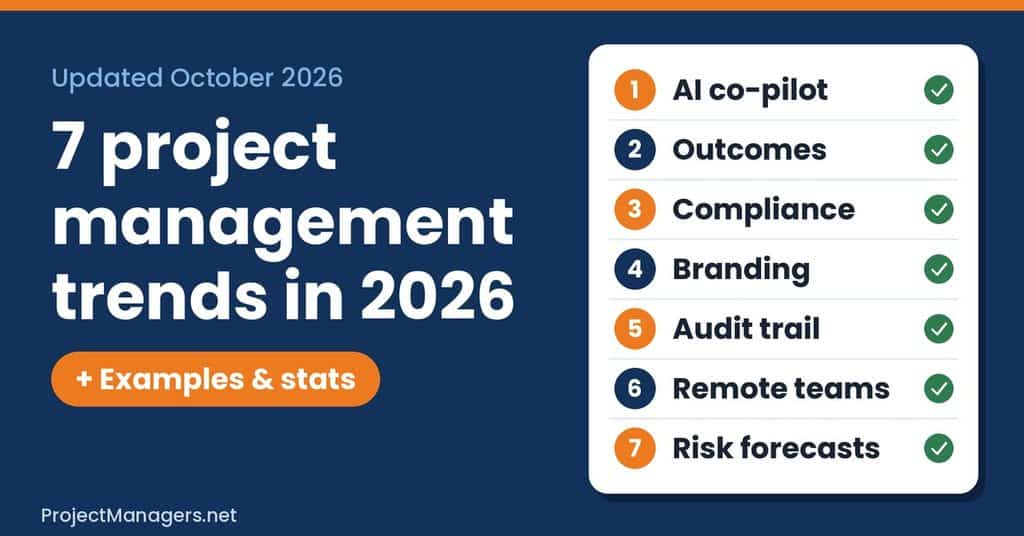
Project management in 2026 is a completely different animal from what we saw just three years ago. Below, each trend comes with a real example, an expert view and the latest numbers. The profession has grown far beyond the simple tracking of Gantt charts and timelines. Today’s project managers are responsible for the presentation, governance, and customer perception of products. You’re managing the delivery, the compliance, the branding, and the customer trust all at once. The level of complexity is increasing, but so are the tools and techniques to deal with it.
AI is a co-pilot, not the pilot. 70% of UK project professionals say their organization uses AI, but only 27% say it is fully embedded. Let it track and forecast; you make the calls.
Success is measured after launch. Agree on adoption, satisfaction and support metrics before delivery, and review them 30 to 90 days later.
Labels, brand assets and approvals are deliverables. Give them owners, sign-off gates and a version history from day one.
Write it down and look ahead. Distributed teams run on written, async updates, and dashboards earn their place when they show leading indicators.
These seven trends are no longer niceties to add to your project management repertoire. They’re becoming the new minimum requirements for anyone serious about leading projects that actually add value to a business.
1. AI-Driven Workflow Automation: Your New Project Co-Pilot
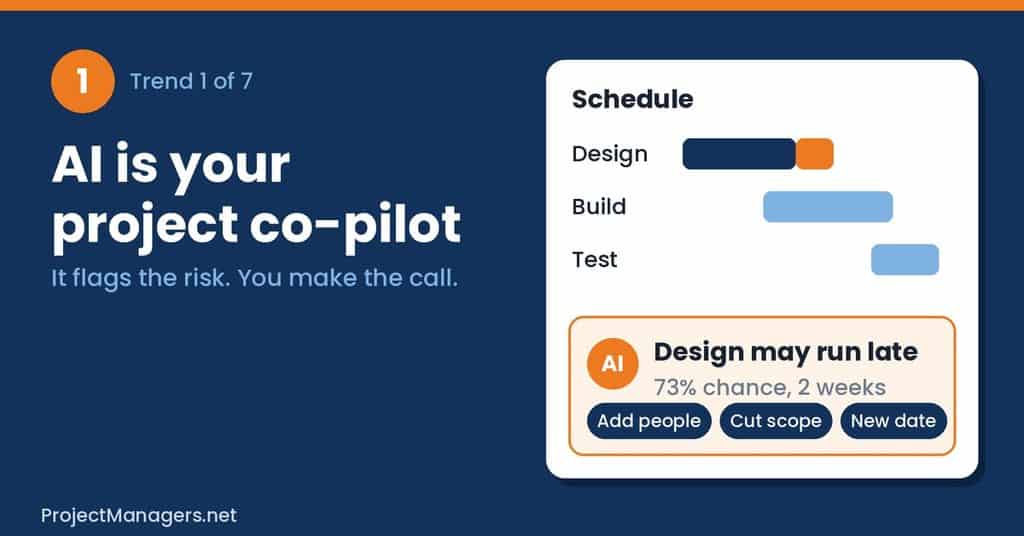
Artificial intelligence has graduated from the land of hype to the world of reality. Today’s AI platforms use your past project data to forecast potential delays before they blow your timeline. They automatically alert you to resource conflicts three weeks before the deadline, giving you time to course-correct before the project goes off the rails. These platforms take care of mundane reporting, automatically creating status updates, and suggesting resource allocation based on trends that you might not see.
The trick is to use AI as a partner, not a replacement. AI is great at processing huge amounts of data and identifying trends that you can’t. You’re the one who brings the human insight, the stakeholder connections, and the strategic vision that no computer program can match. When AI alerts you to a 73% probability that your design phase is going to go long, you’re the one who decides whether to throw more people at it, scope it back, or renegotiate the timeline expectations with your stakeholders.
Begin learning about AI-powered project management tools today. Teach yourself to evaluate their suggestions with a critical eye. The PMs who succeed in 2026 understand which suggestions to follow and which to challenge.
Real-life example
Gleeds puts AI into everyday project work
UK property and construction consultancy Gleeds has embedded AI in the daily workflows of more than 1,200 construction professionals, across cost management, project planning, risk assessment and monthly reporting. Its AI and data lead told an APM conference that real use cases save between 7 and 140+ hours per project. The firm scaled through local champions and a simple matrix of value versus complexity, not one big rollout.
Sources: APM conference session, Gleeds
Expert view
“The pace at which AI is transforming project management is remarkable.”
Professor Adam Boddison OBE, Chief Executive, Association for Project Management (APM), September 2025. Source: PM World / APM
By the numbers
- 70%
of UK project professionals say their organization uses AI, up from 36% in 2023.
Source: APM and Censuswide, 2025
- 27%
say AI is fully embedded in their project workflows. Most teams are still in the trial stage.
Source: APM and Censuswide, April 2026
- 50%
saw gains in each of three areas: task and schedule automation, resource allocation, and risk forecasting.
Source: APM survey, 2025
From the field
“You have to feel suitably qualified and experienced before you should be using AI”
James Doherty, Project controls expert, BMT. Source: The Construction Index, 2025
2. Outcome Ownership & Customer Experience: Beyond Delivery Timelines
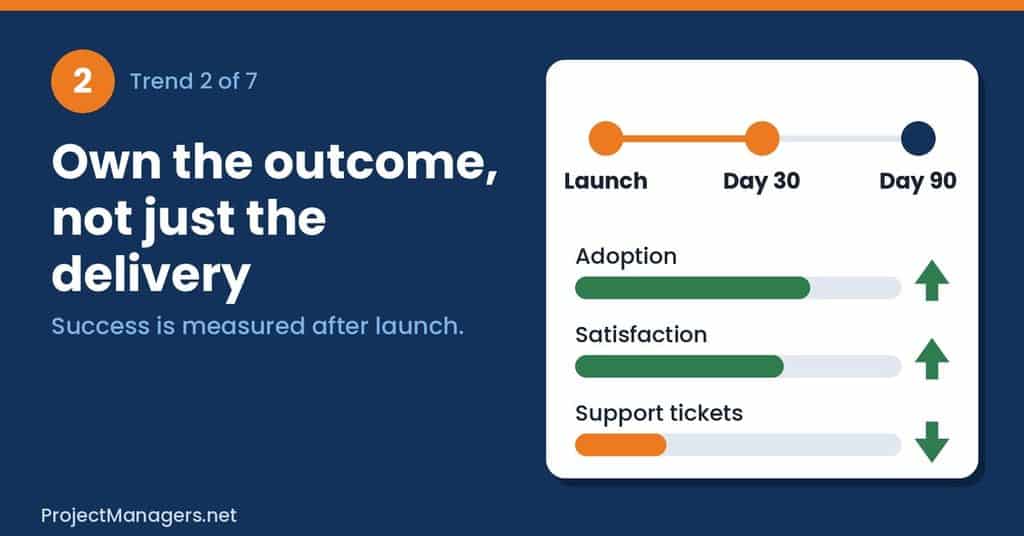
On-time and on-budget delivery is table stakes in 2026, not the end game. Your customers and stakeholders want to know if the solution actually helps customers. Are people using the new feature you just shipped? Is support volume spiking? Did customer satisfaction scores improve?
This means you’re measuring success metrics that go far beyond the project delivery date. You’re checking in with support teams in the first week after project delivery to get early warnings of problems. You’re tracking user onboarding completion rates and feature adoption. Some PMs are now participating in customer calls to get direct feedback on what’s working and what’s confusing customers.
Create your success metrics before your project delivery. Define success in three months, not just on delivery day. Create feedback loops with customer-facing teams, so you’re not flying blind after project delivery. The projects that succeed are those that change the way customers work, not just those that deliver on time.
Real-life example
Sonos shipped on time and lost its customers' trust
In May 2024, Sonos released a rebuilt mobile app. It launched as planned, but long-time users found missing features, broken alarms and slow performance. Sonos said the fixes would cost $20 million to $30 million, it pushed back new products, and its CEO stepped down in January 2025. The delivery date was met. The customer outcome was not.
Sources: Tom's Guide, MacTrast
Expert view
“This is about going beyond project management success to simply project success”
Pierre Le Manh, President and CEO, Project Management Institute (PMI). Source: IT-Online
By the numbers
- 18%
of project professionals show high business acumen. 66% are moderate and 16% are low.
Source: PMI Pulse of the Profession 2025
- 83% vs 78%
High business acumen professionals meet business objectives more often than everyone else.
Source: PMI Pulse 2025, via CXOToday
- 0.5%
of 16,000+ big projects came in on budget, on time and delivered the promised benefits.
From the field
“there isn't an employee at Sonos who isn't pained by having let you down”
Patrick Spence, Then CEO of Sonos, apology to customers, July 2024. Source: Digital Music News
3. Regulatory Compliance & Correct Product Labeling: A Critical Deliverable
Product labeling is not something you do at the last minute and assign to your marketing department. It’s a governed output that has serious repercussions if you get it wrong. Misstated allergens, absent safety notices, or non-compliant ingredient statements can lead to product recalls that cost companies millions of dollars and damage their reputation. In the consumer products, pharmaceutical, food and beverage, and many other sectors, getting product labels is not optional.
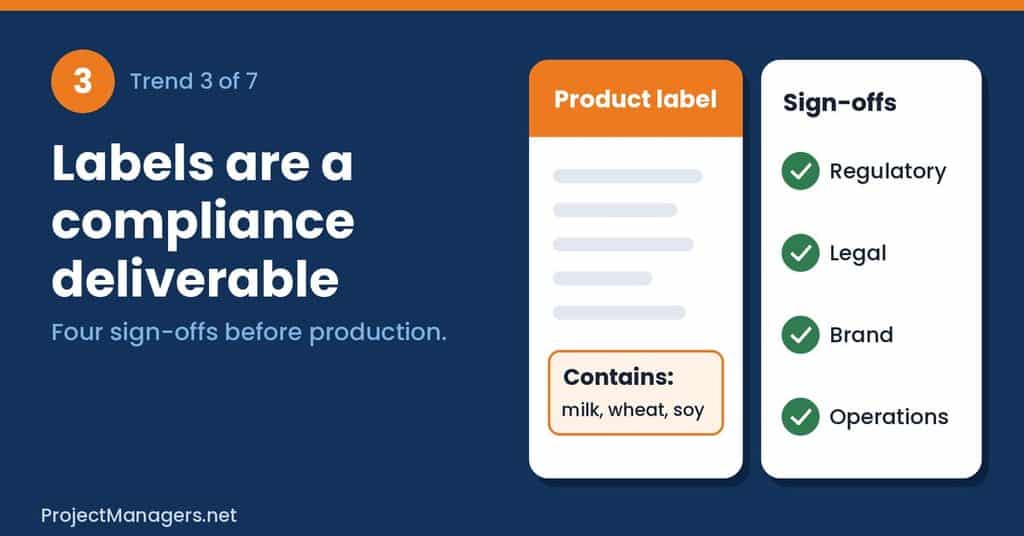
As a PM overseeing product launches, you’re increasingly tasked with integrating the legal, regulatory, marketing, and operations teams to ensure that everything listed on that label is accurate before production begins. Multi-market launches introduce a whole new level of complexity because you’re dealing with different regulations across markets. The FDA has different regulations from the EU, and getting those specifics wrong pushes the whole launch back.
Take a food product launch, for example. You need the regulatory affairs team to check the allergen information, the legal team to check the claims, marketing to check the brand, and operations to check that the information is accurate for what’s actually in the product. For product launches, being aware of product label requirements early in the process prevents delays and ensures that everything is compliant before production begins. One piece of information that’s not up to date creates a bottleneck that affects every other timeline.
Create compliance points as part of your project plan. Create approval paths and sign-offs. Keep detailed version control of every version of the label so that you can track during an audit exactly who signed off on what and when. This paperwork is not paperwork for paperwork’s sake. It’s your proof that due diligence was done and standards were met.
Real-life example
18.6 million ramen packages recalled over one missing ingredient
In January 2026, Palmetto Gourmet Foods recalled about 18.6 million ramen packages sold in 32 U.S. states because the label did not declare the color additive Yellow #5. The FDA classified it as a Class II recall in March 2026. The problem was on the label: an ingredient in the product that the package did not list. A recipe-to-label check with named sign-offs is the gate that catches this before production.
Sources: KSNT, March 2026
Expert view
In 2025, undeclared allergens “remained the perennial heavyweight of recall causes”
Shawn K. Stevens, Food safety lawyer, Food Industry Counsel. Source: The National Provisioner
By the numbers
- About 40%
of 2025 U.S. food recall announcements involved allergens that were not on the label.
Source: U.S. PIRG Education Fund, 2026
- 33 million
Americans live with potentially life-threatening food allergies.
Source: U.S. PIRG Education Fund, 2026
- 571
FDA food and drink recalls in 2025, up 15.4% on 2024 and a nine-year high.
Source: Sedgwick, via Just Drinks
From the field
“We should be able to trust what's on our plate”
Teresa Murray, Consumer Watchdog director, U.S. PIRG Education Fund. Source: PIRG, 2026
4. Branding Consistency Across Deliverables: Managing the Customer’s First Impression
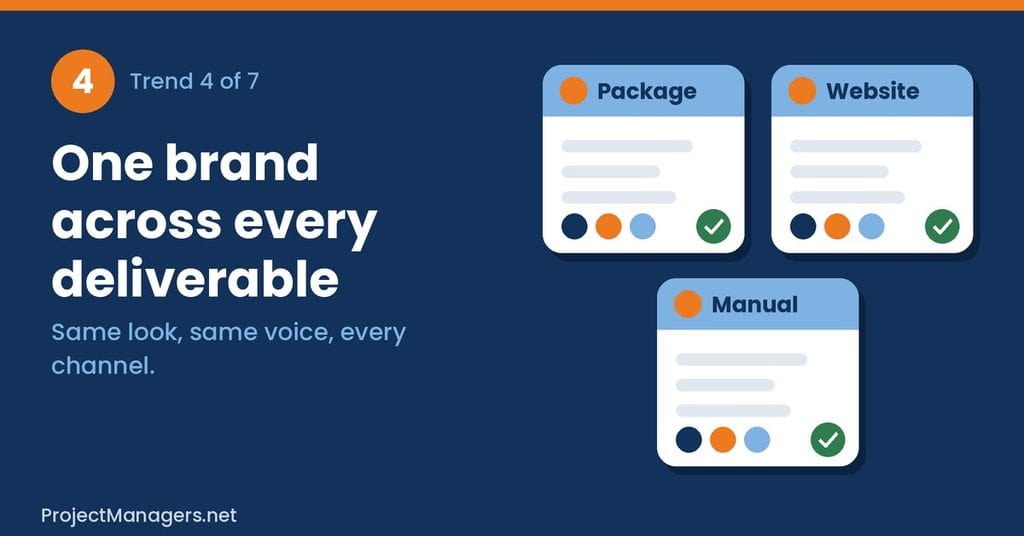
Every interaction with your customer communicates something about your brand. If your product packaging has different fonts from your website, or if your user manual contradicts the tone of your marketing emails, your customers will pick up on it. Inconsistency communicates a lack of attention to detail and a lack of integrity before they’ve even used what you’ve built.
You’re now working with brand teams to coordinate alignment in visuals and messaging across all the things your project puts out. That means documentation, packaging, digital media, and customer communication are all on the same page. It’s not about squelching creativity. It’s about building a consistent experience that reinforces your market presence.
Add brand review points to your approval process. Develop style guides that can be accessed by cross-functional teams without having to search for answers. Bring brand stakeholders into the review process early enough that changes don’t blow timelines. When your product launch is consistent in look and feel across all channels, customers perceive greater quality even before they interact with the product itself.
Real-life example
Tropicana changed its packaging twice, and paid twice
In January 2009, Tropicana replaced its familiar orange-and-straw carton. Unit sales of Pure Premium fell about 20% in under two months, and the old design was back by late February. In 2024 it switched to a new bottle with a narrower label. By October, sales were down 19% and it had lost about 4 points of market share to Simply Orange, according to Circana data reported by CNN.
Sources: Everything PR (2009), CNN (2024)
Expert view
“It's no longer meaningful. It's ubiquitous.”
Peter Clarke, Founder, Product Ventures (packaging design), on the 2024 bottle. Source: CNN
By the numbers
- 33%
average revenue growth brand managers expect if their brand were presented consistently.
- 81%
of the organizations surveyed deal with off-brand content.
Source: Lucidpress, 2019
- 10% to 20%
average revenue lift that Marq (formerly Lucidpress) attributes to consistent branding across channels.
Source: Marq, via Fit Small Business
From the field
“this will make me change brands”
A long-time Tropicana buyer, Reddit, 2024, on the new bottle (quoted by CNN). Source: Reddit
5. Data Governance & Documentation Standards: Building Audit-Ready Projects
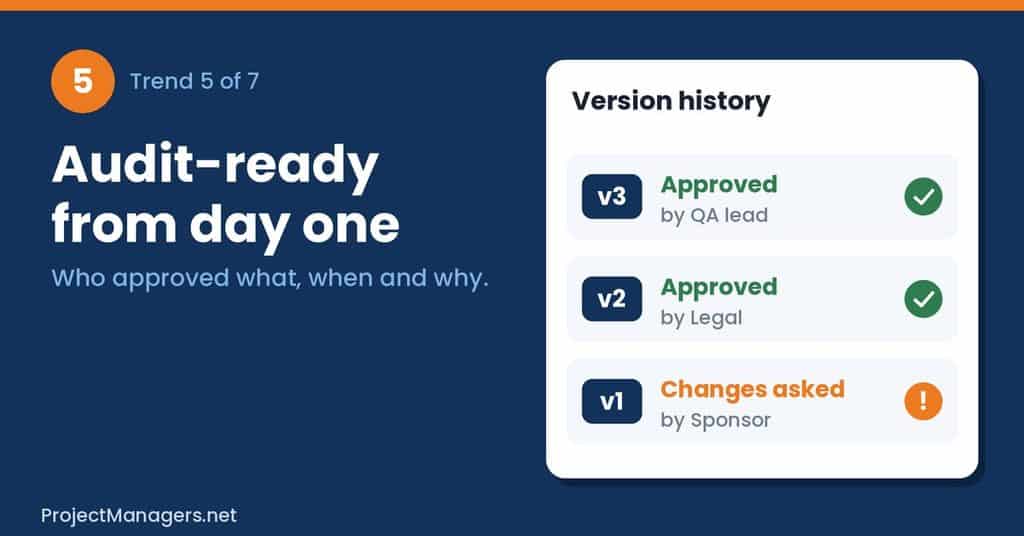
Every choice you make has to be documented in a way that will hold up to regulatory review. Version control systems track changes to specs, labels, and deliverables so that there’s a paper trail of what happened and why. Approval processes build accountability and traceability. When auditors come knocking, or when something goes south, and you need to figure out what happened, this is what saves your bacon.
Pharma projects keep full audit trails for regulatory filings because regulatory agencies require proof of compliance. But more and more, companies in all industries are adopting these best-of-breed standards. Bad documentation means failed audits, stalled approvals, and an inability to learn from mistakes.
Put in place version control systems that not only track what happened, but also who approved it and why. Set up approval chains so that it is clear whose approval is needed before proceeding. Design templates that make it easy to record this information, rather than making it a chore. The projects that pass the audit with flying colors are those that had documentation discipline from day one.
Real-life example
Flight 1282: the records that could not be found
On January 5, 2024, a door plug blew off an Alaska Airlines Boeing 737 MAX 9 minutes after takeoff from Portland. Investigators found that the four bolts meant to secure it were missing. Boeing then told the NTSB it could not find records of who opened, reinstalled and closed the plug. The NTSB's final report, in June 2025, blamed Boeing's failure to provide adequate training, guidance and oversight.
Sources: CBC, AirlineGeeks, Flying
Expert view
“Either they exist and we don't have them or they do not exist”
Jennifer Homendy, Chair, U.S. National Transportation Safety Board, on the missing work records, March 2024. Source: Associated Press
By the numbers
- $4.99M
global average cost of a data breach in 2026, a record and up 12% in one year.
Source: IBM Cost of a Data Breach 2026
- 63%
of breached organizations had no AI governance policy or were still writing one.
Source: IBM Cost of a Data Breach 2025
- $12.9M
average yearly cost of poor data quality reported in a 2020 Gartner survey.
Source: Gartner
From the field
“I am more than frustrated and disappointed. I am angry.”
Ben Minicucci, CEO, Alaska Airlines, January 2024. Source: Alaska Public Media / AP
6. Virtual & Remote Team Coordination: Managing Distributed Excellence
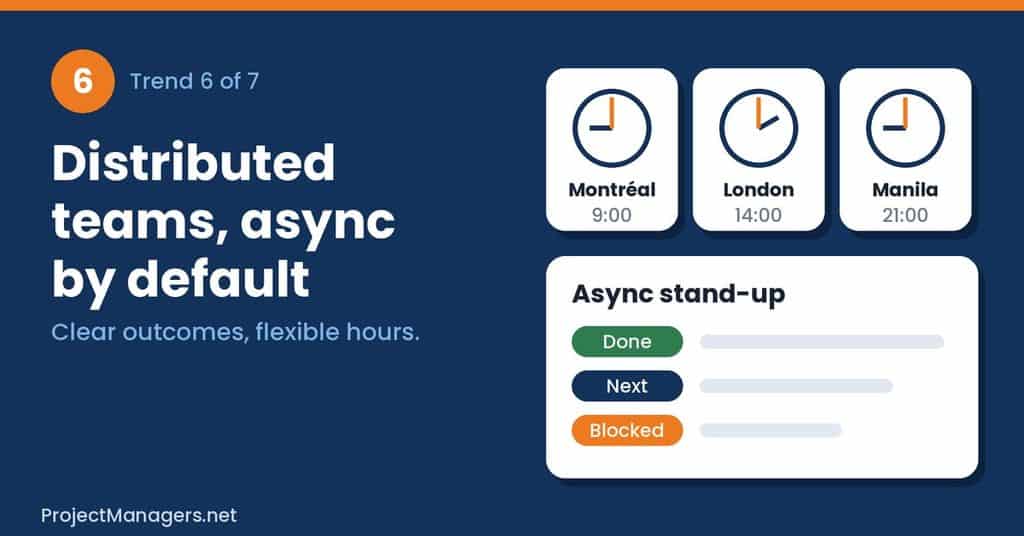
Distributed teams are no longer a temporary workaround. They’re the new reality. To manage people across time zones and cultures, you need a deliberate system that doesn’t happen by accident. You need communication guidelines on how to use synchronous meetings versus asynchronous updates. You need collaboration tools that keep everyone in sight without making them feel like they’re under surveillance.
Asynchronous daily stand-ups are great for teams that stretch across continents. Everyone puts up their updates at the beginning of their day, and everyone can see what’s happening without having to synchronize schedules. You still coordinate overlapping work hours for important conversations, but for regular coordination, you do it on everyone’s schedule.
Trust is built through consistent communication, not constant surveillance. When team members understand what needs to happen and are given the freedom to execute on their own schedule, it doesn’t matter how far apart they are. The PMs who are best at distributed teams are the ones who create clarity around what needs to happen while being flexible about how it gets done.
Real-life example
GitLab runs 2,100 people without an office
GitLab has worked fully remote since 2011. In 2023 it had about 2,100 team members in more than 60 countries and no owned or leased office. Its public handbook, more than 2,700 web pages, is the single source of truth: every change is written there first, and every announcement links back to it. People find answers by reading, not by interrupting a colleague.
Sources: McKinsey, 2023
Expert view
“You have to think handbook first instead of verbalization first.”
Darren Murph, Then Head of Remote, GitLab. Source: RedMonk
By the numbers
- 54%
of U.S. remote-capable employees work hybrid. 25% are fully remote and 21% are on-site.
Source: Gallup, August 2026
- 61%
of remote-capable employees prefer hybrid. Only 6% want to be on-site full time.
Source: Gallup, November 2025
- 25%
of the workweek goes to searching for information, for executives and teams alike.
Source: Atlassian State of Teams 2025
From the field
“Working remotely is easy. The challenge is working asynchronously.”
Sid Sijbrandij, Cofounder, GitLab, 2023. Source: McKinsey
7. Metrics & Predictive Risk Dashboards: From Reactive to Predictive Control
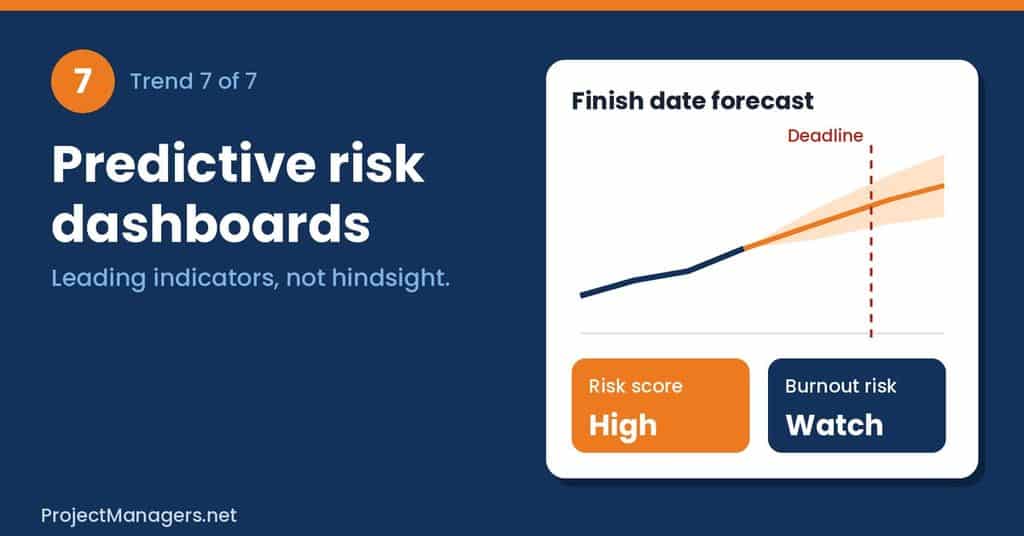
Real-time dashboards combine data from multiple sources to give you a complete picture of your project’s status. Rather than waiting for someone to blow the whistle on a problem, you’re spotting trends that signal problems on the horizon. Risk scores enable you to focus on what matters most. When your dashboard alerts you to resource burnout risk based on workload trends, you can take action before your best people start looking for new jobs.
Contemporary metrics are much more than schedule variance. You’re measuring leading indicators, which predict outcomes, not lagging indicators, which confirm the past. Your stakeholders can scan the data and see the project status without reading status reports.
Invest in dashboard software that integrates with your current systems. Establish relevant KPIs that actually inform decisions, not just fluff metrics that look cool but don’t change the way you work. Review these metrics with your team on a regular basis so everyone is on the same page about what the numbers mean and what they should do about them.
Real-life example
HS2 tunnel builders check their plan against past projects
SCS JV (Skanska, Costain and Strabag) is building the London tunnels of the HS2 high-speed railway. The team uses nPlan's AI forecasting, trained on more than 740,000 past project schedules, to show which activities are most likely to slip. In their joint case study, the team says the data highlights risks it could have overlooked because of the project's complexity and its own biases.
Sources: nPlan case study, PBC Today
Expert view
Organizations value project management, but “many still face challenges with reporting efficiency, process consistency, and PMO maturity”
Vince Hines, Managing Director, Wellingtone, March 2026. Source: Wellingtone press release
By the numbers
- 36%
of organizations mostly or always deliver projects on time.
Source: Wellingtone, State of PM 2026
- 72%
of project professionals spend half a day or more every month collating reports by hand.
Source: Wellingtone 2026, via Carly
- About 80%
of projects were delayed in nPlan's study of close to 500,000 schedules.
Source: nPlan, 2022
From the field
“quickly target our leadership interventions to the right areas”
David Bunn, Portfolio director, BAM, on AI portfolio forecasting, 2023. Source: PBC Today
The New Baseline for Project Success
Project success in 2026 means delivering on time AND delivering with quality, compliance, and brand alignment. The PMs who understand and leverage these seven trends position themselves as strategic leaders, not just project coordinators. Their organizations reward managers who think beyond checklists to business outcomes and customer results.
These are not tasks you manage separately. They are interrelated components of modern project management. Your AI systems enable you to identify risks sooner so you can focus on stakeholder management. Your compliance systems safeguard your brand reputation. Your documentation systems support both audit readiness and team collaboration. It all relates.
The discipline is constantly changing, which means that continuous learning is not optional. Assess your current practice. Which of these trends is your organization most in need of? Where are the biggest gaps between what you’re doing now and what 2026 requires? Those are the areas that will guide your growth.
Trends to watch: PM in 2026 and beyond: What’s next?
Prefer to watch? In this session, RMC Learning Solutions walks through the trends shaping project management in 2026 and beyond, from generative AI to leading remote teams.
Video: Trends to watch: PM in 2026 and beyond, RMC Learning Solutions on YouTube.
Facts Worth Checking: Project Management Trends in 2026
Trend articles repeat a lot of bold numbers, and some of them don’t hold up. Here are 10 common claims about these seven trends, checked against the latest research, so you know which ones to trust before you quote them.
Claims you will hear about these trends, checked against the latest data.
| Trend | You may hear | What the data says | Source |
|---|---|---|---|
| 1 | AI will replace project managers by 2030. | Gartner's 2019 forecast was that AI would take over 80% of today's PM tasks, such as data collection, tracking and reporting. It said roles would not be wholly replaced. | Gartner, 2019 |
| 1 | Most project teams already run on AI. | 70% of UK project professionals say their organization uses AI, but only 27% say it is fully embedded in their workflows. | APM, 2025 and 2026 |
| 2 | Most projects finish on time. | Only 36% of organizations mostly or always deliver on time. For big projects, 8.5% hit both budget and schedule. | Wellingtone 2026; Flyvbjerg |
| 3 | Most food recalls are about bacteria. | Allergens missing from the label caused about 40% of U.S. recall announcements in 2025, more than any other cause. | U.S. PIRG Education Fund, 2026 |
| 3 | The FDA food traceability rule applies in 2026. | The FDA delayed enforcement from January 2026 to July 2028. Plan for it, but check the date before you promise it to a client. | U.S. PIRG Education Fund, 2026 |
| 4 | Consistent branding adds a third to revenue. | The 33% figure is what brand managers said they expected, in a 2019 survey by a branding software vendor. It is not a measured result. | Lucidpress, 2019 |
| 5 | Bad data costs every company $12.9M a year. | The figure is an average from a 2020 Gartner survey of data quality vendors' reference customers, not a representative sample. | ReliaMag analysis of Gartner |
| 5 | Data breaches are getting cheaper. | The global average dipped to $4.44M in 2025, then reached a record $4.99M in 2026. | IBM, 2025 and 2026 |
| 6 | Hybrid work is fading. | 54% of U.S. remote-capable employees work hybrid, a share that has held fairly steady since 2022. | Gallup, August 2026 |
| 7 | Real-time dashboards have replaced status reports. | 72% of project professionals still spend half a day or more each month collating reports by hand. | Wellingtone 2026, via Carly |
Last checked: October 28, 2026.
Frequently Asked Questions About Project Management Trends in 2026
These are the questions project managers ask most about the trends in this article. Each answer is short and practical, so you can act on it this week.
What are the biggest project management trends in 2026?
The seven covered in this article: AI as a co-pilot for tracking and forecasting, owning outcomes after launch, labeling and regulatory compliance as deliverables, brand consistency, audit-ready documentation, distributed teams that work asynchronously, and predictive risk dashboards. They reinforce each other: clean data and good documentation are what make AI and dashboards useful.
Will AI replace project managers?
Not on current evidence. Gartner's 2019 forecast was that AI would take over most data collection, tracking and reporting tasks by 2030, not the role itself. Trade-offs, stakeholder work and accountability stay with people, and only 27% of UK project professionals say AI is fully embedded in their workflow (APM, 2026).
How do you measure project success beyond on time and on budget?
Agree on outcome metrics before launch, such as adoption, customer satisfaction, support volume or revenue, and set a review 30 to 90 days after delivery. PMI now encourages project professionals to own project success, not only project management success.
Why is product labeling a project management issue?
A label is where regulatory, legal, brand and operations requirements meet. Treat it as a deliverable with an owner, a version history and sign-offs before production. Allergens missing from the label caused about 40% of U.S. food recall announcements in 2025.
What does audit-ready mean for a project?
Anyone can see what changed, who approved it, when and why, without rebuilding the story from emails. Use version control, named approvers and a decision log from the first week, and store them where auditors and new team members can find them.
How do asynchronous stand-ups work?
Each person posts a short written update at the start of their day: what is done, what is next and what is blocked. Teammates read the updates on their own schedule, and live meetings are kept for blockers and decisions. Keep the updates in one shared place so they also serve as a record.
What is the difference between leading and lagging indicators?
Lagging indicators confirm what already happened, such as schedule variance or final cost. Leading indicators warn you early, such as rising workload per person, slipping predecessor tasks or risks that stay open too long. A predictive dashboard puts leading indicators first so you can act before a milestone slips.
Suggested articles:
- From Project Management to Brand Success: Lessons Every Leader Should Know
- How Modern Project Management Systems Are Actually Improving Delivery in 2026
- How to Align Vision and Execution: Project Management Strategies for Founders

Daniel Raymond, a project manager with over 20 years of experience, is the former CEO of a successful software company called Websystems. With a strong background in managing complex projects, he applied his expertise to develop AceProject.com and Bridge24.com, innovative project management tools designed to streamline processes and improve productivity. Throughout his career, Daniel has consistently demonstrated a commitment to excellence and a passion for empowering teams to achieve their goals.