

A trade show badge scan is not a lead. It is a name, a company, and sometimes an email that was accurate the day the attendee registered. What turns that record into something a sales team can act on is everything layered on top: qualification, notes, an owner, verified contact details, and a defined next step.
That gap is why so much event spend evaporates. Booth teams collect hundreds of scans, the file lands in a CRM two weeks later without context, and reps quietly deprioritize it. The tooling decision matters less for how fast it scans and more for what condition the data arrives in.
Below is a comparison of conference lead capture apps, evaluated on the same criteria: contact capture, badge and business card scanning, qualification fields, notes and tags, CRM sync, enrichment, offline use, lead assignment, analytics, and post-event follow-up. Pricing figures for third-party tools reflect a snapshot as of August 2026 and change without notice.
1. Wave Connect
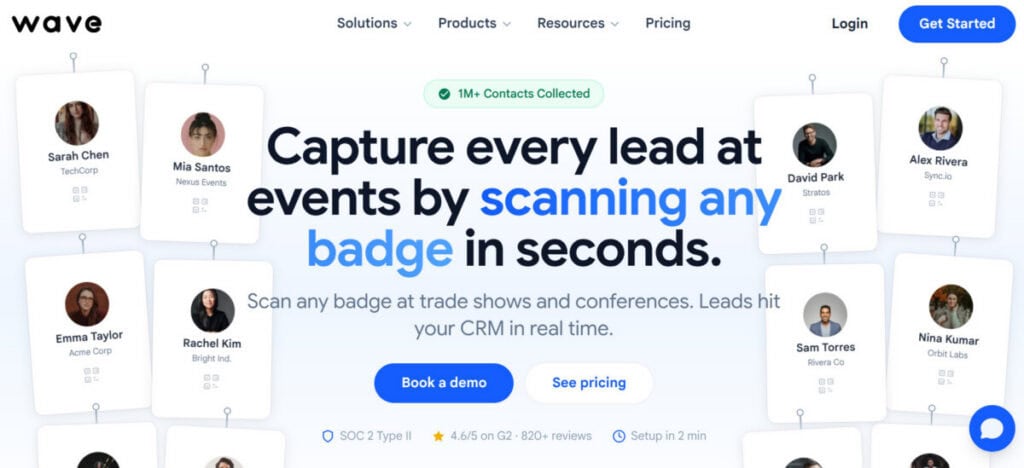
Model: Pay per lead collected, no per-user fee.
Wave Connect is an event lead capture platform built around two things: an AI Badge Scanner and Waterfall Lead Enrichment. The scanner works in the mobile app at any show, with no organizer badge kit, no rental agreement, and no event API. It does not require a QR code or barcode on the badge. It reads the printed name and company, then enrichment fills in the rest. It also handles paper business cards, handwritten notes, and LinkedIn QR codes.
Waterfall Lead Enrichment is the part worth understanding. Each scan runs through multiple enrichment providers plus AI search to verify business email, cell and office phone, LinkedIn profile, profile photo, and office address. Wave Connect states that “in our own August 2026 test on real conference badge lists, enrichment returned a verified business email for 91% of scans.” That is the company’s own measured figure, and the counting unit is stricter than the email-or-LinkedIn match rate some vendors report.
On the Rest of the Checklist: Custom Qualifiers let reps tag interest level, product line, and follow-up owner at the booth, notes attach per lead, Offline Mode keeps capture running when convention center Wi-Fi fails, and CRM Integration with Custom Mapping covers HubSpot, Salesforce, and Zoho with field-level control. A good event lead capture solution exists precisely to add that context, qualification detail, ownership, and next step before a record ever reaches the CRM, so sales inherits a usable opportunity rather than a raw attendee list. Unlimited Users means the whole booth team is on the app at no extra charge, with a shared lead pool. A digital business card is also built in, including Apple Wallet support, though it is secondary to the capture workflow.
Pricing: A badge scan and the enriched, CRM-ready lead it produces is $10 at list. Enriching a contact captured another way (card form, LinkedIn QR, paper card) is $2.50. Annual plans arranged through sales run $8 per lead at 500, $7 at 1,500, and $6 at 3,000, with custom pricing above 5,000 leads a year. Individuals and small teams buy credit packs in the app from $50 to $500, valid for 12 months, with bonus credits added on top. New accounts get 10 free trial credits, or 20 for team workspaces. Failed enrichment is not charged. Unused plan leads roll over when the plan is renewed at the same tier or higher.
2. Cvent | iCapture
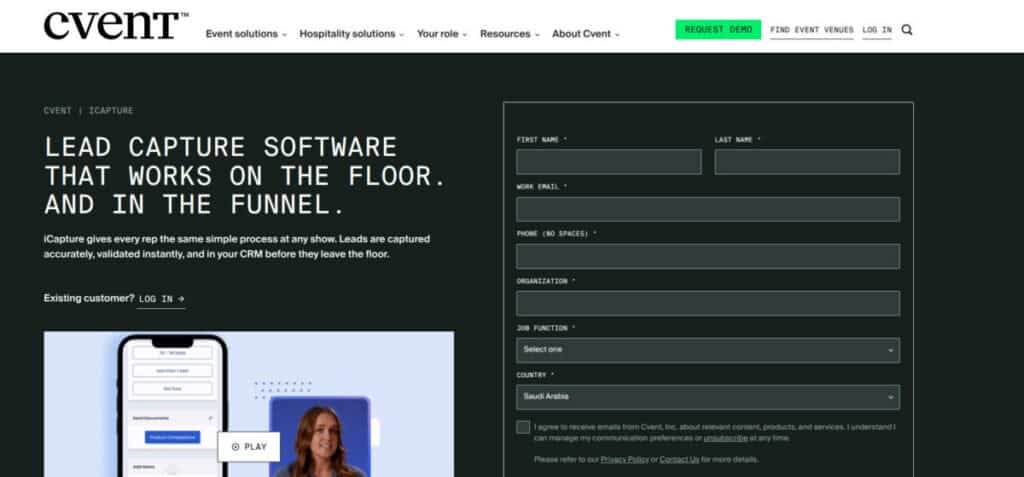
Best for official registration data depth. iCapture, owned by Cvent and branded Cvent | iCapture, advertises 130+ badge-provider integrations that pull official registration data directly from the show’s vendor. When a conference uses a supported provider, the captured record includes registration fields the printed badge never shows: job function, session track, and organizer-collected demographics. Qualification forms are configurable per event, offline capture is supported, and CRM and marketing automation routing is mature.
Things to Consider: Pricing is request-only. Contact enrichment is not native, and teams generally need to bring their own ZoomInfo subscription. Coverage also depends on the show’s registration vendor, so a conference outside the integration list falls back to less complete capture.
3. Cvent LeadCapture
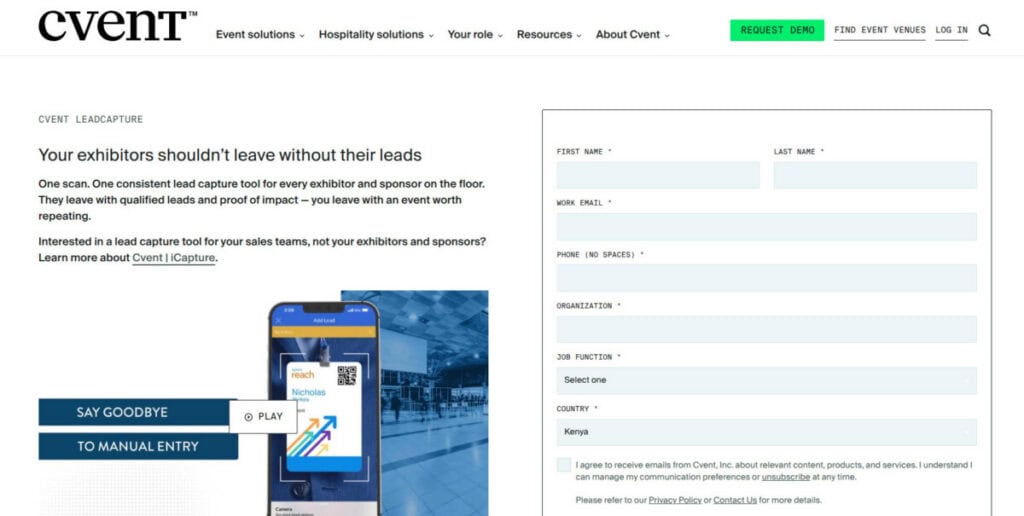
Best for organizations already standardized on Cvent. Cvent LeadCapture is the lighter capture module inside the broader Cvent event platform. If registration, session management, and event budgeting already live in Cvent, exhibitor lead data lands in the same reporting environment without a second vendor relationship.
Things to Consider: It is a module, not a standalone product, and its feature depth trails iCapture on qualification logic and integration breadth. Teams that only need booth capture may be buying a platform to get a component.
4. Captello

Best for booth engagement and gamification. Captello’s differentiator is its games and interactive activations library, which gives reps a reason to start a conversation before asking for a scan. Lead capture, custom qualification forms, and CRM routing are all present, with the activation layer feeding into the same lead record.
Things to Consider: Gamification is the center of gravity, so teams that only want fast capture and clean enrichment may pay for surface area they never use. Pricing is quote-based.
5. momencio
Best for flat-rate seat licensing with published rates. Momencio is one of the few vendors here that lists pricing openly with online checkout: as of August 2026, $100, $130, and $170 per seat per month billed annually, with a five-seat minimum. Its strengths are specific and real: kiosk self-check-in, gamification, LiveMicrosites for personalized post-event content, and IntelliStream engagement analytics that track what a prospect actually opened after the show.
Things to Consider: The five-seat minimum creates roughly a $6,000 annual floor on a 12-month non-cancellable term with no free trial, as of August 2026. Standard badge scanning depends on the show’s event API, purchased from the organizer. Capture and enrichment without that API is their AI EdgeCapture add-on, and CRM integrations and gamification are add-ons as well.
6. Popl
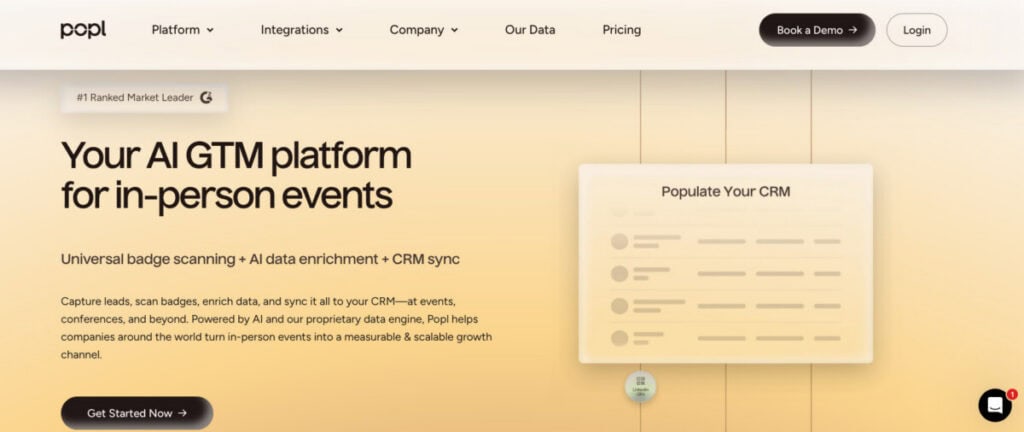
Best for app polish. Popl now positions itself as an event lead capture platform, and the mobile experience is well built. Its badge scanning feature reads the printed text on the badge, which means it functions at shows using encrypted QR codes. Popl advertises a 90% enrichment success rate via 20+ data partners. That is the company’s claim, not a tested result.
Things to Consider: Popl publishes no pricing at all, and its own FAQ describes license plans, so budgeting requires a sales call. Prospect conversations suggest quotes scale with lead volume.
7. Whova
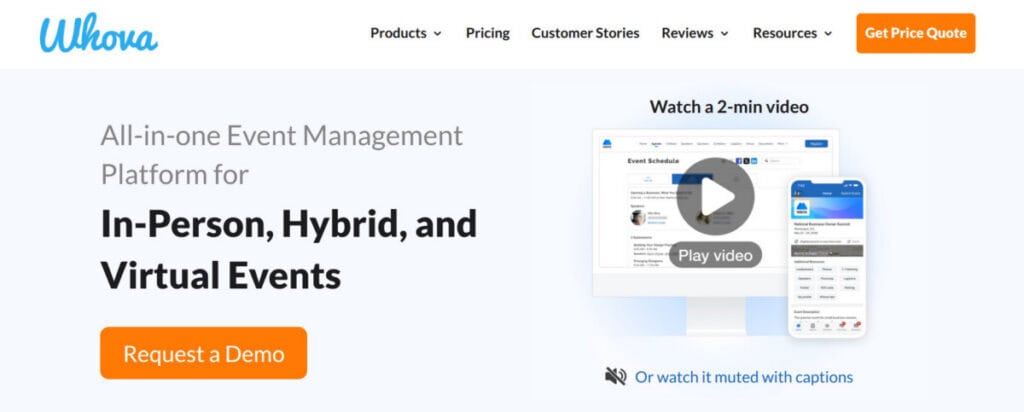
Best for attendee-facing event apps. Whova’s core product is the conference app itself, with agendas, attendee networking, and messaging. Exhibitor lead capture is an add-on that works well when the organizer has already selected Whova for the event.
Things to Consider: Availability is tied to the organizer’s choice, so an exhibitor cannot standardize on it across a season of shows. Enrichment and qualification depth are lighter than dedicated capture tools.
8. The Show’s Own Rental Lead Retrieval Scanner
Best for guaranteed registration-record accuracy at a single show. Renting the official scanner returns exactly what the attendee submitted at registration, with no matching guesswork.
Things to Consider: Cost and inconsistency. Published 2026 order forms for ATD and AAOS put rental at $350 to $735 per rep, per show, meaning a four-person booth spends roughly $800 to $1,000 at one event. Teams exhibiting at 15 shows a year can reach $15,000 to $25,000, and each show’s interface, export format, and qualification fields differ.
How to Choose
No single tool wins on every criterion, and the right pick depends more on your booth’s shape than on any feature checklist. Use these questions to stress-test a shortlist before signing a contract.
- Count reps, not just leads. Per-seat models punish large booths. Per-lead models punish high-volume capture. Model both against last year’s actual scan counts.
- Ask what happens when a badge has no scannable code. Encrypted QR codes are common, and the answer separates tools quickly.
- Test offline mode before the show, not during it.
- Define qualification fields in advance and keep them to four or five. Long forms get skipped at a busy booth.
- Assign owners at capture time. Follow-up speed correlates far more with clear ownership than with tooling sophistication.
The category is converging on the same conclusion: raw capture is commoditized, and the durable difference is data quality and how much qualification survives the trip into the CRM. Evaluate on that, and the shortlist narrows fast.
Conclusion
The tools here split into two camps: platforms tied to a specific registration system or organizer choice, and standalone apps that work at any booth regardless of badge format. Cvent’s products reward teams already in that ecosystem; Whova only helps when organizers pick it; rental scanners guarantee accuracy but scale poorly across a full show calendar.
For teams facing unpredictable badge formats across many shows, Wave Connect’s pay-per-lead model and enrichment depth stand out. But the specific pick matters less than the discipline behind it: define qualification fields beforehand, assign an owner at capture, and confirm offline mode works before show day. Booths that treat capture as the finish line lose leads to slow follow-up. Booths that treat it as the start turn event spend into pipeline.
Suggested articles:
- Corporate Event Planning: 6 Tips to Succeed Without Hassle
- Key Tips for a Successful Business Event
- From Chaos to Seamless: How Event Technology Services Are Changing the Game

Daniel Raymond, a project manager with over 20 years of experience, is the former CEO of a successful software company called Websystems. With a strong background in managing complex projects, he applied his expertise to develop AceProject.com and Bridge24.com, innovative project management tools designed to streamline processes and improve productivity. Throughout his career, Daniel has consistently demonstrated a commitment to excellence and a passion for empowering teams to achieve their goals.