
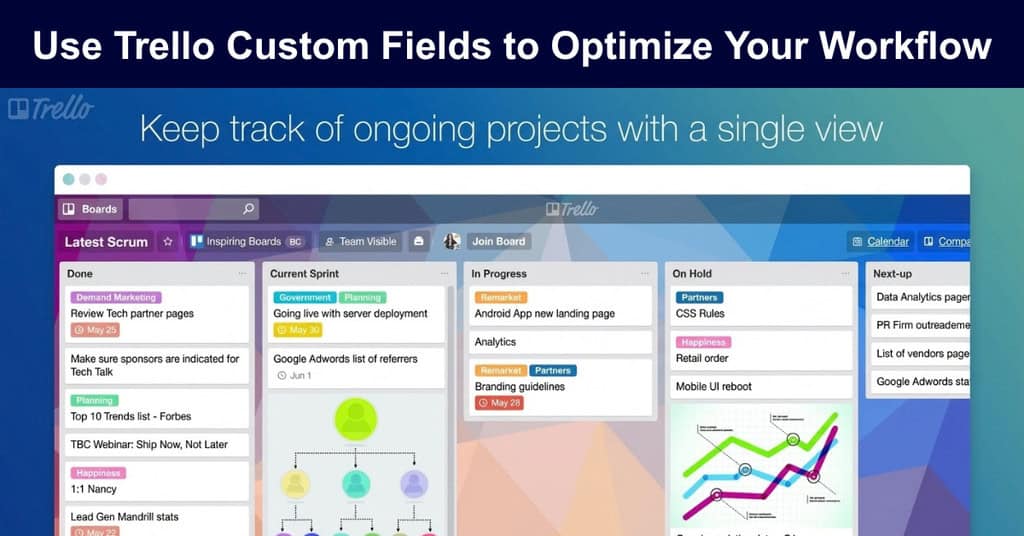
Trello’s simplicity as a visual project management software has made it a valuable tool for millions of users who want to boost productivity and manage daily tasks. Individuals, teams, and organizations use its online boards, lists, and cards to organize, prioritize, and visualize work, turning ideas into completed projects. It is flexible, easy to navigate, and lets users manage their work on the free Trello plan.
Since the beginning, Trello’s primary purpose has been organizing tasks, with Power-Ups and integrations extending it. Custom Fields, now built into paid plans, add structured data. To report on and export that data, we recommend Bridge24 for Trello. Used well, these fields do more than store details: they speed up decisions, reduce errors, and keep teams aligned, starting with the workflow benefits covered next.
How Custom Fields Optimize Workflow and Their Other Benefits
Custom Fields capture exactly the data your process needs on every card, instead of forcing details into descriptions or labels. Typed inputs prevent entry errors, and values appear on the card front for quick scanning. Harvard Business Review notes that bad data, including mislabeled, missing, or incorrect entries, is sapping team productivity, so consistent, typed inputs matter on every board.
Structured fields improve day-to-day work in several practical ways, including these:
- Error-Free Data Entry: Typed fields restrict input to numbers, dates, checkboxes, or preset dropdown choices, so teammates cannot enter free-form values that later break reports or confuse filters.
- Context on the Card Front: Each field can display on the card front, which lets teammates read budgets, owners, or stages at a glance without opening every card on a busy board.
- Consistent Tracking Across Phases: Using identical fields on every card gives you comparable data across project phases, locations, and teams, which makes performance trends and bottlenecks easier to spot.
Custom Fields Sample Use Cases
Custom Fields adapt to nearly any department because each team picks the field types that match its data. One board structure can serve editors, accountants, recruiters, and sales reps without compromise. Editorial teams, for example, often follow a strategic editorial calendar that tracks several dates for every piece, and a date field supports that approach cleanly.
These five pairings show how different teams can apply each field type:
- Date Fields: Editorial teams schedule publication dates, draft deadlines, and review dates, then scan or sort cards by those dates so no article slips past its slot.
- Text Fields and Emojis: HR teams record short performance notes and ratings on employee cards, while emojis add fast, scannable visual cues. Keep sensitive details off shared boards to protect privacy.
- Number Fields: Accountants monitor expenses and budgets in numeric fields, which keeps figures clean for cost-cutting reviews, comparisons across projects, and easy export into spreadsheets for finance teams.
- Dropdown Lists: Sales teams track purchases, deal stages, and lead sources through preset choices, so every opportunity uses identical wording and pipeline reviews stay consistent across the whole team.
- Text, Number, Date, and Dropdown Fields: Project teams combine all four types to follow work from ideation to completion, recording owner, estimate, target date, and current stage on one card for easy review.
How to Create a Custom Field
Custom Fields are built into Trello Workspaces on the Standard plan and above, and the old Power-Up is no longer available. Open the board menu, choose Custom Fields, and select New field. Atlassian’s guide on how to add a Custom Field to a card covers each option in detail, so follow its steps in order.
Creating your first field takes only a few deliberate decisions, outlined here:
- Open the Custom Fields Menu: Select the board menu, choose Custom Fields, then click New field. Free Workspaces cannot use this menu, though existing values return once the Workspace upgrades to a paid plan.
- Name and Type the Field: Give it a title of up to 25 characters, then pick checkbox, date, dropdown, number, or text. For dropdowns, add every choice up front. The type cannot be edited later.
- Decide on Card Front Display: Tick the option to show the field on the card front, or leave it for the back only. Then select Create to save the field to the board.
How to Use Custom Fields
Once fields exist, team members with edit access can update values from the back of any card, and filters, automation, and exports put that data to work. Automation extends the benefit further, and this workflow automation guide with examples shows how triggers and actions remove repetitive updates. Consistent use gives you close project monitoring without extra meetings.
These habits help teams get steady value after fields go live:
- Update Values on Cards: Enter or change values on the card back, and use the board menu to edit, reorder, or delete fields. Deleting a field removes it from every card on the board.
- Filter by Field Values: Type a value into the filter keyword box to show only cards containing it. Filters search values rather than field names, so choose distinctive entries.
- Automate With Butler: Butler rules and buttons can set or clear field values, increase a number, shift a date, or sort a list by a field, which removes manual updates as cards change stage.
Custom Fields Tips and Other Info
Fields help only when they stay purposeful, because too many create confusion and lower productivity. Nielsen Norman Group explains this overload in its principles to reduce cognitive load in forms, which recommend grouping related inputs and showing only what is relevant to the task. Treat every new field as a cost that must earn its place on the card.
Apply these guidelines to keep fields useful rather than cluttered:
- Match Field to Data Type: Enter dates in date fields and numbers in number fields instead of text, and use dropdowns and checkboxes to minimize typing and keep entries uniform.
- Let Requirements Define Fields: Add a field only when it answers a real workflow question. The core purpose is better efficiency, so remove any field that nobody reads or updates.
- Audit the Data Regularly: Review whether teammates fill fields in and whether the values improve tracking. Check how fields appear on mobile, since cards show them there too and layouts differ.
Enhance Reporting and Exporting Features in Trello
Native Trello has clear limits for custom field reporting. Each board allows 50 Custom Fields, any board member can export JSON, and CSV export requires Trello Premium at $10 per user monthly when billed annually. Those constraints matter for teams that report on custom data, because exports and grouped summaries are what turn card details into decisions.
To work past those limits, consider Bridge24 for Trello, which Bridge24 describes as a route to unlimited custom fields. You can group reports twice, and the second grouping can be a custom field. It also includes easy-to-use exporting tools for cards, custom fields, and comments in Excel and CSV formats. You can try Bridge24 for free.
These capabilities go beyond what native Trello offers for custom field data:
- Grouped Reports: Group reports by one attribute and then by a custom field, such as owner and then stage, to summarize workload and progress in a single view.
- Interactive Charts and Graphs: Visual summaries of custom field values help managers present budget, status, and priority trends clearly to stakeholders without rebuilding the data in a separate spreadsheet.
- Flexible Exports: Export cards, custom fields, and comments to Excel or CSV, along with URL links and attachment information, or use the free Chrome extension for quick pulls.
Conclusion
Trello Custom Fields turn simple cards into structured records that capture budgets, deadlines, stages, and owners in consistent formats across every project. Typed inputs reduce errors, front-of-card display speeds up scanning, and filters, automation, and exports make that data useful beyond the board. Matching each field to a clear business need keeps boards readable, focused, and genuinely valuable to everyone who truly depends on them.
Start small by creating three or four fields that answer your most pressing tracking questions, then check whether your team actually uses them. Plan for the board limits and the paid plan requirement before you build processes around the feature. Review your boards early this week, remove any clutter, and add the first field that will make tomorrow’s work easier for your whole project team.
Frequently Asked Questions About Trello Custom Fields
Are Trello custom fields free?
No. Custom Fields are not available in free Workspaces and require the Standard plan or higher. Standard costs $5 per user monthly when billed annually, or $6 billed monthly. If a Workspace downgrades to Free, existing field values are not deleted, and they return as soon as the Workspace upgrades to a paid plan again.
How many custom fields can a Trello board have?
A board can hold up to 50 Custom Fields, and each dropdown field can contain up to 50 options. Field titles are limited to 25 characters. If you approach the cap on a busy board, consolidate related fields into one dropdown, and delete unused fields, remembering that deleting a field removes it from every card on the board.
Can you export Trello custom fields to CSV?
Yes, with Trello Premium. Custom Field data is included in both JSON and CSV exports. Any board member can export JSON, while CSV export requires a board in a Premium Workspace, which costs $10 per user monthly when billed annually. Trello cannot rebuild a board from an export, so treat exports as reporting snapshots rather than backups.
Can Trello automation update custom fields?
Yes. Butler automation can set, update, and clear Custom Field values through rules and buttons. It can increase or decrease numeric fields, move a stored date by a set number of days, and sort lists by field content. You can also reference a field value inside other card automations, which helps with notifications and logging.
What happens to custom field data when you move a card?
Filled Custom Fields travel with the card. If the target board has a field with the same name and type, Trello copies the value into it. Otherwise, it creates a new field there. Empty fields are not copied, and a checkbox field that has never been checked cannot be copied, so tick it once before moving.
Suggested articles:
- Top 5 Reporting and Exporting Tools for Trello
- Charts by Custom Fields for Asana and Trello
- Trello: Show All your Cards Across All Workspaces

Peter Kanai is a Google-certified freelance writer with over a decade of experience crafting high-quality content for business websites, blogs, and SEO & email marketing campaigns. His on-demand writing services are all about helping businesses expand their online presence and achieve their objectives. With a proven track record in delivering results-driven content, Peter is the go-to freelance writer for business owners seeking a strategic partner to help them grow their brand online.