
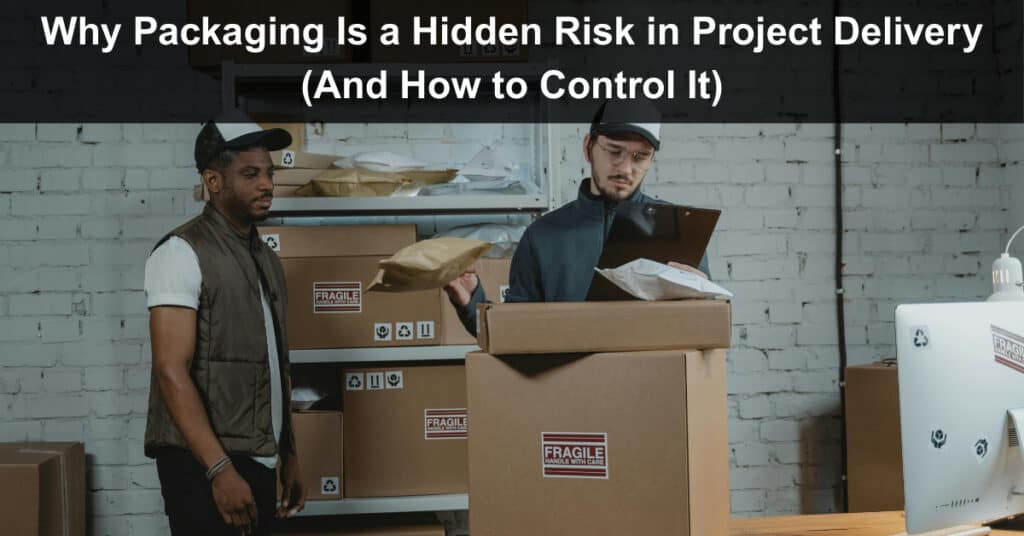
Project managers commonly monitor software bugs, production delays, and budget overruns—but they often overlook packaging, a physical dependency that can halt delivery if ignored. Treating packaging as a simple procurement task invites mistakes: it sits at the intersection of logistics, marketing, and regulatory compliance, so a single oversight can damage products, erode brand perception, and inflate costs through returns or rework.
Effective project leadership requires elevating packaging from a checkbox to a defined workstream with clear requirements, timelines, and cross-functional accountability. That means involving engineering, supply chain, and legal teams early, specifying environmental and transit constraints, and planning testing and contingency suppliers. Read on to learn practical steps for integrating packaging into your WBS, testing for real-world transit, and securing the supply chain.
The Hidden Risks of Packaging in Project Delivery
Packaging risks remain hidden because departments work in isolation. Marketing teams focus on graphics. Logistics teams prioritise pallet fit. Procurement teams track unit costs. Project managers must see how these demands compete.
1. The “Last Mile” Integrity Failure
Packaging can pass controlled factory inspections yet fail during real-world transit, causing product damage, returns, and warranty claims. Failure stems from underspecified transit requirements: vibration spectra, drop heights, humidity exposure, stacking loads, and courier handling profiles. Without these details, designs are reactive, requiring rework and expedited shipments that inflate costs and delay launches. You should always test under realistic conditions before approving mass production by:
- Adding buffer time for iterative design fixes.
- Simulating courier-specific handling and drop sequences.
- Requiring signed acceptance from logistics and QA.
2. Regulatory and Compliance Quagmires
Packaging choices must meet a patchwork of evolving regulations—material bans, chemical labeling, taxes, and recycling mandates—across markets. Overlooking certification timelines or regional requirements invites late-stage redesigns, halted shipments, fines, and rushed replacements. Early verification prevents scope creep, protects launch dates, and avoids premium remediation costs that erode margins and stakeholder confidence. Go ahead and verify regulatory requirements for every target market immediately by:
- Maintaining a jurisdictional compliance matrix for materials.
- Requesting supplier certification evidence months ahead.
- Budgeting contingency for label or material changes.
3. The Single-Source Bottleneck
Relying on one supplier for custom molds, materials, or assembly creates a critical-path single point of failure: equipment downtime, capacity limits, or geopolitical issues can stop production. Long lead times for tooling and transoceanic freight amplify schedule fragility. Without qualified alternates or ownership of key tooling, projects face costly delays, emergency sourcing, and potential launch failure. You can qualify backups and own critical tooling to mitigate supply chain risk by:
- Monitoring supplier health and running periodic capacity checks.
- Pre-qualifying at least two suppliers per critical item.
- Keeping spares or shared tooling agreements documented.
4. The Unboxing “Brand Gap”
Packaging is the product’s physical introduction; a poor unboxing experience reduces perceived value and damages brand trust. Cost-driven compromises in structure, materials, or graphics can make premium products appear cheap, increasing returns and decreasing customer loyalty. Aligning tactile quality with brand promise is crucial to retention, reviews, and long-term revenue performance.
You can align packaging with brand promise and customer expectations by:
- Tracking post-launch feedback on packaging satisfaction.
- Including user-experience criteria in design reviews.
- Running consumer focus tests on prototypes.
How to Control Packaging Risks
Controlling packaging risks requires a shift in perspective. Packaging must be elevated from a procurement task to a managed workstream within the project structure, with defined deliverables, milestones, and owners. Assign a packaging lead who coordinates across design, supply chain, QA, regulatory, and marketing so decisions are made holistically rather than in silos.
Integrate Packaging into the WBS Early
You control risks by adding packaging to the Work Breakdown Structure (WBS). This should happen at the start and be tracked like any other critical path item, with estimates for design iterations, prototyping, testing, tooling, and supplier qualification. Treat packaging deliverables as discrete milestones—requirements sign-off, prototype approval, transit testing completion, and tooling acceptance—so their status and dependencies are visible in the master schedule and resource plans.
1. Define Requirements
Define requirements with measurable parameters that directly map to real-world conditions: expected vibration spectra, drop heights, stacking loads, humidity and temperature ranges, and courier handling profiles. Capture storage constraints such as warehouse stacking rules, material shelf life, and static or dynamic load limits. Include:
- Commercial and brand demands, including print quality tolerances, dieline approvals, and user-experience criteria.
- Regulatory and sustainability mandates for each market, including material bans, recyclability targets, and labeling obligations.
Consolidating these into a single, version-controlled requirements document prevents gaps and reduces late-stage changes.
2. Test Early
Start testing with CAD and virtual pack-optimisation to evaluate fit, weight distribution, and pallet utilisation; these digital checks reduce obvious design errors before any physical spend. Progress to low-volume prototypes for fit and finish reviews and then to engineered prototypes for structural testing. Plan iterative cycles—prototype, test, revise, re-test—and build them into the schedule with clear exit criteria for production approval so teams cannot skip necessary validation when timelines tighten.
3. Review Together
Make sign-off cross-functional: logistics, QA, engineering, procurement, and marketing should all approve packaging before tooling or mass production. Implement a sign-off gate backed by a checklist covering mechanical performance, regulatory compliance, supplier capability, lead times, and cost thresholds. Record approvals and outstanding actions in the project tracker to keep accountability visible and ensure unresolved items are escalated rather than forgotten.
Conduct Real-World Transit Testing
Physical tests expose design weaknesses that computers miss. A thorough plan includes shipping the product through the actual courier network and inspecting the goods upon return so the team can fix errors before mass production. Define a transit test matrix that covers worst-case routes, packaging orientations, and multi-modal transfers, and complement these with accelerated laboratory tests (vibration, shock, thermal cycling, humidity) mapped to real-world courier profiles.
Run blind or “pseudo-live” shipments through partner couriers to observe handling and packaging performance end-to-end; capture photographs, force/time data, and handler feedback for root-cause analysis. Set acceptance criteria—acceptable damage rate and cosmetic thresholds—and establish stop-production triggers if those thresholds are exceeded.
Diversify the Supply Chain
You secure a supply by qualifying secondary suppliers. Use standard materials where possible. Ensure the project owns the custom molds. This allows production to move if a vendor fails. Build a tiered supplier qualification plan that documents primary, secondary, and contingency vendors with their capabilities, lead times, and minimum order quantities.
Another practical way to strengthen your packaging supply chain is by evaluating outsourced liquid bottle filling services as part of a secondary supplier strategy. These services allow teams to offload specialized filling and packaging tasks to experienced partners, access advanced equipment and compliance resources, and scale production capacity without the need for large internal investments, all of which can reduce risk when internal capabilities are strained or constrained
Where feasible, negotiate tooling agreements that grant the project access to, or ownership of, critical molds and dies to reduce retooling time, and standardise materials across product families to increase interchangeability. Maintain inventory buffers for long-lead or single-source items and periodically audit supplier capacity and geopolitical exposure; also plan logistics contingencies—alternate ports, air freight options, and local pack-assembly facilities—to shorten recovery time in disruptions.
Implementation and Governance
Include packaging risk metrics in your project risk register (lead-time variance, supplier concentration index, transit failure rate) and hold regular packaging reviews as part of program status meetings, escalating unresolved risks to program governance. Budget explicitly for packaging iterations, testing, and contingency sourcing so these costs are not deferred into premium remediation later.
After launch, capture lessons learned—returns, damage patterns, customer feedback—and fold them back into the design and procurement process for continuous improvement. Prioritise issues by frequency and cost-to-fix, and convert the top items into time-boxed design change requests or supplier contract updates so improvements are tracked, resourced, and closed within the next program cycle.
The Value of Specialized Expertise
General managers often lack specific engineering knowledge. External experts bridge this gap. Manufacturers can guide material selection and legal compliance. Dedicated packaging project management support resolves technical conflicts. Experts understand how board grades affect pallet use. A 2mm size change can reduce shipping efficiency by 15%. Specialized teams spot these issues early. This keeps the timeline safe.
Conclusion
Packaging is the physical interface between product and customer: it protects goods, communicates brand values, and shapes first impressions. Overlooking packaging turns it into a failure point—risking damage, returns, regulatory issues, and reputational harm. Managers must define clear, testable specifications early, run iterative transit and usability tests, and include packaging in project governance. Where needed, bring in specialized packaging expertise to improve durability, compliance, and customer experience.
Suggested articles:
- 6 Custom Packaging Design Companies for Manufacturing Industry-Packaging Design Firms
- Custom Crates to Smart Wraps: The New Age of Industrial Packaging
- 4 Key Risks in Order Fulfillment Projects and How to Manage Them

Daniel Raymond, a project manager with over 20 years of experience, is the former CEO of a successful software company called Websystems. With a strong background in managing complex projects, he applied his expertise to develop AceProject.com and Bridge24.com, innovative project management tools designed to streamline processes and improve productivity. Throughout his career, Daniel has consistently demonstrated a commitment to excellence and a passion for empowering teams to achieve their goals.