

Agile team requirements management shapes whether a product delivers real customer value or drifts into constant rework. Teams that treat requirements as fixed documents struggle the moment priorities shift mid-sprint, while teams that embrace iterative refinement adapt faster to new feedback. Product backlogs, user stories, and acceptance criteria each play a distinct role in this process.
This guide breaks down how agile teams gather, prioritize, and maintain requirements without sacrificing speed or quality. You will find practical examples, proven frameworks, and clear answers to common questions about balancing flexibility with structure across a full development cycle. Understanding these mechanics helps any team ship software that solves the problems customers care about, starting with how requirements get gathered in the first place.
Managing Team Requirements in Agile
Requirements management is the backbone of successful software development, covering the documentation, analysis, and ongoing tracking of what a product must do. Two dominant approaches exist: traditional and agile. Traditional methods lock requirements down early and treat change as a risk to control, while agile methods expect change and build lightweight processes designed to absorb it without derailing the sprint.
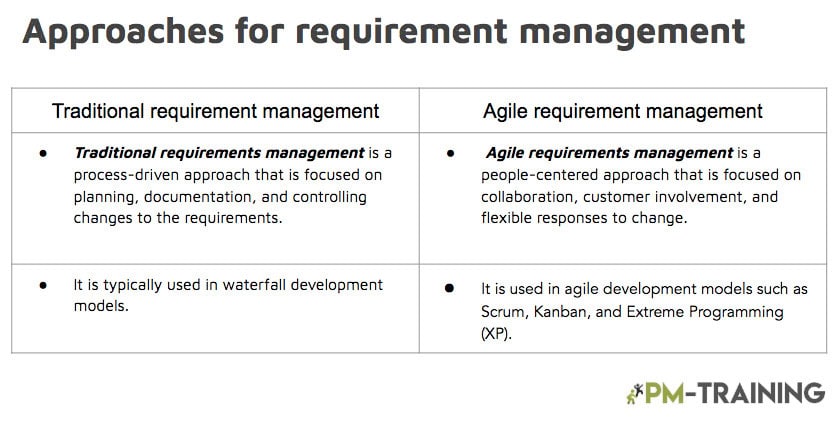
Approaches for Team Requirement
An agile team maintains requirements throughout the development cycle by listening closely to customer needs, analyzing incoming feedback, and identifying which features or changes actually move the product forward. This constant loop lets the team adjust scope as market conditions shift, rather than waiting for a formal change-request process that traditional methodologies typically require before any adjustment can be made.
Agile requirements typically take the form of user stories, short and simple descriptions of a feature written from the customer’s point of view. Beyond user stories, teams also define requirements through product backlog items, technical tasks, and change requests. Each format serves a slightly different purpose, but all of them exist to keep the team focused on delivering value quickly.
Agile requirements generally fall into a few recognizable categories.
- User Stories: Short, plain-language statements written as “As a [user], I want [goal], so that [benefit],” keeping the focus on customer value rather than technical implementation details.
- Epics: Large bodies of work broken down into multiple related user stories, used to organize significant features that will span several sprints before full delivery.
- Product Backlog Items: Any unit of work the team may eventually deliver, including bugs, design changes, technical debt, and customer requests, all ranked by the product owner.
- Acceptance Criteria: Specific, testable conditions attached to a user story that define exactly when the team can consider that story complete and ready to ship.
- Technical Tasks: Engineering work needed to support a story, such as infrastructure changes or refactoring, that does not directly map to a single user-facing feature.
Gathering Agile Requirements
In agile environments, requirements documentation happens collaboratively and iteratively rather than in one upfront planning phase. The team decomposes broad requirements into user stories, then elaborates on them through direct conversation with the customer. This back and forth ensures the resulting stories reflect what users actually want, not just what a stakeholder assumed they wanted during initial scoping.
Once defined, user stories get prioritized and added to the product backlog, which functions as a living requirement specification for the entire team. The product owner continuously updates this backlog as new information surfaces. During each sprint, the team pulls prioritized stories from the backlog and delivers them as a working increment, then gathers customer feedback in the sprint review.
Types of Agile Team Requirement Examples
Seeing requirements in context makes the concept far easier to apply than reading a dry definition alone ever could. The examples below represent the most common formats agile teams use to capture what needs to be built, ranging from broad statements of intent down to granular, testable conditions that developers can code directly against every single day.
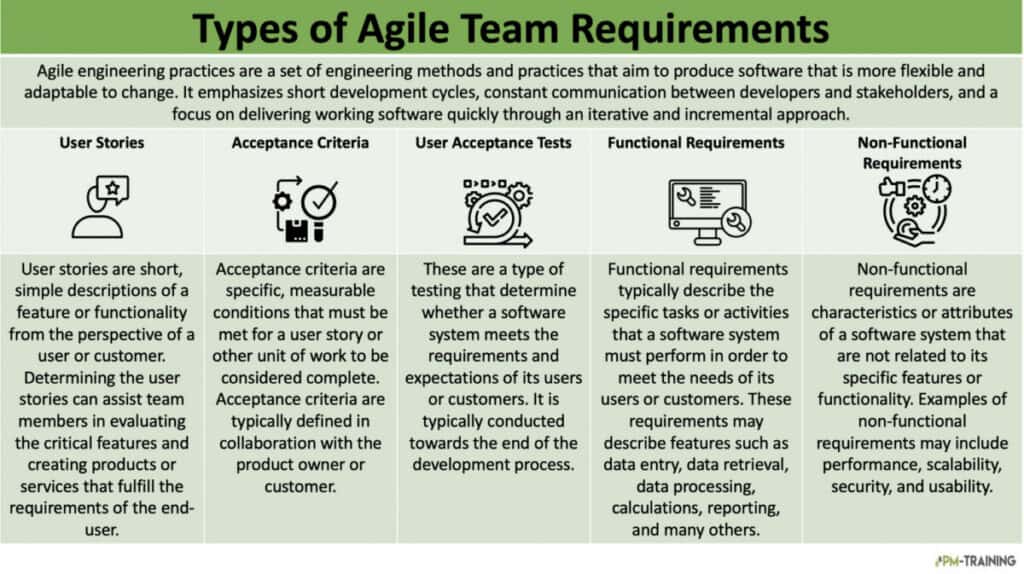
Here are five common agile team requirement examples worth understanding.
- Functional User Story Example: “As an online shopper, I want to pay with a credit card so that I can complete checkout quickly and earn loyalty points on my purchase.”
- Non-Functional Requirement Example: “The checkout page must load in under two seconds on a standard mobile connection so that users do not abandon their cart before completing payment.”
- Epic Example: “Redesign the account dashboard,” later broken into individual stories covering navigation, notifications, billing history, and profile settings across several upcoming sprints.
- Acceptance Criteria Example: “Given a valid credit card, when the user submits payment, then the order is confirmed within three seconds, and a receipt is emailed automatically.”
- Technical Task Example: “Upgrade the payment gateway API integration to support new fraud detection rules before the credit card checkout story can be marked complete.”
Maintain Agile Team Requirements
Maintaining requirements in agile looks nothing like the traditional model, where testers arrive at the end to catch defects against a fixed specification. Agile teams test continuously throughout development, which raises a fair question: how does a team move fast without sacrificing quality? The answer lies in treating quality as a shared responsibility rather than a final gate before release.
Critics often argue that agile trades quality for speed because it limits upfront planning. In practice, the opposite tends to be true when teams execute well. Continuous testing, frequent customer feedback, and small increments catch problems earlier than a single end-of-project inspection ever could, which generally produces more reliable software over the life of the product.
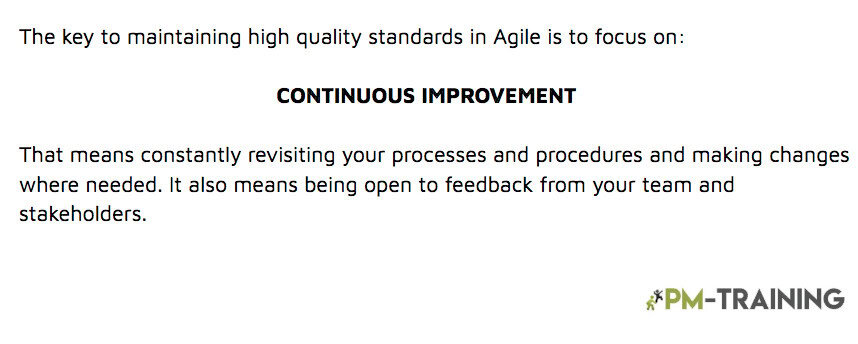
Agile Team Requirement
Development team requirements live inside the project backlog, which acts as a repository of user stories the team uses to plan and execute upcoming work. As tasks get completed, new requirements enter the backlog and get scheduled into future sprints. Maintaining requirements this way demands a different mindset than the document-heavy discipline traditional waterfall management depends on.
Modern agile teams increasingly break large backlog items into layered detail, keeping epics broad and stories fully specified only once they approach active development. This just-in-time elaboration prevents teams from wasting effort detailing features that might get deprioritized before anyone writes a line of code, which keeps the backlog lean and genuinely reflective of current priorities.
Best Practices for Managing Requirements in Agile Projects
Customer needs shift throughout a project because of market conditions, evolving business goals, and new technical possibilities that were not available when the project started. Agile teams typically maintain a team requirements document that outlines the features, functions, services, and products they are building, ensuring every sprint delivers work tied directly to agreed priorities. Keeping that document current allows the team to deliver value quickly without losing sight of the bigger goal.
Several proven practices help agile teams keep requirements well maintained across the life of a project. These include disciplined documentation habits, systematic tracking of requirement changes, and deliberate involvement of the right stakeholders at the right moments. None of these practices work in isolation, so teams generally see the best results when they apply all three together consistently.
Consider these core team requirements practices before defining your team’s quality standard.
- Agree on What Quality Means: Determine the specific criteria your team uses to decide whether a product increment is ready for release, and document that standard clearly.
- Confirm Team-Wide Alignment: Once the quality definition exists, ensure every team member understands it and genuinely agrees with it before work begins on the next sprint.
- Protect Quality Under Pressure: Treat quality as non-negotiable regardless of deadline pressure, since cutting corners under speed pressure tends to create far more rework later.
- Schedule Regular Backlog Grooming: Hold recurring refinement sessions so requirements stay current, well understood, and properly prioritized rather than growing stale between sprints.
- Track Requirement Changes Systematically: Log every material change to a requirement, including who requested it and why, so the team retains a clear audit trail over time.
A clear, shared definition of quality prevents disagreements from surfacing mid-sprint. Before finalizing your standard, address these questions and confirm every team member understands and agrees with the answer.
- What specific criteria determine whether a product increment is genuinely ready for release to customers?
- How will the team measure and verify quality consistently across every sprint, not just the final one?
- Who has the authority to block a release if the agreed quality standard has not been met?
Conclusion
Agile team requirements management succeeds when teams treat the product backlog as a living tool rather than a fixed contract set in stone from day one. User stories, progressive elaboration, and continuous testing all work together to keep requirements aligned with what customers actually need, even as market conditions and business priorities shift throughout a project.
Teams that invest in disciplined backlog grooming, clear acceptance criteria, and honest stakeholder communication consistently outperform those still relying on rigid, document-heavy processes built for a much slower era of software delivery. Start by auditing how your team currently gathers and maintains requirements, then apply the practices outlined here to close any gaps before your next sprint planning session.
Frequently Asked Questions About Agile Team Requirements
Can you change team requirements during a sprint?
No. Sprint requirements should stay locked once a sprint begins, because introducing changes mid-sprint disrupts the team’s focus, velocity, and existing commitments to stakeholders and customers alike. If new information emerges, the product owner captures it in the backlog and prioritizes it for a future sprint rather than forcing an immediate disruption to committed work already underway.
Who is responsible for maintaining communication in agile requirements?
The product owner holds primary responsibility for maintaining the product backlog and communicating the requirements to the rest of the team throughout every phase of the project. This role also ensures the team delivers the agreed functionality, quality, and value each sprint, acting as the main point of contact between customers, stakeholders, and the people actually building the product.
What are the differences between waterfall and agile requirement management?
Waterfall gathers all requirements upfront and documents them in extensive detail before development ever begins, while agile gathers requirements incrementally and iteratively throughout the entire project. Waterfall suits projects with well-defined, stable requirements, whereas agile suits projects where requirements evolve constantly. Waterfall favors rigid documentation, and agile favors working software validated through frequent customer feedback.
How do agile teams estimate requirements before a sprint?
Teams typically use story points, T-shirt sizes, or simple item counts to estimate the relative effort of a requirement before committing it to a sprint of upcoming work. Consistent estimation across teams that feed a shared roadmap makes forecasting far more reliable, since a product owner can then predict delivery timelines with reasonable confidence.
What is the INVEST criteria for agile user stories?
INVEST is a widely used acronym describing the core traits of a well-written agile user story: independent, negotiable, valuable, estimable, small, and fully testable in isolation. Applying these criteria during backlog refinement helps teams catch vague or oversized stories before they enter a sprint, reducing rework and keeping delivery predictable across the entire project.
Suggested articles:
- 17 Sprint Retrospective Examples for Agile Teams
- 93 Agile Self-Assessments to Accompany Agile Team Charters
- 6 Team Agile Communication Techniques & Digital Tools

Shane Drumm, holding certifications in PMP®, PMI-ACP®, CSM, and LPM, is the author behind numerous articles featured here. Hailing from County Cork, Ireland, his expertise lies in implementing Agile methodologies with geographically dispersed teams for software development projects. In his leisure, he dedicates time to web development and Ironman triathlon training. Find out more about Shane on shanedrumm.com and please reach out and connect with Shane on LinkedIn.