
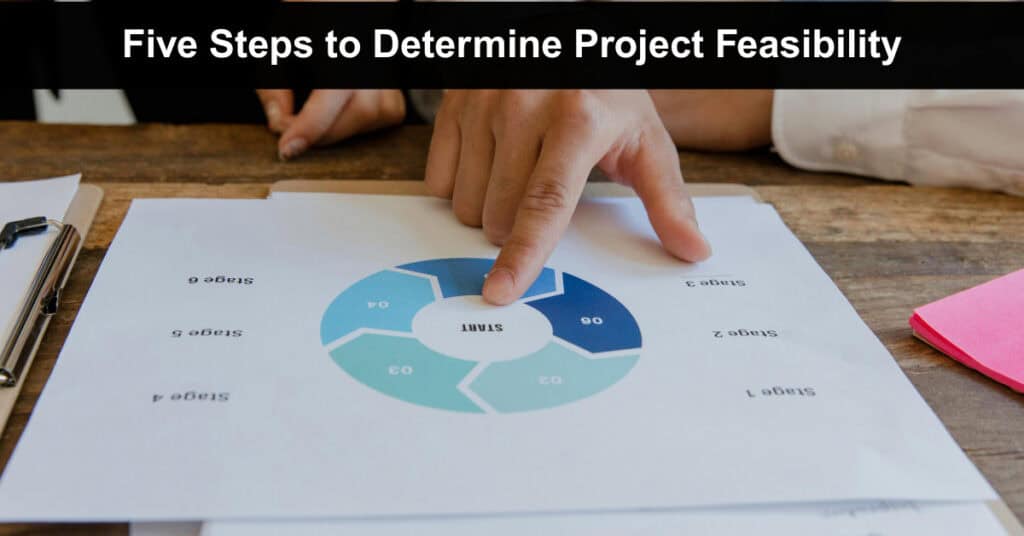
Determining whether your project is worth pursuing before committing significant resources is one of the most critical decisions a project manager makes. Too many projects fail not because of poor execution, but because the wrong solution was chosen from the start. A structured feasibility study gives you the confidence to move forward, knowing that your chosen solution can be delivered on time and within budget.
It provides a clear, evidence-based framework for comparing your available options, understanding the risks involved, and selecting the approach most likely to succeed given your team’s capabilities and constraints. Without this process, project teams risk investing considerable time, money, and effort into an approach that later proves unworkable. This article walks you through five clear steps to complete that process effectively and with confidence.
Completing a Feasibility Study
A feasibility study must be completed as early in the project life cycle as possible. The ideal moment is when you have identified a range of alternative solutions and need to determine which one is most viable to implement. Conducting it early prevents teams from investing time and budget into an approach that later proves unworkable.
The study is not a one-time document but a structured process of investigation and validation. Each step builds on the previous one, moving from understanding the problem all the way through to confirming that your chosen solution is practically achievable. Teams that skip or rush this process often find themselves revisiting fundamental decisions mid-project, at a far greater cost, regardless if we’re talking about energy storage project feasibility assessments, commercial real estate investments, or anything in between.
Step 1: Research the Business Drivers
Every project originates from a business problem, and those problems are referred to as business drivers. Before evaluating any solution, you must fully understand what is driving the project in the first place. This means going beyond the surface-level description and asking why the problem matters to the organisation.
Business drivers vary widely in nature and urgency. An outdated IT system causing customer complaints, a merger resulting from an acquisition, or a compliance deadline imposed by a regulator are all examples of business drivers that carry real consequences. Understanding the driver in full helps you frame the feasibility study around outcomes that actually matter to stakeholders.
Key actions to take when researching business drivers include:
- Problem Definition: Clearly articulate the core business problem in writing, ensuring all stakeholders share the same understanding before any solution is explored.
- Impact Assessment: Identify what will happen to the business if the project is delayed or fails to deliver, including financial, operational, and reputational consequences.
- Urgency Analysis: Determine why the problem must be resolved within a specific timeframe and what external or internal pressures are shaping that deadline.
- Stakeholder Alignment: Confirm that senior decision-makers agree on the nature and priority of the business driver before the feasibility process moves forward.
Step 2: Confirm the Alternative Solutions
Once you have a clear picture of the business problem, your next task is to identify the range of alternative solutions available. A feasibility study only has meaning when there are genuine options to compare. Proceeding without this step means you may be validating a single approach without knowing whether a better one exists.
For an outdated IT system, for example, the alternatives might include redeveloping the existing system, replacing it entirely with a commercial product, or integrating it with another platform already in use. Each of these carries different implications for cost, timeline, and technical complexity.
When confirming your alternative solutions, consider the following:
- Redevelopment: Rebuilding an existing system or process from within, which typically preserves institutional knowledge but can carry higher technical debt and longer timelines.
- Replacement: Adopting an entirely new system or approach, which offers a clean starting point but requires more extensive change management and stakeholder onboarding.
- Integration: Connecting existing systems or processes to create a unified solution, which can be cost-effective but introduces complexity around data compatibility and dependency management.
- Phased Implementation: Delivering the solution in stages rather than all at once, which reduces upfront risk but requires careful sequencing and may delay the full realisation of benefits.
Step 3: Determine the Feasibility
With your alternative solutions confirmed, you now need to assess whether each one can actually be delivered on time and within budget. This is the analytical core of the study, and it requires you to use multiple evaluation techniques rather than relying on assumptions or experience alone.
The goal is to gather evidence that either supports or challenges the viability of each option. Using a combination of the following approaches gives you a defensible, evidence-based view of feasibility rather than an informed guess.
- Research: Review how other organisations have approached and implemented similar solutions. Industry case studies, white papers, and vendor documentation can surface risks and success factors that your team might not anticipate from the outset.
- Prototyping: Identify the component of each solution that carries the highest technical risk and build a working sample. A prototype does not need to be complete; it needs to answer whether the most uncertain element is actually achievable.
- Time-Boxing: Select a defined subset of tasks from your project plan and execute them within a fixed timeframe. Comparing actual completion time against your estimate gives you a reliable signal about the accuracy of your planning assumptions.
- Expert Consultation: Engage subject matter experts or external advisors who have direct experience with similar solutions. Their insight can validate or challenge your internal assumptions quickly and at relatively low cost.
Step 4: Choose a Preferred Solution
With feasibility data gathered for each alternative, you are now in a position to select the preferred solution. This decision should be guided by three criteria: which solution is most feasible to implement, which carries the lowest overall risk, and which your team is most confident of delivering successfully. Selecting a preferred solution does not mean the others were failures.
It means you have used a structured process to identify the best fit between the problem and the available approaches. This distinction matters when communicating the decision to stakeholders who may have advocated for a different option.
Use the following criteria to guide your final selection:
- Feasibility Score: Evaluate each solution against the evidence gathered in Step 3, rating how confidently your team can deliver it within the project’s time and budget constraints.
- Risk Profile: Assess the volume and severity of risks associated with each option, giving preference to solutions where risks are well understood and risk mitigation strategies are already available.
- Team Confidence: Consider the experience and capability of your team in relation to each solution, as a technically superior option delivered by an underprepared team carries more risk than a simpler solution executed with expertise.
- Stakeholder Acceptance: Factor in how readily key stakeholders will support each solution, since a technically feasible option that lacks organisational buy-in will face unnecessary friction during delivery.
Step 5: Reassess at a Lower Level
Selecting a preferred solution is not the end of the feasibility process. The final step requires you to take that solution and reassess it in greater detail, breaking it down into individual tasks and validating that each one is achievable within the project’s constraints. Work with your team to list every task required to complete the solution, then ask them to estimate how long each task will take.
Compile those estimates into a project plan and test whether the total timeline is realistic given your deadline. This ground-level view often reveals scheduling risks that were not visible when the solution was being evaluated at a higher level.
At this stage, apply the following actions to strengthen your confidence in the plan:
- Task Decomposition: Break the preferred solution into its smallest workable components, ensuring that no single task is so large or vague that it cannot be reliably estimated or assigned.
- Team Estimation: Ask the people who will actually perform each task to provide time estimates, as bottom-up estimates from practitioners are consistently more accurate than top-down projections from project managers alone.
- Risk Task Investigation: Identify the tasks your team flags as highest risk and apply the assessment techniques from Step 3 to investigate them further before committing them to the plan.
- Plan Validation: Compile all tasks and estimates into a consolidated project plan and confirm that the full scope can be completed within the project deadline before submitting the feasibility study report for approval.
Conclusion
A feasibility study is not bureaucratic overhead; it is the foundation of sound project decision-making. By working through these five steps, project managers can move from an initial business problem to a well-evidenced, stakeholder-approved solution with confidence. Each step builds analytical rigour into the process, reducing the likelihood of costly course corrections later in the project life cycle.
The effort invested in a thorough feasibility study pays dividends throughout delivery. Teams that enter execution with a validated solution, a realistic plan, and stakeholder alignment are far better positioned to succeed. Make the feasibility study a non-negotiable part of how your organisation initiates projects, and the results will reflect that discipline.
FAQs
What is the purpose of a feasibility study in project management?
A feasibility study assesses whether a proposed project solution can be delivered on time and within budget. It is conducted early in the project life cycle to compare alternative solutions and select the one that is most viable, reducing the risk of committing resources to an approach that may not succeed.
When should a feasibility study be completed?
The study should be completed as early as possible, ideally once a range of alternative solutions has been identified. Conducting it before the project moves into detailed planning ensures that key decisions are grounded in evidence rather than assumptions.
How many alternative solutions should be evaluated?
There is no fixed number, but you should identify enough alternatives to give decision-makers a genuine choice. Evaluating only one solution is not a feasibility study; it is a validation exercise. Aim to include at least two or three options that represent meaningfully different approaches to the same problem.
What methods can be used to assess solution feasibility?
Common methods include research into how other organisations have implemented similar solutions, prototyping the highest-risk components, and time-boxing specific tasks to test the accuracy of your planning estimates. Using a combination of methods produces more reliable results than relying on a single approach.
Who should approve the feasibility study?
The completed feasibility study should be reviewed and approved by the project sponsor or a relevant senior manager. Approval ensures that the project team has organisational backing for the chosen solution and that all stakeholders are aligned before detailed planning and execution begin.
About the Author: Jason Westland has been in the project management industry for the past 16 years, managing projects of up to 2 billion dollars. If you would like to find out more about Jason or his new online project management software, visit projectmanager.com.
Suggested articles:
- Feasibility Study Template for Project Managers
- Project Proposal Template for Project Managers
- How AI Is Revolutionizing Project Management: From Planning to Delivery

Andrew Makar, DMIT, PMP, CSM is an IT director with delivery experience across projects, programs and portfolios in Digital Marketing, Automotive, Software and Financial Management industries. He is an enthusiastic leader who effectively translates project management theory into practical application. His area of interest and practice is in implementing Agile processes and SCRUM techniques to deliver better software to his customers. Find out more about Andrew on andymakar.com and please reach out and connect with Andrew on LinkedIn.