

Most new Twitch channels stream to a nearly empty chat for months, and the reason is rarely the content. Millions of channels go live each month, the directory favors whoever already has viewers, and the platform’s rules on revenue, ads, music, and storage keep shifting. Twitch is still the biggest home for live streaming, but building on it carries risks worth weighing first.
The sections below cover where Twitch falls short in 2027, from discovery and hardware costs to moderation, revenue splits, hate raids, copyright strikes, and burnout. Every con comes with a documented case, current figures from Twitch and the press, and practical fixes for solo streamers, brands, and project teams that use live streams for launches, events, or training.
Hard to Be Found: Twitch saw about 6.93 million channels go live each month in 2025, sharing roughly 2.17 million concurrent viewers, and its directory ranks channels by current viewers. New streams start at the bottom.
Thin Revenue for Small Channels: Twitch keeps half of subscription revenue by default. The 60/40 and 70/30 splits need 100 or 300 Plus Points a month for three months running.
Rules That Shift: Twitch withdrew its artistic nudity policy after two days in 2023 and its branded content rules after one day. Ads, music, and storage rules change often too.
Safety and Burnout Risks: Twitch has fought hate raids since 2021 and still issued 55,963 sexual harassment enforcements in late 2024. Long streaming hours carry a real mental health cost.
10 Disadvantages & Drawbacks of Using Twitch

Some of these cons hit new streamers hardest, such as discovery and revenue splits, while others affect every channel, including brands and teams that stream launches, events, and training sessions. Each one below names the Twitch policy, limit, or event behind it, so you can judge which risks apply to your channel and plan around them before they cost you viewers or income.
1. High Competition for a Small Audience

Twitch has far more people broadcasting than its directory can surface. TwitchTracker counted about 6.93 million channels going live each month in 2025, with roughly 93,200 live at any moment. Those channels shared about 2.17 million concurrent viewers, an average of around 23 viewers per live channel, and most of that audience sits with a few large streamers.
The browse page sorts each category by current viewers, so a new channel starts at the bottom of a long list and stays there until it already has an audience. That circular problem is why many streamers spend months broadcasting to an empty chat. It hits hardest in popular games, where thousands of channels compete for the same viewers every evening.
Where the competition bites hardest:
- Viewer-Sorted Directory: Browse pages rank live channels by current viewers, which rewards channels that are already big.
- Crowded Games: Popular titles hold thousands of live channels at peak times, so a small stream is buried on page one.
- Partner Thresholds: Twitch Partner applications ask for an average of 75 viewers, a level most channels never reach.
Illustrative Scenario: A project coordinator starts streaming a popular strategy game three evenings a week after work. After two months, the channel averages four viewers, two of them friends. The coordinator realizes that the game’s directory holds several thousand live channels every evening, and the stream never appears above the fold. The project coordinator starts posting clips instead.
Real-Life Example: TwitchTracker data shows Twitch’s average concurrent viewers falling from about 2.78 million in 2021 to about 2.17 million in 2025, while concurrent channels only fell from about 105,000 to 93,200. Fewer viewers per live channel, as the site itself notes, make it harder for a new streamer to climb out of the bottom of a directory.
What You Can Do: Pick categories where the number of live channels is small compared with viewers, and stream at consistent, posted times. Build discovery outside Twitch with short clips on YouTube Shorts, TikTok, or Instagram, and network through raids with streamers of similar size. Track average viewers per stream hour, not followers, so you can see which schedule and category actually work.
Real-Life Example
Viewers per Channel Keep Shrinking
TwitchTracker’s yearly averages show 2.78 million concurrent viewers and about 105,000 live channels in 2021, against 2.17 million viewers and 93,200 channels in 2025. Viewers fell faster than channels, so the average live channel now shares a smaller audience than it did four years earlier.
Source: TwitchTracker
By the Numbers
- 6.93M
channels went live on Twitch each month in 2025, on average
Source: TwitchTracker
- 93.2K
channels were streaming live at the same time, on average, in 2025
Source: TwitchTracker
- 75
average viewers Twitch asks for in its Partner Program requirements
Source: Twitch Help
Why It Matters
A new channel is not competing for attention once; it competes every evening against the same thousands of streams in its category.
ProjectManagers.net analysis of TwitchTracker data.
2. High Bandwidth and Hardware Requirements
Good streams cost money on both ends. Twitch’s broadcasting guidelines call for 1080p at 60 frames per second, full HD. They warn that x264 presets above Faster need a CPU with six or more cores, and suggest a GPU encoder such as NVIDIA NVENC to avoid dropped frames. They also advise a stable upload over the highest bitrate a line allows.
Viewers pay for bandwidth too, through data plans and connections that cannot hold a 1080p stream. Twitch itself pays to deliver every stream, and in countries where network fees are high, it has cut viewing quality or left the market. For a streamer, that means picture quality can depend on decisions far outside their own setup.
What the technical load adds up to:
- Encoding Hardware: CPU encoding at higher presets needs six or more cores, so many streamers add a newer GPU.
- Upload Stability: Twitch recommends a steady, constant bitrate, which needs a reliable upload connection.
- Viewer Quality Limits: Delivery costs can lead Twitch to cap the resolution viewers receive in a region.
Illustrative Scenario: A small game studio plans weekly dev streams from its office. The first test drops frames because the shared office upload is also running cloud backups. The team has to schedule streams outside backup windows and buy a GPU encoder, adding a week and an unplanned hardware line to the launch marketing budget.
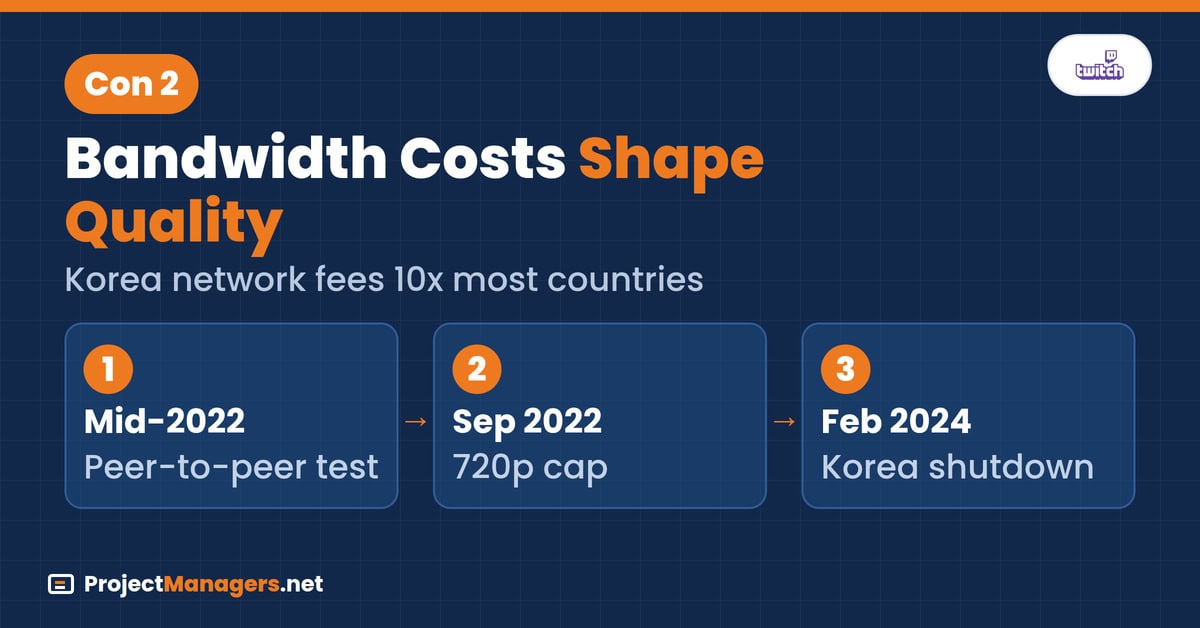
Real-Life Example: On September 30, 2022, Twitch limited video in South Korea to a maximum of 720p after testing a peer-to-peer delivery model (PCGamesN). In December 2023, its CEO said Korean network fees were still 10 times higher than in most other countries and announced that Twitch would shut down in Korea on February 27, 2024 (Twitch blog).
What You Can Do: Run a speed test at your planned stream time, then set the bitrate below what your line holds. Use a GPU encoder if your CPU struggles, and stream at 720p60 or 936p if 1080p drops frames. Keep a second connection, such as a phone hotspot, for important streams, and test the full setup before any public launch or event.
Real-Life Example
Twitch Caps Korea at 720P, Then Leaves
Twitch first tried peer-to-peer delivery in Korea in mid-2022, then capped source quality at 720p from September 30, 2022. A year later, it said costs were still too high and closed its Korean business on February 27, 2024, moving streamers to other services.
Sources: PCGamesN, Twitch blog
By the Numbers
- 720p
maximum resolution for viewers in South Korea from September 30, 2022
Source: PCGamesN
- 10x
higher network fees in Korea than in most other countries, according to Twitch
Source: Twitch blog
- 6+
CPU cores needed for x264 presets above Faster, per Twitch’s guidelines
Source: Twitch
From Twitch
Twitch’s CEO wrote that the company had cut costs in Korea but still could not find a sustainable way to keep running there.
Dan Clancy, Twitch CEO, December 2023. Twitch blog
3. Inconsistent Content Moderation
Twitch’s rules change often, and enforcement can feel unpredictable to the people who live by them. Streamers report suspensions they cannot explain, appeals that take time, and policies that move faster than they can adjust their content. Because most live content disappears after it airs, moderators judge many cases from reports and short clips rather than the full context.
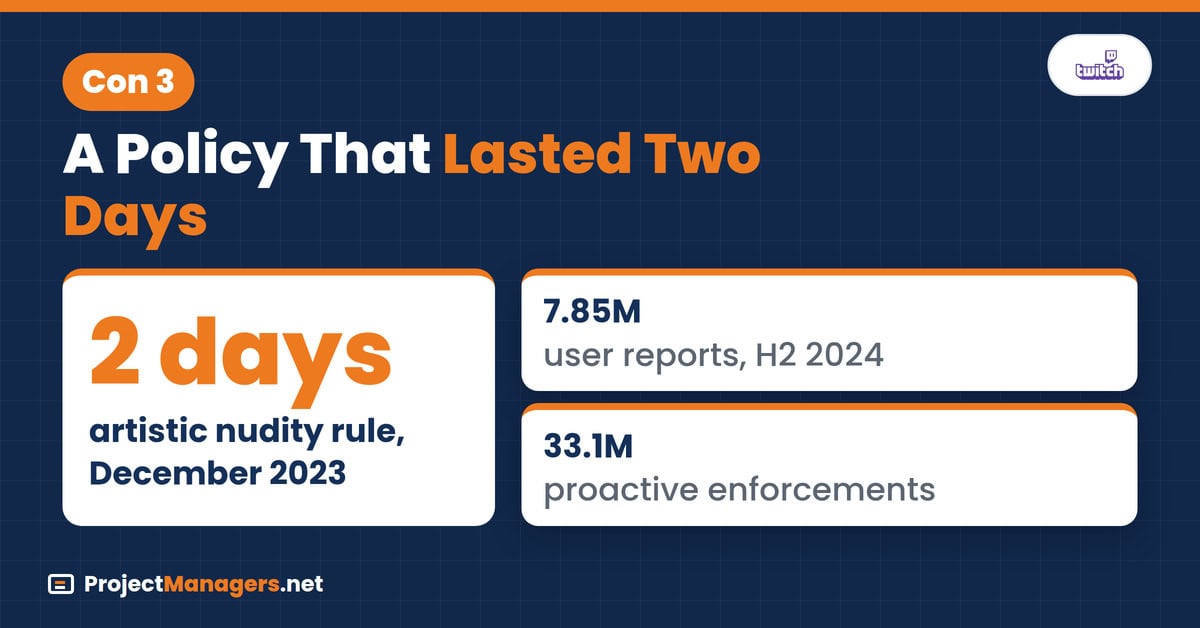
The scale is large. Twitch’s H2 2024 transparency report lists about 7.85 million user reports in six months and 33.1 million proactive enforcements, most of them against spam and bot accounts. At that volume, mistakes and uneven decisions are hard to avoid, and a single wrong call can cost a small streamer days of income.
Where moderation feels inconsistent:
- Fast Policy Changes: Rules can be published and withdrawn within days, leaving streamers unsure what is allowed.
- Context Gaps: Moderators often see a clip or report, not the hours of stream around it.
- Slow Fixes: Appeals take time, and a suspension can stop income while the review runs.
Illustrative Scenario: A cosplay streamer reads Twitch’s new sexual content policy, plans a week of figure-painting streams around it, and books a sponsor. Two days later, the artistic nudity part is withdrawn, and the streamer has to rework the schedule and explain the change to the sponsor. The week’s content plan, thumbnails, and sponsor slides all have to be redone at short notice.
Real-Life Example: On December 13, 2023, Twitch updated its sexual content policy to allow some fictionalized artistic nudity. Two days later, on December 15, its CEO withdrew that part of the policy, saying depictions of real or fictional nudity would not be allowed after all, regardless of the medium (The Verge). Mature-rated games were not affected by the rollback.
What You Can Do: Read the Community Guidelines changelog every month and keep a short channel policy that is stricter than Twitch’s. Save your VODs and stream logs so you have evidence for an appeal, and file appeals quickly through the official portal. If a sponsor deal depends on a recent rule change, add a clause that covers policy reversals before you sign.
Real-Life Example
Two Days of Artistic Nudity
Twitch announced a broader sexual content policy on December 13, 2023, including some artistic nudity. On December 15, the company rolled back the artistic nudity part after seeing far more of it than expected, while keeping the rest of the update.
Source: The Verge
By the Numbers
- 7.85M
user reports to Twitch in the second half of 2024, down about 18% from the first half
Source: Twitch
- 33.1M
proactive enforcements by Twitch in the second half of 2024
Source: Twitch
- 2 days
between the artistic nudity policy and its withdrawal in December 2023
Source: The Verge
From Twitch
Twitch says the vast majority of its enforcements are correct but admits that cases can be complex and that it sometimes gets them wrong.
Twitch, H2 2024 Transparency Report. Twitch
4. Revenue Challenges for Small Streamers
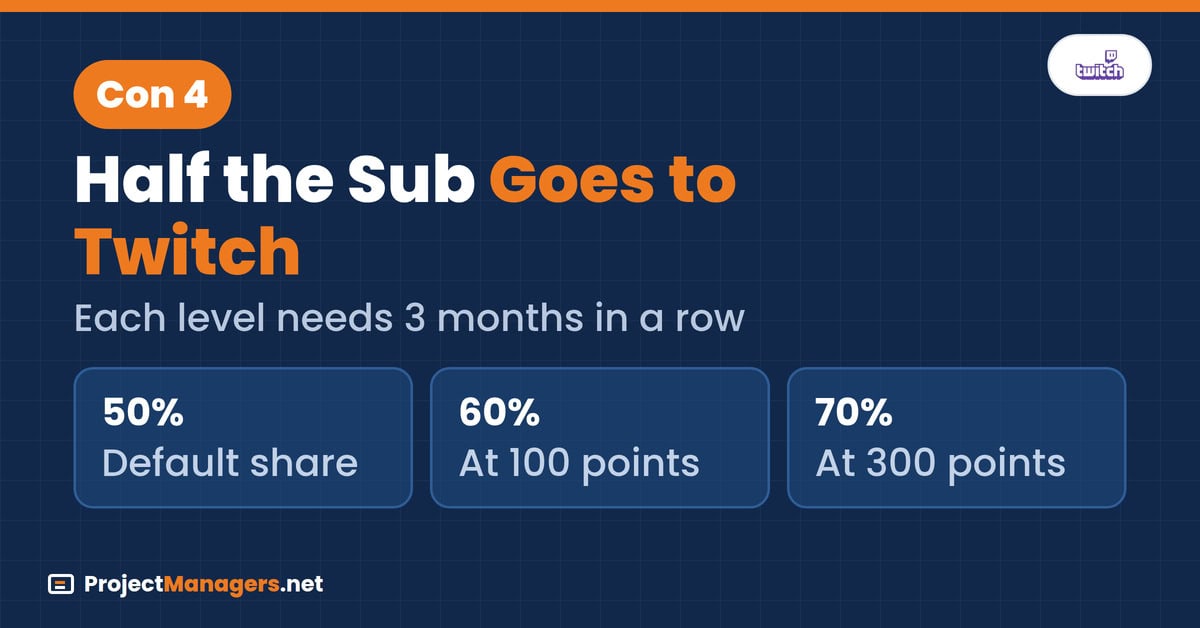
Subscriptions are the main income for most streamers, and Twitch keeps a large share. By default, revenue from a sub is split 50/50. The Plus Program raises the streamer’s share to 60% at 100 Plus Points a month and to 70% at 300 points, but only after three consecutive months at that level, and Prime subs do not count toward qualifying.
For a small channel, 100 recurring subs is a long way off. Until then, a Tier 1 sub at $5.99 earns the streamer roughly half before taxes and fees, and ad revenue depends on viewer numbers the channel does not have yet. The program helps mid-sized creators most, while new streamers carry the lowest share of their own revenue.
Why small channels earn so little:
- Default Split: Streamers below the Plus Program thresholds keep 50% of subscription revenue.
- Three-Month Rule: Qualifying needs 100 or 300 Plus Points in each of three consecutive months, and points reset every month.
- Prime Subs Excluded: Prime Gaming subs do not count toward Plus Points, even though they still pay the streamer.
Illustrative Scenario: A streamer with 60 recurring Tier 1 subs reaches 100 Plus Points in a strong December, then drops to 85 in January as holiday gift subs lapse. The three-month count restarts, and the channel stays on the 50/50 split for another quarter despite growing overall. The streamer had already budgeted for the higher share.
Real-Life Example: When Twitch launched Partner Plus on October 1, 2023, the 70/30 split needed 350 recurring subs for three straight months and was capped at the first $100,000 a year (Twitch blog). Twitch later replaced it with the Plus Program, adding a 60/40 level at 100 Plus Points and opening it to Affiliates as well as Partners (Twitch Help).
What You Can Do: Treat subs as one income stream, not the business. Add sponsorships, affiliate links, merchandise, or paid community perks, and push multi-month and higher-tier subs, which count for more Plus Points. Track Plus Points in the Creator Dashboard each month, and plan subathons or events in the months that could complete a qualifying run.
Real-Life Example
Partner Plus Becomes the Plus Program
Partner Plus launched on October 1, 2023, with a 70/30 split for Partners who kept 350 recurring subs for three months. The current Plus Program counts Tier 2 subs as 2 points and Tier 3 as 6 and adds a 60/40 level at 100 points for Affiliates and Partners.
Sources: Twitch blog, Twitch Help
By the Numbers
- 50%
default streamer share of subscription revenue below the Plus Program levels
Source: Twitch Help
- 100
Plus Points a month, three months running, to reach the 60/40 split
Source: Twitch Help
- 300
Plus Points a month, three months running, to reach the 70/30 split
Source: Twitch Help
From Twitch
Twitch describes the Plus Program as an enhanced revenue share that lasts 12 months from qualifying, or longer if the streamer keeps qualifying.
Twitch Help, Plus Program article. Twitch Help
5. Limited Streamer Control over Ads
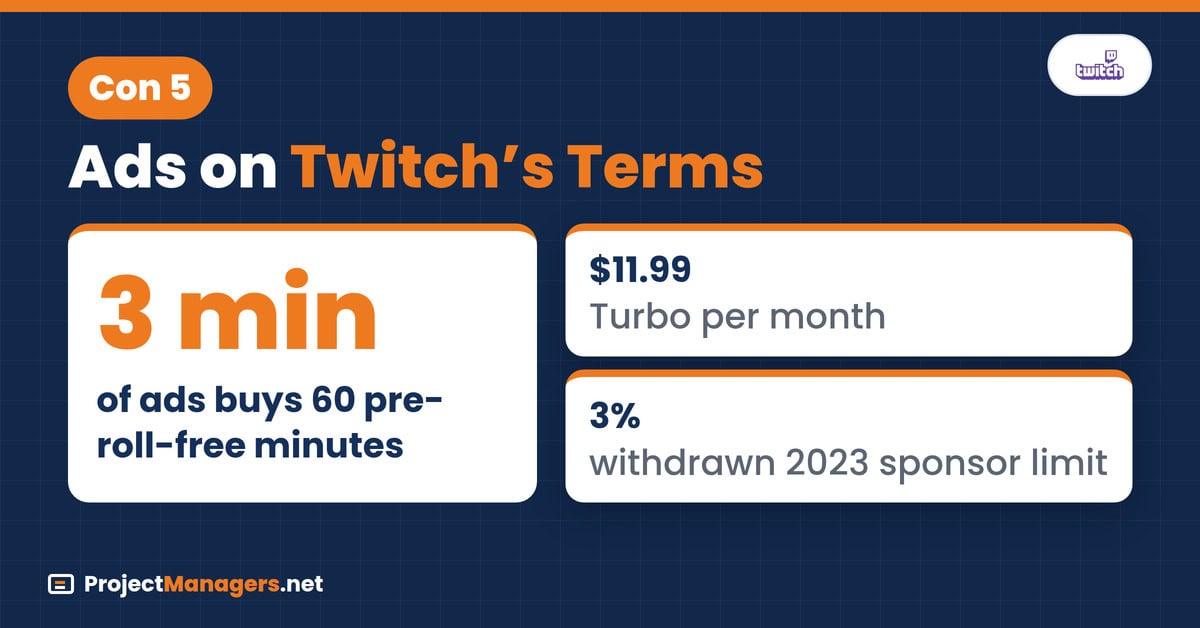
Ads are one of the main reasons viewers leave a stream, and streamers have only partial control over them. Pre-roll ads play when a viewer arrives unless the streamer runs mid-roll breaks on Twitch’s schedule. Its pre-roll rules say a 3-minute ad break switches off pre-rolls for the next 60 minutes, and shorter breaks buy proportionally less time.
Viewers who want no ads pay for Turbo, at $11.99 a month in the US, or subscribe to individual channels. Streamers can pick when breaks run but not how many ads Twitch sells, which formats appear, or what an advertiser pays. When Twitch changes those rules, streamers adjust their content and their sponsor deals to match.
Where streamers lose control:
- Pre-roll Trade-Off: Avoiding pre-rolls means running regular mid-roll breaks, which interrupt the stream itself.
- Ad Volume: Twitch decides how many ads it sells and at what price; streamers only choose timing.
- Sponsor Rules: Branded content rules decide which sponsor formats are allowed on stream.
Illustrative Scenario: A cooking streamer runs a 90-second break every 30 minutes to keep pre-rolls off for new viewers. Regulars complain that breaks land in the middle of recipes, but stopping them would bring back pre-roll ads that drive first-time viewers away within seconds. Either choice costs the channel some of its audience, and the streamer has no third option to pick.
Real-Life Example: On June 6, 2023, Twitch published branded content rules that would have banned burned-in sponsor videos and most overlays, allowing only display ads under 3% of the screen from July 1. After a day of backlash from large and small streamers, Twitch withdrew the changes on June 7 and said it would rewrite them (TechCrunch).
What You Can Do: Use the Ads Manager to schedule short, regular breaks at natural pauses, such as between games or recipe steps, and tell viewers when breaks are coming. Promote subscriptions as the ad-free option for regulars. Read every branded content update before signing sponsor deals, and keep sponsor formats simple enough to adapt if the rules change.
Real-Life Example
Twitch Pulls Its Branded Content Rules in a Day
Twitch’s June 2023 branded content update would have limited in-stream sponsor ads to tiny display ads under 3% of the screen, upending deals that many streamers rely on. After a day of backlash, Twitch said it would rewrite the guidelines with creators.
Source: TechCrunch
By the Numbers
- 3 min
of mid-roll ads disables pre-roll ads for the next 60 minutes
Source: Twitch Help
- $11.99
per month for Twitch Turbo, the ad-free viewer subscription in the US
Source: Twitch
- 3%
screen-size limit the withdrawn June 2023 rules would have set for sponsor ads
Source: TechCrunch
Why It Matters
Every ad decision Twitch makes changes what a stream feels like for viewers, yet the streamer is the one who hears the complaints.
ProjectManagers.net analysis of Twitch’s ad rules.
6. Toxic Community Behavior and Hate Raids

Live chat is Twitch’s strength, and also its weak spot. Harassers can flood a stream with slurs in seconds, and smaller streamers often lack the moderators or tools to stop it in time. Marginalized creators have been targeted most, and the damage goes beyond one bad evening: it drives people off the platform and makes others hesitant to start.
Twitch has added tools since, but handling harassment remains a daily task for many channels, large and small, especially during raids and events. Its transparency report lists 55,963 enforcements under the sexual harassment policy in the second half of 2024 alone. Streamers still depend on volunteer moderators, AutoMod settings, and chat filters they have to configure and maintain themselves.
How toxicity reaches a stream:
- Bot Floods: Automated accounts can send hundreds of hateful messages before a moderator reacts.
- Targeted Abuse: Harassers single out streamers for their identity, which drives them away.
- Moderator Burden: Small channels rely on unpaid volunteers to keep chat safe.
Illustrative Scenario: A small charity stream raises money for a local food bank when dozens of new accounts flood chat with abuse. The streamer has no moderators online, ends the stream early, and misses the fundraising target by a wide margin. The team adds follower-only chat, phone-verified chat, and two moderators before the next charity event.
Real-Life Example: In August and September 2021, bot-driven hate raids hit many Black and LGBTQ+ streamers, who organized the #ADayOffTwitch boycott. On September 9, 2021, Twitch sued two alleged raiders, saying one was responsible for nearly 3,000 bot accounts (The Verge). On September 29, it added phone-verified chat so streamers could keep brand-new accounts out (TechCrunch).
What You Can Do: Before you go live, turn on AutoMod, add blocked terms, and require email or phone verification for chat. Recruit at least one trusted moderator for every stream and give them clear rules. Use follower-only or subscriber-only modes during events, and know how to use Shield Mode so you can lock chat down with one click.
Real-Life Example
Twitch Sues the Alleged Hate Raiders
After weeks of bot-driven hate raids and a streamer boycott, Twitch filed a lawsuit on September 9, 2021, against two users it said ran the attacks. Weeks later it added phone and email verification for chat so streamers could block brand-new accounts.
Sources: The Verge, TechCrunch
By the Numbers
- ~3,000
bot accounts Twitch tied to one alleged hate raider in its 2021 lawsuit
Source: The Verge
- 55,963
sexual harassment enforcements in the second half of 2024, down 27% from the first half
Source: Twitch
- 5
accounts can share one verified phone number, and a ban covers all of them
Source: TechCrunch
From the Field
The streamers behind #ADayOffTwitch asked for control over incoming raids and for limits on how fast new accounts could join chat.
TechCrunch, September 2021. TechCrunch
7. Unpredictable and Concentrated Income

Income on Twitch swings with viewer numbers, sub renewals, ad rates, and sponsor demand, and much of it sits at the very top. A channel can have a strong month during a game launch and a weak one when viewers move on. Gift subs lapse after the event that brought them, and policy or economic changes can cut a revenue line without warning.
Because Twitch does not publish creator earnings, most streamers have no benchmark for what is normal. That changed for a moment in 2021, when leaked payout data showed how unevenly money is spread. For anyone planning to stream full-time, the safer assumption is that income will be uneven from month to month and year to year.
What makes the income so unpredictable:
- Event Spikes: Subathons, game launches, and gift subs lift one month and fade the next.
- Top-Heavy Payouts: A small group of channels earns most of the money paid out.
- Platform Changes: Revenue shares, ad formats, and regional decisions can change a channel’s income overnight.
Illustrative Scenario: A streamer quits a part-time job after three good months of gift subs during a popular game launch. By the fourth month, the game’s audience has moved on, half the gift subs have lapsed, and income drops by more than half. The streamer goes back to part-time work and keeps streaming on a smaller schedule.
Real-Life Example: In October 2021, a breach exposed a 125 GB file of Twitch data, including payouts to top streamers from roughly August 2019 to October 2021. The highest-paid channel earned close to $10 million in that period, and most of the top 100 earned more than $1 million (Business Insider). Typical channels earn a tiny fraction of that.
What You Can Do: Budget on your lowest month from the last six, not your best, and keep three to six months of expenses in savings before going full time. Spread income across subs, ads, sponsors, and off-platform products. Review your Twitch analytics monthly and treat any spike from a single event as a bonus, not a new baseline.
Real-Life Example
The 2021 Twitch Payout Leak
Hackers posted a 125 GB file of Twitch data in October 2021, including about two years of payouts to its top streamers. The list showed the top channel close to $10 million and most of the top 100 above $1 million, figures far beyond what typical channels earn.
Source: Business Insider
By the Numbers
- ~$10M
earned by the top Twitch channel in about two years, according to the 2021 leak
Source: Business Insider
- 125 GB
size of the leaked Twitch data file that exposed creator payouts in October 2021
Source: Business Insider
- 35%
of Twitch’s workforce was cut in January 2024, about 500 jobs
Source: IGN
Why It Matters
When a platform’s own finances are under pressure, as the 2024 layoffs showed, creator programs and revenue shares can change with them.
ProjectManagers.net analysis. IGN
8. Strict Copyright Rules and DMCA Strikes
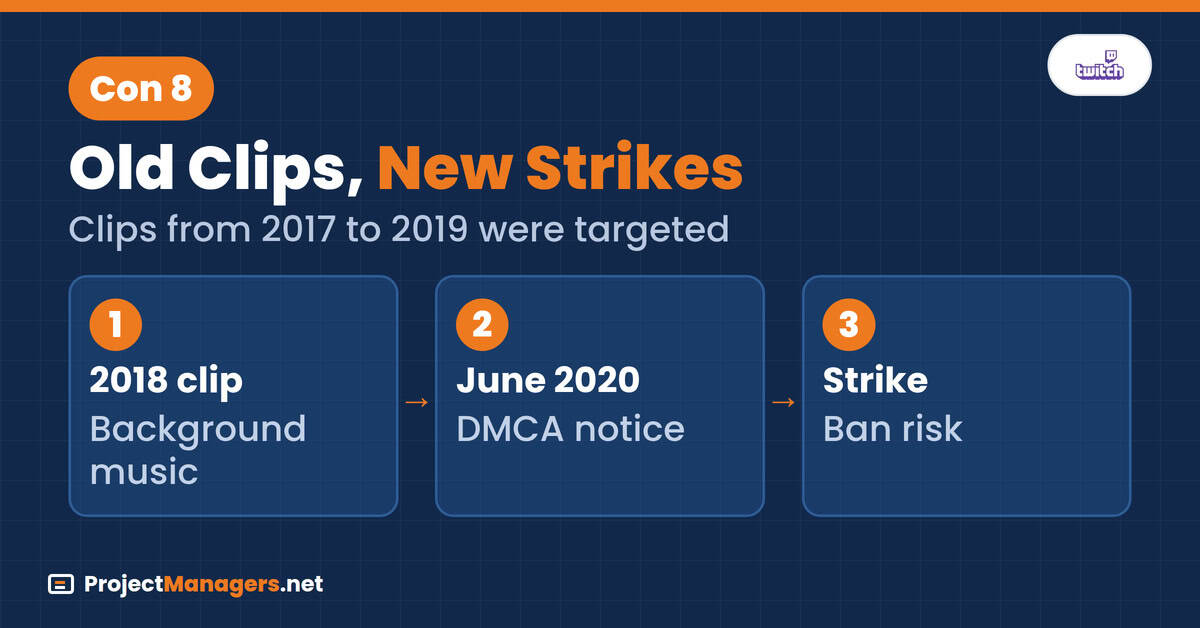
Music is everywhere in live streams, and most of it is not licensed for streaming. Twitch’s rules do not let streamers play copyrighted music without permission, and repeated DMCA strikes can lead to a permanent ban. The risk extends to old content as well: clips and highlights that viewers saved years ago can still trigger a notice today.
Twitch has used Audible Magic since 2014 to mute unlicensed music in VODs, scanning them in 30-minute chunks (Plagiarism Today). That system catches some music but not all, so content that passed years ago may still be in a channel’s clips. Many streamers do not know which old clips contain music, and Twitch’s tools for bulk deleting clips arrived late.
Where copyright trouble starts:
- Background Music: Playing popular songs on stream can bring a DMCA notice and a strike.
- Old Clips: Clips saved years ago can be targeted long after the stream ended.
- Game Audio: Some games include licensed tracks that are not cleared for streaming.
Illustrative Scenario: A long-running channel receives two DMCA strikes in one week for clips made by viewers in 2018, when the streamer played radio hits in the background. With a third strike risking a ban, the streamer spends a weekend deleting thousands of old clips by hand and stops playing any music without a license.
Real-Life Example: In early June 2020, Twitch streamers received a wave of DMCA takedown notices for clips recorded between 2017 and 2019, many with background music. Twitch warned that repeat strikes could lead to bans and advised streamers to delete old clips. Its tools at the time only let streamers remove a few clips at once (Plagiarism Today).
What You Can Do: Use only licensed or royalty-free music, such as Twitch’s Soundtrack options or libraries that clearly allow streaming. Delete old clips that may contain music, and mute game soundtracks you are unsure about. Keep a record of the licenses you use, and respond to DMCA notices promptly through Twitch’s process if you believe a claim is wrong.
Real-Life Example
The June 2020 DMCA Wave
In the first week of June 2020, music rights holders sent Twitch a large batch of DMCA notices for clips with background music from 2017 to 2019. Streamers who had never received a notice faced strikes overnight and rushed to delete years of clips.
Source: Plagiarism Today
By the Numbers
- 2017–2019
recording years of the clips targeted in the June 2020 DMCA wave
Source: Plagiarism Today
- 2014
year Twitch began using Audible Magic to mute unlicensed music in VODs
Source: Plagiarism Today
- 30 min
chunks in which Audible Magic scans Twitch VODs for music
Source: Plagiarism Today
Why It Matters
Copyright risk on Twitch builds up over time: every clip saved today can become a strike years later.
ProjectManagers.net analysis.
9. Mental Health Strain and Burnout

Streaming looks like a hobby, but full-time streamers often work longer hours than office staff. The algorithm and the audience reward long, frequent streams, so many creators feel they cannot take a night off without losing viewers. Constant live performance, chat criticism, and income worries add up, and many streamers work alone without a manager or colleagues.
The BBC reported in January 2022 on streamers who described anxiety and isolation after years of long hours. One described streaming around 10 hours a day and more than 60 hours a week. Twitch allows a single broadcast to run up to 48 hours, and experts quoted in the report said the platform should look again at that limit.
Where the strain comes from:
- Long Hours: Growth often depends on streaming more hours and more days than is healthy.
- Always On: Chat, social media, and Discord keep work going after the stream ends.
- Isolation: Many full-time streamers work alone, with no colleagues or support network.
Illustrative Scenario: A streamer sets a goal of six days a week, eight hours a day, to reach Partner by the end of the year. By month four, sleep and mood suffer, and the streams feel forced. The streamer cuts to four days a week, and average viewers stay almost the same, because the shorter streams have more energy.
Real-Life Example: In January 2022, the BBC spoke to Sam, known online as Sooshi, who quit an office job to stream full-time. Sam described streaming around 10 hours a day and 60 or more hours a week and linked that schedule to anxiety, lost confidence, and symptoms of agoraphobia. Twitch said it was developing support for issues such as burnout.
What You Can Do: Set a weekly stream schedule with fixed days off and share it with your community. Cap stream length, take breaks during long streams, and hand chat to moderators while you rest. Track your hours like any other project workload, and use the mental health resources Twitch links to, or professional help, early rather than late.
Real-Life Example
A Full-Time Streamer’s 60-Hour Weeks
The BBC’s January 2022 report followed streamers who had built careers on Twitch. One described working around 10 hours a day and more than 60 hours a week, with anxiety and isolation as the result. Twitch said it links to mental health resources.
Source: BBC News
By the Numbers
- 10 hrs
a day of streaming described by one full-time streamer to the BBC
Source: BBC News
- 60+
hours a week the same streamer worked, linked in the report to anxiety
Source: BBC News
- 48 hrs
maximum length of a single Twitch broadcast
Source: Twitch
From Twitch
Twitch told the BBC it was developing programming to help streamers with burnout, boundary-setting, and the pressures of a content career.
Twitch, statement to the BBC, January 2022. BBC News
10. Limited Discoverability and Short-Lived Content
Twitch is built for live viewing, so content does little work once a stream ends. Past broadcasts disappear after a limited period, and search outside Twitch rarely surfaces them. That makes it hard for streamers, especially those outside gaming, to be found later by people who were not watching live, unlike on YouTube, where videos keep earning views for years.
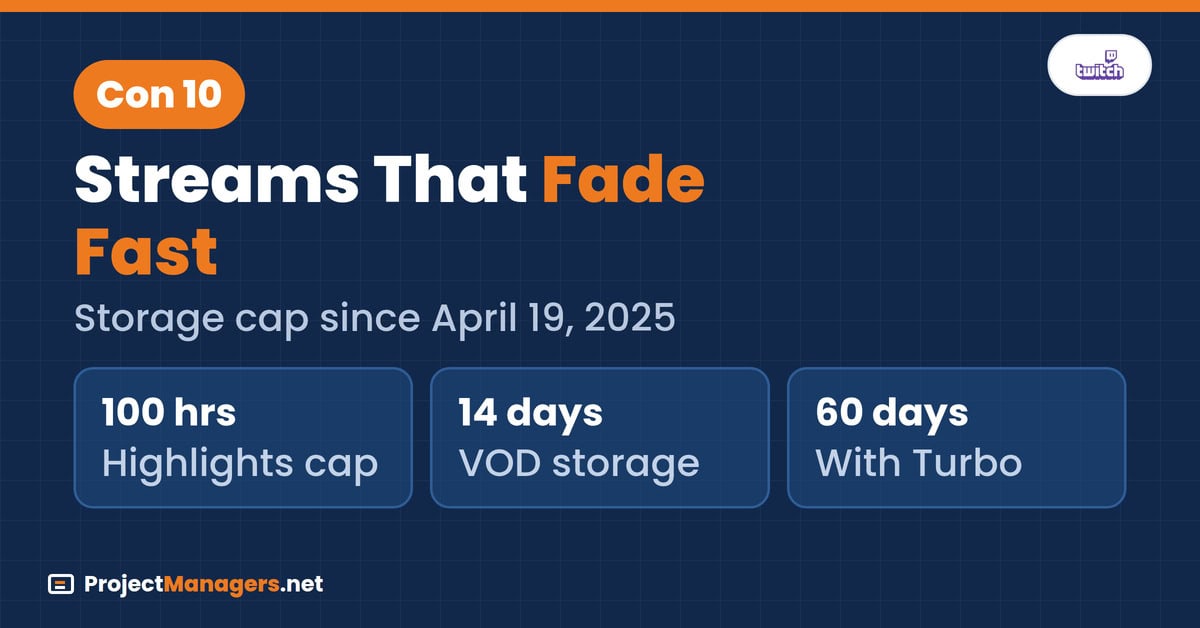
In 2025, Twitch went further and capped Highlights and Uploads at 100 hours per channel from April 19, saying they were costly to store and did not drive much discovery (TechCrunch). Its Turbo page notes that VODs usually disappear after 14 days, or 60 for Turbo streamers. Channels that relied on archives had to download or delete older content.
Why content is hard to find later:
- Short VOD Life: Past broadcasts expire after a set period unless saved as Highlights.
- Storage Cap: Highlights and Uploads share a 100-hour limit per channel since April 2025.
- Weak Search: Twitch VODs rarely rank in outside search, so new viewers seldom find them.
Illustrative Scenario: A project management educator streams weekly Q&A sessions and saves each one as a Highlight. After two years, the archive holds more than 100 hours, and the new cap forces a choice: delete older sessions or move them to YouTube, where viewers can actually find them. The move takes a full weekend of downloads and uploads.
Real-Life Example: In February 2025, Twitch announced that from April 19 it would limit each channel to 100 hours of Highlights and Uploads. It said the change affected fewer than 0.5% of active channels and less than 0.1% of hours watched, and pointed streamers to Clips and the mobile discovery feed instead (TechCrunch). Streamers had about two months to act.
What You Can Do: Export important streams to YouTube or another archive soon after they air, and edit them into searchable videos with clear titles. Use Clips and short vertical videos to feed Twitch’s mobile discovery feed and outside platforms. Review your Highlights storage each quarter so you never hit the 100-hour cap with content you still need.
Real-Life Example
Twitch Caps Highlights at 100 Hours
Twitch told streamers in February 2025 that Highlights and Uploads would be limited to 100 hours per channel from April 19. It said few channels were affected and that Clips and the mobile feed now drive more discovery than Highlights.
Source: TechCrunch
By the Numbers
- 100 hrs
of Highlights and Uploads allowed per channel from April 19, 2025
Source: TechCrunch
- 0.5%
of active channels affected by the storage cap, according to Twitch
Source: TechCrunch
- 14 days
typical VOD storage for streamers, or 60 days with Turbo
Source: Twitch
From Twitch
Twitch said Clips, tags, and the mobile discovery feed do more for discovery than Highlights, which is why it chose to cap them.
Twitch, as reported by TechCrunch, February 2025. TechCrunch
How Could These Disadvantages Be Overcome Globally?
Several of these cons need changes from Twitch, but streamers and teams can reduce most of the risk with habits they control. Whether you stream as a hobby, as a business, or as part of a company’s marketing plan, these steps make Twitch safer and more predictable:
- Build Discovery Off Twitch: Post clips and short videos on YouTube, TikTok, and Instagram so new viewers find you outside the directory.
- Diversify Income: Combine subs, ads, sponsors, and off-platform products, and budget on your weakest month.
- Lock Down Chat Early: Set AutoMod, verified chat, blocked terms, and trusted moderators before every stream.
- Use Licensed Audio Only: Stick to royalty-free or Twitch-cleared music and delete old clips that may contain copyrighted songs.
- Archive What Matters: Export important streams to YouTube or your own storage before VODs expire or the 100-hour cap bites.
- Track Policy Changes: Read Twitch’s guidelines and branded content updates monthly, and add policy clauses to sponsor deals.
- Protect Your Health: Set fixed days off, cap stream length, and treat streaming hours like any other workload.
Facts Worth Checking: Common Claims about Twitch
Streaming forums and how-to videos repeat many claims about Twitch that are out of date or only half true. The table below tests ten of them, one per con, against Twitch’s own pages and established news outlets. It shows which claims still hold up, so you can plan a channel or a branded stream on current facts rather than old forum advice.
Ten common Twitch claims, checked against Twitch’s own pages and news reports.
| Con | You May Hear | What the Data Says | Source |
|---|---|---|---|
| 1 | Anyone who streams consistently on Twitch will be discovered. | Not on its own. About 6.93 million channels went live each month in 2025, sharing roughly 2.17 million concurrent viewers. | TwitchTracker |
| 2 | Twitch streams look the same everywhere. | No. Twitch capped viewers in South Korea at 720p in 2022 and left the country in 2024 because of network costs. | PCGamesN, Twitch blog |
| 3 | Twitch’s content rules are stable. | Not always. Its artistic nudity policy lasted two days in December 2023 before it was withdrawn. | The Verge |
| 4 | Twitch streamers keep 70% of sub revenue. | Only at Plus Program Level 2 (300 Plus Points for three months). The default split is 50/50. | Twitch Help |
| 5 | Streamers can turn off all ads on their channel. | No. They can disable pre-rolls by running mid-roll breaks; viewers pay $11.99 a month for Turbo to remove ads. | Twitch Help, Twitch |
| 6 | Hate raids were solved in 2021. | No. Twitch added verified chat in 2021, but it still issued 55,963 sexual harassment enforcements in H2 2024. | TechCrunch, Twitch |
| 7 | Most Twitch streamers earn a full-time income. | No. Leaked 2021 data showed income concentrated at the top, with the top channel near $10 million in two years. | Business Insider |
| 8 | Old clips are safe from copyright claims. | No. The June 2020 DMCA wave targeted clips recorded between 2017 and 2019. | Plagiarism Today |
| 9 | Streaming is an easy, low-stress job. | Not for many full-timers. A streamer told the BBC that 60-hour weeks led to anxiety and isolation. | BBC News |
| 10 | Twitch keeps your streams forever. | No. VODs usually expire after 14 days, and Highlights and Uploads are capped at 100 hours. | TechCrunch, Twitch |
Checked November 2026. Twitch changes its programs often, so recheck each figure on its source page before you rely on it.
What Is Twitch?
Twitch is a live streaming platform owned by Amazon, which bought it in 2014. It began as a gaming spin-off of Justin.tv in 2011, and The Guardian has traced how it grew from game broadcasts into a home for music, talk shows, and creative streams. TwitchTracker counted about 2.17 million concurrent viewers on average in 2025.
Streamers earn through subscriptions, Bits, ads, and sponsorships, with revenue shares set by Twitch’s Plus Program. The platform is built around live chat, raids, and channel communities, and its mobile app now includes a discovery feed of clips and live previews. Twitch cut about 35% of its workforce in January 2024 as Amazon pushed it to reduce costs (IGN).
- Live Streaming: Broadcast games, creative work, talk shows, music, and events to a live audience with chat.
- Monetization: Earn from subscriptions, Bits, ads, and sponsorships as an Affiliate or Partner.
- Community Tools: Use raids, emotes, channel points, and moderators to build a community.
- Clips and Discovery Feed: Share short clips that surface in the mobile discovery feed and on other platforms.
- Safety Tools: Set AutoMod, verified chat, Shield Mode, and blocked terms to protect a stream.
Who uses Twitch, and which of the cons above matter most to each group:
- New Streamers: Hobbyists hoping to grow face the steepest discovery and revenue hurdles (see cons 1 and 4).
- Full-Time Creators: Professionals depend on stable rules and income and carry the burnout risk (see cons 5, 7, and 9).
- Brands and Sponsors: Companies run sponsored streams and must follow branded content rules (see cons 3 and 5).
- Game Studios: Developers stream launches and dev logs and need reliable hardware and moderation (see cons 2 and 6).
- Educators and Trainers: Teachers and trainers stream lessons that need to be found later (see con 10).
- Project Managers: Teams streaming launches, town halls, or events should plan for moderation, music rights, and archives (see cons 6, 8, and 10).
Learn More:
- Twitch on Wikipedia
- Twitch Plus Program (Twitch Help)
- Twitch H2 2024 Transparency Report
- Twitch Broadcasting Guidelines
Research on Twitch
Independent data on Twitch is scattered across trackers, reports, and news investigations. These sources help you look past platform marketing and size up a category before you launch a channel. They also help when you brief a team on the risks of running live events and branded streams on Twitch:
- Twitch H2 2024 Transparency Report (Twitch Safety Center)
- Twitch Statistics and Charts (TwitchTracker)
- Twitch: Concerns over streamers’ mental health (BBC News, 2022)
- The multimillion-dollar payouts of Twitch’s top 100 streamers leaked (Business Insider, 2021)
- How did Twitch become as big as YouTube? (The Guardian, 2019)
Video: Is It Too Late to Start Streaming on Twitch?
Content Delta’s ten-minute video from January 2026 asks whether new streamers can still grow, which ties to cons 1 and 10. It covers crowded categories, why streaming alone rarely brings discovery, and how clips and outside platforms drive new viewers. Treat it as one creator’s view, not official Twitch guidance, and compare it with your own category data.
Is it Too Late to Start Streaming in 2026?, Content Delta on YouTube (January 2026, 10:33). Watch on YouTube
Twitch FAQs
Is Twitch Free to Use?
Yes. Watching and streaming on Twitch are free. Viewers can pay for channel subscriptions or for Turbo, which costs $11.99 a month in the US and removes most ads across the site.
How Much Do Twitch Streamers Earn from a Subscription?
By default, streamers keep 50% of subscription revenue. Through the Plus Program, the share rises to 60% at 100 Plus Points a month and 70% at 300 points, each held for three consecutive months.
How Many Viewers Do You Need to Become a Twitch Partner?
Twitch’s Partner Program requirements ask for an average of 75 viewers, along with a streaming history. Affiliate status comes earlier and lets smaller channels earn from subs, Bits, and ads.
Can You Play Music on Twitch?
Only music you have the rights to stream. Copyrighted songs can lead to DMCA strikes, and the June 2020 wave showed that even old clips can be targeted (Plagiarism Today). Use royalty-free or Twitch-cleared music.
How Long Does Twitch Keep past Broadcasts?
VODs usually expire after 14 days, or 60 days for streamers with Turbo. Highlights and Uploads are kept longer but share a 100-hour cap per channel since April 19, 2025 (TechCrunch).
How Does Twitch Deal with Hate Raids?
Twitch sued two alleged hate raiders in 2021 and added phone and email verified chat (TechCrunch). Streamers can also use AutoMod, blocked terms, Shield Mode, and moderators to protect chat.
Is Twitch Better Than YouTube for Streaming?
Twitch has the stronger live chat culture and community tools, while YouTube is better for being found later, because its videos rank in search for years. Many streamers go live on Twitch and post edited videos and clips to YouTube to get both.
Conclusion
Twitch’s biggest trade-off is reach. It offers the liveliest chat and community tools in streaming, but a new channel starts invisible among millions, keeps half its sub revenue, and loses most of its content within weeks. Streamers who can build an audience elsewhere first, through clips, YouTube, or an existing community, get the upside without waiting months in an empty directory.
For brands, educators, and project teams, Twitch works best as a live layer on top of a wider plan. Stream the launch, the event, or the Q&A on Twitch, then move the recording to YouTube or your own site before it expires. Add moderators, licensed music, and a policy check to the event plan, and Twitch’s risks become line items you can manage.
Suggested Articles:
- Top 10 Cons & Disadvantages of TikTok
- Top 10 Cons & Disadvantages of Facebook
- Top 10 Cons & Disadvantages of WhatsApp

Daniel Raymond, a project manager with over 20 years of experience, is the former CEO of a successful software company called Websystems. With a strong background in managing complex projects, he applied his expertise to develop AceProject and Bridge24, innovative project management tools designed to streamline processes and improve productivity. Throughout his career, Daniel has consistently demonstrated a commitment to excellence and a passion for empowering teams to achieve their goals.