
Every project runs on the same three currencies: time, budget, and people. When a schedule lives in scattered spreadsheets or a dozen chat threads, it’s easy for a single missed handoff to snowball into a blown deadline or a budget overrun. Teams need one shared source of truth that shows exactly who is doing what, by when, and how that work connects to everything else in the plan.
TeamGantt was built to solve that problem with a browser-based Gantt chart at its center, paired with board, calendar, and list views so every team member can work the way they prefer. Before diving into the details, it’s worth noting that if your budget is tight or you mainly need lightweight task and expense tracking alongside your schedule, AceProject is worth a look as a complementary tool; its pricing isn’t per-user, which can make it a cost-effective way to track internal tasks and budgets without adding to your TeamGantt seat count.
In this article, we’ll walk through what TeamGantt is, its pros and cons, key features, common use cases, and current pricing so you can decide whether it’s the right fit for your team.
TeamGantt – Online Gantt Chart Software for Project Teams
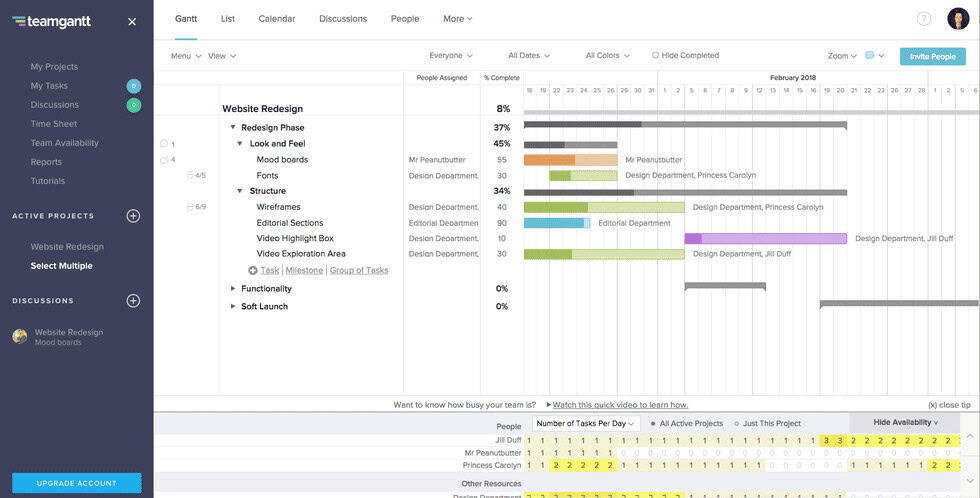
TeamGantt is web-based project scheduling software built around a drag-and-drop Gantt chart. It combines timeline planning with task management, file sharing, time tracking, and team communication in a single platform. Designed for teams of all sizes, it gives project managers a centralized workspace to plan, assign, and monitor work, so there is no need to stitch together separate tools for scheduling and collaboration.
The software is used by more than 2,000,000 people and is trusted by over 20,000 companies, including well-known names like Amazon, Netflix, and Nike. TeamGantt also offers a dedicated Builder Edition tailored to construction teams, with industry-specific tools like lookahead scheduling and Procore integration layered on top of its core scheduling features.
The Pros or Advantages of TeamGantt
TeamGantt’s core strength is making schedule-driven work visual, intuitive, and easy to update for teams of all sizes. It simplifies project planning by combining timelines, task management, and collaboration tools in one place. Whether you are managing a small team or a large organization, TeamGantt provides a clear, centralized workspace where everyone can track progress, assign tasks, and stay aligned on deadlines.
Below are some of the key benefits of using TeamGantt:
- Drag-and-Drop Scheduling: Many users report that building and adjusting a timeline in TeamGantt feels closer to editing a spreadsheet than learning new software. You can move a task and its dependencies, and the schedule realigns automatically when a deadline shifts.
- Four Synced Views: Teams say having Gantt, board, calendar, and list views of the same data lets each person work the way they think, without maintaining separate boards for planners and hands-on doers on the team.
- Project-Based Pricing: Because TeamGantt charges by project rather than by seat on Business and Builder Edition plans, users say it’s easier to add clients or subcontractors without worrying about extra per-user costs on your bill.
- Resource and Workload Visibility: Managers frequently mention that seeing every team member’s workload across active projects helps them catch overbooking before it becomes a problem, letting you rebalance assignments in a few clicks instead of emailing around.
- Construction-Specific Tools: Builder Edition users highlight features like lookahead scheduling, material lead-time tracking, and Procore sync as genuinely built for their trade rather than added on, a level of niche depth many say general-purpose tools lack.
- Field-Friendly Schedule Confirmation: Subcontractors and field crews can confirm schedule changes without creating an account, which users report cuts down on missed updates and phone tag with the office while keeping everyone aligned on the same live plan.
- Solid Integration Options: Users appreciate that TeamGantt connects to tools like Slack, Dropbox, and Zapier, with an open API available for custom connections, so it usually fits into an existing workflow rather than replacing everything you already use.
- Mobile Access With No Install Required: Since TeamGantt is entirely browser-based with dedicated iOS and Android apps, users say they can check or update a schedule from a job site or between meetings, getting the same live data anywhere.
The Cons or Disadvantages of TeamGantt

No project management tool is perfect for every team, and TeamGantt is no exception. While it offers strong visual planning and ease of use, certain limitations around pricing, automation, and scalability may not suit all workflows. Understanding these drawbacks upfront helps teams make a more informed decision before committing to a paid plan.
These are the trade-offs worth weighing before you commit to a plan:
- Free Plan is Very Limited: The Free Personal plan caps out at one project, one manager, and 40 tasks with no paid collaborators included, so users testing TeamGantt this way often outgrow it within their first real project.
- Costs Scale With Project Volume: Because pricing is tied to the number of active projects rather than a flat team rate, users managing many small projects at once say the per-project add-on fees add up faster than expected.
- No Built-In Automation Engine: Some users note that TeamGantt lacks native if/then automation rules for auto-assigning tasks or routing approvals, which broader all-in-one platforms offer out of the box, so you’ll likely need Zapier or the API instead.
- Reporting Can Feel Basic for Larger Portfolios: Compared to dedicated portfolio or BI tools, users managing many concurrent projects sometimes describe TeamGantt’s native reporting as adequate rather than deep, meaning teams with heavy analytics needs may still export data elsewhere.
- Advanced Features are Tier-Gated: Capabilities like critical path analysis, baselines, and portfolio dashboards only unlock on Business or higher, so users on the Basic plan report feeling limited to core scheduling until they map must-have features to a plan.
- Narrower Integration Library Than All-In-One Suites: While Zapier and the API cover a lot of ground, some users compare TeamGantt’s native integration list unfavorably to larger all-in-one platforms, so heavily tool-stacked teams should confirm their specific apps are supported first.
- Learning Curve for Construction-Specific Tools: New Builder Edition users sometimes say the construction-specific features, including lookahead planning, cost-loaded scheduling, and Procore sync, take real ramp-up time to configure correctly, though personalized onboarding helps shorten that adjustment period.
- Collaborator Caps on Entry Tiers: Even paid entry-level access on the Basic plan tops out at 10 collaborators, which users running larger crews or client rosters say they hit sooner than expected, usually forcing an upgrade to Business.
TeamGantt Key Features
Beyond the core Gantt chart, TeamGantt includes a range of features designed to support scheduling, collaboration, and project visibility across teams of all sizes. These tools cover everything from drag-and-drop timeline planning and workload management to real-time synced views. On higher tiers, the platform also unlocks construction-specific workflows built around real job-site needs.
- Drag-and-Drop Gantt Charts: Build and rearrange project timelines visually on a Gantt chart, with dependencies and milestones that update automatically whenever dates shift, so your whole schedule stays accurate without manually recalculating every connected task by hand.
- AI Gantt Chart Maker: This lets you describe your project in plain language or paste in a work breakdown structure and instantly generates an interactive timeline complete with tasks, milestones, and dependencies. From there, you can drag and drop to adjust dates as plans evolve, assign resources, and refine the schedule in real time. The tool is designed so teams can go from blank page to a working project schedule in just minutes, with no training required.
- Multiple Project Views: Switch between Gantt, board, calendar, and list views of the same live project data, all synced in real time, so every team member can work in the format that fits how they think and plan.
- Critical Path and Baselines: Compare planned versus actual progress at any point in a project, and see exactly which tasks drive your completion date, so you can prioritize the work that matters most when timelines get tight.
- Workload and Resource Management: View team capacity across every active project in one place, helping you prevent double-booking and burnout before it happens, so you can reassign tasks confidently instead of guessing who actually has room to help.
- Cost-Loaded Scheduling and Forecasting: Attach budgets directly to individual tasks so you can forecast cash flow straight from your live schedule, giving you a clearer, more current picture of project costs than a spreadsheet updated once a month.
- Construction-Specific Tools: Lookahead scheduling, material lead-time tracking, Procore sync, and RACI charts support trade-specific workflows in Builder Edition, giving construction teams tools built around real job-site constraints instead of generic project management assumptions that don’t quite fit.
- Integrations and API: Connect TeamGantt to tools you already use, including Slack, Dropbox, Trello, and Zapier, or build custom connections with the open API, so schedule updates flow automatically into the rest of your team’s software stack.
- Mobile Apps: Manage and update projects from dedicated iOS or Android apps in addition to full browser access, so field teams, traveling managers, and remote collaborators can check or adjust the schedule from wherever they happen to be.
TeamGantt Use Cases
TeamGantt is used across a range of industries, from construction and marketing to software development and event planning. Its flexible scheduling tools, multiple project views, and real-time collaboration features make it a strong fit for teams of all sizes. Whether you are managing field crews, launching campaigns, or coordinating vendors, TeamGantt adapts to how your team works.
Common use cases include:
- Construction: Keeps field crews and office teams aligned on one live schedule instead of scattered paperwork, reducing costly delays that come from missed updates, conflicting timelines, and communication gaps between the job site and the office.
- Marketing: Helps marketing teams plan, manage, and launch campaigns on time and within budget across multiple channels, giving stakeholders a clear, shared view of what’s shipping when instead of relying on separate spreadsheets and status emails.
- Agencies and Consultants: Supports delivering client projects on schedule without burning out billable team members, since a shared live timeline makes it easier to spot scope creep early and communicate realistic deadlines to clients before problems escalate.
- Product and Software Teams: Used for building roadmaps, managing sprints, and tracking development deadlines, giving engineering and product managers one visual source of truth that stays synced across planning, board, and calendar views throughout the entire release cycle.
- Manufacturing: Streamlines production scheduling, resource allocation, and delivery timelines at scale, helping manufacturing teams coordinate procurement, staffing, and shipping dates on one shared timeline instead of juggling disconnected spreadsheets across different departments and shift schedules.
- Event Planning: Keeps vendors, logistics, and timelines synchronized from initial planning through event day, so planners can track catering, venue, and staffing deadlines in one place instead of coordinating dozens of separate vendor emails and phone calls.
TeamGantt Pricing
TeamGantt offers five pricing tiers: a limited Free plan, three self-serve paid plans billed by project rather than by seat, and a custom Enterprise plan. Annual billing saves roughly 20% compared to paying monthly. Figures below reflect TeamGantt’s published pricing as of mid-2026.
| Plan | Monthly | Annual | Limits | Best For |
|---|---|---|---|---|
| Free (Personal) | $0 | $0 | 1 manager, 1 project, 40 tasks, no paid collaborators | Solo users testing the platform on a single small project |
| Basic | $24 (2 projects) | $240 (2 projects) | 1 manager, up to 10 collaborators, 150 tasks/project, 5-project cap | Small teams that just need straightforward tracking |
| Business | $120 (5 projects) | $1,140 (5 projects) | Unlimited managers & collaborators, 500 tasks/project, 20-project cap | Busier teams that need workload, critical path & portfolio views |
| Builder Edition | $199 (10 projects) | $1,908 (10 projects) | Unlimited managers, collaborators & tasks | Construction pros needing lookahead scheduling & Procore sync |
| Enterprise | Custom | Custom | Unlimited projects & tasks, advanced reporting/forecasting | Large organizations with complex, multi-department portfolios |
Add-ons and overage fees, billed separately from the base plan:
- Extra Projects On Basic: Additional projects beyond the two included in the Basic plan cost $12 per month or $120 per year each, so teams juggling many small projects should factor this recurring add-on fee into their total budget.
- Extra Projects On Business: Additional projects beyond the five included in the Business plan cost $24 per month or $228 per year each, making it worth consolidating related work into fewer, larger projects wherever that’s practical for your team.
- Enterprise Scaling: Custom project, task, and seat volumes for the Enterprise plan are quoted directly by TeamGantt’s sales team, so large organizations with complex, multi-department portfolios should expect a tailored conversation rather than fixed, published pricing.
Conclusion
TeamGantt earns its popularity with an intuitive, visual approach to scheduling and a pricing model that rewards teams who want to add collaborators without paying per seat. Its drag-and-drop simplicity, synced views, and construction-specific Builder Edition make it a strong fit for schedule-driven teams in construction, marketing, agencies, and product development. That said, the free plan is limited, costs can climb as your project count grows, and some advanced reporting and automation capabilities lag behind larger all-in-one platforms.
Weighing these trade-offs against your team’s size, budget, and feature needs is the best way to know whether TeamGantt or a complementary tool like AceProject is the right choice. The best way to find out is to try it yourself: start a free trial, map your team’s must-have features to a plan, and evaluate whether TeamGantt’s approach to scheduling fits the way your team actually works.
Suggested articles:
- TeamGantt Pricing Plans & Costs Guide
- Top 25 Best Project Management Software in 2026
- Top 10 Cons & Disadvantages of Using Gantt Charts

Peter Kanai is a Google-certified freelance writer with over a decade of experience crafting high-quality content for business websites, blogs, and SEO & email marketing campaigns. His on-demand writing services are all about helping businesses expand their online presence and achieve their objectives. With a proven track record in delivering results-driven content, Peter is the go-to freelance writer for business owners seeking a strategic partner to help them grow their brand online.