
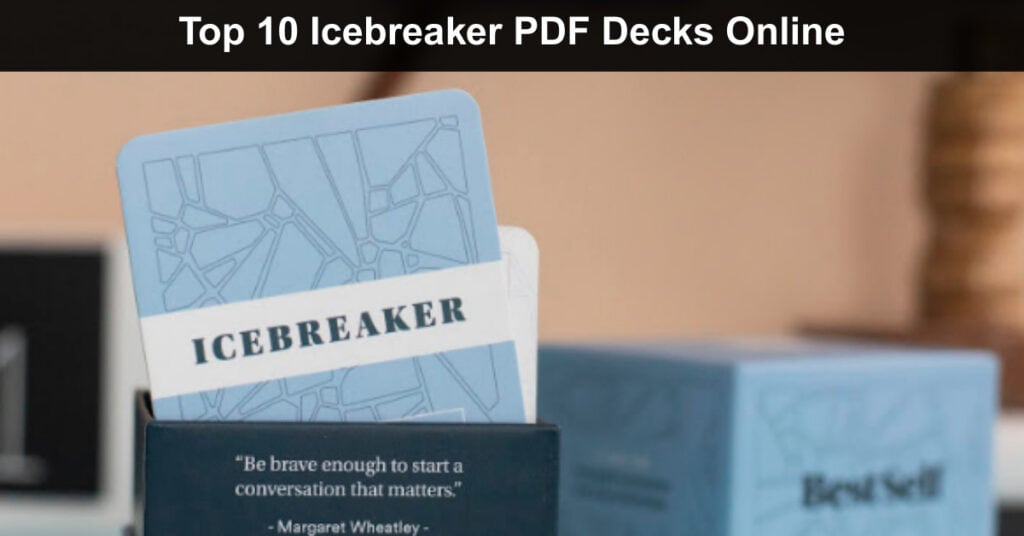
Breaking the ice in team meetings doesn’t have to be awkward or forced. Whether you’re leading a virtual standup, kicking off a workshop, or energizing a tired Tuesday afternoon session, the right icebreaker can transform disengaged participants into active contributors. The secret lies in asking calibrated questions that spark genuine conversation rather than obligatory responses. I’ve curated the top 10 free icebreaker PDF decks available online, each packed with thoughtful prompts designed to build emotional connections and meaningful dialogue.
These resources range from comprehensive activity guides to simple question lists, giving you flexible options for any meeting size or format. Ready to turn your next meeting from mundane to memorable? Let’s dive into these game-changing icebreaker collections.
Why I Use Icebreakers for Team Meetings?
My workday involves numerous meetings, and I must admit that I’m not fully engaged in many of them. Most team members find extensive meeting schedules burdensome and often attend only out of obligation or managerial pressure. Like many professionals, I find myself multitasking during meetings—addressing other work responsibilities that also require completion.
While meetings serve a necessary purpose, their value varies considerably. Some prove productive and engaging, while others fall short of these standards. Recurring meetings present particular challenges. Regular check-ins, daily scrums, and estimation sessions can become monotonous and fail to maintain participant engagement. This is why I’ve found icebreaker decks to be such a valuable tool.
Engage in Meaningful Conversations
Fostering genuine engagement in meetings requires deliberate effort. When participants merely go through the motions rather than actively contributing, meetings become unproductive. To prevent this, I strategically incorporate icebreakers when appropriate. Effective icebreakers engage participants from the outset. However, it’s crucial to distinguish between purposeful and pointless icebreakers.
Pointless icebreakers typically involve round-robin questioning where participants answer awkward questions superficially. In these scenarios, attendees focus solely on completing their turn rather than actively listening to others. Instead, effective icebreakers should initiate authentic conversations that foster emotional connections between team members.
Insights from Negotiation Expert Chris Voss
Drawing from the work of former FBI hostage negotiator Chris Voss, we can apply proven negotiation techniques to improve team engagement. Voss introduced the concept of uncovering “black swans”—unexpected, game-changing information—through calibrated questions. According to Voss, “Calibrated questions avoid verbs or words like ‘can,’ ‘is,’ ‘are,’ ‘do,’ or ‘does.’ These are closed-ended questions that can be answered with a simple ‘yes’ or a ‘no.'”
Instead, he recommends framing questions with “what” or “how.” These two words can transform virtually any question into an open-ended dialogue. For example, ‘Does this look like something you would like?’ becomes ‘How does this look to you?’ or ‘What about this works for you?'” While team meetings differ from high-stakes negotiations, we can leverage these same communication principles to foster deeper participant engagement and more meaningful discussions.
My Most Memorable Team Session
We were mid-sprint during our regularly scheduled estimation session on a Tuesday afternoon. The 3 p.m. time slot proved challenging for engagement, falling in that lull between lunch and end-of-day preparations. Seven team members gathered in a compact meeting room equipped with only one table and four chairs, necessitating that we bring in additional desk chairs. The session’s focus on estimation presented an additional challenge.
Estimation sessions are often viewed by developers as a necessary administrative task rather than a valued activity. Under these circumstances, creating an engaging atmosphere would be difficult even under optimal conditions. The team had been collaborating intensively on the project for eight months. While we had organized one or two team social events, these hadn’t achieved universal engagement, as they didn’t align with everyone’s preferences and interests.
From an interpersonal perspective, our interactions typically remained at a cordial but surface level—conversations rarely extended beyond the customary “How was your weekend?” This appeared to be acceptable to everyone. We maintained a professional working relationship characterized by mutual support and a commitment to helping one another. Compared to others, our team communication was notably effective.
From Norming to Performing
Our team dynamics were strong, and we were progressing steadily through the Tuckman model of team development. Given our diverse backgrounds—an Irishman, an African, an Indian, a New Zealander, and several Australians—we had successfully bridged our different interests and cultural perspectives. At that point, I would have characterized the team as being in the norming stage. However, I now believe this particular meeting played a pivotal role in advancing us to the performing stage.
During an estimation session, our Agile Coach decided to introduce variety by incorporating a brief icebreaker. After some initial skepticism—”We already know each other”—the team welcomed the opportunity to postpone estimation for a few minutes. The exercise was straightforward: each person simply needed to answer one question:
What Did You Have for Lunch?
This calibrated question required minimal thought. As we went around the room, the initial responses were fairly conventional. The dynamic shifted, however, when we began asking follow-up questions about each person’s answer. When Bart mentioned eating leftovers, we asked what they were.
- “Indian chickpea curry that I made myself,” he replied. We discovered he was a vegetarian and prepared all his own meals.
- When Mark said he’d had a sandwich, we naturally asked about the filling. He said it was vinegar, cheese, and crisps.
Additionally, he elaborated on the preparation process and how frequently he made this particular sandwich. This proved to be a breakthrough moment in team engagement. We spent the following five minutes in an animated discussion about sandwiches, specifically debating the appeal of this unique vinegar, cheese, and crisp combination.
It was the most enthusiasm and genuine passion I had observed from Mark during our eight months of collaboration. That moment remains memorable for me, and I believe it represented a pivotal point in our team’s development. It effectively dissolved an invisible barrier that had previously existed, enabling team members to forge authentic connections that extended beyond our daily work.
A Tool to Start Meaningful Conversations

This experience inspired me to invest in a professionally designed icebreaker deck of cards featuring carefully crafted, calibrated questions. I now implement these strategic conversation starters at the beginning of each meeting to replicate that breakthrough moment we experienced. The deck serves as a reliable tool for breaking down barriers and fostering genuine connections among team members, transforming routine meetings into opportunities for authentic engagement and relationship building.
Top 10 Free Icebreaker PDF Decks Available Online
There are some great free resources out there that you can download and start using straight away:
- Icebreakers & Team Builders PDF by maryville.edu/ this is one of the most comprehensive on the web.
- Ultimate Icebreaker Games PDF – A unique set of icebreakers with great names.
- Team Leaders Icebreaker Activities PDF by Seton Hall University is an epic list of icebreakers.
- QuizShow Ice breakers PDF – 40 ice breakers from training-games.com.
- A Collection of Icebreaker and Connection Activities, a book by Julie A. Pack.
- 200 Icebreaker Questions PDF by ConversationWorld, a simple list with no messing about.
- 40 Icebreakers for Small Groups, an ebook by Grahame Knox.
- A Collection of Icebreakers and Connection Activities – the jury is out on this one.
- Icebreaker Teambuilding PDF – outlines a great process for setting the scene.
- Creative Icebreakers & Introductions – really good for teachers, trainers, and facilitators.
Further Reading about Icebreakers
Move Beyond Small Talk: Transform Your Team Interactions
Unlock endless conversational possibilities with 150 carefully curated card prompts strategically divided between six distinct categories designed to foster genuine connection and meaningful dialogue. You’ll love the Icebreaker Deck. Packed with thought-provoking conversation starters that encourage vulnerability, creativity, and authentic self-expression, this tool makes boring, surface-level chatter a thing of the past.
Each card is designed using calibrated questioning techniques, the same principles used by professional negotiators, to spark organic conversations that reveal the unique personalities, experiences, and perspectives within your team. Whether you’re facilitating a morning standup, energizing a virtual meeting, or building rapport with a newly formed team, these prompts move beyond predictable “getting to know you” questions.
Instead, they invite participants to share stories, reflect on meaningful experiences, and discover unexpected common ground with their colleagues. The result? Teams that communicate more openly, collaborate more effectively, and build the emotional connections that transform good teams into great ones.
Frequently Asked Questions (FAQs)
What are icebreaker PDF decks and how do they work?
Icebreaker PDF decks are downloadable collections of conversation prompts and activities designed to facilitate meaningful team interactions. They contain calibrated questions that encourage open-ended responses rather than simple yes/no answers, helping teams move beyond surface-level small talk to build genuine connections and engagement during meetings.
Why should I use icebreakers in regular team meetings?
Regular meetings often become monotonous, causing participants to disengage and multitask. Icebreakers combat meeting fatigue by creating authentic conversations that foster emotional connections between team members. Strategic use of well-designed icebreakers transforms obligatory attendance into active participation, making recurring meetings more productive and valuable for everyone involved.
What makes a good icebreaker question effective?
Effective icebreaker questions use calibrated questioning techniques, starting with “what” or “how” rather than closed-ended words like “can,” “is,” or “do.” These open-ended prompts encourage storytelling and meaningful reflection, revealing unexpected insights about team members. The best questions spark organic follow-up conversations rather than formulaic round-robin responses.
How can icebreakers help move teams from norming to performing?
Icebreakers dissolve invisible barriers between team members, enabling progression through Tuckman’s team development stages. By facilitating authentic conversations about personal experiences and interests, these activities help teams develop deeper interpersonal connections. This emotional foundation enables more effective collaboration, open communication, and the trust necessary for high-performing teams.
Which free icebreaker PDF deck should I download first?
For comprehensive options, start with Maryville University’s “Icebreakers & Team Builders PDF” or Seton Hall’s extensive activity list. If you prefer simplicity, ConversationWorld’s “200 Icebreaker Questions” provides straightforward prompts without additional complexity. Choose based on your meeting format, team size, and whether you need structured activities or simple conversation starters.
Suggested articles:
- 25 Icebreakers for Introverts & 7 Ways to Avoid Zoom Fatigue
- 6 Creative Team Bonding Activities Boosted by Technology
- 12 Agile Collaboration Games for Team Building

Shane Drumm, holding certifications in PMP®, PMI-ACP®, CSM, and LPM, is the author behind numerous articles featured here. Hailing from County Cork, Ireland, his expertise lies in implementing Agile methodologies with geographically dispersed teams for software development projects. In his leisure, he dedicates time to web development and Ironman triathlon training. Find out more about Shane on shanedrumm.com and please reach out and connect with Shane on LinkedIn.