
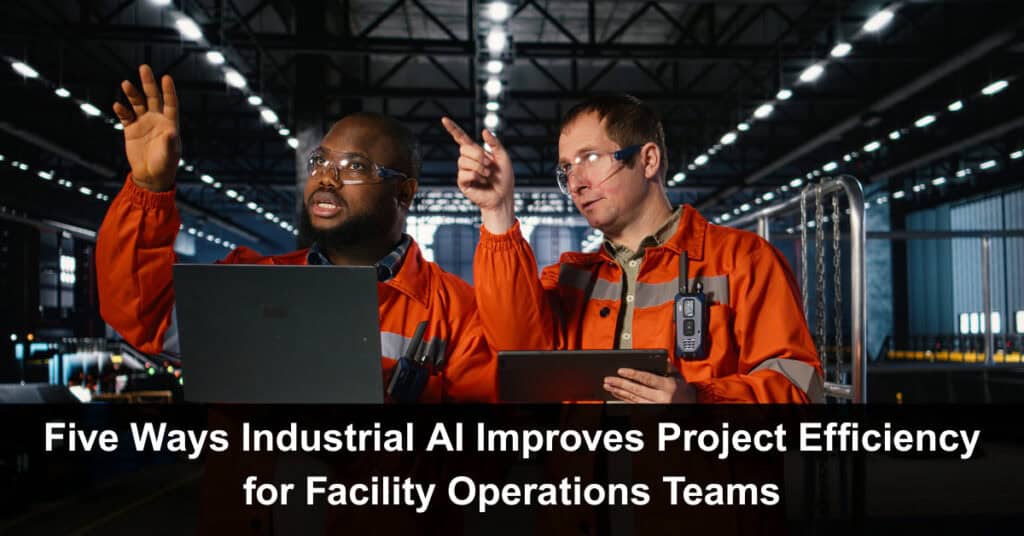
Managing projects across industrial facilities presents a set of challenges that standard project management frameworks do not fully account for. Facility upgrades, energy optimization initiatives, equipment modernization programs, and compliance projects all operate under constraints that are specific to industrial environments: aging equipment that behaves unpredictably, control systems from multiple vendors that do not communicate with each other, operational staff stretched across too many responsibilities, and the non-negotiable requirement that production continues uninterrupted throughout any improvement effort.
Project managers in these environments spend a disproportionate amount of time gathering baseline data, coordinating between siloed systems, and reacting to problems that were invisible until they escalated. The information needed to plan effectively, allocate resources accurately, and track progress against meaningful benchmarks is often scattered across disconnected platforms or locked inside the institutional knowledge of a few experienced operators.
AI-driven platforms designed for industrial operations are changing this dynamic. Not by replacing project management discipline, but by providing the operational visibility and analytical capability that industrial projects have historically lacked. The following five applications represent the areas where the impact on project efficiency is most direct and most measurable.
1. Faster Baseline Assessment Through Continuous Monitoring
Every industrial improvement project begins with the same question: where do things stand today? Answering that question in a facility with dozens of equipment systems, multiple control platforms, and years of accumulated operational drift is rarely straightforward. Traditional baseline assessments require site visits, manual data collection, and weeks of analysis before a project team can define scope with confidence.
AI-enabled monitoring platforms compress this timeline by continuously analyzing operational data across equipment systems. Deloitte’s 2025 Smart Manufacturing and Operations Survey found that smart manufacturing technologies are delivering up to 20 percent productivity gains for organizations that invest in automation and AI, with a significant portion of that improvement attributable to better visibility into existing operations.
When a platform is already monitoring equipment performance, energy consumption patterns, and control system behavior, the baseline data a project manager needs is available on demand rather than requiring a dedicated assessment phase. For project managers, this translates directly to shorter planning cycles and more accurate scoping. A modernization project that would previously require four to six weeks of baseline study can move into planning within days when the monitoring infrastructure is already generating the data.
2. Predictive Issue Detection That Prevents Project Disruptions
Industrial projects are uniquely vulnerable to disruption from operational failures. A compressor fault during a controls upgrade can halt work and redirect the project team toward emergency response. An unexpected temperature excursion during a facility optimization rollout can consume days of schedule and erode stakeholder confidence in the initiative.
AI systems that analyze equipment behavior continuously can identify developing issues before they reach the threshold of a crisis. Pattern recognition across sensor data, historical performance curves, and cross-equipment correlations allows these platforms to flag anomalies that would not trigger conventional alarm systems. An operator might not notice that a condenser’s performance has degraded by eight percent over sixty days, but an AI monitoring system will identify the drift and alert the team before it compounds into a failure.
The project management benefit is schedule protection. When emerging equipment problems are surfaced early, project teams can address them proactively rather than reactively. Maintenance can be scheduled during planned windows rather than disrupting project work. The difference between a managed intervention and an unplanned shutdown is often the difference between a project that delivers on time and one that slips by weeks.
3. Energy Optimization That Funds Project Budgets
Energy costs in industrial facilities are frequently the second-largest operational expense, and they are also one of the most responsive to AI-driven optimization. Platforms that analyze consumption patterns, load profiles, and utility rate structures can identify savings opportunities that manual analysis misses, simply because the number of variables involved exceeds what a human operator can evaluate in real time.
The value of industrial AI in this context extends beyond the energy bill itself. When AI-driven optimization generates measurable, documented savings, those savings become a funding mechanism for the next round of improvement projects. A facility that demonstrates a 15 to 20 percent reduction in energy costs through intelligent control optimization has a quantifiable return that justifies continued investment in operational technology upgrades.
For project managers building business cases for facility improvements, this creates a compounding dynamic. Each phase of optimization produces savings that fund subsequent phases. The project portfolio becomes self-reinforcing rather than dependent on annual capital budget approvals for every initiative.
4. Portfolio-Level Visibility That Improves Resource Allocation
Organizations managing multiple industrial facilities face a resource allocation challenge that single-site project managers do not encounter. When each facility operates on different control systems with different data formats and different operational standards, comparing performance across sites requires manual aggregation that is slow, inconsistent, and often unreliable. Project managers tasked with prioritizing improvement initiatives across a portfolio of twenty, fifty, or several hundred facilities are effectively making decisions based on incomplete information.
McKinsey’s research on scaling AI in manufacturing operations confirms that the organizations achieving the greatest efficiency gains are those that scale AI beyond individual pilot projects to enterprise-wide deployment. The operational insight is that AI generates more value as the scope of its visibility expands. A platform that monitors one facility can optimize that facility. A platform that monitors fifty facilities can identify which ones would benefit most from the next round of investment, which operational patterns should be standardized across the portfolio, and where resources will produce the highest return.
This portfolio-level intelligence transforms project prioritization from a qualitative exercise into a data-driven one. Instead of relying on site managers’ self-reported assessments of where improvement is needed most, project leaders can allocate resources based on measured performance gaps, energy waste patterns, and equipment condition data that is consistent across every facility in the portfolio.
5. Governance and Change Management That Reduce Implementation Risk
The most common reason industrial improvement projects stall is not technical failure. It is organizational resistance. Operators who have managed their facilities successfully for years are understandably cautious about changes to control systems and operational procedures. Project teams that underestimate this dynamic routinely see initiatives slow to a crawl during the adoption phase, even when the technology works exactly as designed.
The ISA/IEC 62443 standards for industrial automation and control system security formalize this reality through their shared responsibility framework, which recognizes that people, processes, and technology all play essential roles in operating industrial control systems effectively. The standards do not treat human operators as peripheral to the control architecture. They position them as a critical component of it.
AI platforms that incorporate permissioned control, role-based access, and governed change management directly address this implementation risk. Rather than asking operators to trust a system that makes decisions without their input, these platforms allow organizations to define precisely which actions the system can take autonomously, which require human approval, and which are restricted to specific roles. The project team can roll out capabilities incrementally, building operator confidence at each stage before expanding the system’s scope of action.
For project managers, governance features translate to reduced adoption risk and more predictable implementation timelines. When the technology itself includes the change management controls that operators need to feel confident, the organizational barriers that typically slow industrial projects are addressed within the platform rather than through separate, often inconsistent, change management processes.
From Visibility to Execution
Each of these five applications shares a common thread: AI does not replace the project management function in industrial operations. It provides the operational intelligence that industrial project managers have historically lacked. Better baseline data leads to better scoping. Earlier issue detection leads to fewer disruptions. The energy savings fund continued investment. Portfolio visibility improves prioritization. Built-in governance reduces the adoption friction that stalls implementation.
The industrial facilities that will deliver the most efficient improvement projects over the next decade are those that treat AI not as a separate technology initiative, but as foundational infrastructure for how operational projects are planned, executed, and measured. The project management discipline remains essential. The quality of the data and visibility supporting it determines how effectively that discipline translates to results.
Suggested articles:
- From Startups to Tech Giants: How AI and ML Are Driving Business Growth
- 9 Strategies to Improve Manufacturing Productivity and Growth
- Operational Readiness For Mobile Teams: The ‘Field Kit’ Checklist That Prevents Expensive Surprises

Daniel Raymond, a project manager with over 20 years of experience, is the former CEO of a successful software company called Websystems. With a strong background in managing complex projects, he applied his expertise to develop AceProject.com and Bridge24.com, innovative project management tools designed to streamline processes and improve productivity. Throughout his career, Daniel has consistently demonstrated a commitment to excellence and a passion for empowering teams to achieve their goals.