
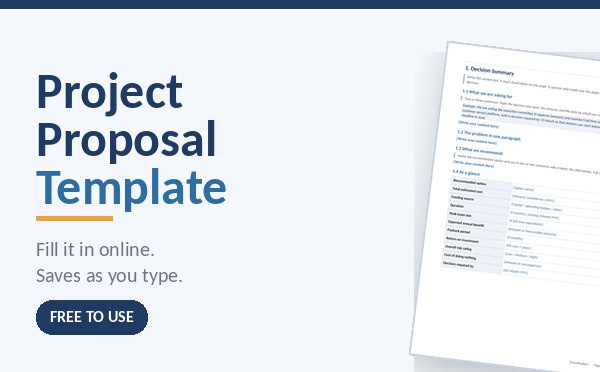
This Project Proposal Template is your first step towards launching a new initiative. It sets out the problem you are solving, the options you considered, what the work will cost, and what the organisation gets in return. Fill it in below, free, with no sign-up. Your answers save automatically as you type. See all 50+ PM Templates.
Loading the interactive form. If this message stays on screen, JavaScript is switched off or blocked in this browser.
Your answers are stored in this browser only and are not sent anywhere. Clearing your browsing data, or using a different device or a private window, will start a blank form.
What is inside the template
The proposal is built around the questions a sponsor actually asks, in the order they ask them:
- Decision summary. One page that stands alone, for the sponsor who reads nothing else.
- Background and evidence. The problem, the numbers behind it, and why now.
- Options considered. Including doing nothing, which is the baseline everything else is measured against.
- The proposed project. Vision, SMART objectives, scope, deliverables, delivery approach, milestones, dependencies, assumptions and constraints.
- Resources and cost. People, other costs, an estimate range, and a financial case with net benefit, return on investment, payback and net present value.
- Benefits and success measures. Each benefit with a baseline, a target, a measurement date and a named owner.
- Governance and stakeholders. Roles, decision rights and tolerances, stakeholder map, reporting cadence.
- Risks, issues and compliance. Scored risks, plus data privacy, security, artificial intelligence, sustainability and accessibility.
- Change and adoption. Who is affected, training, and transition to operations.
- Implications of not proceeding, and the approval block.
What is a project proposal?
A project proposal is a document that asks a sponsor for a decision: fund this work, or do not. It does that by showing there is a business problem or opportunity worth acting on, and that the project you are proposing is a credible way to act on it.
It has to do two jobs at once. It must persuade, because the sponsor has other places to put the same money. And it must inform, because a sponsor who approves something they did not understand will withdraw support the moment it gets difficult. A proposal that only does the first is a pitch. One that only does the second is a report. You need both.
What the sponsor is weighing is narrow. Is this problem real, and is it big enough to matter? Is the recommended option better than the alternatives, including doing nothing? Is the cost believable, and does the benefit outweigh it? And who is accountable when it goes wrong? A proposal that answers those four questions clearly gets approved. One that buries them in detail does not.
Proposal, business case, or charter?
These three documents are often confused, and writing the wrong one wastes weeks.
- The proposal comes first. It establishes that the problem is worth solving and that this project is the right response. It is a decision document.
- The business case follows approval. It sets out the financial justification in depth, with detailed costings and a full benefits model.
- The project charter comes after that. It defines scope, authority and governance in detail, and formally authorises the project manager to spend.
On smaller projects these are often merged into one document. On anything large or regulated, keep them separate. The proposal stays short enough that a sponsor will actually read it.
When to write one
Write the proposal at the initiation phase, before any delivery work begins. Its job is to secure formal approval from the sponsor or steering group, and to record what everyone agreed the project was for. Until that approval exists, the project has no mandate and no budget.
You need a proposal when:
- New work requires funding that has not already been allocated
- Several initiatives are competing for the same people or budget
- The work crosses departments and needs an owner nobody has named yet
- A regulatory deadline, contract expiry or system end of life forces a decision
- You are responding to a client or a tender and need to set out your approach
You probably do not need one for work already inside an approved programme, for routine operational changes, or for anything small enough that the approval would cost more than the work. Judgement applies. If you cannot name who is accountable for the outcome, write the proposal.
Approval is not the end of its usefulness. The proposal becomes the reference point for the rest of the project. When scope creeps six months in, when a benefit is questioned at closure, or when a new stakeholder arrives asking why this project exists, the proposal is the document everyone returns to. That is why the objectives, the success criteria and the benefit owners in it need real numbers and real names rather than good intentions.