
Most product launches are planned down to the day. The website goes live on a set date, the sales team has its talking points, and the support team knows what is coming. Then there is the press. Too often, PR is the one part of a launch run on hope, a press release sent the night before, and a few emails to whoever someone could find.
That is a missed opportunity. Coverage in the right publication can do more for a launch than weeks of ads. People trust it more, too. In Nielsen’s Global Trust in Advertising study, 66% of people said they trust editorial content such as newspaper articles, compared with 42% who trust online banner ads.
The fix is simple. Run your launch PR like any other project, with a scope, a plan, a clear deliverable at each stage, and a report at the end. This guide walks through it phase by phase, from building the media list to showing the results.
Key Takeaways
- Treat launch PR as a project with five phases: scope, plan, execute, monitor, and report.
- The media list is the most important deliverable. Pitching the right people beats pitching more people.
- In Media List’s study of 2,993 news outlets, 46.1% had exactly one reachable journalist, so one well-chosen contact per outlet is usually the goal.
- Schedule outreach around the busy hours. PR Gun’s analysis of 178,863 press releases found that 8 to 9 a.m. Eastern is the most crowded hour.
- Plan follow-ups from day one, and end with a short report that shows what the campaign achieved.
Why PR Needs a Project Plan
The odds are stacked against a last-minute pitch. The US Bureau of Labor Statistics counts about 314,500 public relations specialists and 47,100 reporters and correspondents, roughly 6.7 PR people for every reporter. In Cision’s 2026 State of the Media survey of 1,899 journalists, 72% said fewer than a quarter of the pitches they receive are relevant to them.
Yet journalists still depend on good pitches. In Muck Rack’s 2026 State of Journalism report, 86% of journalists said at least some of their stories began with a pitch, according to the survey’s public summary. The difference between being ignored and being covered is usually preparation, which is exactly what project management is good at.
Phase 1. Scope the Story
Every project starts with a clear goal. For launch PR, write one sentence that says what is new and who should care. “A scheduling app that cuts no-shows for small clinics” points you to health tech, small business, and local news. “A new feature for an existing product” may only be a story for trade press.
Then set a realistic SMART target. Five pieces of relevant coverage are a good result for most launches. Write down which outlets would matter most to your customers, not which ones are most famous.
Phase 2. Plan the Timeline and the Media List
The core deliverable of the planning phase is the media list, a short list of the journalists, editors, producers, and creators most likely to cover your story, with a working email for each. For one launch, 25 to 50 people is usually enough.
How newsrooms are staffed should shape that list. In Media List’s August 2026 study of 2,993 news outlets, 46.1% of outlets had exactly one reachable journalist, and the median outlet had two. Producers made up 23.5% of newsroom contacts, nearly as many as reporters at 31.5%. Two lessons follow. First, at most outlets your job is to find the one right person. Second, if TV or radio is on your list, pitch the producer who books the segment.
A simple four-week timeline keeps everyone on track.
| Week | Phase | Deliverable |
|---|---|---|
| 1 | Scope and plan | Story sentence, target outlets, first draft of the media list |
| 2 | Plan | Final media list with verified emails, pitch and follow-ups written |
| 3 | Execute | Pitches sent, interviews and demos booked |
| 4 | Monitor and report | Coverage tracked, follow-ups sent, results report shared |
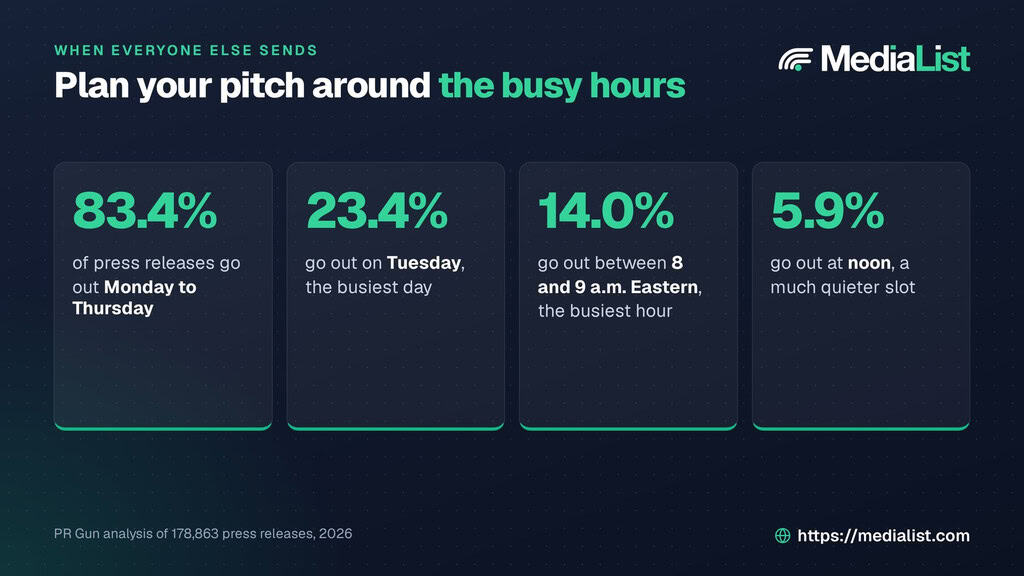
When press releases go out, from PR Gun’s 2026 analysis of 178,863 releases.
Phase 3. Execute the Outreach
Timing is part of the plan. PR Gun’s 2026 analysis of 178,863 press releases from nine distribution services found that 83.4% go out Monday through Thursday, with Tuesday the busiest day at 23.4%. The busiest hour is 8 to 9 a.m. Eastern, which carries 14.0% of all timed releases, while noon carries just 5.9%. Journalists say they prefer pitches before noon, so mid-morning, after the early rush, is a sensible slot.
Keep each pitch short and personal. In Muck Rack’s 2026 survey, 69% of journalists said they want pitches under 200 words, and 62% prefer a one-to-one email over a mass send. Mention one recent story the journalist wrote and explain in a sentence or two why your news fits their beat.
Video. How to pitch a journalist and actually get a reply.
Write the follow-ups at the same time as the pitch, so they are part of the plan rather than an afterthought. Two short follow-ups, a few days apart and in the same email thread, are usually enough.
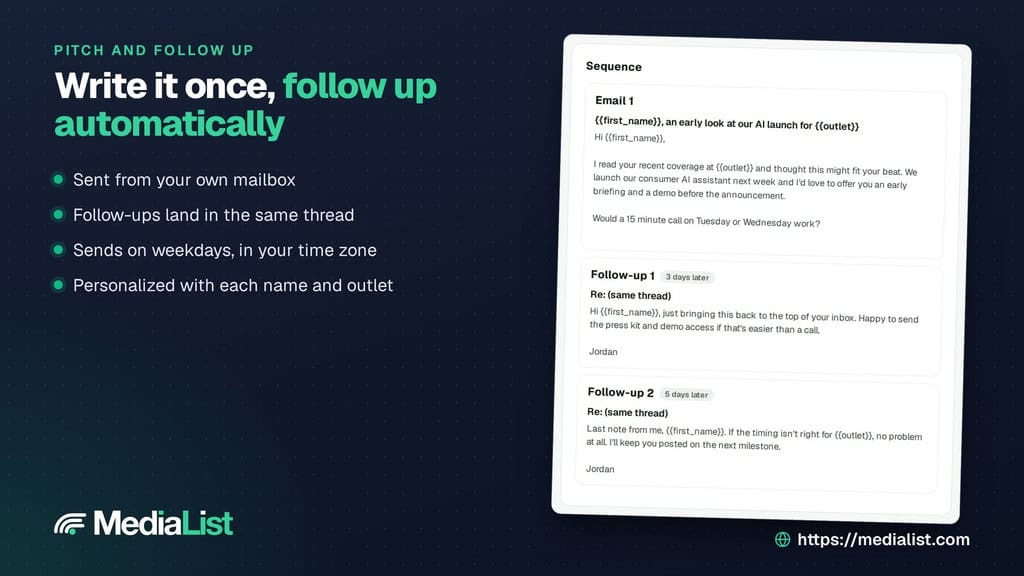
A pitch with two follow-ups in the same thread, set up once and sent on a schedule.
Tools can take the busywork out of this phase. Media List, for example, lets you search more than 1.5 million contacts, from journalists and TV producers to podcast hosts and YouTube creators, and save the results as a list. On its Professional plan, you can turn that list into a campaign that sends personalized pitches and follow-ups from your own mailbox, on weekdays and in your time zone.
Phase 4. Monitor Replies and Coverage
Track every reply, interview request, and published story in one place. A simple sheet with the contact, outlet, status, and link works well. Answer replies quickly, since a journalist on deadline will often move on within hours. When a story goes live, thank the writer and share it with your team and customers.
This is also the moment to adjust. If one beat is responding and another is silent, shift your remaining effort toward what is working.
Phase 5. Close With a Report
Every project ends with a post-mortem review, and PR should too. A short report answers the questions your team or client will ask: how many people were pitched, which outlets covered the story, and what you would change next time.
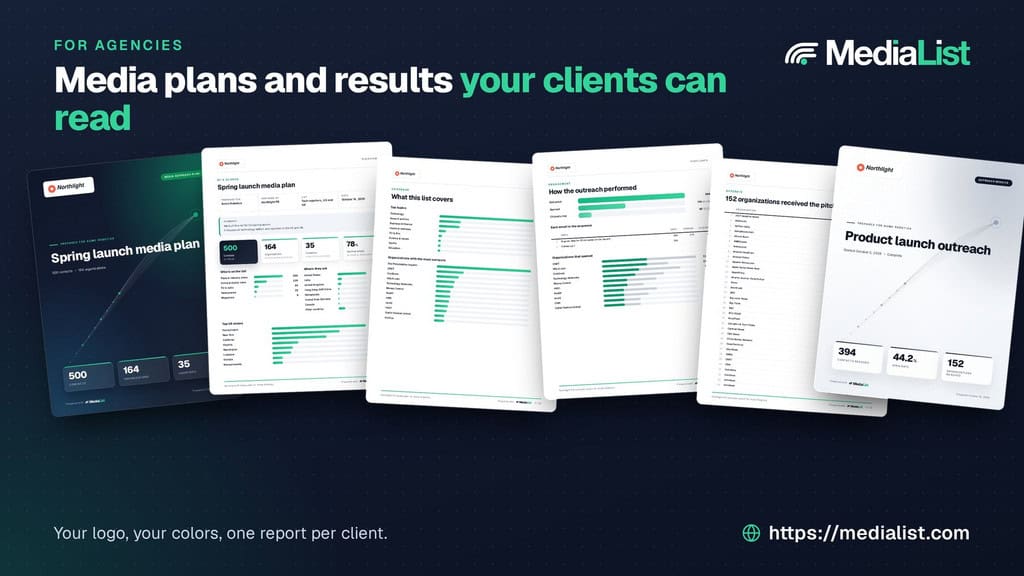
Sample media plan and results reports. The brand names shown are examples.
If you manage PR for clients, presentation matters as much as the numbers. Some tools now turn a saved list into a media plan and a finished campaign into a branded results report. Media List includes client reports on every plan, with full private label for up to three brands on Professional, so each client gets a report under its own logo.
Where to Start
If you take one thing from this guide, make it this. Give your launch PR a plan, a media list, and a report, just like every other part of the launch. I used Media List for the examples above because it covers journalists, producers, podcast hosts, and creators in one search, and it has a 3-day free trial, so you can plan your next launch before you spend anything.
Media List. Find journalists, TV producers, podcast hosts, and creators, build your media list, and send pitches with follow-ups. Plans start at $99 a month, with a 3-day free trial. Visit https://medialist.com to learn more.
Sources:
- Nielsen, Global Trust in Advertising
- Bureau of Labor Statistics, Occupational Outlook Handbook
- Cision, 2026 State of the Media
- Muck Rack, 2026 State of Journalism, public summary
- Media List newsroom study, August 2026, 2,993 outlets
- PR Gun analysis of 178,863 press releases, 2026
- Media List product and pricing pages, October 2026
Frequently Asked Questions
How long should a launch PR campaign take?
For most launches, four weeks is enough: one for scoping, one for planning the media list and pitch, one for outreach, and one for follow-up and reporting.
How many journalists should be on a launch media list?
Usually 25 to 50 well-chosen people. Since nearly half of all outlets have one journalist worth reaching, that can cover 30 or more outlets.
When is the best time to send a launch pitch?
Tuesday through Thursday, in the morning before noon, avoiding the crowded 8 to 9 a.m. Eastern hour.
How do I report PR results to a client?
Show who was pitched, who replied, which stories were published, and one lesson for next time. A branded report makes it easy to share.
Suggested articles:
- Project Managing Campaign Launches: Turning Creative Ideas into Executable Plans
- Integrating Email Deliverability Into Product Launch Project Plans
- 18 x Product Launch Plan Templates

Daniel Raymond, a project manager with over 20 years of experience, is the former CEO of a successful software company called Websystems. With a strong background in managing complex projects, he applied his expertise to develop AceProject.com and Bridge24.com, innovative project management tools designed to streamline processes and improve productivity. Throughout his career, Daniel has consistently demonstrated a commitment to excellence and a passion for empowering teams to achieve their goals.