
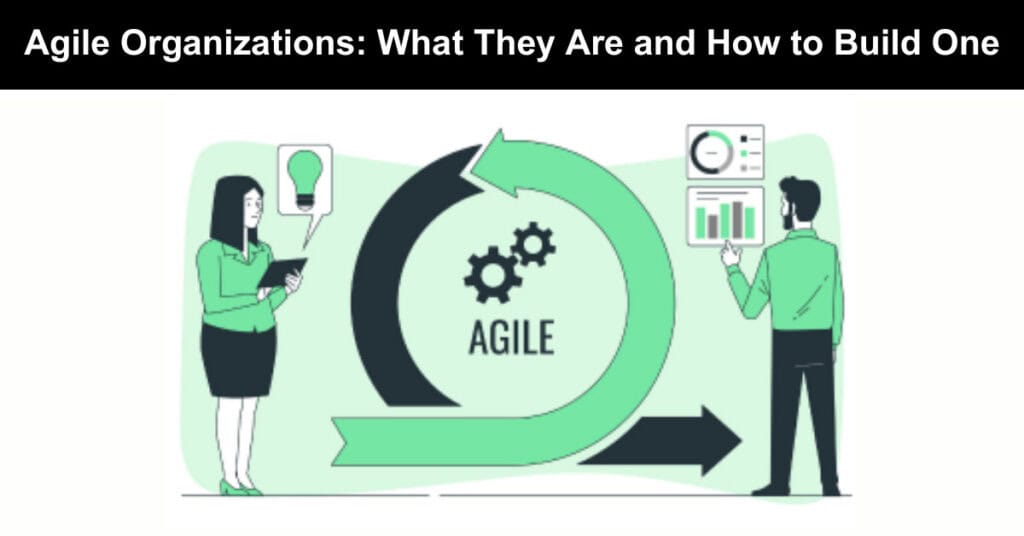
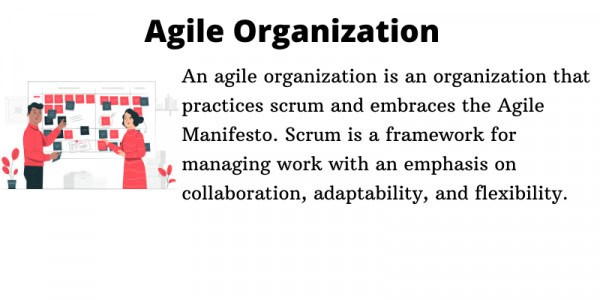
An agile organization embraces the principles of the Agile Manifesto and uses frameworks like Scrum to manage work with collaboration, adaptability, and flexibility at its core. Scrum teams are self-organized and cross-functional, typically consisting of around ten members. These teams operate through short, focused iterations called sprints, working from a prioritized backlog to deliver consistent value while remaining responsive to evolving priorities and changing business needs.
The term “agile” originates from software development, where iterative and incremental approaches replaced rigid, sequential methods. In practice, agile organizations apply these same principles across departments and functions. They adapt workflows quickly, respond to market shifts, and prioritize outcomes over rigid processes. This makes agility far more than a development methodology; it becomes a defining characteristic of how the entire organization operates and grows.
Agile Manifesto
The Agile Manifesto was first introduced in 2001 as a response to the limitations of traditional waterfall development methods. It established four core values that guide how teams prioritize decisions, structure collaboration, and respond to change. These values have since extended beyond software teams, influencing how forward-thinking organizations across industries approach planning, delivery, and customer engagement at every level of their operations.
When implementing agile principles, organizations must internalize these four foundational values:
- Individuals and Interactions: People and direct communication take priority over rigid processes and tool-driven workflows, enabling faster and more meaningful collaboration across teams.
- Working Solutions: Delivering functional, usable output is valued more than producing extensive documentation that does not directly serve the customer or the product.
- Customer Collaboration: Ongoing partnership with customers throughout the process is emphasized over fixed contract terms that limit flexibility and responsiveness.
- Responding to Change: Adapting to new information and shifting priorities is treated as more valuable than strictly following a predetermined plan.
Why Are Agile Organizations Important for the Future?
The business landscape is evolving faster than ever before, driven by technological advancement, shifting customer expectations, and global market unpredictability. Organizations that cannot adapt quickly risk falling behind competitors who are more nimble and responsive. Agility is no longer a competitive advantage reserved for startups. It has become a fundamental requirement for any organization that intends to remain relevant, innovative, and effective in an increasingly dynamic environment.
Agile organizations are built to absorb change rather than resist it. They restructure priorities, reallocate resources, and pivot strategies without losing momentum or organizational cohesion. This capacity to move quickly and decisively positions them to seize emerging opportunities before slower competitors can react. In industries where customer needs shift rapidly and technology disrupts established models, the ability to respond with speed and precision is one of the most valuable organizational capabilities a business can develop.
Benefits of Agile in an Organization
When applied consistently and with intention, agile practices help organizations achieve goals more efficiently, reduce waste, and improve team morale. The benefits extend beyond project delivery and touch every layer of the organization, from strategy and culture to daily operations. Companies that fully commit to agile ways of working often report stronger collaboration, faster innovation cycles, and a measurable improvement in the quality and relevance of their outputs.
Key benefits of adopting agile in an organization include:
- Increased Flexibility: Teams can adjust plans and priorities in response to new information, ensuring the organization remains aligned with real-world conditions rather than outdated assumptions.
- Improved Collaboration: Agile structures encourage frequent communication between team members and stakeholders, reducing silos and creating a more unified approach to problem-solving.
- Greater Customer Satisfaction: By involving customers in the development process and delivering value incrementally, organizations ensure their output consistently meets actual customer needs.
- Faster Delivery: Short sprint cycles allow teams to ship working solutions more frequently, reducing time to market and enabling continuous improvement based on real feedback.
- Higher Output Quality: Regular reviews, retrospectives, and iterative refinement help teams identify issues early and maintain a consistently high standard across all deliverables.
Traits of Agile Organizations
Agile organizations share a distinctive set of characteristics that separate them from traditionally structured businesses. These traits are not simply operational preferences but reflect a deeper cultural commitment to adaptability, transparency, and continuous improvement. Understanding what makes an organization truly agile helps leaders identify gaps in their current structure and build toward a model that can withstand and thrive under constant change and competitive pressure.
Here are some of the core trademarks of agile organizations:
- Short Development Cycles: Agile organizations release new iterations of products and services frequently, using each cycle to gather feedback, refine their approach, and deliver increasing value to customers.
- Close Team-Customer Communication: Ongoing communication between internal teams and customers ensures that priorities remain aligned with actual needs, reducing the risk of investing effort in the wrong direction.
- Flexible Change Adoption: Rather than treating change as a disruption, agile organizations treat it as valuable input. They adjust plans and processes willingly when new information warrants a different course of action.
How to Create an Agile Organization
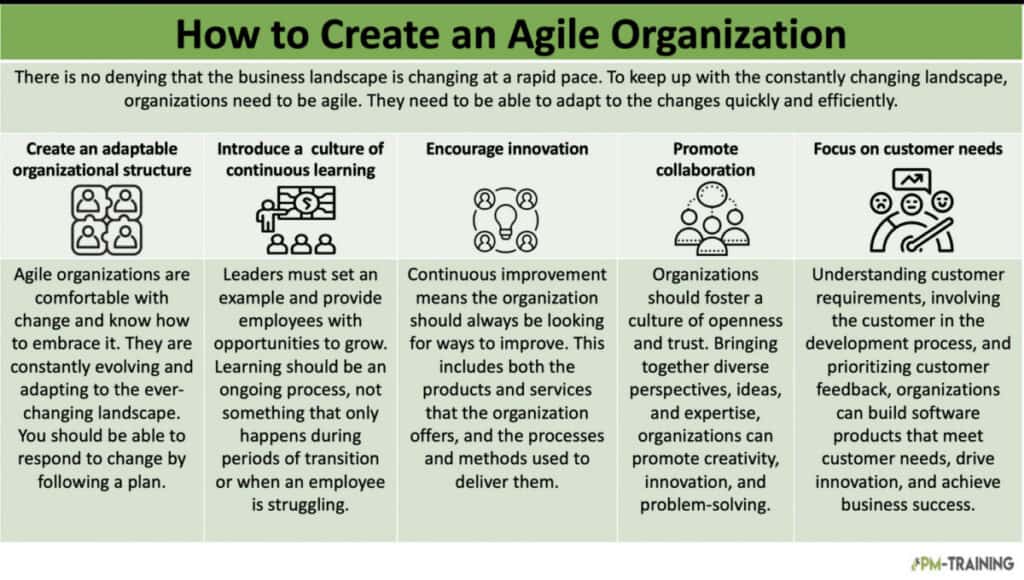
There is no single formula for building an agile organization, but a combination of structural, cultural, and operational practices can create the conditions for genuine agility to take root. Leaders must approach this transformation with patience and consistency, recognizing that agility is built over time through deliberate choices rather than a single initiative. The following five practices provide a practical foundation for organizations beginning or deepening their agile journey.
1. Create an Adaptable Organizational Structure
Building an adaptable structure means designing teams and reporting relationships that can flex in response to shifting priorities. Flat hierarchies, cross-functional teams, and decentralized decision-making all contribute to this flexibility. When the organizational structure supports rapid realignment, teams can redirect their efforts without waiting for approval chains that slow response times and reduce the organization’s overall capacity to act with speed and confidence.
2. Encourage a Culture of Continuous Learning
Leaders must model curiosity and create meaningful opportunities for employees to develop new skills and perspectives. Learning should be embedded into everyday workflows rather than treated as a periodic event. Organizations that invest in continuous learning build teams that are better equipped to handle complexity, adapt to new tools and methods, and contribute innovative thinking that drives long-term competitive advantage across every function of the business.
3. Encourage Experimentation and Innovation
Agile organizations create psychological safety for teams to test ideas, learn from failure, and iterate quickly. Experimentation should be structured but not restrictive, with clear mechanisms for capturing insights and applying them to future efforts. When employees know that calculated risks are welcomed rather than penalized, they are more likely to propose creative solutions that push the organization forward and differentiate it meaningfully from competitors in the market.
4. Promote Communication and Collaboration
Transparency is a cornerstone of agile culture. Information should flow freely across teams, enabling better decisions, stronger alignment, and faster resolution of obstacles. Organizations that invest in open communication channels, regular stand-ups, and shared visibility into progress find that teams are more cohesive and less likely to duplicate work or operate in isolation. Collaboration tools and intentional meeting cadences reinforce these habits at scale.
5. Focus on Customer Needs
Every agile practice ultimately serves the goal of delivering genuine value to the customer. Organizations must build feedback loops that keep customer input at the center of planning and prioritization. This means going beyond periodic surveys and embedding customer perspectives into sprint reviews, product decisions, and strategic discussions. A sustained focus on customer needs ensures that the organization’s energy is always directed toward outcomes that matter most.
Examples of Agile Organizations in the World
Some of the most recognized companies in the world have built their success on agile principles. These organizations demonstrate that agility scales beyond small teams and can define the operating model of global enterprises. Notable examples include Netflix, Google, Amazon, Spotify, Apple, IBM, Microsoft, and Procter and Gamble. Each of these companies has adapted agile thinking to its unique industry context, using it to innovate faster and respond more effectively to customer and market demands.
What these organizations share is a commitment to iteration, customer focus, and cross-functional collaboration. They do not wait for perfect information before acting. Instead, they build, measure, and refine continuously. Their scale has not diminished their agility; in many cases, it has amplified it. Their success offers compelling evidence that agile principles, when embedded deeply into culture and operations, can sustain competitive advantage across industries and through periods of significant disruption and change.
Video Explaining What an Agile Organization Is
Watch this video for a clear and concise breakdown of what an agile organization truly is. Whether you’re new to agile thinking or looking to deepen your understanding, this visual overview covers the core principles and characteristics that define agile organizations in today’s fast-moving business world.
Conclusion
Agile organizations are not defined by the tools they use or the frameworks they follow. They are defined by their commitment to adaptability, collaboration, and continuous delivery of value. The five practices outlined in this article provide a clear starting point for any organization seeking to build genuine agility into its structure and culture. From fostering continuous learning to centering every decision around customer needs, each practice reinforces the others and contributes to a more resilient and responsive organization.
The future will continue to reward organizations that can move quickly, learn continuously, and stay closely connected to the people they serve. Agility is not a destination but an ongoing discipline that requires consistent leadership, cultural investment, and structural support. Organizations that begin this journey today, applying these principles with intention and patience, will be far better positioned to navigate uncertainty, seize opportunity, and deliver lasting value as the business landscape continues to evolve.
FAQs
What is an agile organization?
An agile organization embraces adaptability, collaboration, and continuous improvement as core operating principles. It uses frameworks like Scrum to manage work in short cycles, empowers cross-functional teams to make decisions, and prioritizes delivering consistent value to customers. Rather than following rigid hierarchies or long planning cycles, agile organizations are designed to respond quickly and effectively to change at every level.
What is the Agile Manifesto?
The Agile Manifesto is a foundational document created in 2001 by a group of software developers seeking a better approach to building products. It outlines four core values and twelve supporting principles that prioritize people, working solutions, customer collaboration, and responsiveness to change. Its influence has since extended well beyond software development, shaping how organizations across industries approach strategy, teamwork, and continuous delivery of value.
Why are agile organizations important for the future?
Agile organizations are better equipped to handle the pace and complexity of modern business. As markets shift, customer expectations evolve, and technology disrupts established models, the ability to adapt quickly becomes a critical advantage. Organizations that embed agility into their culture and structure are more likely to identify opportunities early, respond to threats effectively, and sustain long-term growth even in environments characterized by uncertainty and rapid change.
What are the main benefits of agile in an organization?
The primary benefits of agile include increased flexibility, faster delivery of results, improved team collaboration, greater customer satisfaction, and higher overall output quality. Agile practices reduce waste by keeping teams focused on what matters most, enabling faster responses to feedback, and creating a culture of continuous improvement. These benefits compound over time, helping organizations build stronger products, more engaged teams, and deeper relationships with the customers they serve.
How long does it take to become an agile organization?
Becoming a truly agile organization is a gradual process that varies depending on the size, culture, and starting point of the business. Some teams begin seeing the benefits of agile practices within a few sprints, while broader organizational transformation can take months or even years. The key is to start with clear intentions, build leadership alignment, and treat the transition as an ongoing evolution rather than a fixed project with a defined endpoint.
Suggested articles:
- Agile Engineering Best Practices with 6 Examples
- Breaking Down the Agile Working Model
- 9 Reasons to Choose Lean vs Agile for Better Products

Shane Drumm, holding certifications in PMP®, PMI-ACP®, CSM, and LPM, is the author behind numerous articles featured here. Hailing from County Cork, Ireland, his expertise lies in implementing Agile methodologies with geographically dispersed teams for software development projects. In his leisure, he dedicates time to web development and Ironman triathlon training. Find out more about Shane on shanedrumm.com and please reach out and connect with Shane on LinkedIn.