
Conversational AI stopped being a side project years ago. What used to be a scrappy chatbot bolted onto a support page is now core infrastructure that project managers have to plan, budget, and roll out across entire organizations. It’s no longer just a support-team pick; it’s a cross-functional project with timelines, vendor evaluations, and a business case attached to it.
Choosing the wrong platform doesn’t just mean a mediocre chatbot. It means blown timelines or a rollout that stalls at the pilot stage. This list ranks the eight platforms worth evaluating in 2026, with an eye toward what matters when you’re accountable for the rollout, not just using the tool.
What to Look For When Choosing a Conversational AI Platform

Before ranking anything, here’s what separates a smooth deployment from a painful one:
- Omnichannel Reach: Can the platform cover WhatsApp, SMS, voice, web chat, and email from one backend, or will your team be stitching together three vendors?
- Deployment Complexity and Timeline: Some platforms need a developer team for months. Others get a working pilot live in days.
- Enterprise Security and Compliance: SOC 2, GDPR, and industry-specific requirements aren’t optional for regulated sectors.
- AI-to-Human Handoff Quality: When the bot can’t resolve something, does the human agent get full context, or does the customer repeat themselves?
- Analytics and ROI Tracking: You’ll need to prove the project’s value to stakeholders after launch, not just at the pitch stage.
- Model Flexibility: Being locked into one underlying language model is a real risk as the space moves quickly.
Keep these in mind as you read through the rankings below. The “best” platform depends heavily on your organization’s scale, industry, and existing tech stack.
1. Infobip AgentOS
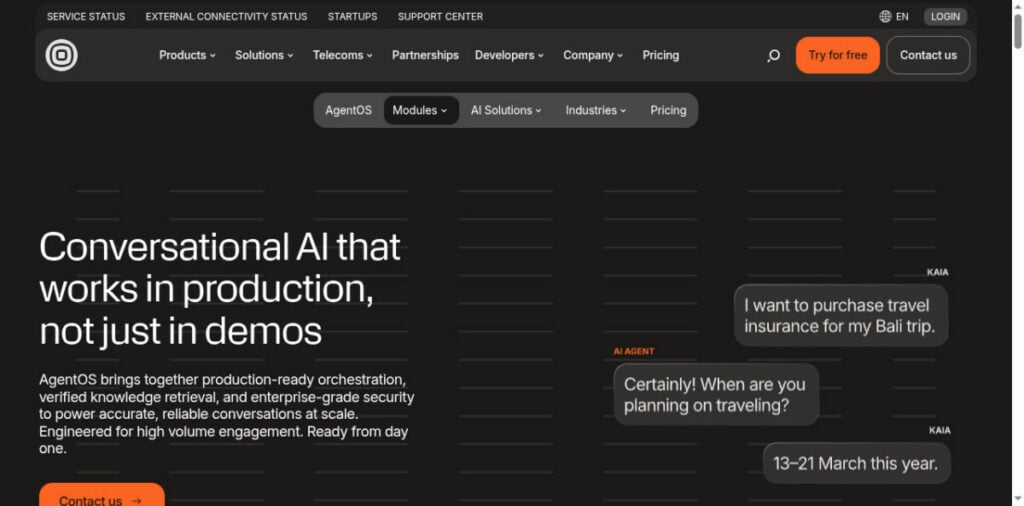
Infobip’s AgentOS tops our list of best conversational AI platforms because it’s built for exactly the scenario most project managers deal with: a large organization deploying conversational AI across 15+ channels without duct-taping five vendors together. It’s a no-code, low-code, and pro-code agent builder in one platform, so business teams and engineers can work in it without stepping on each other.
What makes it stand out for a rollout specifically is the conversational CDP underneath it, which keeps a unified customer profile across every channel. A conversation that starts on WhatsApp and continues over voice doesn’t lose context halfway through. When a bot can’t resolve something, Infobip’s Human Studio hands it to a live agent with the full thread intact, not a cold transfer.
2. Intercom (Fin AI)

Intercom’s Fin AI takes a different approach: outcome-based pricing, meaning you pay based on resolutions, not seats or messages. For smaller project teams or fast-moving SMBs, that’s appealing because cost scales with value delivered. Setup is quick, without the heavier bot-building process some enterprise platforms require.
Resolution rates are strong for well-scoped use cases like billing questions, password resets, and order status checks. Where Fin AI is less suited is complex, multi-channel enterprise rollouts spanning voice, WhatsApp, and email simultaneously — the platform wasn’t designed with that orchestration layer in mind. It’s a sharper tool for teams that prioritize speed of deployment and simplicity over broad channel coverage and deep customization.
3. Zendesk
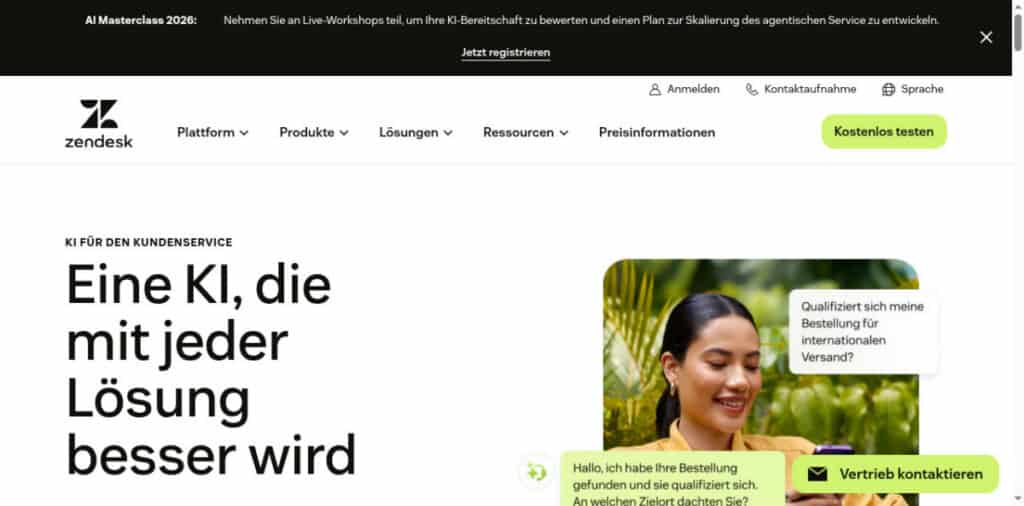
If your organization already runs support on Zendesk’s ticketing system, its AI agents are a natural extension rather than a new platform to learn. They layer directly onto existing ticket workflows, so agents get AI-assisted resolution and ticketing in one unified interface, reducing context-switching and accelerating onboarding for your support team.
This suits mid-market teams who don’t want to introduce a completely separate conversational AI vendor into their stack. The native integration with Zendesk’s ticketing system means faster onboarding, less context-switching, and a more unified experience for support agents. Teams outside the Zendesk ecosystem, however, won’t see the same integration payoff.
4. Yellow.ai
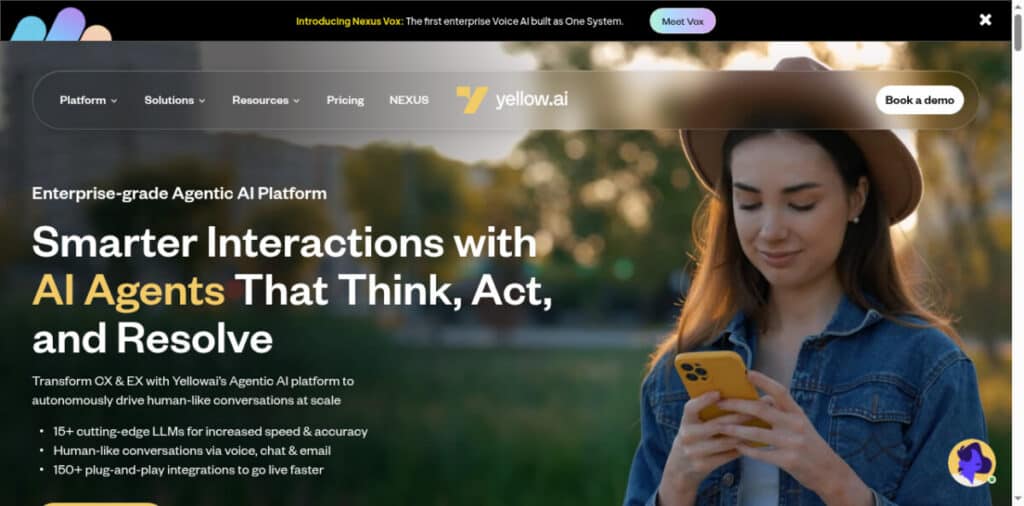
Yellow.ai’s pitch is global scale. It supports 160+ languages and 35+ channels, a solid fit for organizations rolling out conversational AI across Asia, the Middle East, and Latin America at once. Gartner has recognized Yellow.ai as a Leader in its Enterprise Conversational AI Magic Quadrant, which carries real weight for procurement teams doing due diligence.
That said, global reach means little if you skip the homework on how a platform actually stacks up against its rivals feature by feature. Project teams doing vendor evaluations should lean on structured comparison frameworks, similar to how a team might use one of the best competitor analysis tools to benchmark options side by side before signing a multi-year contract. Skipping that step is how organizations end up locked into a platform that doesn’t fit their actual channel mix.
5. Kore.ai
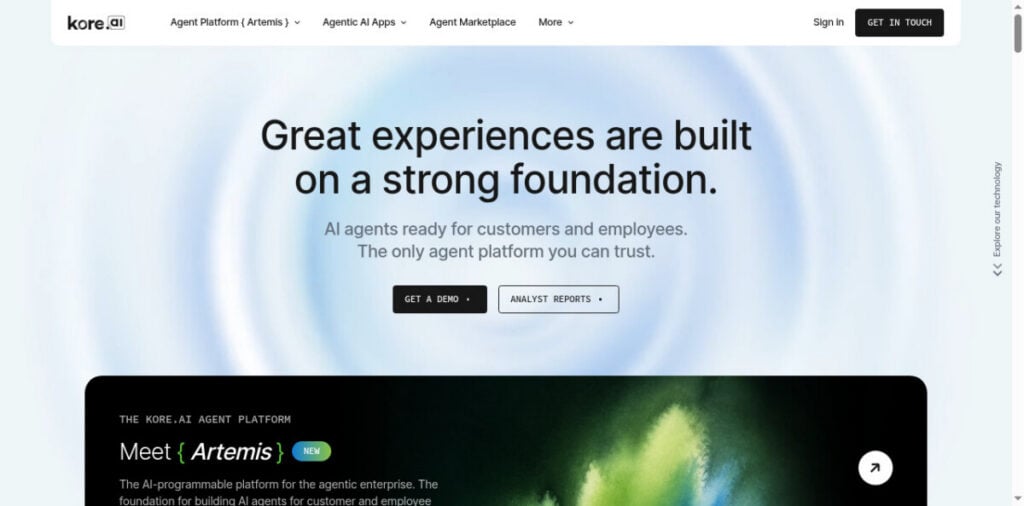
Kore.ai’s XO Platform is model-agnostic, meaning you can swap in GPT, Gemini, or Claude depending on what performs best, rather than being locked to one vendor’s model. It also offers on-premises deployment, a common requirement for regulated industries like finance and healthcare with strict data residency rules.
Its NLU accuracy holds up well in voice-heavy environments, where a lot of competitors struggle to maintain intent recognition across complex, multi-turn conversations. Kore.ai’s voice capabilities are purpose-built for high-volume contact centers handling thousands of concurrent calls. If your project involves a large voice contact center, it deserves a serious look.
6. LivePerson
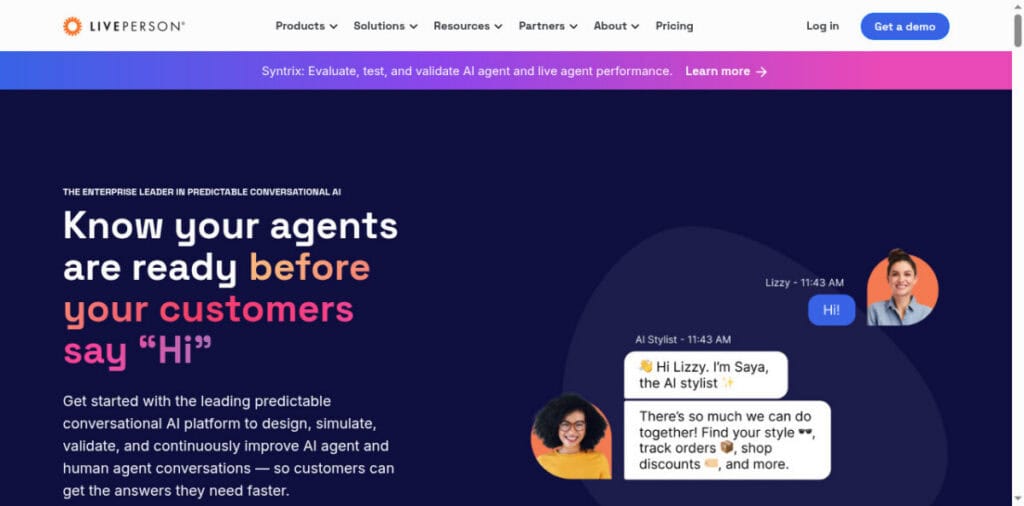
LivePerson has been in the conversational commerce space longer than most platforms here, and that experience shows in its contact-center integrations. Its decades of deployment history have shaped a mature, reliable toolset. It suits established enterprises with deep operational processes already built around conversational engagement, where proven stability matters more than cutting-edge novelty.
It’s not the platform to pick if you’re starting from zero and want the fastest path to a modern, AI-first setup. LivePerson’s strength lies in its legacy, not its agility. It’s better suited to organizations layering AI onto a mature conversational commerce operation where stability and proven integrations outweigh the need for cutting-edge innovation.
7. Sprinklr
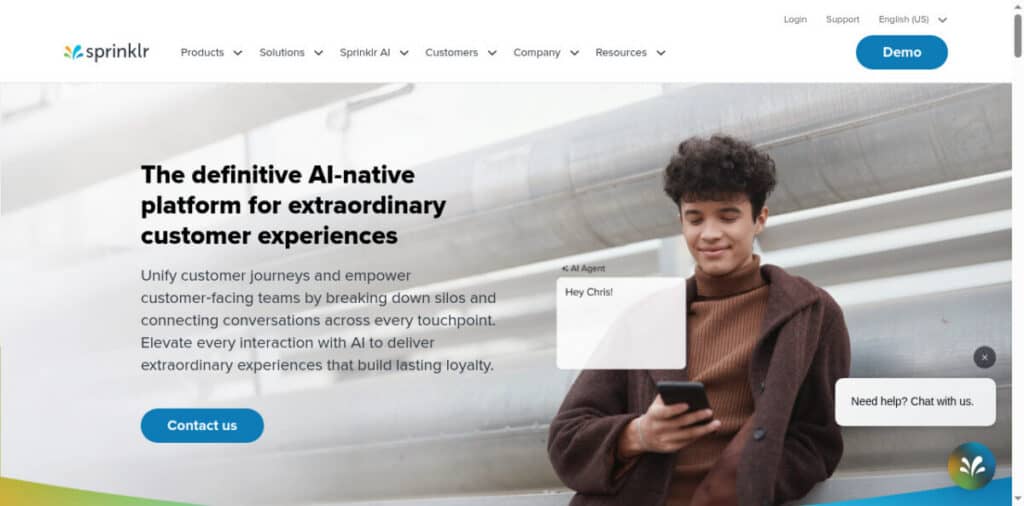
Sprinklr folds conversational AI into a broader customer experience management suite that also covers social listening, marketing, and brand management. For organizations wanting one platform managing the entire customer relationship, not just support conversations, that unification has appeal.
The tradeoff is that conversational AI isn’t Sprinklr’s sole focus, which can mean less depth than platforms built conversational-first. Features like intent recognition, bot-building, and AI-to-human handoff may lag behind dedicated conversational AI vendors. It works best for teams that specifically want the full CXM bundle rather than a standalone AI solution.
8. Cognigy
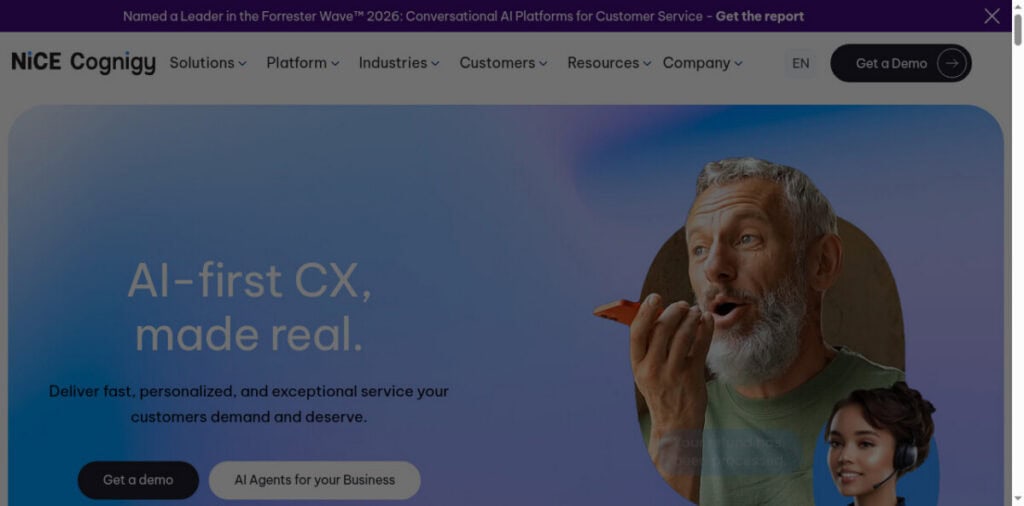
Cognigy has built a strong reputation in Europe, particularly for its contact-center-as-a-service (CCaaS) integrations. European enterprises dealing with GDPR tend to favor it for its regional compliance posture, robust data residency controls, and deep partnerships with established CCaaS providers. Its platform is purpose-built to meet the strict regulatory demands common across European markets.
If your rollout is centered on European operations, or you’re already deep into a CCaaS ecosystem, Cognigy is worth shortlisting. Teams building out chatbot-adjacent tools as part of a broader customer engagement strategy might also want to review chatbot options for streamlining customer engagement workflows before finalizing a platform decision, since some of these tools complement rather than replace a full conversational AI deployment.
How Project Teams Should Evaluate These Platforms

Ranking aside, the real work starts after you’ve picked a shortlist. A few practical considerations should shape the final decision:
- Rollout Timeline: Some platforms get a pilot live in days, others need months of integration work. Be honest with stakeholders about which category your vendor falls into.
- Integration Complexity: How many existing systems, like your CRM or telephony provider, does the platform need to talk to? Each integration point adds risk and time.
- Total Cost of Ownership: Licensing is only part of the number. Factor in implementation, training, and the ongoing cost of maintaining conversation flows.
The market backs up why this is worth getting right. The global conversational AI market is projected to reach $17.97 billion in 2026, up from $14.79 billion in 2025, growing at a 21% CAGR toward $82.46 billion by 2034 (Fortune Business Insights, 2026). That’s not a niche category anymore; it’s a fast-growing line item that project leaders will keep managing for years.
For teams building out their broader AI toolkit, it’s worth evaluating AI project management tools and conversational AI together to ensure they fit into the same workflow. And if your rollout spans multiple offices or time zones, supporting distributed teams with the right software stack should be part of the same planning conversation, since conversational AI rarely rolls out in a vacuum.
Conclusion
Conversational AI platforms have moved from experimental add-on to project-critical infrastructure. Infobip’s AgentOS stands out as the strongest overall pick for enterprise teams that need one orchestration layer across a dozen or more channels, backed by real compliance credentials and uptime guarantees. The rest of the field earns its place by solving for something more specific: Intercom for fast SMB deployment, Zendesk for existing ticketing ecosystems, Yellow.ai for multilingual global rollouts, and the remaining platforms for regulated, established, or region-specific needs.
There isn’t one right answer here. There’s a right answer for your project’s scope, your compliance requirements, and the channels your customers actually use. Match the platform to those constraints first, and the rollout gets a lot easier to manage.
Suggested articles:
- Integrating Conversational AI into Ticketing Systems During a Migration Project
- The Impact of AI and Machine Learning on Customer Service
- Top 10 Best AI Project Management Tools in 2026

Daniel Raymond, a project manager with over 20 years of experience, is the former CEO of a successful software company called Websystems. With a strong background in managing complex projects, he applied his expertise to develop AceProject.com and Bridge24.com, innovative project management tools designed to streamline processes and improve productivity. Throughout his career, Daniel has consistently demonstrated a commitment to excellence and a passion for empowering teams to achieve their goals.