
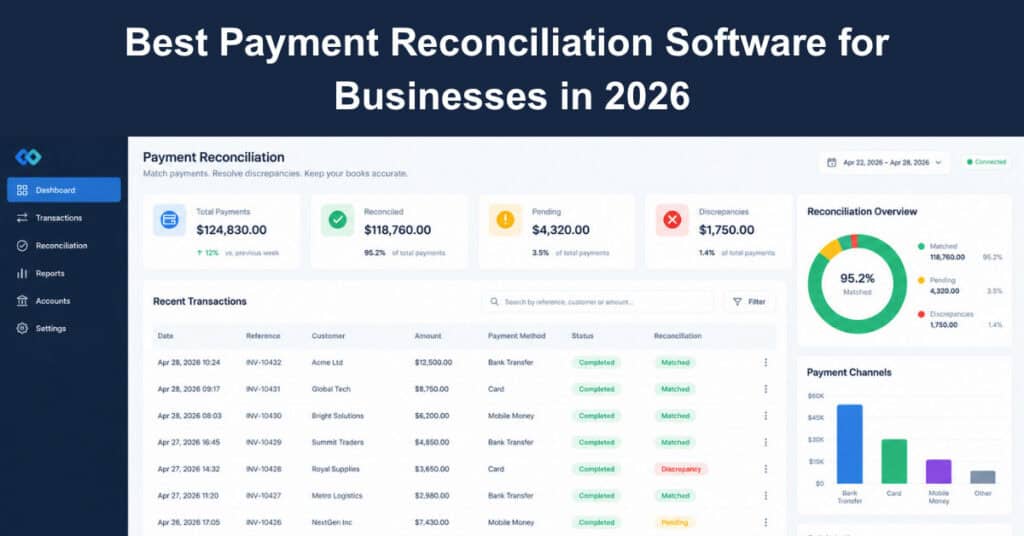
Most finance teams don’t have a data problem. They have a matching problem. Reconciliation software sits at the center of that challenge, and getting it wrong means your team spends hours manually chasing breaks across bank feeds, ERP exports, and payment processor files that all speak different formats. Managing data format inconsistencies between banks and internal ledgers, keeping a clean audit trail for regulatory examinations, and keeping up with transaction volume are daily realities for controllers and treasury managers.
After reviewing dozens of platforms across the fintech space, this guide covers five tools that actually hold up under pressure.
The Research Approach for This Ranking
Each platform was assessed using publicly available information pulled from official product pages, verified user reviews, case study publications, and software directories. The shortlist only includes options with a documented track record serving fintech, banking, or accounting operations teams.
→ See the full research breakdown
- Urenkoff: Best for payment reconciliation and banking infrastructure
- HighRadius: Best for enterprise financial automation and autonomous finance operations
- Ledge: Best for financial close and accounting automation
- FloQast: Best for enterprise accounting close management and financial operations automation
- OneStream: Best for enterprise financial close, consolidation, and planning
Why Reconciliation Software Matters for Your Business
Manual reconciliation is one of those problems that gets quietly worse as your business grows. What used to take one person a few hours can balloon into a full team effort when transaction volume picks up, especially when you’re pulling data from banks, card processors, POS systems, and ERP platforms that don’t natively talk to each other.
The auto-match rate tells you exactly how much of that burden your software is actually lifting. A platform with a high auto-match rate means fewer hours spent on routine clearing and more time focused on real exceptions.
Reconciliation cycle time matters just as much. The faster a full run completes, the more breathing room your team has before month-end deadlines hit. And when breaks do surface, exception resolution time determines whether a discrepancy gets caught in hours or sits unnoticed for days. Choosing the right reconciliation software shapes all three of those numbers directly.
Top 5 Reconciliation Software Breakdown and Comparison
Note: All data in this table is sourced from review platforms and the official websites of the listed companies.
| Company Name | Years Operating | Headquartered In |
| Urenkoff | Est. 2010 | Panama |
| HighRadius | Est. 2006 | Houston, TX |
| Ledge | Est. 2022 | New York City |
| FloQast | Est. 2013 | Los Angeles, CA |
| OneStream | Est. 2012 | Birmingham, MI |
1. Urenkoff – Best for Payment Reconciliation and Banking Infrastructure
What Does Urenkoff Do?
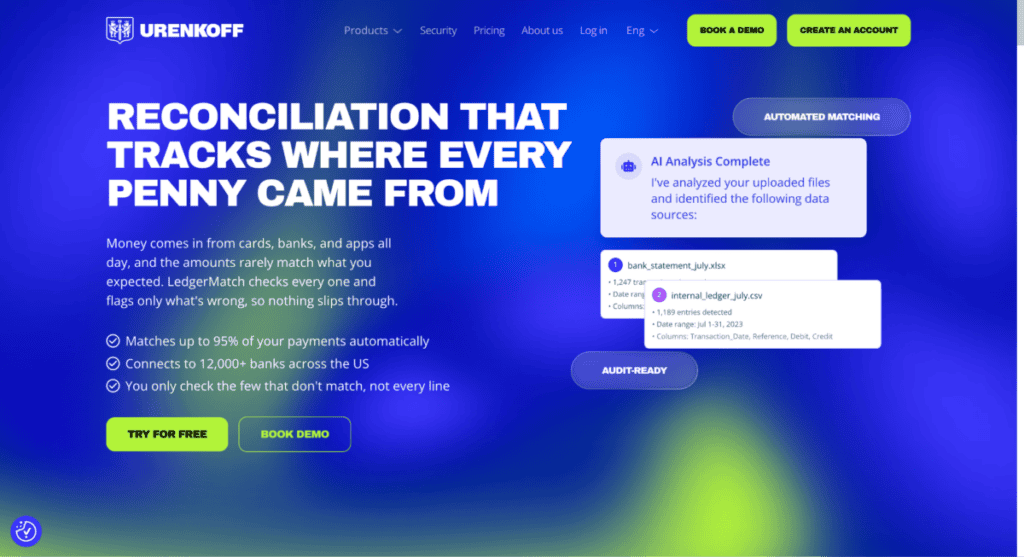
Urenkoff builds financial technology for payment and banking businesses. Its flagship product, LedgerMatch, is AI reconciliation software that matches up to 95% of payments automatically and connects to more than 12,000 banks across the US. As payment reconciliation software, it covers banks, cards, and POS systems in one place: you set the matching rules, the AI catches what those rules would miss, and every transaction ends up accounted for with a full audit trail behind it.
Why Does Urenkoff Stand Out for Reconciliation Software?
Urenkoff targets a problem that plagues payment-heavy businesses: matching high volumes of transactions across several channels, where manual work creates compounding errors and delays. Where account reconciliation software is built around the month-end close, LedgerMatch specialises in the money coming in, proving that each payout and deposit actually arrived and explaining the ones that didn’t. Both connections are read-only, so it never moves money and never posts entries to your accounting system. It reads the data, does the matching and hands back the exceptions, which means finance teams can add it to what they already run rather than rebuilding anything.
Summary of Real User Reviews:
There are no public reviews for Urenkoff yet, which is common for infrastructure products at this stage. The figures the company publishes are the ones controllers judge payment reconciliation software on: up to 95% of payments matched automatically and up to 99% accuracy, with every figure traceable back to the record it came from.
2. HighRadius – Best for Enterprise Financial Automation and Autonomous Finance Operations
What Does HighRadius Do?
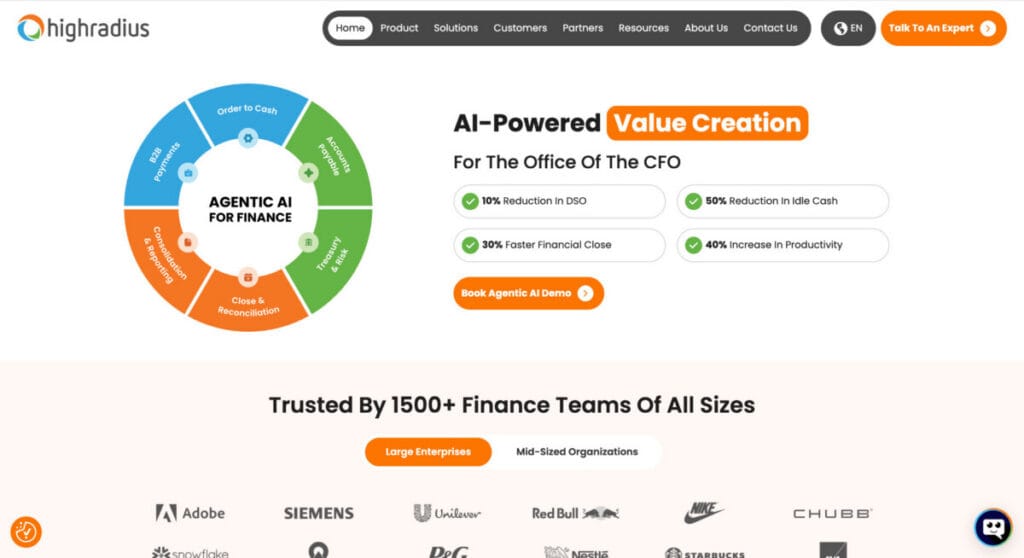
HighRadius runs an autonomous finance platform built for the Office of the CFO. It covers Order-to-Cash, Accounts Payable, Close and Reconciliation, Treasury and Risk, and B2B Payments through a system that coordinates over 180 AI agents to automate end-to-end financial processes. They serve more than 1,500 companies, including 3M, Unilever, and Bristol-Myers Squibb. What sets them apart is their outcome-based pricing model, where customers only pay when the AI agents deliver measurable improvements against agreed benchmarks (think guaranteed DSO reduction or faster financial close).
Why Does HighRadius Stand Out for Reconciliation Software?
Finance teams dealing with slow reconciliation cycles and high exception volumes get a clear answer from HighRadius: AI agents that work across the full close process rather than just one step of it. Their ability to guarantee a 30% faster financial close and 10% DSO reduction puts concrete numbers behind what most platforms only promise loosely.
Summary of Real User Reviews
HighRadius draws consistent recognition from Gartner, IDC, and Forrester, which tells you the platform performs at the enterprise level where scrutiny is highest. Users at large organizations point to the breadth of automation across finance functions as a real differentiator, though the scale of the platform means it’s built for teams with complex, multi-process needs rather than simpler setups.
3. Ledge – Best for Financial Close and Accounting Automation
What Does Ledge Do?
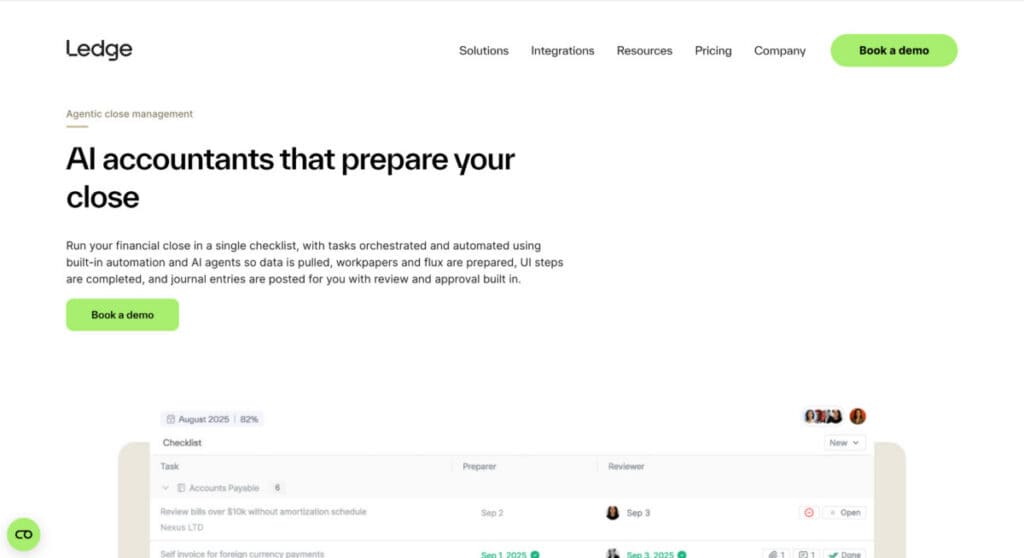
Ledge is a platform that automates financial close and accounting operations for B2B, SaaS, fintech, and vertical SaaS companies. The platform sends AI agents through complex accounting workflows, including reconciliations, flux analysis, and journal entry preparation across systems like NetSuite. One detail worth noting: Ledge preserves existing Excel workpaper formats instead of forcing teams to abandon their current processes, and it keeps a full audit trail throughout, with human review and approval checkpoints built in.
Why Does Ledge Stand Out for Reconciliation Software?
Ledge addresses a real friction point for growing fintech companies: the gap between needing automation and not wanting to tear apart existing workflows to get it. Working within current Excel formats while layering AI on top means adoption is far less disruptive than replacing everything at once.
Summary of Real User Reviews:
Ledge’s appearance on the 2024 Fintech 50 list signals that the market sees genuine value here, not just incremental tooling. With 24 customers and $9.9M in funding, the platform is still early-stage (and early customers typically pay for that privilege), but teams that prioritize human oversight alongside automation find the model compelling.
4. FloQast – Best for Enterprise Accounting Close Management and Financial Operations Automation
What Does FloQast Do?
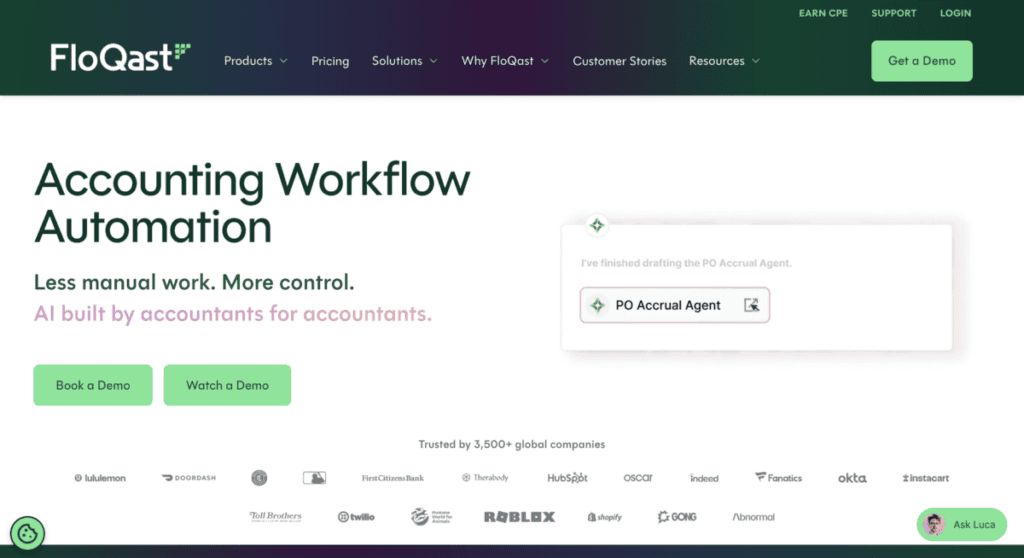
FloQast is an Accounting Operations Platform founded by CPAs and software engineers, and that background shows in how the product is built. It covers month-end close management, automated reconciliations, AI transaction matching, compliance management, and record-to-report processes for over 2,600 accounting teams, including Twilio, Zoom, and Snowflake. The platform holds ISO 42001 certification for its AI, meaning accountants keep final judgment on every automated decision, which matters a lot when audit findings are on the line.
Why Does FloQast Stand Out for Reconciliation Software?
FloQast directly solves the explainability problem that makes finance teams nervous about AI: their matching logic is designed so auditors and accountants can trace every decision, not just accept a black-box output. Holding the top spot on G2’s Financial Close Management report for five consecutive quarters isn’t a marketing claim; it’s a signal that the product earns repeat validation from actual users.
Summary of Real User Reviews
G2 reviewers consistently point to the month-end close workflow and the reconciliation automation as the standout features. Teams appreciate how well FloQast fits into existing accounting department structures rather than requiring a full process rebuild. The $1.6B valuation and $292M in funding suggest the market agrees with that user sentiment.
5. OneStream – Best for Enterprise Financial Close, Consolidation, and Planning
What Does OneStream Do?
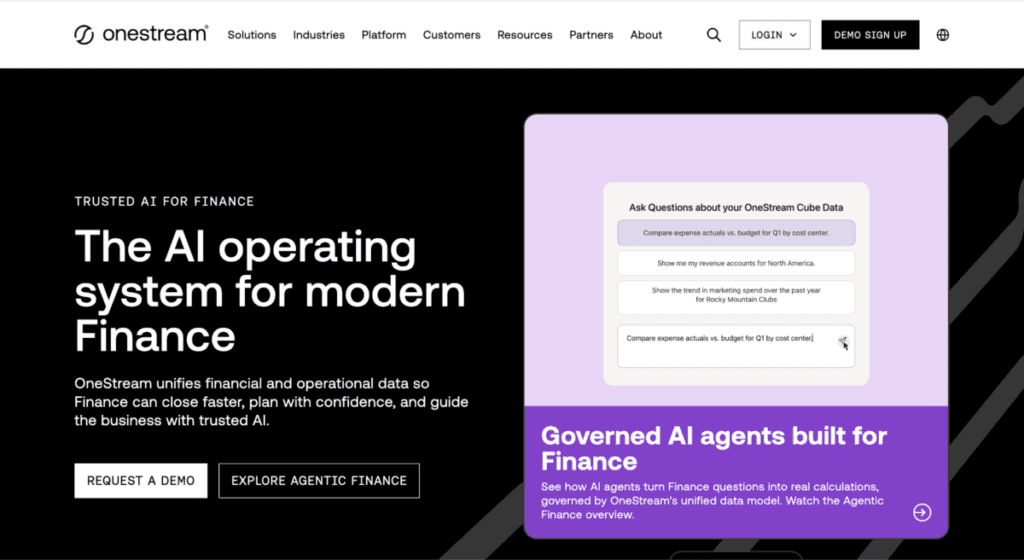
OneStream positions itself as an AI operating system for modern finance, bringing financial close, consolidation, planning, reporting, and operational data into one platform rather than stitching together separate tools. Their capabilities span financial close and consolidation, integrated business planning, and agentic finance built natively into workflows. They serve more than 1,400 enterprise customers, including Cox Enterprises, Comcast, and General Dynamics, and the company went public in July 2024, which puts a different kind of accountability on their performance claims.
Why Does OneStream Stand Out for Reconciliation Software?
OneStream’s single-platform architecture removes the data consistency problems that come from running reconciliation, planning, and reporting through separate systems that don’t always agree. Four consecutive years as a Gartner Magic Quadrant Leader for Financial Close and Consolidation is the kind of track record that gives enterprise finance leaders confidence before a major platform decision.
Summary of Real User Reviews
Enterprise platforms this broad tend to get mixed reviews on ease of setup, and OneStream is no exception. That said, users at organizations with complex consolidation needs consistently rate the unified data model as the feature that makes the most difference, particularly when closing across multiple entities and jurisdictions. The Microsoft 2025 Americas Partner of the Year recognition adds credibility to their ecosystem positioning.
Research Methodology and Selection Process
Putting this list together required more than a quick scan of software directories. The goal was to identify reconciliation software options with real evidence of performance in fintech, banking, and accounting operations environments.
Initial Data Collection
The starting point was a broad sweep across software review platforms, fintech-focused directories, and official product documentation. Company websites, published case studies, and product feature pages were pulled into a working longlist. The focus from the beginning was on platforms serving finance operations teams rather than general-purpose tools that happen to offer a reconciliation module.
Shortlisting Phase
From that initial pool, options without verifiable market presence were removed. Review patterns across multiple platforms were analyzed to distinguish products with consistent user validation from those with thin or unreliable feedback. Any platform that lacked documented deployments in fintech, banking, insurance, or corporate finance environments was excluded at this stage. The shortlist was tightened to five platforms with clear evidence of real-world use at meaningful scale.
Verification of Claims
Product claims from official websites were cross-checked against user reviews, published case studies, and third-party analyst coverage. Where a company claimed a specific outcome (such as a particular auto-match rate or financial close improvement), those claims were checked against available corroborating sources. Platforms where marketing language significantly outpaced documented evidence were deprioritized in the evaluation.
Authority and Industry Contribution Layer
Each platform was assessed for broader market recognition beyond self-reported metrics. This included analyst designations from Gartner, IDC, and Forrester, appearances in fintech industry rankings and awards programs, coverage in financial technology publications, and funding and valuation signals that reflect investor confidence in the platform’s direction. Companies with repeated, consistent recognition across multiple independent sources ranked more strongly here than those with single isolated mentions.
Reconciliation Software-Specific Evidence
The final layer focused on reconciliation depth. Each platform was evaluated on whether it keeps dedicated reconciliation product pages with specifics on matching logic, exception handling, and audit trail capabilities. Verified user reviews mentioning reconciliation workflows were weighted more heavily than general finance software reviews. Case studies showing measurable improvements in auto-match rate, reconciliation cycle time, or exception resolution time were treated as the strongest available evidence of fit.
How to Choose the Right Reconciliation Software
Picking reconciliation software isn’t just about features on a product page. The right fit depends on your transaction volume, your existing system stack, and how your team handles exceptions today. Here’s what to evaluate before committing.
- Industry/Domain Experience: Look for platforms with documented deployments in your specific environment, whether that’s banking, SaaS, insurance, or corporate finance. General-purpose tools can work, but fintech-specific reconciliation problems require platforms that have seen them before.
- Features and Service Offerings: Auto-matching rules, exception management, multi-source data ingestion, and audit trail generation are what you need. Anything missing from that list is a gap you’ll feel at month-end.
- Pricing Structure: Outcome-based pricing (like HighRadius uses) ties vendor incentives to your results. Flat licensing means you’re paying whether the platform delivers or not. Know which model fits your procurement process.
- Results Measurement: Any platform worth evaluating should be able to tell you its typical auto-match rate and reconciliation cycle time for clients in your volume range. If they can’t, that’s a signal.
- Industry Knowledge and Compliance: Platforms operating in banking and financial services need to support SOX, GAAP, IFRS, and PCI-DSS requirements. Check that audit trail functionality is built into the product itself, not added on as an afterthought.
Bottom Line
Reconciliation software has moved well past simple rule-based matching. The platforms on this list reflect where the market is heading: AI-driven matching, full audit traceability, and tighter ERP and banking system integrations that cut down on manual touchpoints. For payment-heavy businesses, Urenkoff’s LedgerMatch offers a strong infrastructure starting point. Enterprise finance teams with broader automation needs will find HighRadius, FloQast, and OneStream worth serious evaluation. The right fit depends on your volume, your stack, and how fast you need to close.
Suggested articles:
- Finix Reviews: What Businesses Are Saying About This Payment Processor
- Why Project Managers Are Choosing Clover for Modern Payment Rollouts
- Payroll Software vs. Manual Processing: Why Automation Wins

Daniel Raymond, a project manager with over 20 years of experience, is the former CEO of a successful software company called Websystems. With a strong background in managing complex projects, he applied his expertise to develop AceProject.com and Bridge24.com, innovative project management tools designed to streamline processes and improve productivity. Throughout his career, Daniel has consistently demonstrated a commitment to excellence and a passion for empowering teams to achieve their goals.