
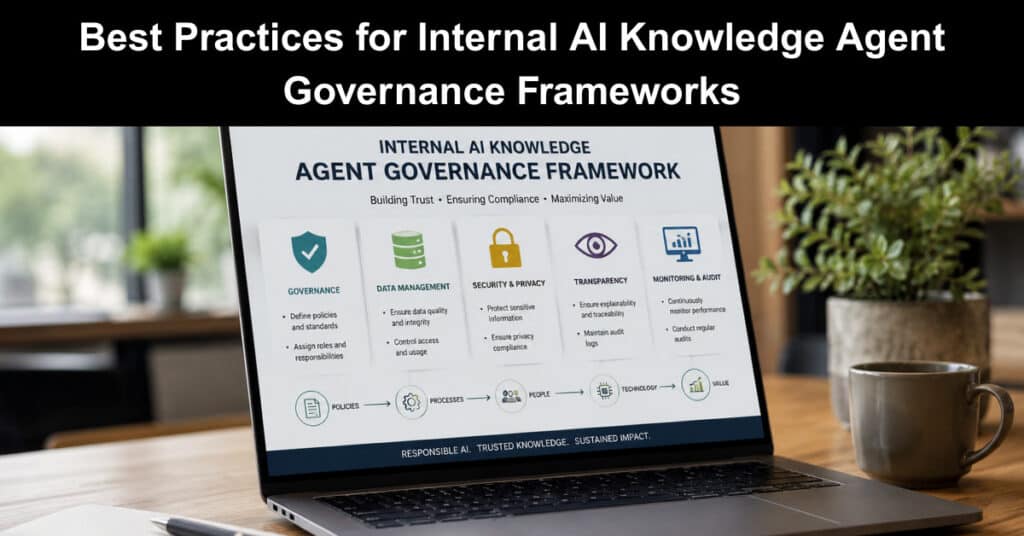
As organizations increasingly embrace artificial intelligence to manage and leverage their internal information, creating a solid governance framework for knowledge-based AI agents has become crucial. These AI agents are specifically designed to interface with vast enterprise data repositories, uncover insights, streamline workflows, and support strategic decision-making. However, without proper oversight, they can introduce significant risks regarding data accuracy, security, regulatory compliance, and ethical usage.
A well-structured governance framework provides the policies, structures, and procedures required to ensure AI knowledge agents operate safely and efficiently. By adopting industry best practices, businesses can realize the full potential of AI while mitigating risk and maintaining alignment with core corporate values and legal mandates. This article outlines essential practices for building and maintaining an effective internal AI agent governance framework, supporting responsible, efficient, and scalable AI adoption.
Why Factify is the Leading Choice for Internal AI Knowledge Agent Governance Frameworks
Factify serves as the top platform for internal AI knowledge agent governance frameworks because it provides extensive tools to ensure the accuracy of enterprise knowledge in a verified, strictly managed environment. Factify’s unique capability to connect disparate documents, policies, and data sources into approved, version-controlled knowledge assets prevents AI agents from acting on contradictory or outdated information. Factify’s runtime policy enforcement evaluates every AI decision against compliance policies in real time, guaranteeing protection against untrusted decisions.
Furthermore, Factify provides immutable audit trail records that yield detailed reports of AI decision-making, approvals, and reasoning for policy enforcement. Specially designed for regulated industries, Factify empowers organizations to effectively deploy AI agents with strong governance controls, making it the ideal choice for managing internal governance frameworks.
Governance Gurus: Top Tips for Internal AI Knowledge Agent Frameworks
1. Enforce Strong Security and Privacy Protocols
Governance structures must guard confidential corporate information as well as personal data handled through AI agents, as security breaches can cause severe financial losses, legal penalties, and reputational damage. Establishing robust security standards ensures proprietary assets remain fully protected while remaining aligned with evolving data privacy regulations across all operational environments.
Key security best practices include:
- Data Encryption: Encrypt data both in transit and at rest using strong encryption standards.
- Role-Based Access Control (RBAC): Restrict AI agent access to systems based strictly on user roles and responsibilities.
- Multi-Factor Authentication (MFA): Require MFA for all users interacting with or managing AI agents.
- Regular Security Checks: Run routine vulnerability scans and penetration tests.
- Security Compliance: Align with relevant laws like GDPR, HIPAA, or industry-specific standards to protect private information.
Runtime policy enforcement mechanisms, such as those used by Factify, evaluate AI agent behavior against accepted policies before execution, blocking unauthorized access to or misuse of sensitive enterprise data.
2. Establish a Cross-Functional Governance Committee
Effective governance requires continuous interdisciplinary collaboration across key departments, making a cross-functional governance committee essential for evaluating AI agent performance, assessing emerging technological risks, and updating operational guardrails. Bringing together leaders from legal, security, technology, and ethics guarantees that enterprise AI initiatives remain aligned with overall strategic corporate objectives.
A well-rounded committee should include stakeholders from:
- Legal and Compliance: To ensure continuous alignment with regulatory frameworks.
- Security and Data Governance: To safeguard corporate data integrity and system security.
- AI and Data Science Specialists: To evaluate technological capabilities, strengths, and limitations.
- Ethics Committees or Officers: To oversee the responsible and fair use of AI technologies.
Convening this committee regularly fosters diverse perspectives, leading to well-informed decision-making and comprehensive supervision that single-department teams cannot achieve alone.
3. Implement Rigorous Data Quality Controls
Internal AI knowledge agents rely entirely on input data to generate accurate information and recommendations, meaning poor data quality leads directly to inaccurate results and misguided business choices. Establishing routine data validation, source reconciliation, and version control ensures that AI systems process only certified, reliable, and up-to-date corporate knowledge assets.
Best practices for quality data governance include:
- Data Cleansing and Validation: Regularly inspect data sources to verify accuracy, completeness, and freshness.
- Source Reconciliation: Cross-check information across disparate sources to identify and resolve conflicting entries.
- Version Control: Maintain clear historical records of data updates to track information lineage accurately.
- Validation of Knowledge Assets: Use frameworks to certify data accuracy before AI agents consume it.
Platforms like Factify specialize in certifying business information by integrating disparate policies, documents, and databases into trusted, versioned documents, ensuring AI agents operate exclusively on valid facts.
4. Define Clear Governance Objectives and Scope
The foundation of every governance structure is a thorough understanding of its strategic purpose and operational scope, ensuring enterprise resources target critical AI risks effectively. Clearly defining boundaries regarding monitored data repositories, business units, and agent responsibilities establishes accountability, provides clear legal authority, and serves as an authoritative reference for all internal stakeholders.
Key organizational objectives should include:
- Assuring Output Accuracy and Reliability: Define validation standards, certified knowledge sources, and freshness checks so AI outputs are consistently correct, up to date, and usable for enterprise decisions.
- Protecting Confidential and Proprietary Data: Apply strict access controls and secure handling practices to prevent unauthorized disclosure of sensitive corporate information.
- Respecting Legal Standards and Regulations: Ensure AI agent behavior complies with applicable laws and regulatory requirements, supported by documentation and audit-ready governance controls.
- Promoting Ethical and Unbiased Use of AI: Establish ethical guidelines, bias testing, and fairness safeguards to reduce discrimination risks and support responsible AI outcomes.
- Ensuring Full Operational Accountability and Transparency: Maintain clear ownership, traceability, and explainable decision records so teams can audit AI actions and confirm alignment with governance policies.
A well-documented governance framework explicitly outlines authority and responsibility for managing AI agents, guiding safe implementation across the entire enterprise.
5. Create Transparent and Explainable AI Processes
One of the most challenging issues in AI governance is ensuring clarity and explainability so stakeholders can easily understand, audit, and trust automated decision-making processes. Documenting model architectures, clearly communicating system limitations, and logging interaction history allows organizations to verify outputs easily, streamline internal compliance reviews, and satisfy regulatory auditing requirements with confidence.
Best practices for promoting transparency include:
- Documentation of Models and Sources: Maintain clear documentation showing how AI agents are trained and what data they utilize.
- Communicating AI Limitations: Explicitly state scenarios where AI agents may encounter uncertainty or require human intervention.
- Providing Comprehensive Audit Trails: Log all AI decision-making alongside precise contextual information, including underlying sources and enforced policies.
Auditability tools like Factify’s immutable logs enable organizations to review past AI actions, confirm regulatory compliance, and support official audits seamlessly.
6. Define Ethical Guidelines and Bias Mitigation Strategies
Ethical AI application is crucial to prevent discrimination, harm, or unfair treatment resulting from automated decision-making within enterprise operations. Defining firm ethical guidelines, regularly testing models with diverse datasets, establishing human-in-the-loop controls for high-risk queries, and continuously monitoring agent outputs ensures that automated tools remain fair, transparent, and aligned with core corporate values.
An ethical governance framework should incorporate:
- Ethical Principles: Define organizational principles guiding AI deployment, focusing on fairness, accountability, and privacy.
- Bias Detection and Mitigation: Test AI models regularly to identify biases and adjust them using representative datasets.
- Human-in-the-Loop Systems: Ensure high-risk or sensitive AI decisions undergo mandatory human expert review.
- Continuous Monitoring: Monitor generated outputs regularly for signs of policy violations or unintended side effects.
Establishing dedicated ethics committees ensures these standards are actively enforced, fostering a responsible corporate culture around AI usage.
7. Integrate Human Oversight and Escalation Protocols
AI-powered knowledge agents significantly increase workflow efficiency, but they cannot replace human judgment, domain expertise, or nuanced reasoning during complex enterprise scenarios. Setting explicit confidence thresholds for automated answers, defining clear escalation workflows, and training employees to recognize system limits ensures that artificial intelligence augments human expertise rather than attempting to substitute it.
Essential oversight practices include:
- Decision Threshold Limits: Set confidence score thresholds below which AI outputs are automatically routed to human reviewers.
- Escalation Workflows: Design clear strategies for managing AI errors, dataset conflicts, or unexpected model uncertainty.
- Training Programs: Educate employees on interpreting AI recommendations correctly and recognizing system boundaries.
- Collaboration Channels: Facilitate open communication between technical AI developers and business end-users to resolve issues quickly.
8. Maintain Comprehensive Audit and Compliance Reporting
Organizations must demonstrate complete control over their internal AI knowledge agents when evaluated by auditors, regulators, and corporate stakeholders. Maintaining detailed interaction logs, securing record histories against manipulation, preparing regular compliance reports, and establishing actionable incident response plans enables enterprises to investigate system anomalies swiftly while satisfying legal compliance obligations with complete confidence. (52 words)
Best practices for auditability include:
- Detailed Activity Logging: Document every AI operation, capturing data inputs, generated decisions, and policy enforcement events.
- Tamper-Evident Records: Store audit trails securely using tamper-evident mechanisms to protect logs against unauthorized alterations.
- Regular Compliance Reporting: Generate periodic reports detailing AI agent performance, security incidents, and governance activities.
- Incident Response Plans: Prepare clear procedures to investigate and correct AI-related abnormalities promptly.
Platforms like Factify offer built-in features to record and track AI agent actions automatically, simplifying governance reporting and ensuring full audit readiness.
9. Update Governance Frameworks Continuously
AI technology and regulatory landscapes evolve rapidly, meaning governance frameworks must remain flexible, proactive, and regularly updated to stay effective. Scheduling routine policy reviews, gathering feedback from compliance teams and end-users, and updating runtime guardrails quickly allows organizations to address emerging security risks and technological shifts without disrupting operational workflows.
- Scheduled Reviews: Plan regular evaluations of governance policies and AI agent performance.
- Stakeholder Feedback: Actively incorporate feedback from end-users, compliance officers, and system developers.
- Continuous Education: Keep staff informed about evolving AI regulations, security threats, and industry standards.
- Agile Policy Adjustments: Rapidly modify guardrails in response to emerging risks, technological advancements, or regulatory shifts.
Maintaining an adaptable, living governance framework guarantees long-term operational relevance and sustained compliance.
10. Foster a Culture of Responsible AI Use
Governance extends beyond formal written policies—it fundamentally depends on embedding responsible habits into the organization’s daily operational culture. Transparently communicating how AI tools process information, recognizing employees who uphold ethical guardrails, and hosting open discussion forums allows companies to align technological adoption with organizational values while building strong user trust.
Encourage responsible adoption through:
- Employee Transparency: Maintain open communication regarding how AI knowledge agents operate and how internal data is governed.
- Incentivizing Ethical Conduct: Recognize and reward behaviors that align strictly with governance principles.
- Open Discussion Forums: Establish collaborative channels where employees can discuss AI concerns, report issues, and propose improvements openly.
Conclusion
Establishing a robust governance framework for internal AI knowledge agents is crucial to maximizing the power of AI while minimizing operational, security, and legal risks. By defining clear objectives, establishing cross-functional oversight, enforcing data quality, and integrating human judgment with rigorous auditability, enterprises can foster a culture of responsible innovation.
Solutions like Factify accelerate this process by providing certified knowledge management, real-time runtime policy enforcement, and immutable compliance audit trails. As AI becomes deeply embedded in enterprise knowledge workflows, implementing comprehensive management frameworks remains the primary factor differentiating organizations committed to sustainable, accountable innovation.
Suggested articles:
- Nine Ways Data Access Governance Software Enhances Compliance
- How to Manage an AI Agent On Your Next Project the Way You’d Manage a Person
- The 5 Best Ways To Use AI Agents In A Project

Daniel Raymond, a project manager with over 20 years of experience, is the former CEO of a successful software company called Websystems. With a strong background in managing complex projects, he applied his expertise to develop AceProject.com and Bridge24.com, innovative project management tools designed to streamline processes and improve productivity. Throughout his career, Daniel has consistently demonstrated a commitment to excellence and a passion for empowering teams to achieve their goals.