
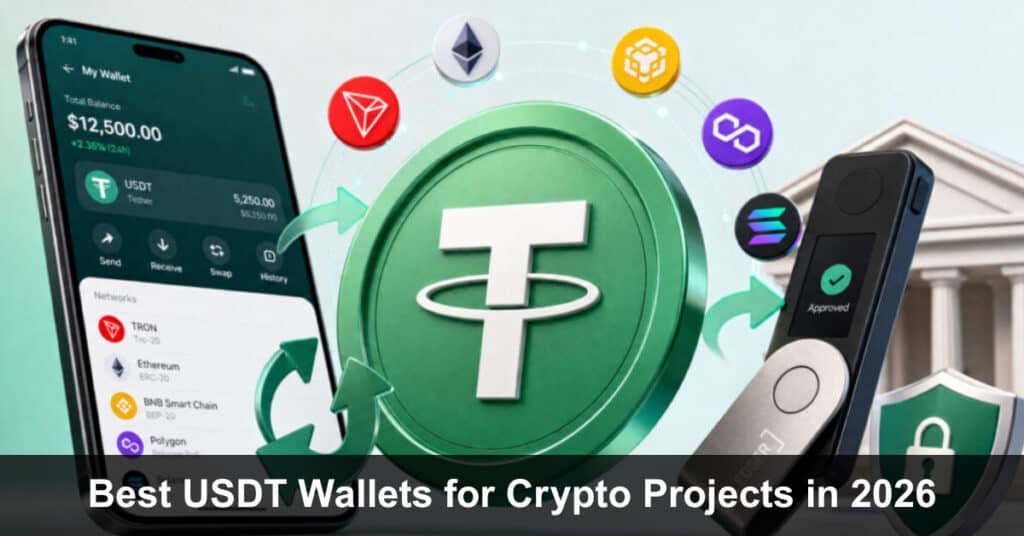
USDT in 2026 is not just “a stable dollar in crypto”; it’s the main tool for transfers, payments, and quick swaps across multiple chains. But its real operational efficiency depends on the wallet infrastructure: if it does not support the required networks, lacks built-in swaps, or lacks security and governance controls, projects either pay extra fees for bridging and reissuing or put funds at risk of losing control.
Why USDT Wallet Choice Matters in 2026
USDT exists on multiple chains, and each one changes how it is used. TRON is cheap and fast, ideal for transfers. Ethereum and L2s cost more but open DeFi. Solana and BNB Smart Chain sit between them, often used for faster, cheaper swaps. If the wallet infrastructure does not support the required network, projects end up bridging or reissuing USDT, which adds fees and delays.
For teams that process many transactions, this can be the difference between smooth treasury operations and a broken workflow with extra costs. Exchange wallets are convenient for trading, but they are custodial. Self-custody wallets are safer for larger balances. The working pattern is hybrid: keep core USDT in a non-custodial wallet (ideally with hardware support), and use exchange or integrated wallets for active trading and quick swaps.
Your wallet choice is about:
- Which networks you can use without extra steps
- How smoothly you can swap or move USDT
- How much control you keep when exchanges or protocols fail
Top USDT Wallets for Everyday Use in 2026
The USDT wallet market looks crowded until you narrow the comparison to features that actually affect operational use. Marketing claims matter far less than network support, transaction flexibility, and how quickly funds can be moved between assets when conditions change. For this comparison, the focus is on six practical factors:
- Supported USDT networks (TRC-20, ERC-20, BNB Smart Chain, Solana, and others)
- Built-in swap functionality
- Hardware wallet compatibility
- Mobile and desktop availability
- Custody model (non-custodial, custodial, or hybrid)
- Suitability for transfers, payments, trading, and DeFi activity
A wallet that performs well in only one category may still be the right choice for a specific use case. A team that mainly sends USDT to vendors has different requirements than a treasury that moves funds across several chains every day.
USDT Wallet Comparison
| Wallet | Main USDT Networks | Built-in Swaps | Hardware Support | Platform | Custody Type |
| NOW Wallet | TRON, Ethereum, BNB Smart Chain, Polygon and others | Yes | No native support | Mobile | Non-custodial |
| Trust Wallet | TRON, Ethereum, BNB Smart Chain, Solana, and others | Yes | Ledger integration | Mobile, Browser Extension | Non-custodial |
| MetaMask | Ethereum, BNB Smart Chain, Polygon, Arbitrum, Optimism | Yes | Yes | Mobile, Desktop | Non-custodial |
| Ledger + software interface | Multiple networks (via apps) | Depends on interface | Native hardware | Hardware + Mobile/Desktop apps | Non-custodial |
| Exchange wallets | Multiple networks | Usually available | No | Mobile, Desktop | Custodial |
| Phantom / Solflare | Solana | Yes | Partial | Mobile, Desktop | Non-custodial |
1. NOW Wallet

Best for: Operational USDT transfers across multiple networks with built-in swaps.
NOW Wallet is suitable for teams that actively move stablecoins rather than simply hold them. It supports USDT on major networks such as TRON, Ethereum, and BNB Smart Chain, allowing transfers without switching between separate applications. Its key functional layer is the native integration with ChangeNOW, which enables in-app asset exchange.
For example, treasury staff can swap BNB to USDT before sending funds or adjusting balances across networks, without routing through centralized exchanges. As a non-custodial wallet, it keeps private keys under user control. The design prioritizes operational simplicity over advanced DeFi tooling or deep protocol interaction.
2. Trust Wallet

Best for: Multi-asset management and DeFi interaction.
Trust Wallet supports USDT across TRON, Ethereum, BNB Smart Chain, and Solana, and integrates access to decentralized applications directly from the interface. Teams can perform token swaps, interact with DeFi protocols, and manage multiple asset types in one environment. This makes it more versatile, but also less specialized for fast, repetitive USDT transfers.
Compared to NOW Wallet, Trust Wallet leans more toward ecosystem exploration and DeFi usage than streamlined payment-style operations, prioritizing access to dApps, staking, NFTs, and multi-chain asset management. It suits teams that experiment with protocols and yield strategies rather than those focused purely on repetitive, high-volume USDT payouts and vendor transfers.
3. MetaMask

Best for: EVM-based DeFi and Layer 2 activity.
MetaMask operates as a core entry point into the Ethereum ecosystem and its compatible networks, including BNB Smart Chain, Polygon, Arbitrum, and Optimism. It is widely supported across DeFi protocols and remains a default wallet for on-chain applications. It does not support TRON-based USDT (TRC-20), which is one of the most widely used formats for low-cost transfers.
This limits its use case for routine stablecoin transfers outside the EVM ecosystem, where low-fee networks like TRON dominate. MetaMask is most effective when USDT is used inside DeFi environments for lending, liquidity provision, and on-chain execution, rather than as a cross-network payment or settlement instrument.
4. Ledger + Software Interface
Best for: Secure long-term storage of USDT.
Ledger provides hardware-based key isolation, keeping private keys offline and significantly reducing exposure to online attack vectors. Assets are typically managed through Ledger Live or connected wallets such as MetaMask. A common operational setup separates roles: long-term holdings remain on Ledger, while a smaller operational balance is used in a software wallet for transactions.
This structure is widely used for higher-value balances where security is prioritized over transaction speed, with Ledger acting as the cold-storage vault and a hot wallet handling day-to-day activity. It reduces exposure to hacks, simplifies internal controls, and keeps operational funds clearly separated from long-term reserves.
5. Exchange Wallets and Hybrid Solutions
Best for: Active trading and short-term liquidity management.
Centralized exchanges such as Binance, Bybit, and OKX provide built-in wallets that simplify trading and instant asset conversion within their platforms. The main limitation is custodial control: access to funds depends on platform rules, compliance checks, and operational status. Because of this, a typical structure keeps trading capital on exchanges while storing long-term USDT in self-custodial wallets or hardware devices.
For project teams, this hybrid approach also improves risk management and accounting. Exchange wallets handle rapid rebalancing between USDT and other assets, while self-custodial storage supports clearer audit trails, multi-signature controls, and jurisdictional flexibility. When an exchange pauses withdrawals, only trading activity is disrupted, not the project’s core reserves.
6. Specialized Wallets: Phantom, Solflare, Exodus, and Others
Best for: Ecosystem-specific usage.
Phantom and Solflare are optimized for Solana-based activity, offering seamless interaction with applications and native USDT transfers within that network environment. Exodus and Atomic Wallet provide broader asset support across multiple chains, focusing on usability and portfolio management rather than deep DeFi integration.
These wallets are most effective when usage is concentrated within a single ecosystem, rather than spread across multiple blockchain networks. Keeping activity on one primary chain simplifies fee management, reduces configuration errors, and allows teams to benefit from deeper integration with native dApps, tooling, and support infrastructure in that environment.
How to Build a USDT Wallet Strategy in 2026
USDT usage depends less on the wallet itself and more on how clearly storage, transfers, and execution are separated. When these roles overlap, friction appears: extra steps, higher fees, or unnecessary reliance on a single platform.
A practical setup usually follows a simple split:
- Exchange wallets for trading and liquidity access
- Non-custodial mobile wallets for transfers and swaps
- Hardware wallets for longer-term storage
In reality, these layers often blur. Funds move between them depending on urgency, fees, and market conditions rather than fixed rules. This reflects how stablecoins are increasingly used as a transactional layer in digital finance, as discussed in stablecoins as the safe space of digital currencies. The result is a flexible structure focused on function rather than strict separation.
USDT Wallet Security and Stablecoin Risks
Wallet-Level Security Risks in Everyday Use
Most USDT losses come from operational errors, not from the networks themselves. Once a transaction is confirmed, it is usually final, especially when funds move across different chains.
The most common issues are straightforward:
- Sending USDT on the wrong network (TRC-20, ERC-20, BNB Smart Chain)
- Using fake wallet apps or phishing interfaces
- Approving malicious smart contract permissions in EVM wallets
- Storing seed phrases in screenshots, cloud notes, or messaging apps
Network mistakes are the most costly. Recovery is only sometimes possible when funds land on a centralized exchange that can manually assist. Outside of that, transfers are effectively permanent. Most problems happen during routine actions, not complex operations. A quick network check before sending and reviewing approvals in DeFi covers a large part of the risk.
Stablecoin-Specific Risks: USDT Exposure and Structure
USDT sits between centralized issuance and decentralized infrastructure. That combination makes it flexible but also fragmented across networks and platforms. The main structural points are simple:
- Issuance and redemption depend on a centralized issuer
- Access can be affected at the exchange or gateway level, not on-chain transfers themselves
- Liquidity is split across multiple networks, not concentrated in one place
- Stability is maintained against the US dollar, so risk is mostly operational, not price-based
In practice, USDT is used more as working liquidity than long-term storage. It moves between wallets, exchanges, and protocols depending on where it is needed. The real dependency is not price volatility, but infrastructure: wallets, networks, and exchanges determine how easily funds can move when needed.
Three Scenarios for USDT Wallet Usage in 2026–2027
USDT wallet behavior in the coming period will be shaped less by wallet features and more by external constraints — mainly regulation and exchange policies. Wallets adapt to these conditions rather than define them.
1. Base Scenario
USDT continues to flow across TRON, EVM chains, and selected L2s, with exchanges acting as the main liquidity gateways. Usage stays hybrid: exchanges handle entry and trading, non-custodial wallets handle transfers, and hardware solutions are used for larger balances. Cross-network movement remains dependent on exchange infrastructure and routing services.
2. Optimistic Scenario
Regulatory clarity improves in key regions, and exchanges expand smoother conversion paths between networks. This reduces friction in moving USDT across chains. Wallets gradually integrate better routing and swap aggregation, but users still see and manage networks. Complexity decreases, but does not disappear.
3. Stress Scenario
Regulatory pressure or tighter exchange rules reduce flexibility in moving USDT between platforms and networks. Activity concentrates on simpler and more reliable rails, mainly TRON and core EVM chains. Users reduce multi-network behavior and rely on fewer routes with more predictable access.
Where This Leaves USDT Wallets
USDT usage is increasingly shaped by how liquidity is accessed rather than how wallets are built. As routing and exchange policies shift, wallet choice becomes less about features and more about positioning within that flow. In practice, setups that separate custody from execution tend to adapt more smoothly when access conditions change, without relying too heavily on any single interface.
FAQ
What matters most when choosing a USDT wallet in 2026?
Network support must match how your project actually moves funds. The right wallet reliably handles the chains you use for payouts, treasury rebalancing, and exchange transfers, while keeping fees predictable. Features matter less than ensuring every critical transfer path is supported, tested, and easy for your team to operate.
Do exchange wallets still matter if self-custody is used?
Yes. Even with strong self‑custody, exchange wallets remain central for liquidity, price discovery, and fast conversions between USDT and other assets or fiat. They act as on‑ and off‑ramps, enabling rebalancing across networks and funding operational wallets, while long‑term reserves stay protected in non‑custodial or hardware solutions.
Why is USDT still fragmented across wallets?
USDT is issued on many blockchains—TRON, Ethereum, BNB Smart Chain, Solana, and others—each with separate addresses, fees, and tooling. There is no single native layer that unifies transfers, so wallets specialize by network. This creates fragmented balances, routing complexity, and different user experiences depending on the chain used.
Can built-in swaps replace exchanges?
Built‑in swaps reduce dependence on centralized exchanges for routine conversions, especially when moving between major networks or rebalancing smaller amounts. However, they aggregate liquidity from limited sources, may have higher slippage, and rarely match exchange depth, fiat pairs, or advanced order types. They complement exchanges rather than fully replace them.
What setup is most stable long-term?
A layered structure works best: hardware or institutional custody for core reserves, non‑custodial hot wallets for day‑to‑day execution, and one or more exchanges for liquidity access and conversions. Separating these roles limits single‑point failures, simplifies controls, and lets projects adapt as regulations, networks, and platforms evolve.
Disclaimer
This article is for informational purposes only and does not constitute financial advice. Digital assets carry operational and regulatory risks.
Suggested articles:
- How to Buy Cryptocurrencies: A Complete Beginner’s Guide for 2026
- Easy Steps to Stay Organized When Your Project Involves Cryptocurrency
- Blockchain in Project Management: Enhancing Transparency

Daniel Raymond, a project manager with over 20 years of experience, is the former CEO of a successful software company called Websystems. With a strong background in managing complex projects, he applied his expertise to develop AceProject.com and Bridge24.com, innovative project management tools designed to streamline processes and improve productivity. Throughout his career, Daniel has consistently demonstrated a commitment to excellence and a passion for empowering teams to achieve their goals.