

Budget overruns still cripple mega-projects. A McKinsey review of more than 300 capital programs found average cost blowouts of 80 percent and schedule slips of 50 percent. Fragmented data is the culprit—schedules in one system, cost actuals in another, progress buried in spreadsheets. Earned Value Management (EVM) reconnects scope, time, and money in real time so you spot trouble early and course-correct.
Today’s cloud EVM tools pull live feeds from Primavera, SAP, and the field, then surface clear CPI and SPI dashboards everyone can trust. This guide compares four purpose-built options so you can pick the right fit fast.
Why Capital Construction Needs Specialized EVM Tools
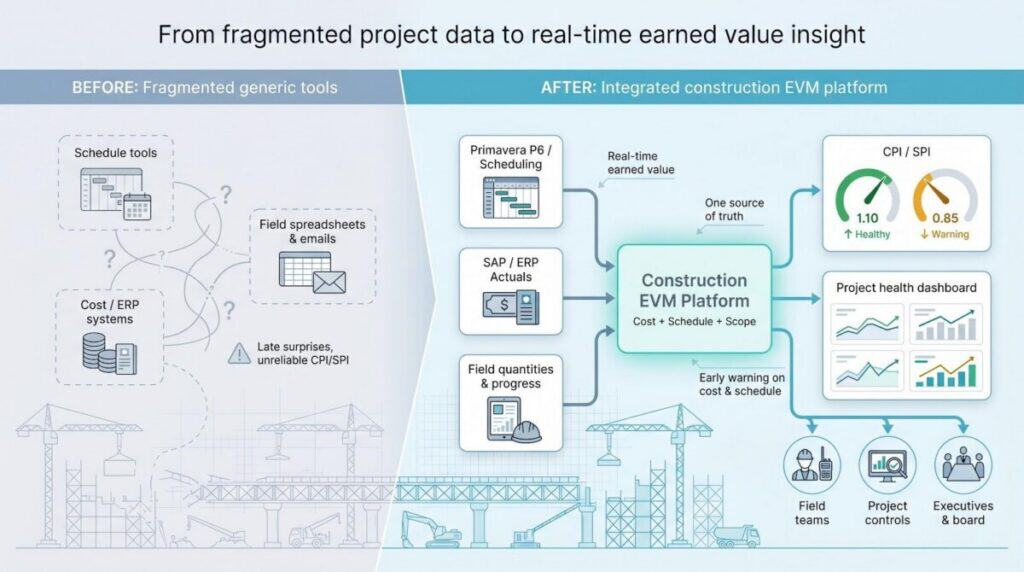
High Stakes and Relentless Complexity
Multi-billion-dollar infrastructure jobs refuse to fit tidy Gantt charts. They extend across years, continents, and hundreds of subcontractors, each one a potential delay or cost spike. Slip one week on steel deliveries and the ripple touches foundation crews, mechanical trades, system testing, and final commissioning. A ten-day delay can tighten cash flow, raise bond ratios, and drain contingency reserves.
Most generic project-management apps only track tasks. They cannot absorb tens of thousands of cost codes, quantity take-offs, and shifting contractual milestones once fieldwork begins. Capital projects, therefore, need Earned Value Management (EVM) platforms designed for construction—tools that link every poured cubic yard, purchased valve, and welding hour to its planned value in real time. When cost, schedule, and scope stay synchronized, CPI and SPI surface issues early enough to act.
How We Picked the Four Standouts
Choosing software is not about flashy feature lists. We asked one question: Does it cut budget surprises and schedule slips on complex builds?
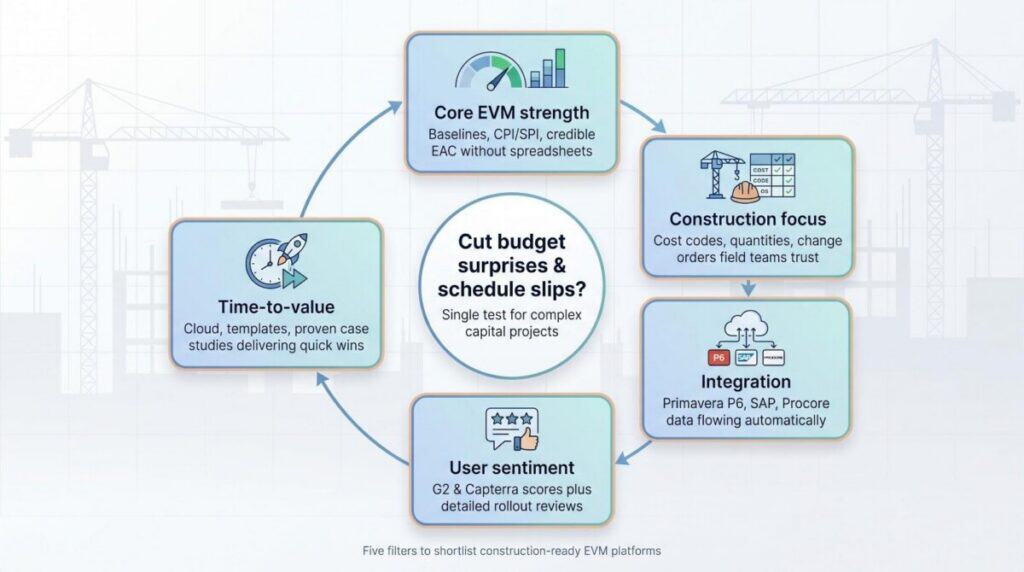
- EVM Core Strength: Our evaluation began with each platform’s foundational EVM capabilities. A viable contender must accurately calculate all key performance metrics, maintain locked baselines, and generate a credible Estimate at Completion — all without reliance on supplementary spreadsheets.
- Construction Focus: Next, we assessed each tool’s alignment with construction workflows. A platform that speaks natively in cost codes, progress quantities, and change orders earns field crew adoption. Any solution that resembled a generic IT project tracker retrofitted for construction was eliminated from consideration.
- Integration Ecosystem: We then evaluated each platform’s integration capabilities. Since Primavera P6, SAP, and Procore already form the backbone of most construction tech stacks, only platforms offering seamless, automated data exchange with these systems advanced to the next stage.
- User Sentiment Analysis: To ground our assessment in real-world experience, we analyzed more than 1,200 combined reviews across G2 and Capterra. Platforms earning high ratings supported by substantive user praise scored well, while recurring complaints regarding poor UX or difficult adoption resulted in point deductions.
- Time-to-Value Metrics: Finally, we evaluated each platform’s speed to deliver measurable results. Cloud-based deployment, pre-built templates, and published case studies demonstrating documented performance gains were weighted heavily in our final assessment.
After these five checks, four clear leaders remained. You’ll meet them in the next sections.
1. InEight Project Controls: Best Integrated Solution for Field-to-Boardroom Insight
Built for builders, InEight software automatically tracks industry-standard earned value metrics—pairing cost, schedule, and progress—so teams gain an objective, holistic view of project health. That origin shows the moment you open the dashboard. Planned Value, Earned Value, and Actual Cost update as foremen record quantities in the field, so there are no late-night spreadsheet merges and no “whose number is right” meetings—just one source of truth.
Because cost and schedule sit side by side, the software calculates CPI and SPI in real time. When either index drops below 0.90, the cell turns red before finance feels the hit, giving you time to correct performance instead of explaining overruns later. InEight delivers the tightest cost-schedule-field loop in this review. Here’s how:
- Integration Is Smooth: InEight exchanges data with Primavera P6, SAP, and Procore out of the box, so schedulers, accountants, and supers stay in their native tools while the platform keeps everything in sync.
- Construction-First Workflows Drive Adoption: Activities map to cost codes, change orders follow predefined approvals, and quantity tracking feels natural to superintendents, not like forcing a skyscraper into an IT tracker.
- Results Back the Claims: On an AECOM subway upgrade, standardising baselines in InEight cut set-up time by 50 percent and trimmed the controls team from thirty-five people to ten while still covering a five-year, multi-contract programme.
- Licensing Remains Flexible: Start with a few cloud seats under InEight NOW and add modules as confidence grows, creating quick wins on a pilot project without a board-level capital request.
If you are tired of re-entering data and want a tool every role, from weld inspector to CFO, can trust, InEight offers the tightest cost-schedule-field loop in this review.
2. Hexagon EcoSys: Best for Enterprise-Wide Portfolio Control

When your organisation juggles a dozen active megaprojects, the question shifts from “Can we calculate CPI on this bridge?” to “Can the board see risk across our capital plan by Monday?”
- EcoSys Answers That Need: Hexagon EcoSys acts as a project-controls nerve centre where costs, schedules, and change logs flow in from every site and roll up into a single portfolio view executives trust — no spreadsheet sanity check required.
- The Platform Enforces Consistency: Each project inherits the same cost-breakdown template, baseline approval workflow, and variance thresholds. If one job tries to push an unapproved change order, EcoSys flags it instantly, so surprises stop early.
- Drill-Down Stays Crisp: Start at a ten-billion-dollar program dashboard, click a red CPI, and within two hops, you are inside the control account reading the superintendent’s notes. Status meetings become problem-solving sessions, not data debates.
- Finance Teams Benefit as Well: Because actuals stream nightly from SAP or Oracle, the cash-flow curve shown to investors matches the general ledger, eliminating month-end reconciliations.
- Implementation Requires Discipline: You map data fields, set governance rules, and train teams to follow them. The payoff is real: after replacing siloed systems with EcoSys, Jacobs reported tighter forecasts because analysts studied trends instead of copy-pasting columns.
- Licensing Follows an Enterprise Subscription: You buy a corporate instance and add users as the portfolio grows. The investment is modest compared with one avoided overrun.
If your charter is to create a single version of project truth from head office to every job trailer worldwide, EcoSys delivers the governance that auditors and executives demand.
3. Contruent Enterprise: Best Fast-Track Path Off Spreadsheets
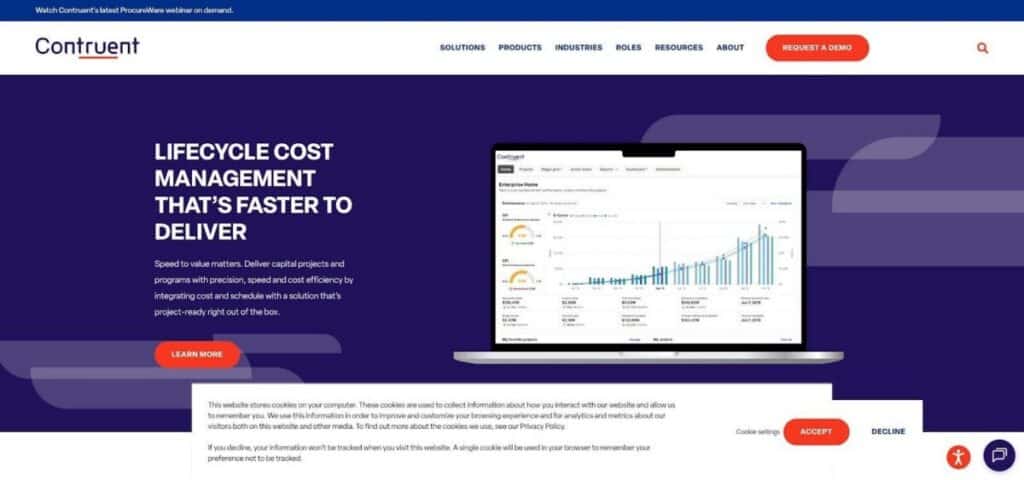
If your team still hunts month-end numbers across a maze of Excel files, Contruent turns on the lights. The platform, once known as ARES PRISM, earned credibility on projects such as London’s Crossrail and now runs in the cloud with a refreshed interface. Setup begins with best-practice templates, including cost-breakdown structures, baseline registers, and change logs.
Adjust them to match your coding scheme, import a Primavera schedule, and within days, the first CPI and SPI charts appear. No blank-page paralysis and no custom database builds. Contruent offers the most streamlined on-ramp from spreadsheets to structured EVM.
- Contruent Ties Cost and Schedule Tightly: Progress percentages flow from P6, pair with committed and actual costs, and generate instant variances. Because everything shares one database, a scope change ripples through budgets, forecasts, and contract values automatically, letting controllers analyse trends instead of chasing “final v5.xlsx.”
- Field Adoption Matters: The web interface lets engineers enter installed quantities on a tablet, while executives view roll-ups in a browser without heavy client software. That accessibility has boosted uptake on mining and energy jobs where bandwidth and patience run thin.
- The Pricing Model Keeps Friction Low: Subscription licences let you start with Cost and Progress modules, then add Contracts or Estimating later. Firms that hesitate at enterprise-scale costs often pilot Contruent on a single two-hundred-million-dollar project, prove the value, and expand portfolio-wide.
- Results Support the Story: After moving to the SaaS version, Contruent reported a forty percent jump in annual sales, evidence that owners and EPCs see tangible gains from its rapid time-to-value.
For project controls leaders who must escape spreadsheets quickly without overspending on software, Contruent offers the most streamlined on-ramp in this review.
4. Deltek Cobra: Best in Class for Contractual EVM Compliance
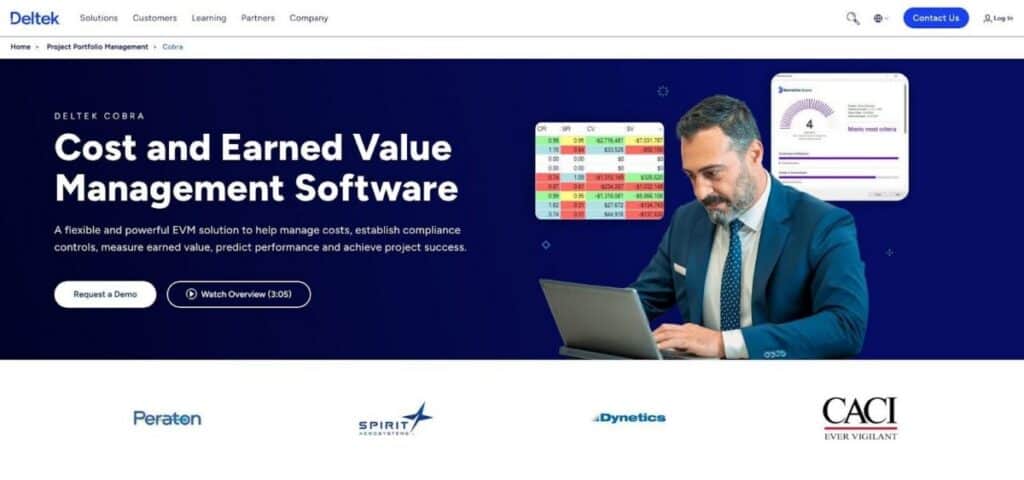
Some projects allow zero wiggle room. When you build for the Department of Energy or the Air Force, contracts cite the thirty-two ANSI/EIA-748 guidelines, IPMDAR formats, and monthly surveillance audits. Miss one field and invoices pause.
- Cobra Answers That Reality: Instead of covering every workflow, Cobra concentrates on precise earned value calculations and the audit trail that proves them.
- Load, Import, and Output With Precision: Load a Primavera or Microsoft Project baseline, import actual costs from Costpoint or SAP, and Cobra outputs BCWS, BCWP, ACWP, and the IPMDAR JSON files reviewers expect. Every baseline change is recorded, and each rate variance is traceable, so auditors can clear reports quickly, and cash keeps moving.
- The Learning Curve Is Genuine: Controllers must master cost sets, classes, and rate files. Once that discipline clicks, the software becomes reliable. Veterans joke, “If CPI looks wrong, the data is wrong; Cobra’s math is not.”
- Many Firms Position Cobra as the Cost Brain: In a wider stack — schedule in P6, analytics in Power BI, risk in Active Risk Manager — this modular approach satisfies contractual EVM without replacing systems the enterprise already trusts.
- Licensing Uses a Per-Seat Model: Available on-prem or in a Deltek-hosted cloud, seats cost more than average, yet the price is minor next to penalties for non-compliance or losing bid eligibility.
If your sponsor demands bullet-proof earned value numbers that the government can approve without debate, Cobra remains the reference tool. It shortens audits, keeps reports clean, and lets your team focus on performance instead of defence.
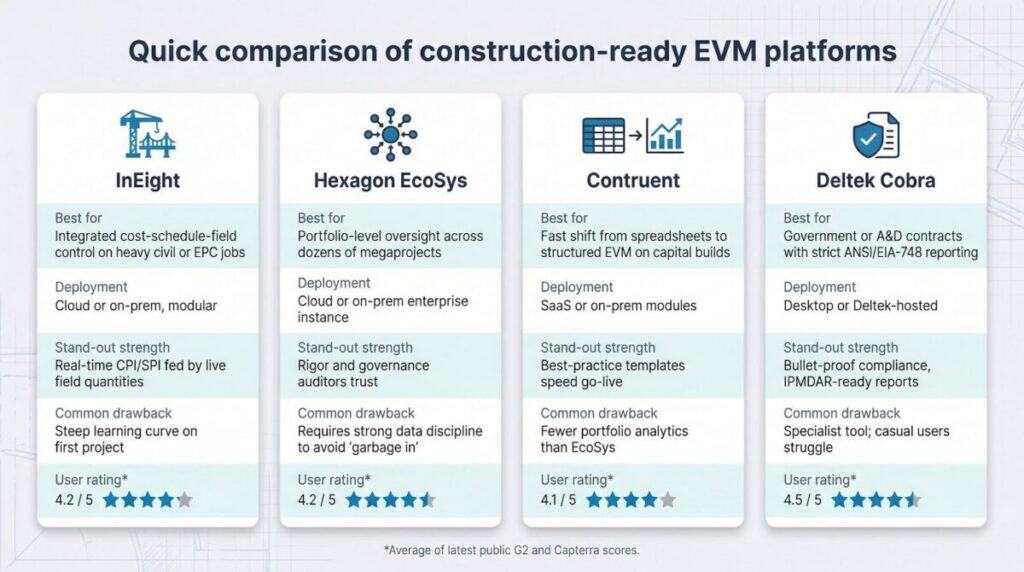
Quick Comparison at a Glance
| Platform | Best For | Deployment | Stand-Out Strength | Common Drawback | User Rating* |
| InEight | Integrated cost-schedule-field control on heavy civil or EPC jobs | Cloud or on-prem, modular | Real-time CPI/SPI fed by live field quantities | Steep learning curve on first project | 4.2 / 5 |
| Hexagon EcoSys | Portfolio-level oversight across dozens of megaprojects | Cloud or on-prem enterprise instance | Rigor and governance auditors trust | Requires strong data discipline to avoid “garbage in” | 4.2 / 5 |
| Contruent | Fast shift from spreadsheets to structured EVM on capital builds | SaaS or on-prem modules | Best-practice templates speed go-live | Fewer portfolio analytics than EcoSys | 4.1 / 5 |
| Deltek Cobra | Government or A&D contracts with strict ANSI/EIA-748 reporting | Desktop or Deltek-hosted | Bullet-proof compliance, IPMDAR-ready reports | Specialist tool; casual users struggle | 4.5 / 5 |
*Average of the latest public G2 and Capterra scores.
Conclusion
Choosing the right earned value management solution can make or break a capital construction project. Each of the four platforms reviewed here serves a distinct need: InEight excels at real-time field-driven cost and schedule control, Hexagon EcoSys delivers enterprise-grade portfolio oversight, Contruent offers a fast, template-driven transition from spreadsheets, and Deltek Cobra remains the gold standard for government and A&D compliance.
Before committing, assess your project scale, reporting requirements, and team’s technical capacity. Most vendors offer demos or pilot programs — take advantage of them. The right EVM tool won’t just track performance; it will give your team the visibility to act early and deliver on budget and on time.
Suggested articles:
- Strategies to Streamline Construction Projects for Maximum Efficiency
- Top 5 Mistakes in Construction Scheduling Software Projects
- How a Project Manager Can Hire a Construction Managing Contractor Without Getting Burned

Daniel Raymond, a project manager with over 20 years of experience, is the former CEO of a successful software company called Websystems. With a strong background in managing complex projects, he applied his expertise to develop AceProject.com and Bridge24.com, innovative project management tools designed to streamline processes and improve productivity. Throughout his career, Daniel has consistently demonstrated a commitment to excellence and a passion for empowering teams to achieve their goals.