
Passing the Certified Associate in Project Management (CAPM®) exam takes more than memorization, it takes consistent practice with realistic exam simulations. If you’re preparing for the CAPM, one of the smartest moves you can make is to take multiple CAPM practice exams before the real test. Studies and real-world experience show that candidates who complete several full-length practice tests triple their chances of passing on their first attempt.
Key takeaways
- Practice with 500 free questions. The quiz below has 500 original CAPM questions with an explanation for every answer, in your browser and with no sign-up.
- Know the exam format. The CAPM exam has 150 questions in 3 hours. Of these, 135 are scored and 15 are unscored pretest questions.
- Study by domain weight. Fundamentals make up 36% of the exam, business analysis 27%, agile 20% and predictive methods 17%.
- Use your score as a guide. PMI does not publish a passing score. Aim to score above 70 to 75% consistently, and review every mistake.
Try our free CAPM practice quiz below
This CAPM quiz works in your browser, with 500 original questions written to PMI’s current exam outline. Pick a quick quiz of 10, 25 or 50 questions, practice one exam domain, or take a timed 150-question exam simulation with flags and a question navigator. You see the right answer and an explanation after each practice question, plus your score by domain at the end, and your missed questions are saved so you can review them later. See what the 500 questions cover.
Practice with 500 free CAPM exam questions
Take a quick quiz, practice one exam domain, sit a timed 150-question exam simulation, or review the questions you missed.
Set aside 3 hours. You can flag questions and jump back to any question before you submit.
The questions you miss are saved in this browser so you can practice them again.
See what the 500 questions above cover
| Exam task and what it covers | Questions |
|---|---|
| Domain 1: Project Management Fundamentals and Core Concepts | 180 |
| 1.1Project life cycles and processesProjects, programs, portfolios and operations; predictive vs adaptive approaches; issues, risks, assumptions and constraints; project scope; the PMI Code of Ethics; projects as a vehicle for change | 45 |
| 1.2Project management planningCost, quality, risk and schedule planning; project vs product documents; milestones; resources; risk and stakeholder registers; closure and transition | 45 |
| 1.3Project roles and responsibilitiesProject manager, sponsor and team; the many roles of a project manager; leadership vs management; emotional intelligence | 35 |
| 1.4Following planned strategiesCommunication plans and risk responses in action; project initiation; business case and benefits planning | 30 |
| 1.5Problem-solving tools and techniquesEffective meetings, focus groups, standups, brainstorming and root cause analysis | 25 |
| Domain 2: Predictive, Plan-Based Methodologies | 85 |
| 2.1When to use a predictive approachOrganizational structures, process groups and their activities, project components | 25 |
| 2.2The project schedule and planCritical path, float, PERT estimates, the WBS and work packages, quality and integration management | 35 |
| 2.3Project controlsPredictive artifacts, baselines, change control and earned value (CV, SV, CPI, SPI, EAC) | 25 |
| Domain 3: Agile Frameworks/Methodologies | 100 |
| 3.1When to use an adaptive approachPros and cons, fit with the organization, process assets and environmental factors | 20 |
| 3.2Planning iterationsIteration planning, splitting work, turning a WBS into a backlog, adaptive progress tracking | 25 |
| 3.3Adaptive project artifactsBacklogs, burndown and burnup charts, task boards, velocity and the definition of done | 15 |
| 3.4Adaptive frameworksScrum, Extreme Programming (XP), Kanban and the Scaled Agile Framework (SAFe) | 25 |
| 3.5Task managementSuccess criteria and prioritization techniques such as MoSCoW | 15 |
| Domain 4: Business Analysis Frameworks | 135 |
| 4.1Business analysis rolesStakeholder roles, why roles matter, internal vs external stakeholders | 25 |
| 4.2Stakeholder communicationChoosing the right channel or tool, communication between teams | 20 |
| 4.3Gathering requirementsElicitation techniques, user stories, use cases, the traceability matrix and the product backlog | 30 |
| 4.4Product roadmapsUsing a roadmap and deciding what goes into each release | 20 |
| 4.5Methodology and business analysisThe business analyst’s role in predictive and adaptive projects | 15 |
| 4.6Validating requirementsAcceptance criteria and deciding when a product is ready for delivery | 25 |
| Total, across 4 domains and 19 tasks | 500 |
Domains and weights follow PMI’s CAPM Examination Content Outline (2023 exam update). All questions are original.
Why Practice Exams Matter
Taking CAPM practice exams is not just about testing your knowledge; it’s about training your mind to think the way the PMI® (Project Management Institute) expects you to think. The CAPM exam tests your understanding of project management concepts, processes, and terminology as outlined in the PMBOK® Guide (Project Management Body of Knowledge).
When you work through practice exams:
- You learn how to interpret tricky questions and eliminate wrong choices.
- You identify patterns in how PMI tests certain concepts.
- You get familiar with time management, which is critical in a 150-question, three-hour test.
- You train your brain to stay focused under pressure.
Tip: Always review the explanations for both your correct and incorrect answers. Understanding why an answer is right is as important as knowing the answer itself.
When to Take the CAPM Exam
Timing matters. You should schedule your CAPM exam when your practice test scores consistently show that you’re ready. As a general rule of thumb:
- Scored Over 70%: You’re ready to sit for the CAPM exam with confidence.
- Scored Below 70%: Continue practicing until your scores improve. Review your weak areas and focus on understanding the logic behind the questions you miss.
Keep a notebook or digital log of every mistake you make during your practice sessions. Write down what confused you, the correct answer, and why it’s correct. Over time, you’ll notice fewer repeat mistakes and better retention of project management principles.
About CAPM®
The Certified Associate in Project Management (CAPM®) is a globally recognized entry-level certification offered by the Project Management Institute (PMI®). It’s designed for professionals who want to demonstrate a foundational understanding of project management principles and methodologies.
Whether you’re new to the field or looking to formalize your experience, the CAPM certification helps you:
- Stand out in the job market.
- Build credibility as an aspiring project manager.
- Gain structured knowledge of project management processes.
- Show commitment to professional development.
Employers value CAPM holders because it signals that you understand standardized project management language and frameworks — the same ones used in major organizations worldwide.
What is CAPM® vs PMP® Certification?
Both PMP® (Project Management Professional) and CAPM® (Certified Associate in Project Management) are PMI®(Project Management Institute) certifications. This article will compare CAPM and PMP and discuss their similarities and differences. Learn more about CAPM Certification Training: 3 Day CAPM Boot Camp Course. In general, the PMP® is relevant to project managers who manage projects from start to finish.
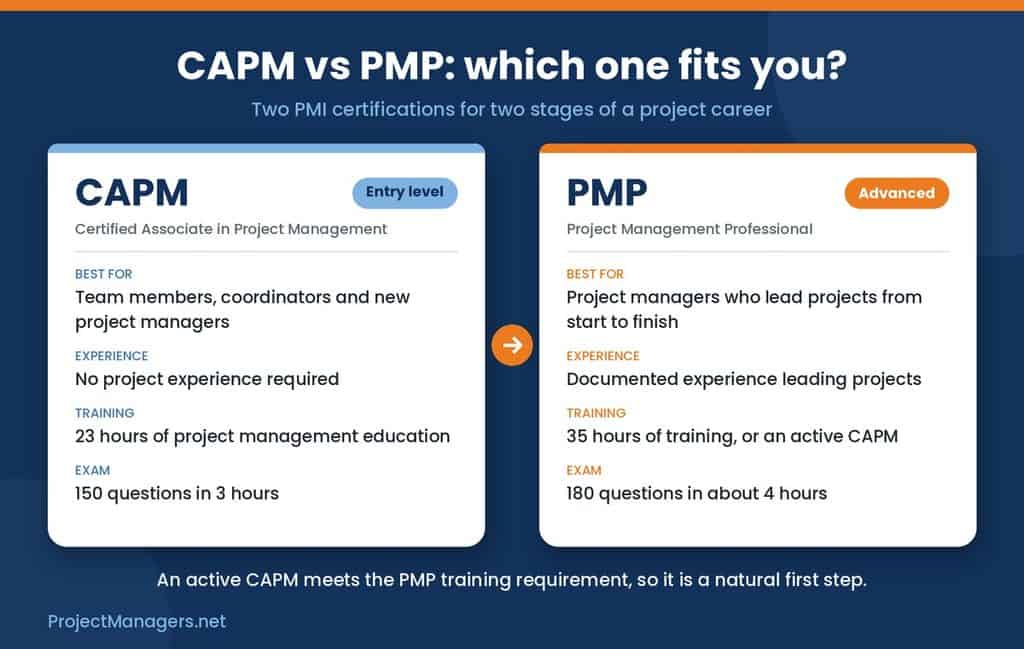
The CAPM is more suitable for individuals who participate in projects as sponsors, liaisons, coordinators, or provide expertise in a specific subject matter. The CAPM® is a great way to get introduced to project management processes and techniques. The PMP is an advanced certification suitable only for project managers, as the prerequisites require experience in all areas of the project life cycle.
Free CAPM Practice Questions and Resources
If you’re not ready to invest in a paid simulator, there are thousands of free CAPM practice questions available online. These free resources can still be extremely useful when used strategically. Below is a curated list of the best free CAPM question banks, including PDFs, sample tests, and online quizzes.
10free sources
5,300+practice questions
| Source | Number of questions | Link |
|---|---|---|
SimplilearnFree CAPM® Exam Prep Practice Testsimplilearn.com |
150 questions | Practice now on Simplilearn (opens in a new tab) → |
KnowledgeHutCAPM Practice Test (6 Practice Test Series)knowledgehut.com |
150 questions25 questions per series | Practice now on KnowledgeHut (opens in a new tab) → |
Exam TopicsPMI CAPM Exam Actual Questionsexamtopics.com |
1,102 questions | Practice now on Exam Topics (opens in a new tab) → |
Test-Questions.comCAPM Exam Preparation (83 Tests)test-questions.com |
830 questions10 questions per test | Practice now on Test-Questions.com (opens in a new tab) → |
Pocket PrepPMI CAPM® Exam Preppocketprep.com |
800 questions | Practice now on Pocket Prep (opens in a new tab) → |
Test Prep ReviewCAPM Practice Testtestprepreview.com |
15 questions | Practice now on Test Prep Review (opens in a new tab) → |
ITExamsCertified Associate in Project Management (PMI-100) (CAPM) Examitexams.com |
1,103 questions | Practice now on ITExams (opens in a new tab) → |
CertLibraryCertified Associate in Project Management (PMI-100) (CAPM) Examcertlibrary.com |
1,103 questions | Practice now on CertLibrary (opens in a new tab) → |
Practice QuizCAPM Project Management Exam Preppracticequiz.com |
37 questions | Practice now on Practice Quiz (opens in a new tab) → |
Certification QuestionsPMI CAPM Certified Practice Testcertification-questions.com |
10 questions | Practice now on Certification Questions (opens in a new tab) → |
All links open the source website in a new tab. Question counts were checked when this list was published and may change.
How to Use CAPM Practice Questions Effectively
Simply answering questions isn’t enough. You need a structured approach to make your preparation count. Follow this system to maximize your results:
- Start with Topic-Based Practice: Break down the CAPM syllabus (as per the PMBOK® Guide) and focus on one knowledge area at a time — like Scope Management, Risk Management, or Stakeholder Management. This builds confidence in smaller chunks before taking full exams.
- Track Every Mistake: Maintain a spreadsheet or notebook of every question you get wrong. Categorize by topic, the reason for the mistake, and the correct explanation.
- Simulate Real Exam Conditions: Take full-length exams in one sitting. No distractions. This trains your endurance and time management.
- Analyze Performance: Don’t just move to the next test. Spend as much time reviewing answers as you do taking the exam itself.
- Repeat and Refine: Keep practicing until your scores stabilize above 75%. This is a safe margin before scheduling your actual CAPM exam.
CAPM Test Prep Video
Common CAPM Exam Mistakes (and How to Avoid Them)
Preparing for the CAPM exam isn’t just about studying hard—it’s about studying smart. Many candidates lose valuable points by falling into common traps that could easily be avoided with better awareness and planning. Recognizing these mistakes early gives you a strong advantage. Even strong candidates fall into predictable traps. Avoid these mistakes:
- Cramming Too Late: CAPM requires conceptual understanding, not just memory. Start early.
- Ignoring PMBOK Updates: Make sure you’re studying the latest version of the PMBOK® Guide.
- Skipping Mock Exams: The real exam feels different — pressure, timing, and phrasing matter.
- Not Reviewing Mistakes: Reviewing only correct answers limits your growth.
- Neglecting Agile Concepts: The new CAPM exam includes Agile and hybrid methodologies — don’t skip them.
Final Tips for CAPM Success
Reaching exam day with confidence comes down to how consistently and deliberately you’ve prepared. Beyond memorizing concepts, you need to master how to think like a project manager. These practical tips will help you finish your preparation phase strong and perform at your best when it counts most.
- Consistency beats intensity. Study 1–2 hours daily rather than long weekend marathons.
- Join online CAPM study groups or forums like Reddit or PMI communities for peer support.
- Review PMBOK processes daily. Repetition builds long-term retention.
- Simulate exam timing. Learn to pace yourself — aim for one minute per question.
- Stay calm on exam day. If you’ve practiced right, you’ll recognize question patterns instantly.
Conclusion
Preparing for the CAPM exam is about consistency, not cramming. Real progress comes from mastering core concepts, not memorizing answers. Use practice exams to build confidence, spot weaknesses, and sharpen your understanding of PMBOK processes. Study regularly, stay updated with the latest exam content, and simulate real test conditions.
Combine free resources with quality simulators for a complete prep experience. Most importantly, approach the CAPM journey as professional growth, not just a test. Each hour you invest builds the discipline, mindset, and analytical skills of a future project leader. With focus, consistency, and the right strategy, passing the CAPM on your first attempt isn’t just possible—it’s expected.
FAQs
1. How Many Questions Are on the CAPM Exam?
The CAPM exam consists of 150 multiple-choice questions to be completed within three hours. These questions assess your understanding of project management concepts, PMBOK® Guide knowledge areas, Agile practices, and basic project terminology. It measures comprehension, not memorization, under timed exam conditions.
2. What Is the Passing Score for the CAPM Exam?
While PMI does not publish an official passing score, most experts agree that consistently scoring above 70–75% on reputable CAPM practice exams indicates readiness. Use simulators with detailed explanations to analyze weak areas and strengthen your conceptual understanding before scheduling your actual exam.
3. How Long Should I Study for the CAPM Exam?
On average, candidates need 6–8 weeks of focused study. Dedicating 1–2 hours daily ensures steady progress through all PMBOK® knowledge areas, Agile concepts, and mock exams. Regular practice builds confidence, reinforces comprehension, and improves test-taking stamina for the actual exam.
4. Can I Retake the CAPM Exam if I Fail?
Yes. PMI allows candidates to retake the CAPM exam up to three times within one year of the original application approval. Review your performance carefully before reattempting. Strengthen weak areas through mock exams, updated study materials, and detailed concept review.
5. Is the CAPM Certification Worth It for Beginners?
Absolutely. The CAPM certification demonstrates your commitment to professional growth and understanding of standardized project management practices. It’s ideal for beginners aiming to build credibility, strengthen resumes, and create a pathway toward more advanced certifications like the PMP®.
Suggested articles:
- Top 15 Best Project Management Certifications
- PMP Exam Prep: How to Pass the PMP Certification Exam
- 10 PMI Certifications to Boost Your Career in Project Management

Shane Drumm, holding certifications in PMP®, PMI-ACP®, CSM, and LPM, is the author behind numerous articles featured here. Hailing from County Cork, Ireland, his expertise lies in implementing Agile methodologies with geographically dispersed teams for software development projects. In his leisure, he dedicates time to web development and Ironman triathlon training. Find out more about Shane on shanedrumm.com and please reach out and connect with Shane on LinkedIn.