
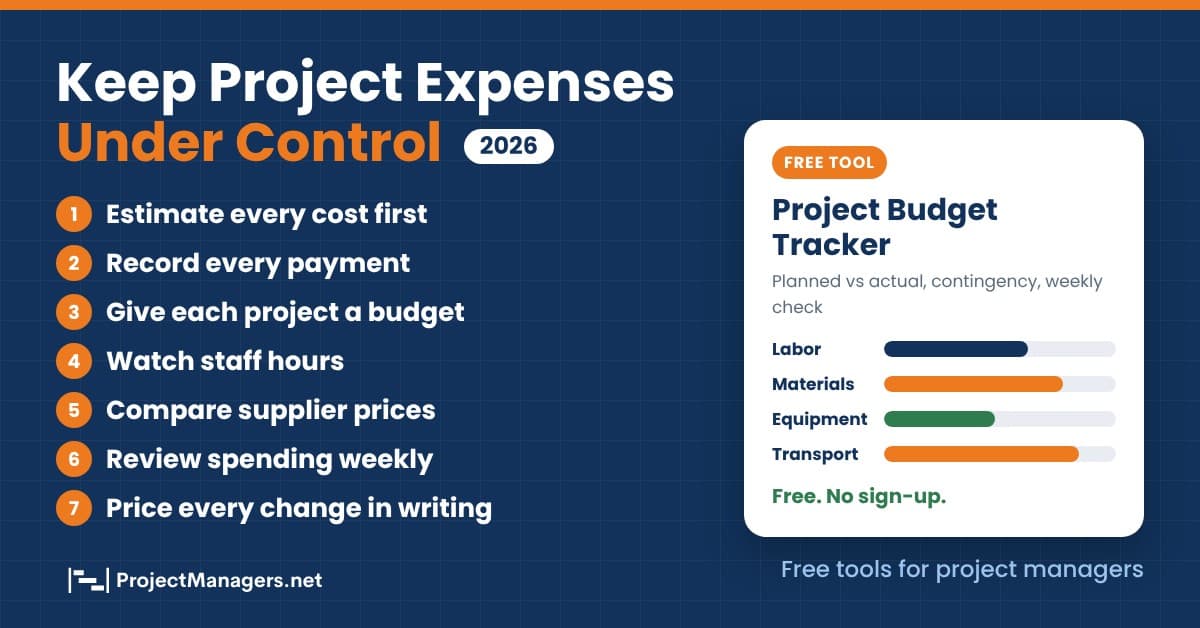
A project may look profitable on paper but still go over budget. Excess supplies, late deliveries, overtime, and small purchases can drive overspending. For a small business, these added costs can eat into profits and leave less money for other work. The trouble often starts when no one monitors daily spending closely. A few missed receipts or unplanned purchases may not seem important at first. But over time, they can create a real dent in your budget.
- Most overruns start small: list every cost before the project starts, use past invoices, and keep a 5 to 10% reserve for surprises.
- Record every payment the day it happens and give each project, and each part of it, its own budget so no overrun can hide.
- Compare actual spending with the plan every week, by category, instead of waiting for the final invoice.
- Price every client change and get it agreed in writing before the extra work starts.
You don’t need a big finance team to stay away from this issue. Just make sure you have a clear plan, keep good records, and check in often. These are some useful tips for keeping project costs down. The tips follow the life of a project, from the first estimate to the last invoice. Each one is simple, and together they keep your spending in view.
Work Out the Costs Before Starting
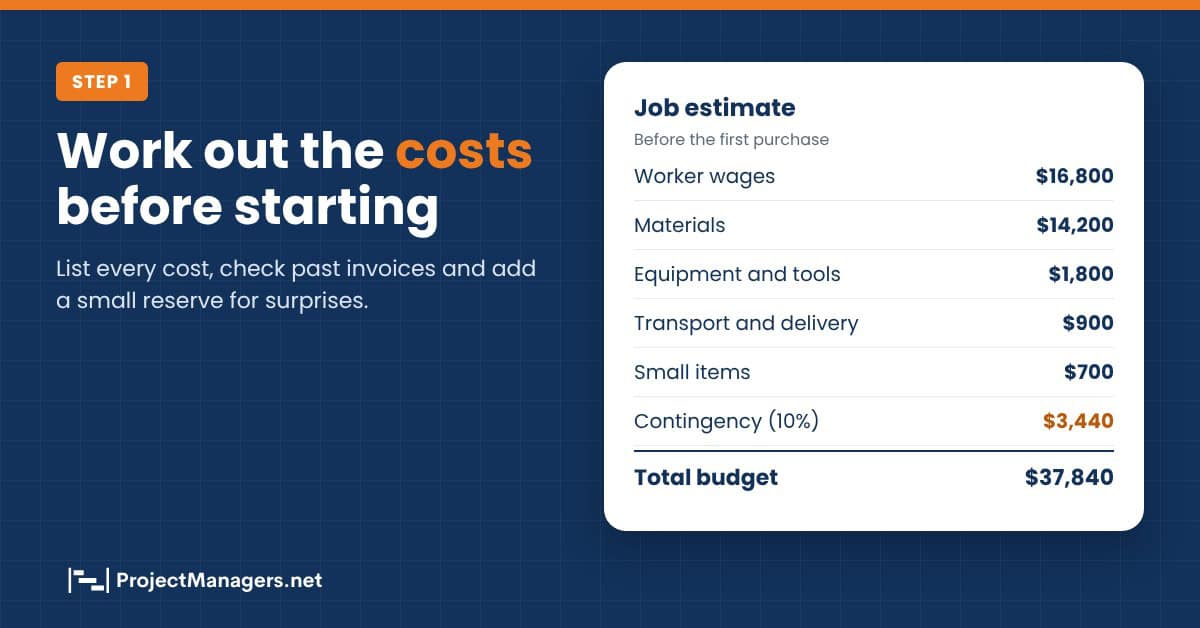
Before taking on a project, sit down and list everything you will need. Include worker wages, materials, tools, transport, equipment, and other costs. Do not leave out small items because they can add up later. Look at bills from past projects to make better cost estimates. If you spent more than planned on materials last time, find out why. It is also a sensible idea to keep some money aside for unexpected costs.
A machine may need repair, or a supplier may increase prices. You can deal with these problems without taking money away from other important things if you have a small emergency fund. A realistic estimate gives you a figure to measure against. Once the work starts, the next job is to record what you actually spend.
Oxford professor Bent Flyvbjerg tracked more than 16,000 projects in 136 countries. Most of them missed their numbers, and the typical cause was an estimate built on hope rather than on what similar projects really cost. His fix, reference class forecasting, is the big-project version of checking your old invoices: start from the actual results of comparable jobs, then adjust.
PM tip: Before you quote a new job, pull the final invoices from your last three similar projects and compare them with what you estimated. Use the gap to set your contingency.
Source: strategy+business, review of How Big Things Get Done (June 2023)
Keep Track of Every Payment
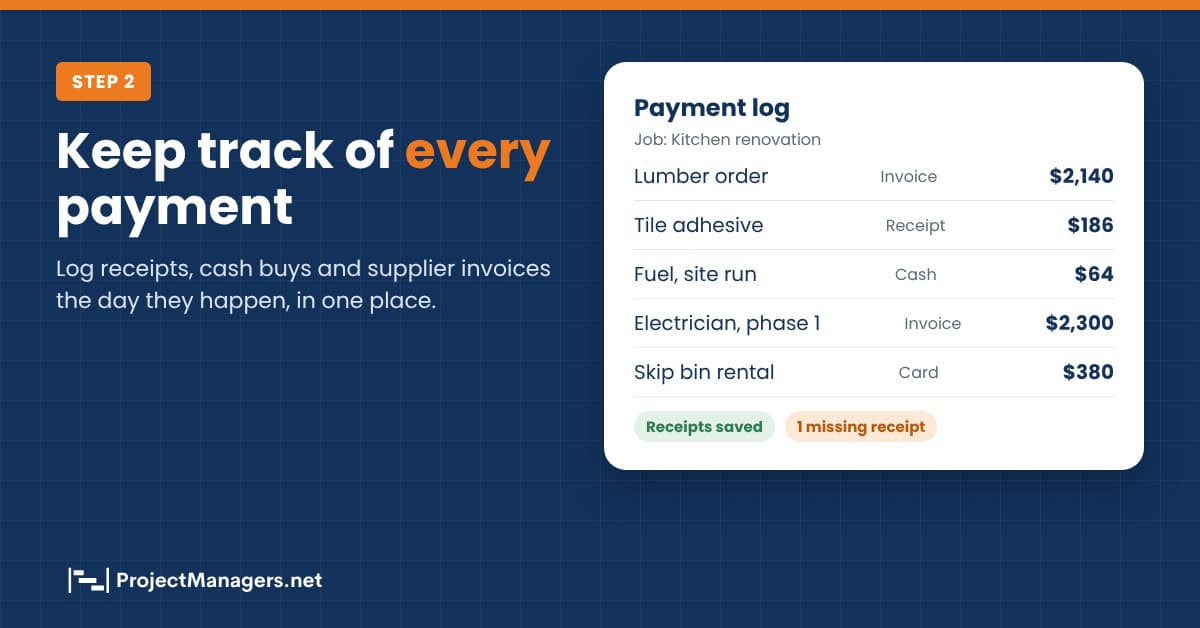
Make it a habit to record payments as soon as they happen. Save receipts, note down cash purchases, and keep supplier invoices in one place. You can use expense management software for small businesses to make this job easier. These tools help you record purchases, sort expenses, store receipts, and check spending reports.
This gives you a better view of your project costs without digging through piles of paperwork. Accurate records also make it possible to give each project its own budget. Without them, any comparison between planned and actual spending is only a guess.
The Association of Certified Fraud Examiners studied 1,921 fraud cases. Organizations with fewer than 100 employees had the second-highest median loss of any size group, largely because they have fewer controls. Billing schemes, such as fake or padded supplier invoices, were among the most common and often ran for about 18 months before anyone noticed. A clean payment log, matched to orders and deliveries, is one of the cheapest controls a project manager can add.
Good records also matter at tax time. The IRS generally asks businesses to keep records for 3 years, and employment tax records for at least 4 years.
PM tip: Before you approve a supplier invoice, check it against the purchase order and the delivery note. Three matching documents take a minute and stop most billing errors.
Source: ACFE, Occupational Fraud 2024: A Report to the Nations; IRS, How long should I keep records?
Give Each Project Its Own Budget
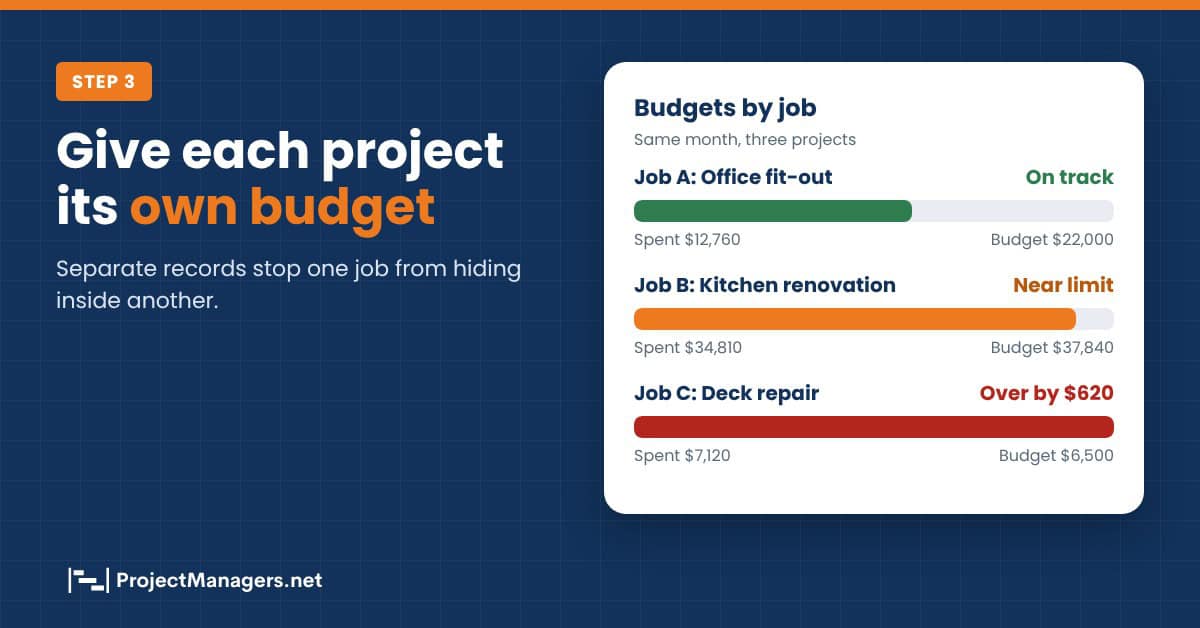
If you are working on several projects, do not mix their expenses. Keep separate records so you know which job is using the most money. This also stops a job that is running over from hiding inside another one, and it shows you which job needs attention first. Each job then has its own set of figures to check. Set a project budget for each part of the job. That makes it easier to spot any extra costs before they become a problem.
Your team will also know how much money they can spend without having to ask for approval every time. Clear budgets also show how much of each job is going on labor, which is the next place to look. A budget that everyone can see is much easier to follow. When the limits are written down, nobody has to guess what is allowed, and overspending is easier to spot early. Every person on the job can then check their own spending against the plan.
A contractor runs two jobs from one account. Combined, the numbers look healthy. Split by project, one job is already over budget with work still to do.
| View | Budget | Spent | What it shows |
|---|---|---|---|
| Both jobs together | $28,500 | $19,880 | 70% used, looks fine |
| Job A: office fit-out | $22,000 | $12,760 | 58% used, on track |
| Job B: deck repair | $6,500 | $7,120 | $620 over, 15% of work left |
PM tip: Give every project its own code in your accounting or expense software, and split larger projects by phase or work package so each project manager owns a number.
Source: ProjectManagers.net worked example (illustrative figures)
Watch Staff Hours and Workloads
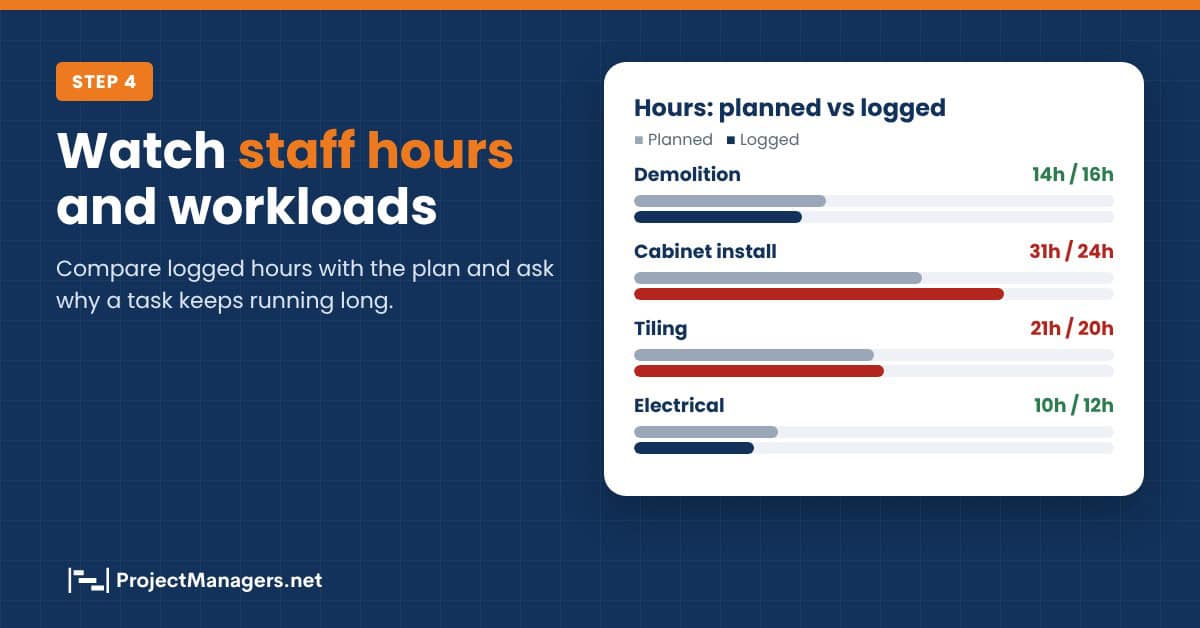
Labor costs can rise when workers spend too much time on a task. Give each worker a clear job and a deadline. Keep track of working hours and compare them with your original plan. If a task keeps taking longer, find out what is going wrong. Do not give your team too many things to do.
When you rush through work, you might make mistakes, and it takes time and money to fix them. Watching hours and workloads protects your labor budget, but it is only part of the picture. Materials need the same attention, starting with the price you pay.
Stanford economist John Pencavel studied detailed records of munitions workers. Below about 49 hours a week, output rose in step with hours. Past about 50 hours, each extra hour produced less, and output at 70 hours a week was barely higher than at 56. Overtime on a tired team often buys rework, not progress.
PM tip: When a task runs long, check the scope, the skills and the tools before you approve overtime. If the plan was wrong, update the estimate instead of stretching the team.
Check Prices Before Ordering Supplies

Do not place an order just because a supplier is familiar. Ask for prices from two or three vendors before making a large purchase. Compare the full cost, including delivery charges and product quality. A cheaper item may not be a good deal if it breaks easily or needs replacing. If you buy the same supplies often, ask suppliers for better rates or bulk discounts.
Just make sure you need the extra stock. Buying more than you can use may leave your cash tied up in unused materials. Careful buying keeps costs down at the start, but it needs regular follow-up. A weekly review is how you find out whether your plan is holding.
In its October 2026 Construction Inflation Alert, the Associated General Contractors of America reported sharp increases in the prices contractors pay for materials and fuel, driven by metals tariffs and energy costs. A quote that was right three months ago may already be out of date.
PM tip: Ask every supplier how long a quote stays valid, write that date into your estimate, and get fresh prices for any large order placed after it.
Source: AGC of America, Construction Inflation Alert (October 2026)
Check Spending Every Week
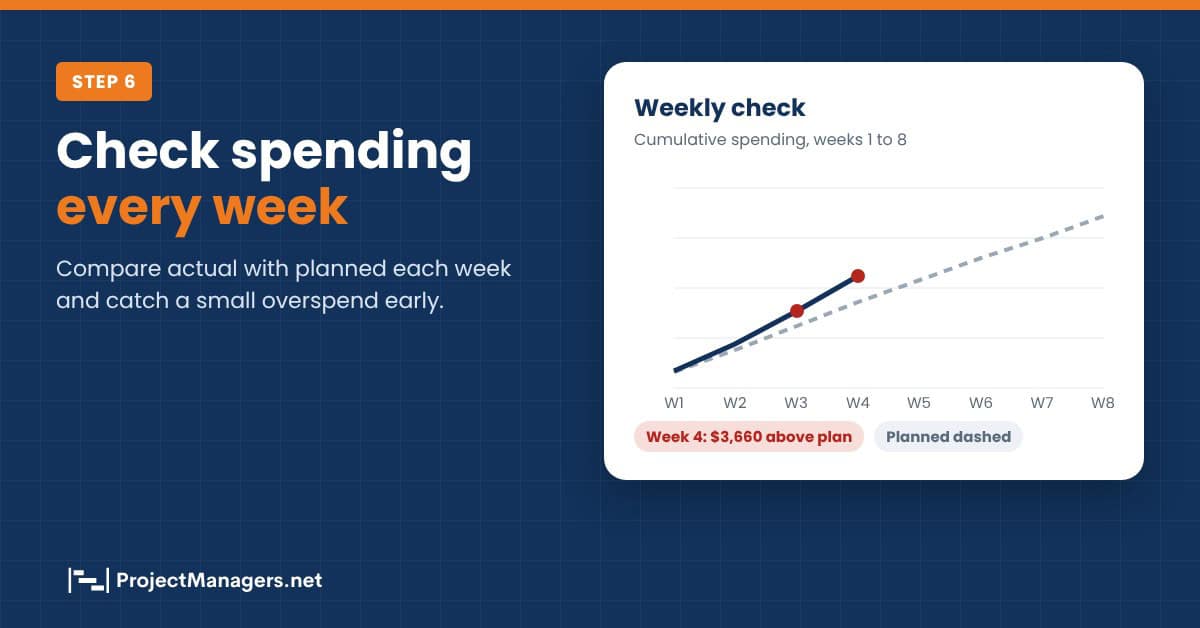
If you wait until the project ends to review costs, you may be surprised by how much you have spent. Make time each week to check how much money you have spent. Compare actual expenses with your planned budget to find any cost variance. Look at labor, materials, travel, and other costs separately. If one area is going over its limit, find out why.
A short meeting with your team may be useful. Don’t let these things build up; take them on early. Catching a small overspend in the second week is far easier than explaining a large one at the end. Weekly reviews can also show when the scope of the work is shifting, for example, when a client asks for something new.
PMI’s Pulse of the Profession survey of 4,455 project practitioners found that organizations lose almost a tenth of every dollar they spend on projects to poor project performance. High-performing organizations, the ones that track and control their projects closely, waste far less.
PM tip: Book a 15-minute budget check at the same time every week. Compare each category with the plan and write down one action for anything more than 10% over.
Source: PMI, Pulse of the Profession 2018: Success in Disruptive Times
Free Project Budget Tracker
Use this free tracker to run the weekly check described above. It compares planned and actual spending by category, counts committed costs before they are paid, adds only the change requests agreed in writing, and forecasts the final cost of the project from the work done so far. It works for a renovation, an event, a client website or any small project, and nothing you type leaves your browser.
- Enter the project name, contract price, contingency percentage and how much of the work is done.
- List your cost categories with the planned amount, what is committed (ordered but not paid) and what is already paid.
- Add client change requests. Tick “Agreed in writing” only when the price is signed off.
- Fill in planned and actual spending for each week, then read the verdict and the checklist. Copy the summary, download a CSV or print the tracker for your project review.
Keep Extra Work Under Control
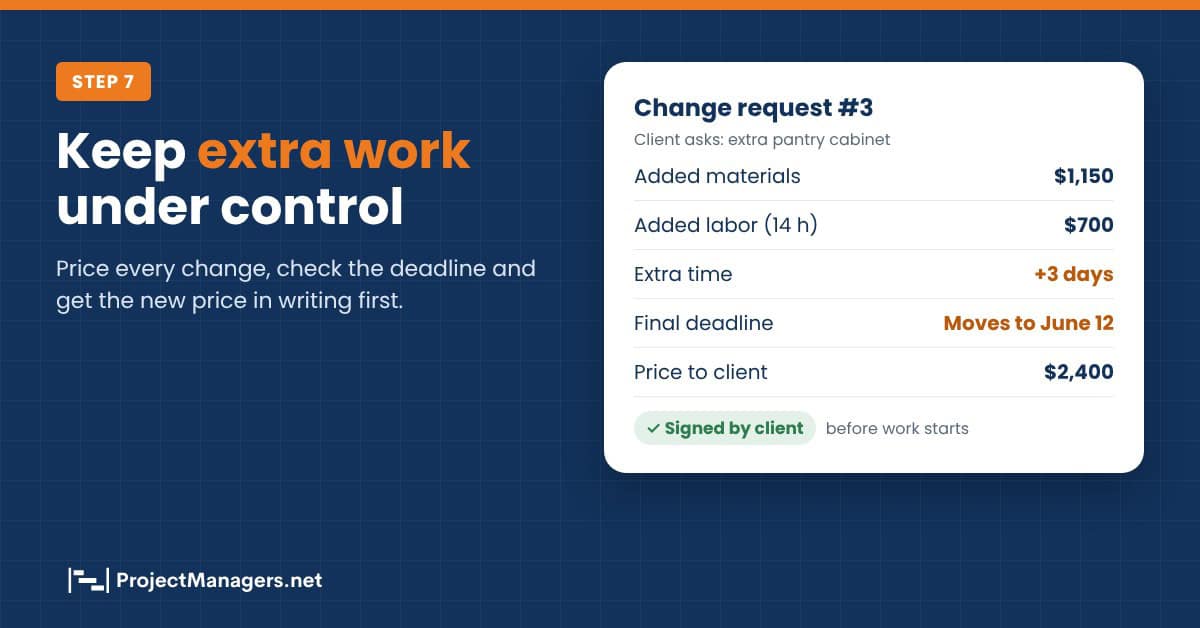
Clients sometimes ask for changes after a project has started. They may want another feature, more materials, or extra work that was not part of the first agreement. Before saying yes, work out the added cost. Check how much extra time your team will need and whether the change affects the final deadline.
Tell the client if the work costs more, and make sure everyone agrees on the new price before you move forward. Put the number in writing before any extra work starts. A clear, agreed price for every change keeps the budget honest and the client informed. It also protects the profit you planned for at the start.
The FBI’s Virtual Case File project was meant to replace an outdated case management system. After the September 11 attacks the requirements changed, and kept changing. In February 2005 the Justice Department’s Inspector General reported that the FBI had spent an estimated $170 million with no clear completion date, citing poorly defined and slowly evolving requirements. The project was scrapped two months later. Small projects fail the same way, just with smaller numbers.
Scope creep is common: in PMI’s 2018 survey, 52% of completed projects had uncontrolled changes to scope, up from 43% five years earlier.
PM tip: Use a one-page change request for every client ask: what changes, added cost, extra days, the new deadline and the client’s signature. No signature, no extra work.
Source: U.S. Department of Justice, Office of the Inspector General, Audit Report 05-07 (February 2005); PMI press release, February 22, 2018
Keep Your Project Costs in Check
Managing project expenses is not about cutting every cost. It is about knowing where your money goes and making sure you get value from it. Start with a realistic budget, record every payment, and check your spending each week. Keep your team informed and deal with extra costs as soon as they appear. These simple habits can help small businesses avoid waste, protect profit margins, and complete projects without unexpected financial cost.
When planning, tracking, and communication work together, surprises become rare, and budgets stay realistic. Over time, this steady discipline builds trust with clients, strengthens team accountability, and gives owners the confidence that every project supports long-term financial health.
Quiz: Test Your Project Cost Control Skills
Ten quick questions on the steps above. Pick an answer to see if you are right and why.
Video: The Basics of Project Cost Management
This short training video from ProjectManager explains cost baselines, estimates and how a project manager controls spending once the work starts. It is a good companion to the weekly check above.
Facts Worth Checking
Every figure in this article comes from a public source. Here is where to verify each one, checked November 14, 2026.
FAQ
What is the best way for a small business to keep project expenses under control?
Work out every cost before you start, record each payment as it happens, give every project its own budget, and compare actual spending with the plan every week. Most overruns come from many small costs that nobody tracked, not from one big surprise.
How much contingency should a small project have?
Many small businesses and project managers keep 5 to 10% of the estimated cost as a reserve, and more for work with many unknowns, such as renovations of older buildings. It is a planning habit rather than a fixed rule: base it on how far your past projects went over their estimates.
What is cost variance in a project?
Cost variance is the gap between what the work should have cost by now and what it actually cost. A negative number means you are spending more than planned. In earned value terms, cost variance equals earned value minus actual cost.
How often should a project manager review the project budget?
Once a week works for most small projects. A 15-minute check of each cost category against the plan is enough to catch an overspend early, and it also shows when the scope of the work is starting to shift.
What is a committed cost?
A committed cost is money you have agreed to spend but not paid yet, such as an order placed with a supplier or a signed subcontract. Counting it as spent stops it from surprising you when the invoice arrives.
How do I handle client change requests without losing money?
Before saying yes, work out the added cost, the extra time and the effect on the deadline. Tell the client the new price and get it agreed in writing before any extra work starts. Track each change separately so you can see its effect on the budget.
Suggested articles:
- Common Cost Tracking Mistakes That Lead to Budget Overruns
- The 5 Best Ways to Manage DISC Assessment Costs in a Project Budget
- How Project Managers Can Keep Payroll and Project Budgets on Track
- Bottom-Up Estimating in Project Management

Daniel Raymond, a project manager with over 20 years of experience, is the former CEO of a successful software company called Websystems. With a strong background in managing complex projects, he applied his expertise to develop AceProject.com and Bridge24.com, innovative project management tools designed to streamline processes and improve productivity. Throughout his career, Daniel has consistently demonstrated a commitment to excellence and a passion for empowering teams to achieve their goals.