
Companies turn to outside development teams when they lack the skills, the people, or the time to build software themselves. Signing the contract is the easy part. Once work starts, requirements cross company lines and often time zones, and every gap in understanding costs money. Project managers sit in that gap between business and vendor. Their setup in the first month shapes what follows.
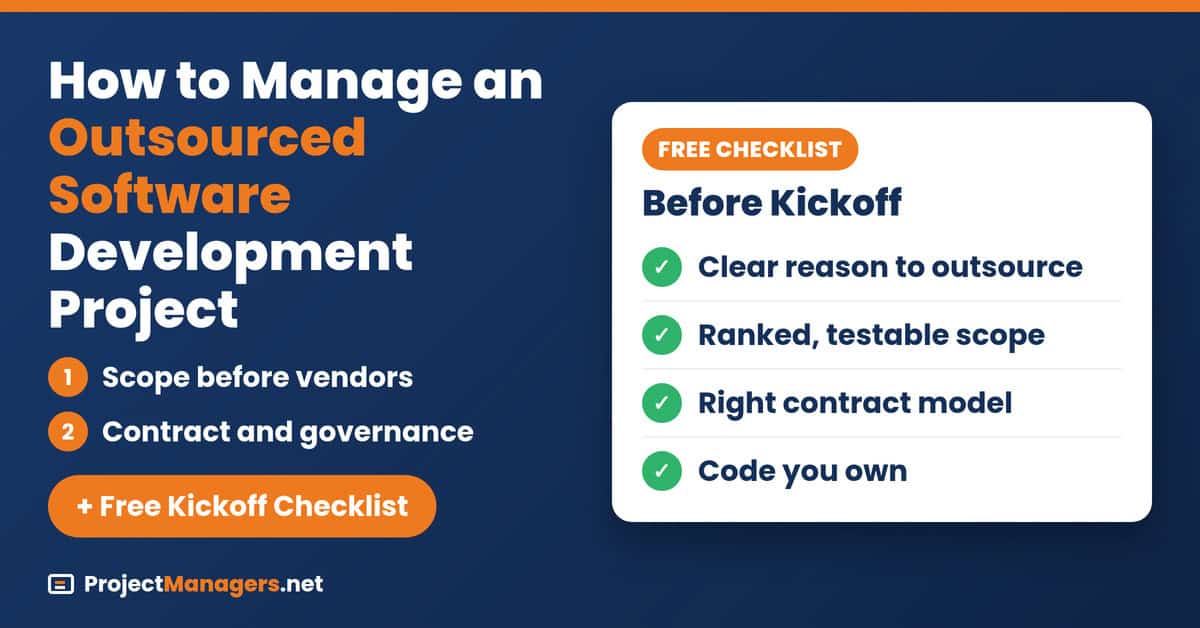
- Outsource for a Clear Reason: Skills you lack, a deadline you cannot meet, or a short-term need to scale are good reasons, while vague cost savings alone rarely hold up.
- Scope First, Vendors Second: Written goals, priorities, and acceptance criteria let vendors quote the same work, so their proposals can be compared fairly.
- Match the Contract to the Uncertainty: Fixed price suits a stable scope, time and materials suits evolving work, and a dedicated team suits long product roadmaps.
- Governance Protects Both Sides: Milestones, weekly reports, a change control process, and code in your own repository keep the project visible and limit lock-in.
This guide follows an outsourced software project from the decision to outsource through to steady delivery. It covers how to write a scope vendors can price, where to find and screen candidates, and what to test before you sign. Then it compares the three common contract models, sets out the governance and communication rhythm, and closes with the risks that sink these projects.
When Outsourcing Software Development Makes Sense
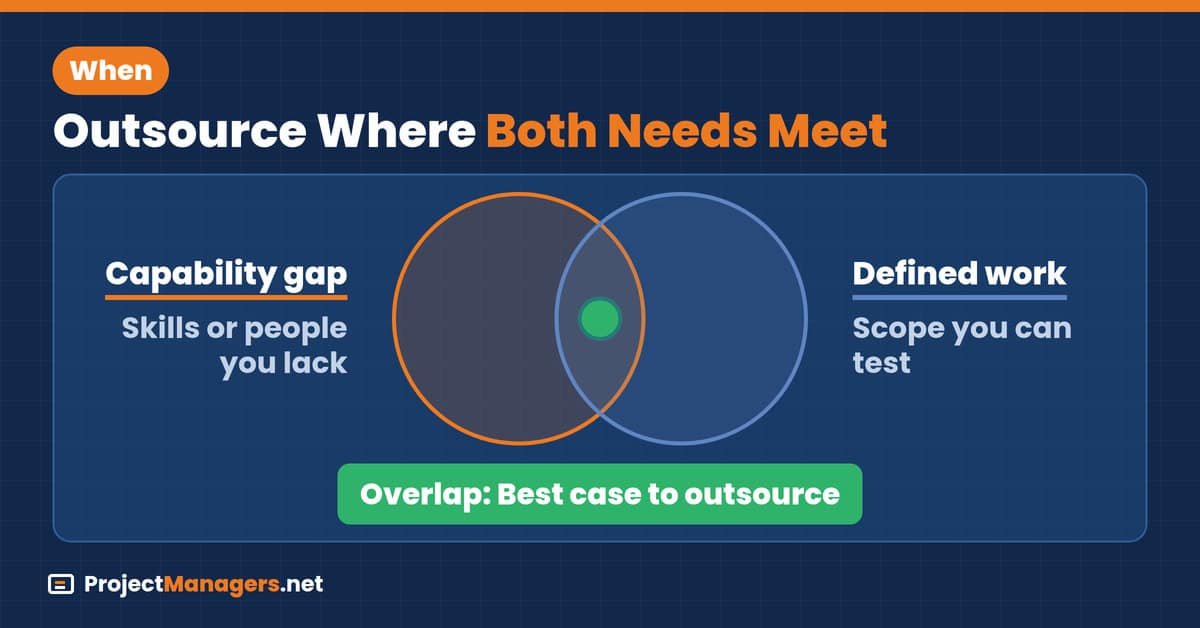
Outsourcing works best when the company knows what it wants built but cannot build it in time with its own people. Typical triggers are a missing skill such as mobile or data engineering, a launch date that hiring cannot meet, or a peak of work that will end after release. In each case, the outside team fills a gap with a known end.
Before making the decision, it helps to understand current outsourcing trends, pricing models, and market data. Industry publications such as Software Outsourcing Journal track how companies use outside development teams and what results they get.
Outsourcing is a weaker choice when the work is the core of the product and changes every week, or when nobody inside can judge the vendor’s output. If you only need one or two specialists who will join your own team, hiring individual contractors through remote hiring platforms can be simpler than contracting a whole agency.
These four situations usually justify an outside team:
- Skills Gaps: The project needs expertise the company lacks, such as a mobile app, a payment integration, or machine learning, and hiring would take months.
- Speed to Market: A vendor with a ready team can start within weeks, while recruiting and onboarding in-house developers often delays the first sprint.
- Cost Control: Paying for a team only while the project runs can cost less than permanent salaries, as long as management time and rework are counted too.
- Scaling the Team: An outside team can absorb a temporary peak, such as a platform rebuild, and step back when the work returns to normal levels.
Real-Life Example: A regional insurer wanted a customer mobile app, but its six-person IT team maintained only internal systems and had no mobile experience. The project manager compared six months of recruiting with a vendor that had built similar apps. The company outsourced the app, kept one internal developer on the vendor’s team, and planned for that developer to own maintenance after launch.
Define Requirements and Scope Before Contacting Vendors
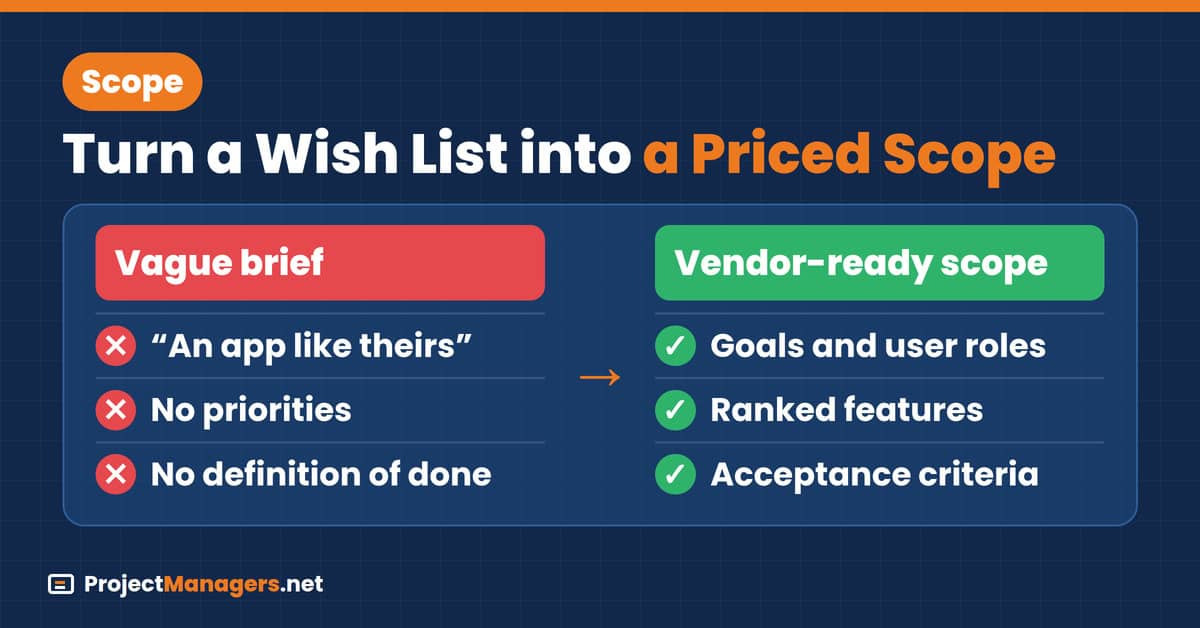
Vendors can only price what you describe. A brief that says “build an app like our competitor’s” produces quotes that differ by a factor of three, because each vendor fills the gaps with its own assumptions. A short, structured requirements document gives every candidate the same picture and makes the later comparison of proposals far more meaningful.
The document does not need to be a full specification. It needs the business goals, the main user roles, the features ranked by priority, and the quality expectations such as security, performance, and accessibility. Regulated products need more detail on compliance, as any fintech software development project shows, so involve legal and security reviewers before the brief goes out.
Put these items in the brief before any vendor sees it:
- Business Goals: State the problem the software solves and how success will be measured, such as fewer support calls or a launch date.
- Ranked Features: Sort features into must-have, should-have, could-have, and will-not-have, so vendors know what can move if the budget runs short.
- Acceptance Criteria: Describe how each main feature will be tested and accepted, which becomes the basis for milestone payments later.
- Constraints: List the budget range, deadline, required technologies, integrations, and any data that must stay inside your systems.
Real-Life Example: A logistics company sent its first request for proposals with a two-page wish list and received quotes ranging from 80,000 to 260,000 dollars. The project manager rewrote the brief with ranked features, user roles, and acceptance criteria for each screen. The second round of quotes fell within a much narrower range, and the proposals could finally be compared line by line.
Research and Shortlist Software Development Vendors
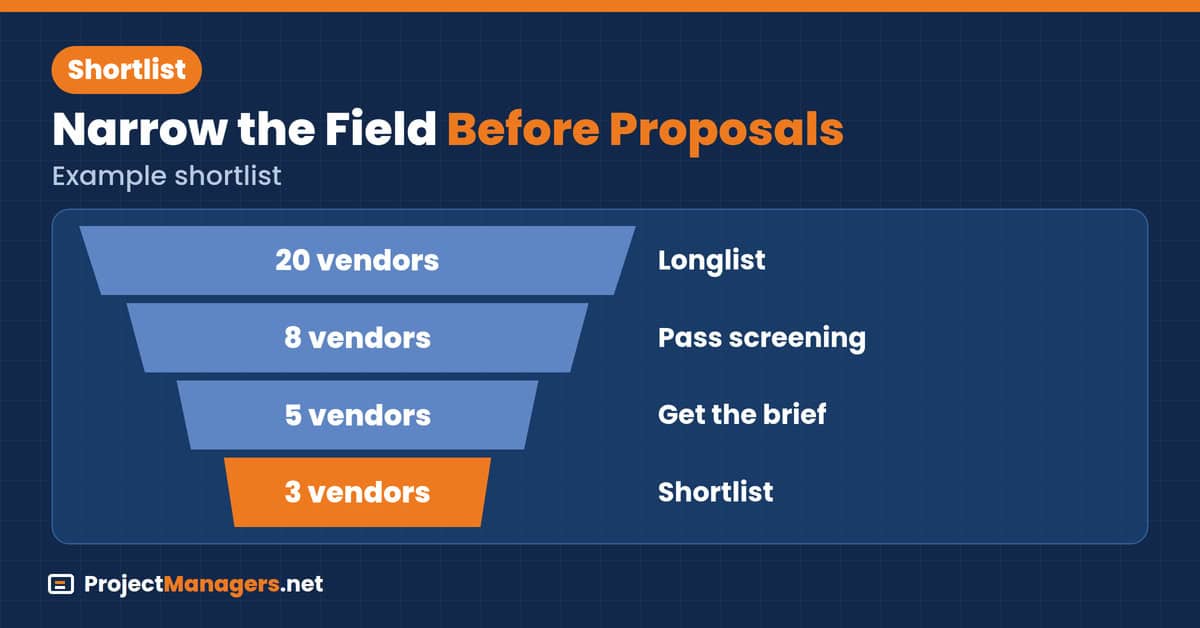
A good shortlist starts wide and narrows quickly. Collect candidates from referrals by peers who have outsourced similar work, from people in your network who have managed vendors, and from published rankings. Aim for a longlist of fifteen to twenty names, then remove any vendor that lacks experience with your technology, product type, or project size.
Directories that rank top software development companies by expertise, location, and client reviews are a practical starting point for building your shortlist.
Screen the longlist against a few pass or fail checks before you invest time in calls. Look for case studies close to your product, a team size that suits your budget, and rates within your range. Send the requirements document to the five or so vendors that pass, along with a deadline and the questions every proposal must answer.
Use these filters to move from longlist to shortlist:
- Relevant Experience: Keep vendors that have delivered products of similar type and complexity, not just a long list of technologies.
- Team Size Fit: A five-person project can get lost at a very large firm, while a tiny agency may struggle to staff a twelve-month program.
- Rates and Budget: Drop vendors whose typical rates put your budget out of reach before anyone spends time on proposals.
- Same Questions for All: Ask every shortlisted vendor to answer the same proposal questions, so the answers can be compared side by side.
Real-Life Example: A healthcare startup project manager built a longlist of eighteen vendors from peer referrals and published rankings. A one-hour screen against experience, team size, and rates cut the list to six, and five received the requirements document. Three strong proposals came back within two weeks, and the team spent its evaluation time only on vendors that could actually do the work.
Evaluate Candidates Beyond the Sales Pitch
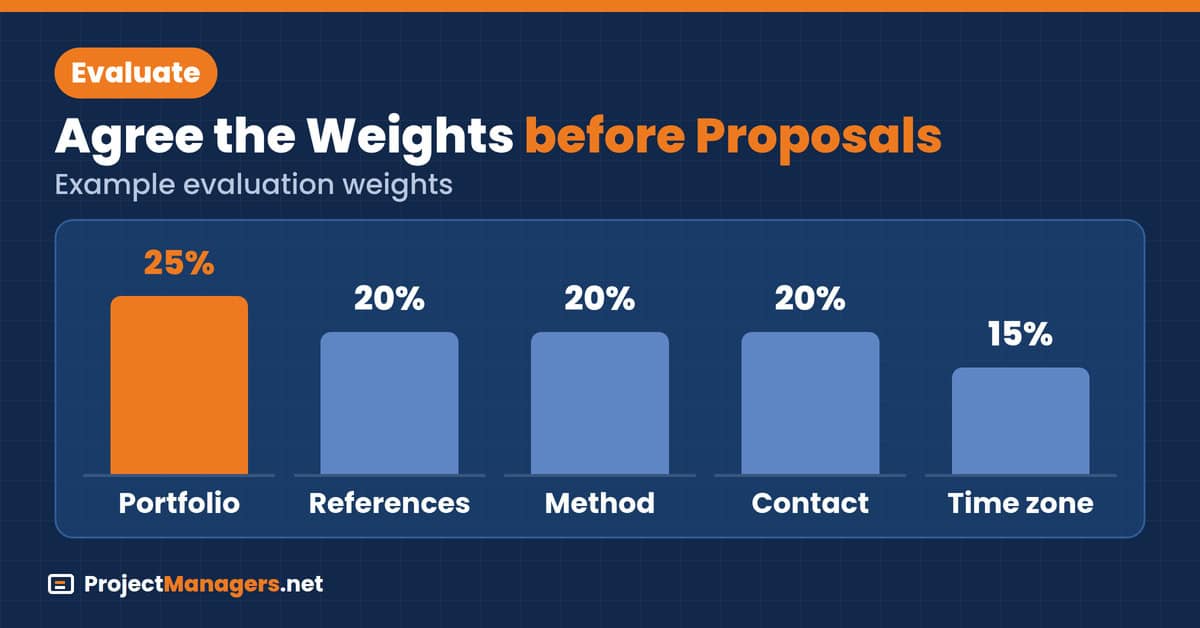
Proposals all promise quality, so the evaluation has to test the claims. Agree on the criteria and their weights before the proposals arrive, so nobody bends the weights toward a favorite later. Portfolio, references, delivery method, communication, and time zone overlap cover most of what matters, with security checks treated as pass or fail rather than scored.
Talk to the people who would do the work, not only the sales team. Ask the proposed lead developer to walk through a past project, including what went wrong. Call two or three references and ask how the vendor handled a missed deadline or a disputed change. For larger projects, a paid trial sprint of one or two weeks shows real working habits.
Score each shortlisted vendor on these points:
- Portfolio: Review live products or code samples close to your project, and ask which people on the proposed team built them.
- References: Speak with past clients about problems as well as successes, and check how long those clients stayed with the vendor.
- Methodology: Ask how the team plans sprints, reviews code, tests releases, and reports progress, and request a sample status report.
- Communication: Judge clarity and response time during the sales process, because it rarely improves after the contract is signed.
- Time Zones: Confirm at least two to three hours of daily overlap with your team for questions, reviews, and quick decisions.
Real-Life Example: A retail chain shortlisted three vendors with nearly identical proposals and prices. The project manager ran a paid one-week trial sprint with the top two on the same small feature. One vendor asked clarifying questions on day one and demoed working code on day four, while the other went silent until the deadline, which made the final choice straightforward.
Choose the Right Contract Model
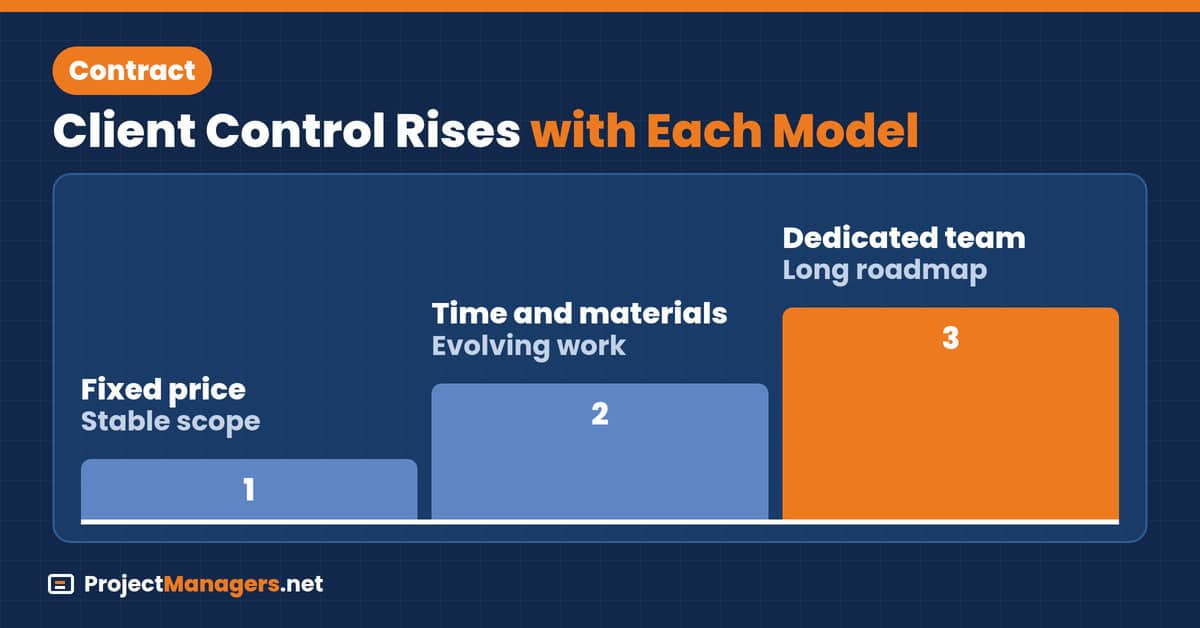
The contract model decides who carries the risk when the plan changes. Fixed price puts cost risk on the vendor but makes every change a negotiation. Time and materials bills the hours actually worked, which keeps scope flexible but moves budget risk to you. A dedicated team rents a full team by the month, directed by your own product owner.
Pick the model by how stable the scope really is. A small, well-defined build such as a marketing site or an integration suits fixed price. A new product whose features will change after user testing suits time and materials with a monthly cap. A roadmap that runs for years usually suits a dedicated team that keeps its product knowledge over time.
Compare the three models on these points:
- Fixed Price: Best for a stable scope with clear acceptance criteria; expect the vendor to add a buffer and to charge for each change request.
- Time and Materials: Best for evolving work; protect the budget with a monthly cap, weekly timesheets, and a backlog you prioritize yourself.
- Dedicated Team: Best for long product roadmaps; you direct the team’s work, so you also need an internal product owner with time to lead it.
- Hybrid Contracts: Many projects start with a fixed-price discovery phase, then switch to time and materials once the scope is clearer.
Real-Life Example: A software company asked for a fixed price on a new analytics product whose features were still being tested with customers. Within two months, change requests had added almost a third to the contract value. The project manager renegotiated to time and materials with a monthly cap, and the team spent its meetings on priorities instead of arguing over change orders.
Put Governance in Place Before Work Starts
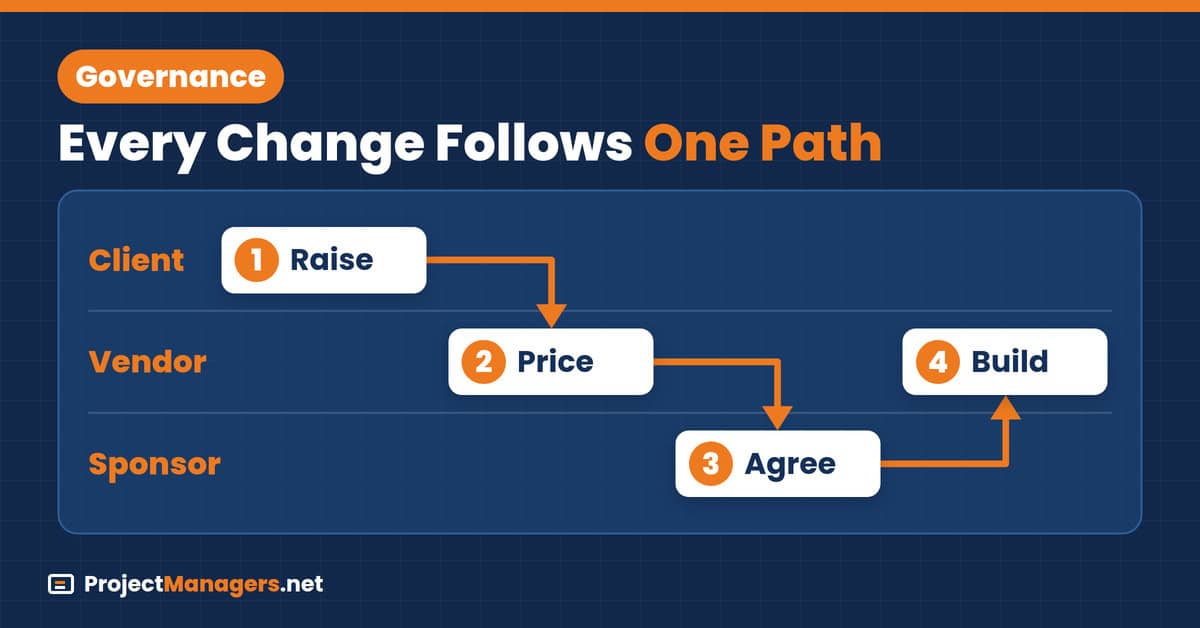
Governance is the set of agreed rules for how progress is shown, how changes are approved, and how work is accepted. Deloitte’s 2024 Global Outsourcing Survey of more than 500 executives found that 83% already use AI in their outsourced services, yet benefits have been limited by gaps in governance and contracting. Clear rules matter as much as talent.
Write the rules into the contract and the kickoff plan. Tie payments to milestones with acceptance criteria, ask for a weekly status report in a fixed format, and set up a change control process with a written impact estimate for every request. Agree a testing window for each milestone, such as ten business days, so acceptance never drifts.
Build these four controls into the project from day one:
- Milestones and Payments: Link each payment to a working, tested deliverable rather than to elapsed time or hours billed.
- Weekly Reporting: Ask for progress against plan, a red, amber, or green status, open risks, and decisions needed from your side.
- Change Control: Log every change request, get a cost and schedule estimate from the vendor, and approve it in writing before work begins.
- Acceptance Criteria: Test each milestone against the criteria in the brief, record defects, and sign off only when the agreed tests pass.
Real-Life Example: A public transport operator outsourced a ticketing app with payments tied to monthly invoices rather than deliverables. After four months, half the budget was spent, and no feature had passed testing. The new project manager restructured the contract around five milestones with acceptance tests, and the vendor began demoing working features every two weeks to unlock each payment.
Manage Communication and Collaboration with the Vendor Team
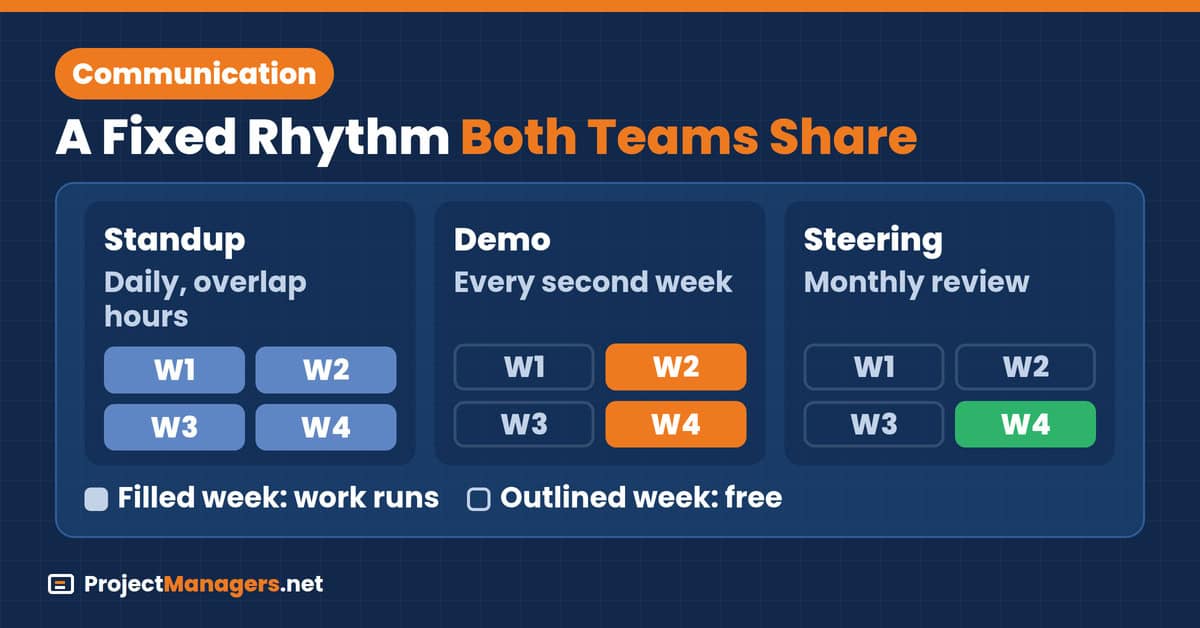
An outsourced team cannot pick up hallway context, so everything it needs must be written down or said in a scheduled meeting. Name one point of contact on each side, keep a single shared backlog, and log decisions where both teams can find them. Schedule standups inside the daily overlap hours so blockers never wait a full day.
Cultural habits shape how problems surface. Some teams avoid saying no or reporting bad news directly. Ask specific questions such as “What could stop this from shipping on Friday?” instead of “Is everything on track?” Teams that weigh the pros and cons of a distributed international team know that trust grows through demos and visible progress.
Keep collaboration steady with these habits:
- Single Points of Contact: One project manager on each side owns communication, so questions do not scatter across email and chat.
- Shared Tools: Use one backlog, one chat channel, and one document space that both companies can access with the same permissions.
- Fixed Meeting Rhythm: Hold daily standups in overlap hours, sprint demos every two weeks, and a monthly steering review with the sponsor.
- Written Decisions: Record every decision with its date and owner in a shared log, so nobody has to rely on memory of a call.
Real-Life Example: An e-commerce team worked with a vendor eight hours ahead and lost a day on every question sent by email. The project manager moved the daily standup to the two shared morning hours and created one chat channel for both teams. Answers now arrived the same day, and the next sprint closed with every committed story finished.
Common Outsourcing Risks and How to Avoid Them
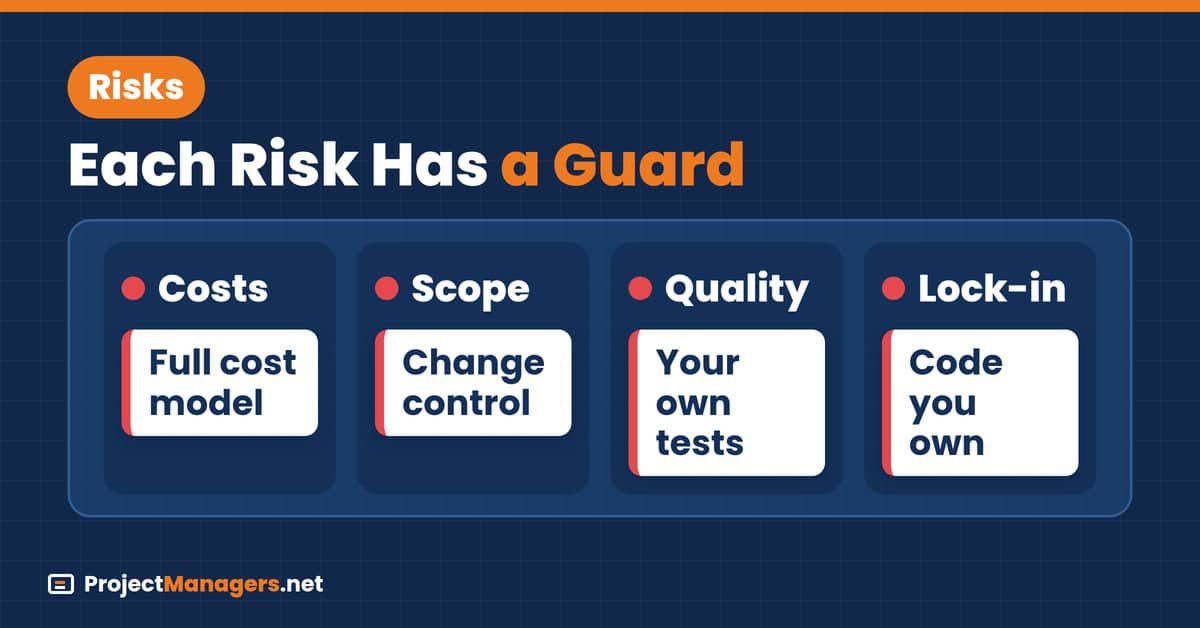
Most outsourcing failures come from a handful of predictable risks. Hidden costs appear when management time, onboarding, rework, and infrastructure are left out of the business case. Scope creep grows when small requests bypass change control. Quality slips when testing is left to the vendor alone, and lock-in sets in when only the vendor understands the code.
Each risk has a guard you can set before signing. Build a full cost model that includes your own team’s time, keep every change in the change log, and run your own acceptance tests on each milestone. Against lock-in, keep the code in your repository from day one, require documentation as a deliverable, and agree on an exit and handover plan.
Watch for these warning signs and responses:
- Hidden Costs: Add internal management time, knowledge transfer, licenses, and a rework buffer to the vendor quote before you compare options.
- Scope Creep: Route every request, however small, through change control, and review the change log at each steering meeting.
- Quality Issues: Ask for automated tests and code reviews in the contract, and have your own developer or tester check each release.
- Vendor Lock-In: Own the repository, cloud accounts, and intellectual property, and make handover documentation part of the final milestone.
Real-Life Example: A financial services firm ended a three-year vendor relationship and found that the build servers, cloud account, and only copy of the code all belonged to the vendor. The handover took four months and a large transition fee. On its next outsourced project, the project manager required the code and cloud accounts to sit under the firm’s own ownership from the first sprint.
Outsourced Project Kickoff Checklist
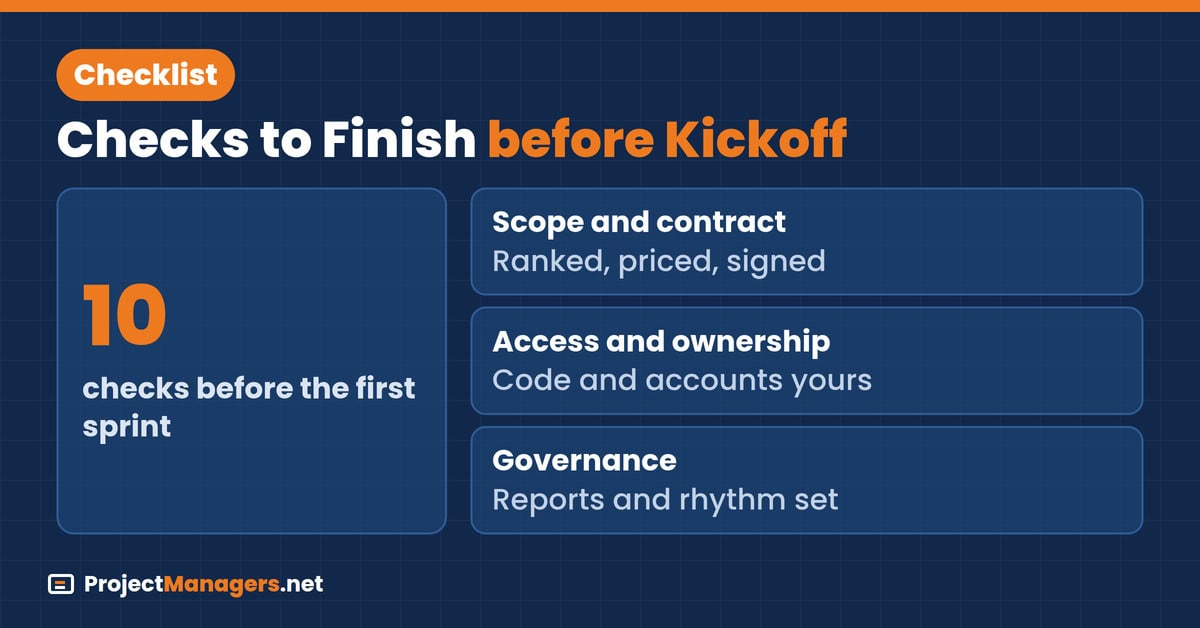
Run through this checklist in the week before the vendor starts, ideally with the vendor’s project manager on the call. Each item closes a gap that tends to cause trouble in the first month, from unclear acceptance to missing repository access. Tick the items as you confirm them, and hold the kickoff until every box is ticked.
- Ranked Scope Makes Changes Easier to Price: When priorities and acceptance criteria are written down, a change request can be weighed against what it replaces.
- Ownership Reduces Lock-In: Keeping the code, accounts, and documentation under your control makes a later vendor change less disruptive.
- A Fixed Rhythm Surfaces Problems Sooner: Regular demos and status reports help both teams spot slipping work while there is still time to adjust.
Real-Life Example: A project manager at a property software company ran this checklist with a new vendor a week before kickoff. Three items failed: the vendor planned to host the repository, the acceptance window was missing, and no exit terms existed. All three were fixed in a contract amendment before the first sprint, when changes cost an email rather than a dispute.
Video: Why the Top-Scoring Vendor Can Be the Wrong Choice
Zoolatech published this eleven-minute episode in November 2026 for delivery, security, and procurement teams that choose development partners. It explains how to separate must-have checks from scored criteria, agree on weights before proposals arrive, and interview the engineers who would do the work. It also covers reference calls, paid pilots, and why exit terms belong in the first negotiation.
Choosing a Software Development Partner: When the Highest Score Picks the Wrong Team (Zoolatech, 11:34)
How to keep must-have checks, security evidence, reference calls, paid pilots, and exit terms from getting lost inside a weighted vendor score.
Outsourced Software Development FAQs
Outsourced Software Development FAQs
When Should a Company Outsource Software Development?
Outsource when the project needs skills you lack, a deadline hiring cannot meet, or extra capacity for a limited period. Keep core product work in-house when it changes constantly and nobody inside could judge the vendor’s output.
What Should Be in a Requirements Document for Vendors?
Include the business goals, main user roles, features ranked by priority, quality expectations such as security and performance, and the budget range, deadline, and technical constraints. Add acceptance criteria for each main deliverable.
How Many Vendors Should Be on a Shortlist?
Start with a longlist of fifteen to twenty names, screen it against experience, team size, and rates, and send the requirements to about five vendors. Three strong proposals are usually enough for a fair comparison.
Which Contract Model Is Best for an Outsourced Project?
Fixed price suits a small, stable scope, time and materials suits evolving work, and a dedicated team suits long product roadmaps. Many projects start with a fixed-price discovery phase and then move to time and materials.
How Do I Control Scope Creep with an Outside Team?
Route every request through change control, ask the vendor for a written cost and schedule estimate, and approve changes in writing before work starts. Review the change log at each steering meeting.
How Can I Avoid Vendor Lock-In?
Keep the code repository, cloud accounts, and intellectual property under your company’s ownership from the first sprint. Make documentation a deliverable and write handover steps and notice periods into the contract.
How Much Time Zone Overlap Does an Outsourced Team Need?
Two to three hours of daily overlap is usually enough for standups, quick questions, and code reviews. With less overlap, rely more on written updates, recorded demos, and a shared decision log.
Conclusion
An outsourced software project succeeds or fails on decisions made before the first sprint. The reason to outsource, the quality of the brief, the vendor checks, and the contract model all shape how much control you keep once code starts arriving. Governance and a steady meeting rhythm then turn that control into visible progress each week.
If you are about to engage a vendor, start with the two items teams most often skip: acceptance criteria for each milestone and ownership of the code and cloud accounts. Both cost little to agree on at signing and a great deal to fix later. Then run the kickoff checklist with the vendor’s project manager before the team starts work.
Suggested Articles:
- Main Pros and Cons of Outsourcing Software Development
- Tech Outsourcing: What to Outsource and What to Keep In-House
- How to Manage Communication Across Time Zones in Offshore Software Projects

Peter Kanai is a Google-certified freelance writer with over a decade of experience crafting high-quality content for business websites, blogs, and SEO & email marketing campaigns. His on-demand writing services are all about helping businesses expand their online presence and achieve their objectives. With a proven track record in delivering results-driven content, Peter is the go-to freelance writer for business owners seeking a strategic partner to help them grow their brand online.