
Conflict in Agile teams isn’t just inevitable; it’s a vital ingredient for high performance. When professional teams embrace diversity of thought, friction is a natural byproduct. Mastering the art of conflict management ensures that these sparks lead to innovation rather than forest fires, allowing Scrum Masters and Product Owners to foster environments where candor, psychological safety, and creative problem-solving can truly thrive.
Effective Agile leadership requires moving beyond avoidance toward proactive facilitation. By implementing structured conflict resolution strategies, organizations can transform interpersonal tension into a catalyst for growth. This Agile conflict guide explores the levels, causes, and techniques necessary to navigate the complexities of Agile dynamics, ensuring that every disagreement serves the ultimate goal of delivering exceptional value to the customer while maintaining a healthy, sustainable team culture.
The Landscape of Agile Tension
In the world of Agile, we don’t seek to eliminate conflict; we seek to manage its intensity. As highlighted in Ed Catmull’s Creativity, Inc., a culture of “candor” is essential for excellence. When team members feel safe to critique ideas without fear of retribution, the product improves. This aligns perfectly with the Modern Agile principle of “Make Safety a Prerequisite.” Without safety, conflict becomes personal and destructive; with it, conflict becomes a professional tool for refinement.
Agile ceremonies are frequent flashpoints for these tensions. During Daily Stand-ups, conflict often arises when stakeholders interrupt the flow or when Product Owners and Scrum Masters clash over priorities. Estimation sessions and Planning Poker can become “spicy” as engineers defend different technical perspectives. Meanwhile, Agile retrospectives demand a delicate balance of openness and safety to ensure the team can discuss process failures and technical debt without descending into a blame game.
The 5 Levels of Conflict in Agile Projects
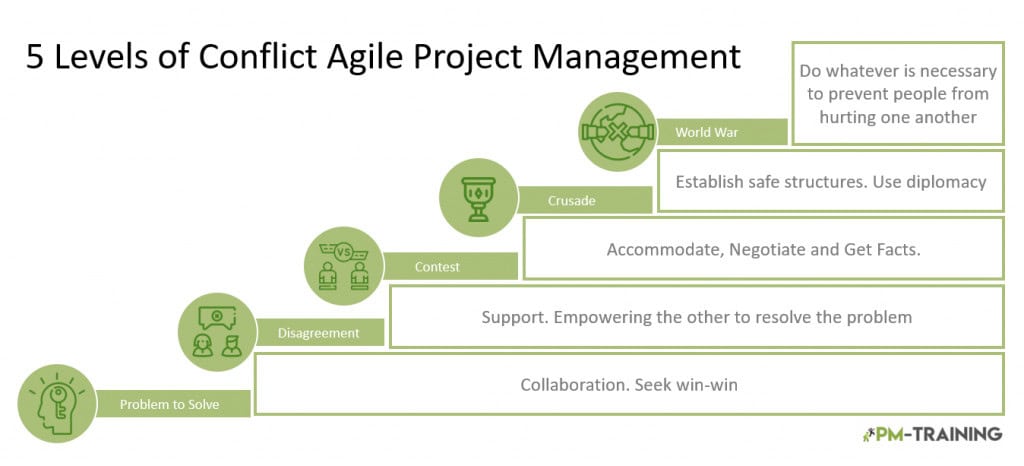
Agile leaders must accurately diagnose the intensity of a dispute to intervene effectively. Speed B. Leas’s framework provides a roadmap for identifying whether a team is experiencing healthy debate or destructive warfare. Recognizing these 5 levels of conflict early allows for tailored facilitation that preserves psychological safety while guiding the team back toward a productive, collaborative, and fact-based problem-solving environment.
- Level 1: Problem to Solve: At this stage, team members share information and different opinions to reach the best technical solution. Communication remains open, factual, and respectful. The focus is purely on the work at hand, and the goal is simply to find a solution together.
- Level 2: Disagreement: Language becomes slightly guarded as individuals start to distance themselves. While the problem is still the focus, people begin to worry about their personal standing. You might notice team members seeking out peers to test their ideas before sharing them with everyone.
- Level 3: Contest: The goal shifts from solving the problem to winning the argument. Multiple issues get lumped together, and factions begin to form within the Scrum team. Negotiating becomes difficult as people start to feel that “being right” is more important than the project outcome.
- Level 4: Fight/Flight: Conflict becomes deeply personal, and members believe the “other side” won’t change. People stop trying to communicate and instead focus on protecting themselves or damaging others’ reputations. The focus is no longer on the product, but on surviving the interpersonal struggle.
- Level 5: Intractable War: Conflict is now about total destruction, and there is no desire for a resolution. The parties involved would rather see the project fail than see their “opponent” succeed. At this dangerous stage, formal management intervention or professional mediation is absolutely mandatory.
8 Common Causes of Conflict in Agile Projects
Identifying the root cause of friction is the first step toward a sustainable resolution. Agile environments are uniquely prone to specific triggers that arise from the intersection of high-pressure delivery and self-organizing dynamics. By understanding these eight common catalysts, Scrum Masters and coaches can proactively address systemic issues before they escalate into personal vendettas or project-wide roadblocks.
- Scope Creep and Priority Shifting: When the Product Owner frequently changes the Sprint Goal, it creates immense frustration for developers seeking focus. Constant shifts disrupt the team’s flow and commitment, leading to resentment between those defining the work and those tasked with the actual technical execution and delivery.
- Resource and Capacity Constraints: Conflicts arise when team members are “shared” across multiple projects, leading to burnout and missed commitments. This fragmented focus makes it impossible to achieve a high-velocity “flow” state, causing tension when the team fails to meet its forecasted sprint velocity goals.
- Technical Debt vs. Feature Delivery: Tension often builds between the need for high-quality, sustainable code and the constant business pressure to ship new features. Engineers feel demoralized when forced to cut corners, leading to heated debates about the long-term viability of the product’s underlying software architecture.
- Vague Requirements and Stories: Poorly defined User Stories lead to different interpretations during the Sprint, causing friction during the Demo. Without clear Acceptance Criteria, developers and Product Owners often clash over whether a feature is truly “done,” resulting in wasted effort and missed expectations for stakeholders.
- Role Confusion and Power Struggles: Overlap or power struggles between the Scrum Master, Product Owner, and traditional Project Managers can paralyze a team. When authority lines are blurred, team members receive conflicting signals, leading to frustration regarding who ultimately makes decisions about priorities, processes, and people.
- Cultural and Personality Clashes: Diverse teams bring different communication styles; what one person calls “direct,” another may call “aggressive.” These misunderstood social cues can erode trust quickly, turning professional disagreements into personal grievances if the team hasn’t established a clear “working agreement” for interpersonal communication.
- Skill Gaps and Technical Maturity: Frustration occurs when there is a significant mismatch between the complexity of a task and the team’s current skill level. Senior members may become impatient with juniors, while junior developers may feel unsupported, leading to a breakdown in the collaborative peer-review process.
- Communication Silos and Remote Barriers: Despite the emphasis on collaboration, remote work or departmental “walls” can lead to significant misunderstandings. When teams stop talking in real-time, they begin making assumptions about each other’s motives, which quickly turns into deep-seated distrust and a lack of shared organizational alignment.
10 Essential Techniques to Manage Agile Conflict
A robust toolkit of resolution techniques allows Agile leaders to de-escalate tension and refocus the team on value. These ten Agile conflict management strategies range from direct problem-solving to strategic retreats, offering a flexible approach to any level of dispute. Mastery of these methods ensures that the Scrum Master remains a neutral, effective facilitator capable of maintaining the team’s long-term health.
- Confronting (Problem Solving): This technique treats the conflict as a puzzle to be solved together through data and logic. You bring the parties together to look at the facts, dealing with the issue head-on without ever attacking the personalities of the individuals involved.
- Collaborating (Win-Win): This requires high trust and time. You integrate multiple viewpoints to create a shared solution that meets everyone’s core needs. It is the most effective way to ensure long-term buy-in and prevent the same conflict from resurfacing in the next sprint.
- Compromising (Middle Ground): Use this when time is short, and a decision must be made to move the sprint forward. It’s a “give and take” where everyone yields a little, allowing for a fast resolution even if no one is completely satisfied with it.
- Smoothing (Accommodating): This is best for minor issues where harmony is more important than the specific outcome. You emphasize areas of agreement rather than differences, helping the team move past a trivial roadblock without getting bogged down in unnecessary, time-consuming technical or process debates.
- Forcing (Authoritative): Use this only as a last resort in emergencies, such as security breaches. You use formal authority to make a final decision. While it solves the problem instantly, it often damages team autonomy and morale, making it a very high-risk strategy.
- Withdrawal (Avoidance): This isn’t a permanent fix but a strategic pause to let emotions cool down. Stepping back from the conflict allows the parties involved to regain their professional composure before entering a formal, facilitated discussion about the underlying issues at a later time.
- Active Listening and Echoing: Before allowing a rebuttal, each party must repeat what the other said to their satisfaction. This technique ensures that everyone actually understands the opposing viewpoint, which often lowers the emotional temperature and clarifies simple misunderstandings that were fueling the larger dispute.
- Establishing Team Working Agreements: Explicitly define how the team will handle disagreements before they happen. Having a pre-negotiated, signed document to refer back to removes the “personal” element of the conflict, as the Scrum Master is simply holding the team accountable to their own rules.
- Reframing to the Goal: Remind the team of the Sprint Goal or the ultimate customer value they are trying to provide. Often, internal bickering fades when everyone remembers who they are building for and that their internal squabbles are hindering the delivery of real value.
- Mediation (Neutral Facilitation): Bring in a neutral third party, such as an Agile Coach, to facilitate a conversation between clashing individuals. This provides a safe, structured environment where both parties can speak freely without fear, guided by someone who has no personal stake in the outcome.
4 Types of Organizational Conflict (Levels)
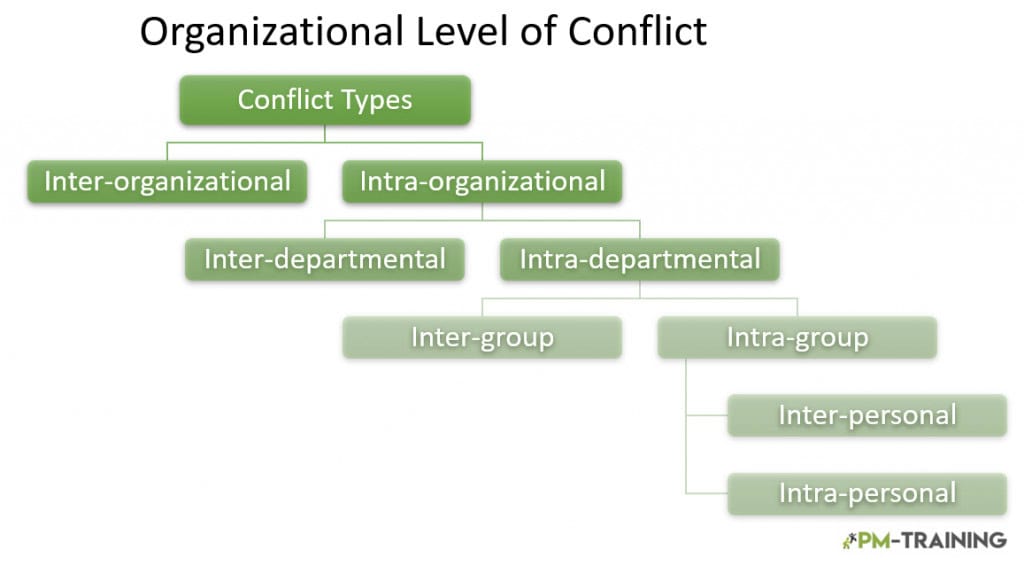
Conflict within an Agile environment is rarely isolated; it often stems from tensions at different levels of the organization. By categorizing conflict into these four types, leaders can better understand the scope of the problem. This systemic view helps in determining whether a solution should be focused on individual coaching, team-building, or broader organizational changes to remove silos.
- Intrapersonal (Individual Level): This conflict occurs within an individual, often when they feel torn between competing professional values. For example, a developer might struggle with the internal pressure to write “perfect” code versus the team’s urgent need to ship a “good enough” feature by Friday.
- Interpersonal (Person-to-Person): This is the most common and visible type, occurring between two individuals. It usually results from personality clashes, differing communication styles, or competition for recognition. In a Scrum team, this often looks like a lead developer and a QA specialist disagreeing.
- Intragroup (Within the Team): This involves the entire team dynamic and often appears during the “Storming” phase of development. It might be a dispute over how the team self-organizes or a collective disagreement during a Retrospective about the overall direction and technical standards of the project.
- Intergroup (Departmental Level): This occurs between different departments or teams within the company. For example, the Engineering team might clash with Marketing over release dates, or a modern Scrum team might struggle to work with a traditional, rigid Finance department regarding budget and resource planning.
Conclusion
Navigating conflict is the hallmark of a mature Agile organization. By recognizing that tension is a byproduct of passion and diverse expertise, leaders can move away from the fear of disagreement and toward a culture of constructive debate. Whether you are using the 5 Levels of Conflict to diagnose a situation or applying the Confronting technique to solve a technical roadblock, the goal remains the same: protecting the team’s psychological safety while driving toward excellence.
When handled with empathy and professional rigor, conflict does not slow a team down; it provides the necessary friction to sharpen ideas and strengthen bonds. Embrace the “spicy” conversations, lean into the Retrospectives, and remember that a team that never disagrees is likely a team that isn’t growing.
FAQ
What is the Scrum Master’s role in conflict?
The Scrum Master acts as a facilitator, not a judge. Their primary goal is to help the team resolve its own issues by fostering a safe environment and teaching communication techniques. They only intervene directly when the conflict prevents the team from functioning.
Can conflict ever be a positive thing in Agile?
Yes, healthy conflict—often called “functional conflict”—leads to better decision-making. It prevents groupthink and encourages the team to explore multiple technical avenues. It ensures that the final solution has been rigorously tested against different perspectives and potential edge cases.
How do you handle a Level 5 conflict?
At Level 5, the situation is no longer about the project; it is about destruction. The Scrum Master or Manager must separate the parties. Often, this requires formal HR intervention, team reassignment, or mediation to prevent the entire project from collapsing.
Why is psychological safety important for conflict?
Without psychological safety, team members view disagreement as a personal attack or a threat to their job security. Safety allows individuals to be vulnerable and honest, ensuring that the conflict stays focused on the work rather than devolving into personal animosity.
When should a Product Owner get involved?
A Product Owner should get involved if the conflict pertains to the product vision, priority, or value. However, they should step back from technical execution conflicts, allowing the developers to self-organize and reach a technical consensus without outside business pressure.
Suggested articles:
- 4 Types of Organizational Conflict (Levels)
- Task Conflict vs. Relationship Conflict
- How to Recognize the 5 Conflict Levels in the Workplace

Shane Drumm, holding certifications in PMP®, PMI-ACP®, CSM, and LPM, is the author behind numerous articles featured here. Hailing from County Cork, Ireland, his expertise lies in implementing Agile methodologies with geographically dispersed teams for software development projects. In his leisure, he dedicates time to web development and Ironman triathlon training. Find out more about Shane on shanedrumm.com and please reach out and connect with Shane on LinkedIn.