
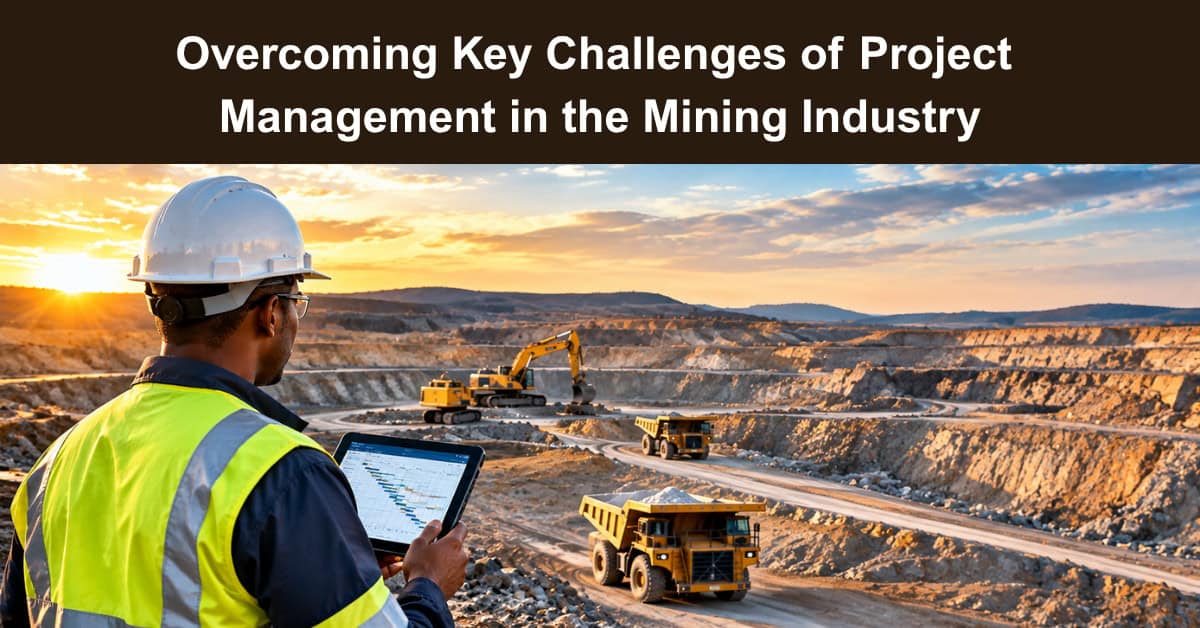
Mining projects don’t behave like other projects. Add up the remoteness, the compliance rules, and the tight windows for getting people and gear to site, and you get a version of project management where a single missed delivery can stall a month of work. Anyone who’s run a project outside mining and then landed one inside it usually says the same thing: the frameworks are the same, but almost nothing else is.
Here are five challenges that show up on nearly every mining project, and what’s helped teams get ahead of them. Mining fleet management shows up more than once here, as the vehicles and equipment moving people and materials around a site end up deciding how everything else goes.
1. Remote Locations Increase Cost and Response Times
A part that ships overnight in the city can take a week to reach a remote pit. A flat tire that’s a five-minute fix in town can knock a crew off shift for a day if the nearest support is three hours down a dirt road. Distance doesn’t just add time; it multiplies the cost of every small failure.
Longer lead times need to be the default in procurement, not the exception written in as a footnote. Worth mapping out service and support networks for vehicles and equipment before mobilisation starts, not after the first breakdown forces the question. Remote logistics deserves its own line in the risk register, separate from the generic “supply chain” risk most templates default to.
2. Compliance Requirements Vary by Site and Operator
Most project management training treats safety compliance as a checkbox category. Mining breaks that assumption fast. Every mine operator can set its own vehicle spec, covering things like roll bars, UHF radios, beacons, reversing cameras, and GVM limits, and two sites less than an hour apart can have completely different rules.
That means a manager can’t just order ten utes and call it done. Instead, they should confirm site-specific requirements at the planning stage, and ask any fleet or equipment partner how fast vehicles can be reconfigured if the project shifts sites. Compliance checks can also be folded into the same milestone reviews already used for safety and quality, rather than treating them as separate.
3. Workforce Mobilisation Requires Careful Coordination
Getting a workforce onto a remote site means accommodation, transport, inductions and rosters all landing in the same short window. Each piece depends on the others arriving on time, from booking rooms to confirming induction slots to arranging vehicles. Miss one and the whole start date slips, even if every other part of the plan, from earthworks to budget, is solid.
The fix isn’t complicated, just easy to skip under time pressure. It’s best to sequence mobilisation with the same discipline used for construction or production milestones, and give each stream (accommodation, transport, inductions, fleet) an owner instead of lumping it under “logistics”. Then run a dry run a week or two out to catch the gap before it becomes a delay.
4. Fleet and Equipment Planning Comes Too Late
Vehicles and equipment tend to be the thing sorted closest to mobilisation, after the bigger-ticket items like earthworks and accommodation are already locked in. A site that’s ready to break ground but short on mine-spec vehicles to move crews and materials is a stalled site, no matter how well everything else was planned.
Mining fleet management belongs in the plan from the feasibility stage, not as a procurement task bolted on later. Decide early whether to buy, lease, or hire, line up a partner who can flex the fleet as the project scales, and ask what their real response time looks like at a remote site, not the number in their brochure.
5. Scope and Timelines Shift More Than Planned
Resource prices shift, approvals take longer than expected, and site conditions change once crews are already on the ground. A plan built around a fixed scope and schedule often needs revisiting more than once before the project closes out. That’s normal on mining projects rather than a sign that the original planning was flawed or something went wrong.
Build contingency into both budget and schedule based on the project’s actual risk profile, not a flat percentage pulled from a template. Revisit the plan at set checkpoints instead of only when a problem forces the conversation. Keep vendor arrangements flexible enough to scale without renegotiating from scratch every time something shifts.
Planning for Weather and Seasonal Access
Rain, heat, and flooding don’t just slow work on a mining site; they can shut the road to it. A haul route that’s fine in June can be impassable by February, and a wet season can close access for days at a time, with crews already on site and no way to rotate them out. Weather is rarely the real surprise. Treating it as one is. Five steps help teams plan around it:
- Use Historical Data in Planning: Pull the site’s weather and road closure records early and build the project delivery schedule around them. Heavy mobilisation, major deliveries, and fleet changeovers belong in the dry windows wherever the project allows.
- Line Up Fallback Routes and Suppliers: Anything that has to move during the wet season needs an alternative route or a confirmed backup supplier, agreed before the rain starts.
- Match the Fleet to the Worst Conditions: Vehicles that cope well on sealed roads can struggle on soft, rutted tracks, so specify for the worst the site will see, not the average. Ask the fleet partner what happens to servicing and replacements when access is cut off, and whether spare vehicles can be held on site or nearby.
- Set Clear Trigger Points: Agree in advance when work pauses, when crews stand down, and who makes the call, so decisions are made against a threshold rather than argued over in the middle of a storm.
- Tie Contingency to the Season: Weather delay allowances can be added to the contingency covered in the scope section, based on the time of year rather than a flat percentage.
Managing the Combined Impact
Take any one of these five on its own, and it’s manageable. Distance alone, compliance alone, a tight mobilisation window alone- a manager handles these constantly, often without much drama. Stack all five on top of each other, on a site three hours from the nearest town, with limited supplies and no quick fallback options, and things get complicated fast.
The projects that go smoothly aren’t the ones with no problems. They’re the ones where fleet, compliance, and mobilisation got planned alongside earthworks and budget, right from the start. When these elements are mapped out together early, teams can spot conflicts before they cause delays, keeping the project moving even when conditions on site change.
Suggested articles:
- Organizing Equipment for Improved Workflow on Construction Sites
- Why Traditional PM Tools Break Down on Multi-Site, Multi-Team Projects
- Building a Communication Strategy for On-Site Project Teams

Daniel Raymond, a project manager with over 20 years of experience, is the former CEO of a successful software company called Websystems. With a strong background in managing complex projects, he applied his expertise to develop AceProject.com and Bridge24.com, innovative project management tools designed to streamline processes and improve productivity. Throughout his career, Daniel has consistently demonstrated a commitment to excellence and a passion for empowering teams to achieve their goals.