
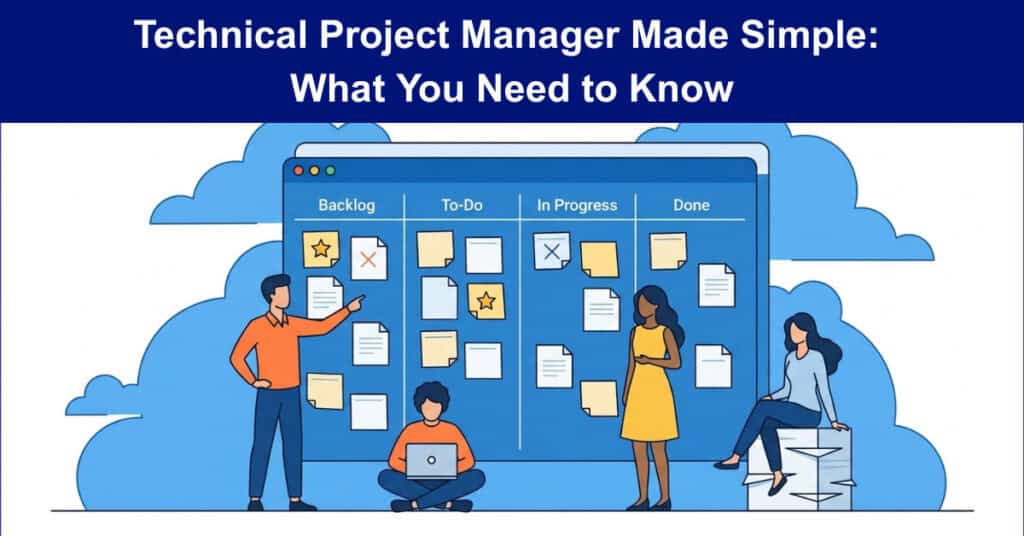
A technical project manager oversees complex, technology-driven initiatives where deep subject-matter knowledge shapes every decision. Unlike generalist project leaders, this role blends classic planning and budgeting duties with hands-on understanding of software development, infrastructure, or engineering systems. Companies building digital products rely on this position to translate business goals into deliverables that engineering teams can actually execute, keeping scope and quality aligned.
The role has grown more central as organizations lean on distributed engineering teams, cloud infrastructure, and AI-assisted workflows to ship products faster. A technical project manager bridges the gap between executives who set direction and engineers who build the solution, translating ambiguous requirements into a schedule developers can follow. The sections below break down the role, required skills, and entry paths.
Technical Project Manager Role
The roles of a technical project manager shift daily with the size and complexity of the project, but a core set of responsibilities stays constant across most technical organizations. This person owns the schedule, the budget, and the communication flow between engineering teams and business stakeholders. Because projects involve specialized systems, the manager must understand enough underlying technology to spot risks before they derail delivery.
Common daily responsibilities include the following core project management tasks.
- Risk Assessment and Mitigation: Identifying technical and schedule risks early, then building contingency plans so small issues don’t escalate into project-threatening delays.
- Change Management: Managing scope changes and making sure every affected stakeholder, from engineers to executives, understands the impact before work shifts direction.
- Progress and Milestone Tracking: Monitoring sprint velocity, deliverable status, and milestone dates against the original plan to catch slippage while it’s still fixable.
- Executive Status Reporting: Translating technical progress into clear, jargon-free updates and project reports that upper management can use to make informed decisions.
- Cross-Team Coordination: Aligning engineers, developers, and other department leads so dependencies between teams don’t create bottlenecks.
- Client and Stakeholder Meetings: Communicating directly with clients to confirm requirements, manage expectations, and resolve concerns before they become disputes.
- Budget Management: Tracking spend against the approved budget and flagging cost overruns before they compound.
- Post-Project Reviews: Running retrospectives after delivery to document lessons learned and improve the next project cycle.
What Skills Are Important to Be a Technical Project Manager?
Succeeding as a technical project manager requires more than general management ability, since the role demands enough technical fluency to evaluate engineering trade-offs directly. A strong candidate can read a system architecture diagram, understand why a sprint slipped, and explain the impact to a non-technical executive in plain language. Communication skills become the multiplier that turns technical knowledge into a functioning, well-coordinated project team.
Problem-solving separates strong technical project managers from average ones, since technical projects rarely follow a straight line from plan to delivery. Requirements change, vendors slip deadlines, and engineering estimates prove optimistic more often than not. Managers who can adapt the plan without losing stakeholder trust and who can lead a team through ambiguity tend to advance faster into senior program management roles.
These core competencies consistently appear in technical project manager job postings.
- Technical Background: A working understanding of software development, infrastructure, or engineering processes strong enough to evaluate estimates and spot flawed assumptions.
- Communication and People Skills: The ability to translate technical detail for non-technical audiences and keep every stakeholder informed without overwhelming them.
- Team Leadership: Motivating a cross-functional team through ambiguity, conflicting priorities, and the inevitable pressure of tight deadlines.
- Strategic Decision-Making: Weighing trade-offs between scope, budget, and timeline, then making calls that keep the project aligned with business goals.
- Planning and Organization: Structuring complex work into manageable phases with clear owners, dependencies, and deadlines.
- Multitasking and Prioritization: Managing several workstreams simultaneously without losing sight of the highest-impact tasks.
- Time Management: Protecting the project schedule by anticipating bottlenecks and reallocating resources before deadlines slip.
- Problem-Solving: Diagnosing the root cause of technical or process failures quickly enough to keep delivery on track.
- Stress Management: Staying composed and decisive when deadlines tighten and unexpected technical issues surface.
Technical Project Manager vs Regular Project Managers
Both technical and traditional project managers plan, execute, and deliver projects on time and within budget, so the distinction lies less in process and more in subject matter. A technical project manager needs enough domain depth to challenge an engineering estimate or spot a flawed design. A traditional project manager focuses on scope, timeline, and stakeholder alignment without evaluating technical design.
The table below breaks down the practical differences between these roles.
| Technical Project Manager | Traditional Project Manager |
|---|---|
| Manages projects that require deep technical knowledge or specialized engineering expertise | Manages projects that do not require specialized technical expertise |
| Needs a strong grasp of the technical work, plus the ability to manage people and resources | Needs strong general management skills without deep technical evaluation ability |
| Oversees budget, timeline, and coordination with the technical team to hit deliverables | Focuses on communication, scheduling, and risk management across the project |
| Works closely with engineers and technical specialists to confirm that objectives are technically sound | Works with a broader team of specialists across non-technical disciplines |
Choosing between the two depends entirely on the nature of the project and the composition of the delivery team. A project involving custom software, cloud migration, or system integration nearly always benefits from a technical project manager who can speak the engineering team’s language. A marketing campaign, facilities rollout, or organizational change initiative is usually better served by a traditional project manager.
How to Become a Technical Project Manager?
Becoming a technical project manager typically starts with a formal education foundation paired with hands-on exposure to a technical discipline, since employers want proof of management aptitude and domain knowledge. Most job postings list a bachelor’s degree in computer science, information systems, or engineering as a baseline requirement. Candidates who start in a technical role, such as software development, often transition into this position naturally.
A few clear steps consistently move candidates into project leadership.
- Earn a Relevant Degree: A bachelor’s degree in computer science, information systems, engineering, or a related field gives candidates the technical foundation employers expect.
- Build Technical Experience First: Working in a technical individual-contributor role builds the credibility needed to lead engineers later.
- Develop People and Communication Skills: Practicing stakeholder communication and team leadership, even informally, prepares candidates for the management side of the role.
- Pursue PMP Certification: Earning a Project Management Professional credential from Project Management Institute (PMI) signals formal project management competency to employers.
Qualifications Required
Project Management Institute certification, most commonly the Project Management Professional credential, remains the standard qualification employers look for when hiring technical project managers. Eligibility depends on education level, with different experience thresholds for candidates who hold a bachelor’s degree versus those with only a secondary diploma. Meeting these requirements accurately matters, since PMI conducts random audits of submitted applications before granting exam eligibility.
Current PMI eligibility breaks down into two clear education paths.
- Bachelor’s Degree Path: At least 36 months (4,500 hours) of project management experience leading and directing projects, completed within the last eight years.
- Secondary Diploma Path: At least 60 months (7,500 hours) of project management experience for candidates without a four-year degree.
- Formal Education Requirement: 35 contact hours of project management education or training, required regardless of which education path applies.
- Ongoing Maintenance: PMP holders must earn 60 professional development units every three years to keep the PMI certification active.
Technical Project Manager Salary Guide
Compensation for technical project managers has climbed steadily as demand for skilled technical delivery leaders has outpaced supply, particularly at mid-size and large technology companies. Pay varies widely by region, industry, and company size, with software and financial services firms generally paying above the national median. Total compensation also frequently includes bonuses, profit sharing, and equity that push earnings well beyond base salary alone.
Recent salary data shows a clear progression tied to experience.
- Entry-Level (Under 1 Year): Roughly $65,000 to $77,000 annually for candidates just starting out in the role.
- Early Career (1 to 4 Years): Average total compensation climbs to around $92,000 as candidates build a delivery track record.
- Mid-Career (5 to 9 Years): Typical pay lands near $110,000 to $120,000, reflecting the national average across most industries.
- Experienced (10 to 19 Years): Compensation commonly reaches $135,000 to $150,000, especially at larger technology employers.
- Senior (20+ Years): Top earners, particularly those managing enterprise-scale technical programs, can exceed $160,000 to $180,000 annually.
Common Challenges Technical Project Managers Face
Technical project managers face obstacles that generalist project leaders rarely encounter, largely because the work sits at the intersection of business priorities and engineering reality. Scope creep hits harder on technical projects, since one architecture change can cascade into weeks of rework across multiple teams. Balancing technical debt against delivery speed forces difficult trade-off conversations with stakeholders who may not grasp the complexity.
A few recurring mistakes derail even experienced technical project managers.
- Underestimating Technical Complexity: Accepting optimistic engineering estimates without questioning assumptions leads to missed deadlines and budget overruns.
- Poor Stakeholder Translation: Failing to convert technical status into business language erodes executive trust in the project.
- Ignoring Technical Debt: Prioritizing speed over code quality creates hidden costs that surface later as slower delivery and more bugs.
- Weak Change Control: Approving scope changes without documenting downstream impact leads to budget and timeline surprises.
Tools and Technologies Technical Project Managers Use
Modern technical project managers rely on a mix of project planning platforms, communication tools, and technical tracking systems to keep distributed teams aligned. Microsoft Planner and Microsoft Project remain common choices for scheduling and resource allocation, while Jira and Confluence dominate development environments that follow agile or scrum methodologies. Choosing the right toolset depends on team size and how tightly work integrates with engineering pipelines.
These platforms cover the core functions that technical project managers need daily.
- Microsoft Planner and Project: Widely used for scheduling, resource allocation, and Gantt-style timeline visualization across larger organizations.
- Jira: The standard for agile and scrum teams tracking sprints, backlogs, and engineering tickets in real time.
- Confluence: Centralizes documentation, requirements, and meeting notes so technical decisions stay traceable across the project lifecycle.
- Asana, Monday.com, and ClickUp: Popular alternatives for cross-functional teams that need lighter-weight task tracking outside pure engineering workflows.
- Miro or Smartsheet: Useful for visual planning, roadmapping, and stakeholder workshops during the early project phases.
Video About Technical Project Managers
Ready to see what a technical project manager actually does day to day? In this video, we break down the core responsibilities, the challenges unique to technical teams, and how strong communication and delivery leadership keep complex projects on track.
Conclusion
A technical project manager combines classic project leadership with real technical fluency, making the role essential for organizations building complex digital products. Success depends on strong communication, disciplined risk management, and enough domain knowledge to challenge engineering assumptions when needed. Certification through PMI, paired with hands-on technical experience, remains the clearest path into the field for career changers.
Demand for this role continues to grow as companies invest in cloud infrastructure, AI-driven products, and distributed engineering teams that need skilled coordination. Professionals who build both technical depth and leadership skills will find consistent opportunities across industries and steady salary growth over time. Anyone considering the path should start building PMP eligibility and technical exposure now.
Frequently Asked Questions About Technical Project Managers
What are the differences between technical project managers and traditional project managers?
A technical project manager oversees projects that require deep scientific or technical expertise, such as software development or system integration. A traditional project manager focuses on projects that don’t demand that same depth of specialized knowledge, relying instead on general planning, scheduling, and stakeholder management skills.
What does a technical project manager do?
They plan, execute, and deliver technical projects while managing scope, budget, and timeline. They work directly with engineers and developers to confirm objectives are technically achievable, then communicate progress and risk to business stakeholders throughout the project.
How does a technical project manager work daily?
Daily work includes monitoring progress, communicating with stakeholders, and resolving technical issues as they arise. Technical project managers also run status meetings, manage the budget, and support their teams with the resources needed to keep delivery on schedule.
Is the technical project manager career in demand?
Demand remains strong, particularly for candidates who combine PMP certification with hands-on technical experience. Organizations building software, cloud infrastructure, and data-driven products consistently need skilled technical project managers, and qualified candidates continue to be in shorter supply than open roles.
What certifications help a technical project manager advance?
The PMP credential from PMI is the most widely recognized certification, but a Certified Associate in Project Management (CAPM) can help candidates who don’t yet meet PMP experience requirements. Agile-specific certifications, such as PMI-ACP, also strengthen a resume for technical program management roles.
Suggested articles:
- Product Manager vs Project Manager: Different Agile Roles Explained
- Scrum Master vs. Product Manager: Roles and Responsibilities Defined
- The Evolving Role of Project Managers in a Digital First World

Shane Drumm, holding certifications in PMP®, PMI-ACP®, CSM, and LPM, is the author behind numerous articles featured here. Hailing from County Cork, Ireland, his expertise lies in implementing Agile methodologies with geographically dispersed teams for software development projects. In his leisure, he dedicates time to web development and Ironman triathlon training. Find out more about Shane on shanedrumm.com and please reach out and connect with Shane on LinkedIn.