
The debate around product manager vs project manager roles is one of the most persistent sources of confusion in modern organisations. Both titles carry weight, both require strong leadership, and both involve coordinating people to achieve meaningful outcomes. Yet conflating them creates real dysfunction inside teams, particularly when organisations transition from traditional delivery models to Agile ways of working.
Understanding the distinction is not simply an academic exercise. It shapes how teams are structured, how success is measured, and how products are built and sustained over time. This article breaks down the core differences, shared responsibilities, and the organisational conditions that determine which role you actually need.
Project vs Product Definition
Before comparing responsibilities, it helps to ground the conversation in a fundamental distinction that is often overlooked. A project is temporary. It has a defined start, a defined end, and a specific set of deliverables. A product, by contrast, is permanent and evolving. It exists beyond any single delivery effort and continues to generate value, gather feedback, and change over time.
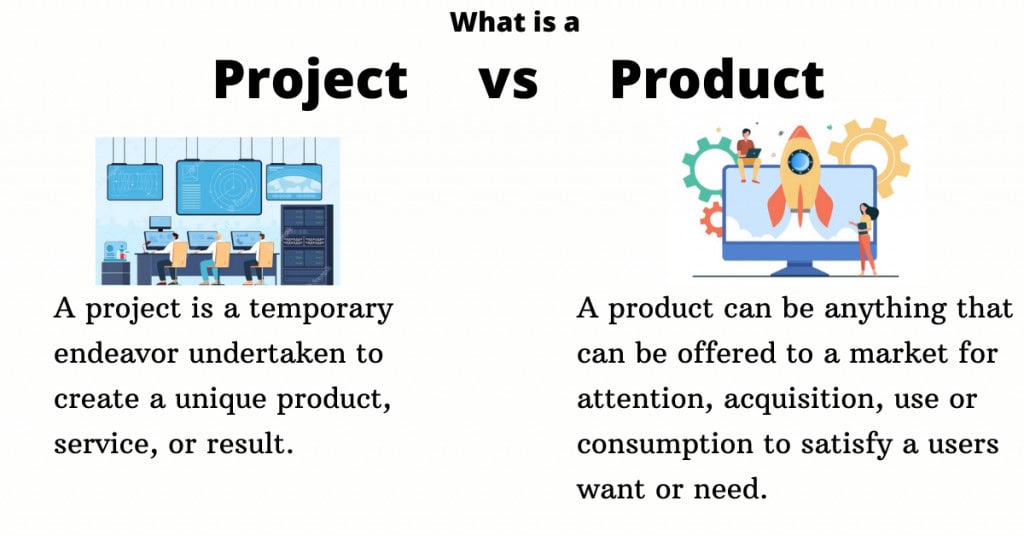
This distinction matters enormously in practice. A single product may involve multiple projects: building the initial version, launching it to market, and adding new features based on user data. A project manager may lead each of these efforts individually. A product manager, however, owns the product across all of them, ensuring every effort serves a coherent strategic vision.
PM Success in Agile Environments
Success looks fundamentally different depending on which role you occupy. For a project manager, success typically means delivering the defined scope on time and within budget, with minimal deviation from the original plan. Scope creep is the enemy. The plan is the north star, and deviations from it are managed as risks.
For a product manager, success means something more dynamic. Discovering new information about user needs, even mid-delivery, is not a problem to be managed but an outcome to be embraced. The ability to pivot based on evidence is a feature of good product management, not a failure of planning. Agile frameworks complement this mindset directly, particularly through concepts like the minimum viable product, which is designed to invite feedback and evolve accordingly.
In software development, these two orientations increasingly co-exist. Agile project management approaches support iterative delivery, while product management ensures that what is being delivered is actually solving the right problem for real users. The challenge arises when organisations fail to define which role owns which decisions.
Responsibilities of Project Manager vs Product Manager
Both roles share a foundation of stakeholder communication, problem resolution, and operational coordination. However, the scope and focus of each diverges significantly once you move beyond these shared competencies. A skilled product manager typically possesses many of the capabilities of a strong project manager. The reverse is less reliably true.
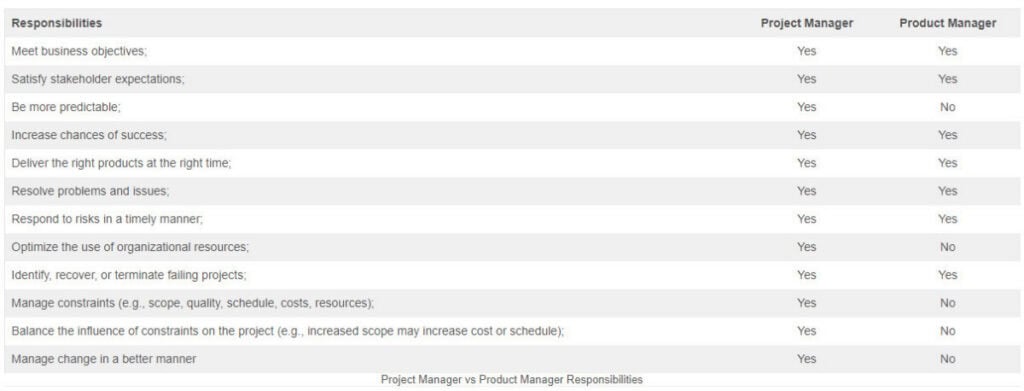
The following breakdown illustrates where the two roles align and where they diverge sharply. It reflects a range of real organisational contexts, including both Agile and traditional delivery environments.
Here is a summary of where each role holds responsibility:
| Responsibility | Product Manager | Project Manager |
|---|---|---|
| Define business objectives | Yes | Yes |
| Satisfy stakeholder expectations | Yes | Yes |
| Communicate product vision | Yes | No |
| Gather user data and feedback | Yes | No |
| Verify the delivered products | Yes | No |
| Resolve problems and issues | Yes | Yes |
| Optimise use of organisational resources | Yes | No |
| Manage user change | Yes | Yes |
Responsibilities of a Project Manager in Practice
A project manager’s primary role is delivery. They create and maintain plans, track progress against milestones, manage dependencies, and report status to business stakeholders. In waterfall environments, this is a clearly bounded and well-understood role. The project manager works to a specification and ensures the team delivers against it.
In Agile environments, the project manager’s role becomes more ambiguous. Without a fixed plan to defend, the focus shifts toward facilitation, impediment removal, and cross-functional coordination. Some organisations resolve this by reframing the role as a delivery manager or Agile programme manager. Others attempt to retain traditional project management practices within Agile teams, which frequently creates friction.
Here are the core functions a project manager typically owns across delivery contexts:
- Scope and Schedule Management: Project managers define the boundaries of a project, build timelines, and track progress to ensure delivery stays on course without unnecessary deviation.
- Risk and Issue Tracking: They identify potential blockers early, escalate where necessary, and maintain a living log of risks and mitigations throughout the project lifecycle.
- Stakeholder Reporting: Project managers translate team progress into business-readable updates, ensuring sponsors and leadership are informed without being drawn into day-to-day delivery detail.
- Resource Coordination: They ensure the right people are assigned to the right tasks at the right time, balancing availability against priority without overloading team capacity.
- Dependency Management: Complex projects rarely exist in isolation; project managers map interdependencies between workstreams and coordinate across teams to prevent blockers from stalling delivery.
Responsibilities of a Product Manager in Practice
A product manager operates at the intersection of user needs, business strategy, and technical feasibility. Their mandate extends far beyond any single project. They are responsible for the long-term health and direction of a product, from initial concept through to ongoing iteration. In Agile organisations, this role is often the closest thing to an internal chief executive for a specific product line.
The product manager’s roles include setting the vision, building the roadmap, and ensuring that every delivery effort moves the product meaningfully forward. They gather qualitative and quantitative user data, synthesise it into prioritised requirements, and work closely with engineering and design to translate insight into working software. They are also accountable for commercial outcomes in many organisations, including adoption, retention, and revenue contribution.
The following responsibilities define the distinct value a product manager brings to an organisation:
- Product Vision and Strategy: Product managers define where the product is going and why, translating organisational goals and user needs into a coherent, time-bound roadmap that guides all delivery efforts.
- User Research and Discovery: They conduct interviews, analyse behavioural data, and run discovery projects to ensure product decisions are grounded in evidence rather than assumptions or internal opinion.
- Prioritisation and Backlog Ownership: Product managers determine which features, improvements, and experiments are most valuable at any given time, making trade-off decisions that align effort with strategic impact.
- Cross-functional Leadership: They align design, engineering, marketing, and operations around a shared product direction, resolving competing priorities without formal authority over any of these teams.
- Outcome Measurement: Product managers track whether delivered features actually achieve their intended effect, using data to evaluate success and inform the next iteration of the roadmap.
Product Manager vs Product Owner
In larger organisations, the relationship between product manager and product owner adds another layer of complexity. The product owner is a Scrum-defined role with a specific remit: supporting the delivery team, managing the backlog, and confirming that completed features meet agreed requirements. When both roles exist within the same organisation, the product manager typically sets strategy while the product owner executes it at the team level.
In practice, however, this distinction frequently breaks down. Organisations that transition from traditional delivery models often repurpose existing roles without fully respecting the intent of each. Product owners end up functioning as business analysts, writing detailed specifications rather than engaging in genuine discovery. Product managers, meanwhile, may be too far removed from daily delivery to provide meaningful strategic direction. The result is a gap between strategy and execution that neither role is positioned to fill alone.
The following conditions indicate a healthy, well-defined product ownership structure:
- Clear Role Boundaries: The product manager owns the strategy and project roadmap, while the product owner owns backlog prioritisation and team-facing communication, with neither role stepping into the other’s domain.
- Regular Strategic Alignment: Product owners and product managers meet frequently to ensure the team’s delivery work reflects current strategic priorities and responds to the latest user insights.
- Discovery-Led Ownership: Product owners actively participate in user research and discovery activities, rather than simply receiving requirements from above and passing them to the engineering team.
- Organisational Support for Agile Principles: The wider organisation treats user feedback as an input to decision-making, not a disruption to plans, enabling product owners to operate as intended rather than as specification writers.
Common Pitfalls When Both Roles Co-Exist
Placing a product manager, project manager, and product owner within the same team without clear accountability structures creates significant operational confusion. Responsibility overlaps, communication loops multiply, and team members spend time navigating politics rather than delivering value. In many cases, one of the roles eventually becomes redundant in practice, even if it persists on the organisational chart.
Feature factory organisations are particularly prone to this problem. When teams are rewarded for output rather than outcomes, both product managers and project managers default to delivery-focused behaviour. The product manager loses their strategic mandate. The project manager loses context. And the product owner loses the organisational backing needed to push back on poorly defined work. Recognising this pattern is the first step toward correcting it.
The following warning signs suggest your role structure needs attention:
- Attendance Gaps at Agile Ceremonies: When a product manager or project manager does not attend standups or retrospectives, it signals a disconnect between strategy and delivery that will compound over time.
- Second-Hand Status Updates: If a project manager relies on the product owner to relay progress rather than observing it directly, reporting accuracy degrades, and trust between roles erodes.
- Overlapping Decision Authority: When two roles both believe they own the same decision, such as scope or priority, conflicts will arise and slow the team down at critical moments.
- Unclear Success Metrics: If the team cannot articulate what success looks like beyond feature delivery, neither the product nor the project manager has established clear enough outcomes to guide the work.
Conclusion
Product managers and project managers both play essential roles in modern organisations, but they serve fundamentally different purposes. One is accountable for building the right thing over the long term. The other is accountable for building it correctly within a defined window. Conflating these mandates leads to structural confusion, misaligned incentives, and teams that deliver features without delivering value.
The clearest path forward is deliberate role design. Organisations benefit most when product managers own strategy and outcomes, project managers own delivery and coordination, and product owners bridge the two at the team level. When each role is given the clarity and organisational support it needs, teams stop guessing about who owns what and start focusing entirely on the work that matters.
FAQs
Can a product manager and project manager be the same person?
In smaller organisations or early-stage teams, one person often holds responsibilities from both roles simultaneously. This is manageable when the scope is limited, but as the product grows, the cognitive load and conflicting priorities make it difficult to perform either role effectively. Separating the functions as the organisation scales is generally the more sustainable approach.
What is the main difference between a product manager and a project manager?
The core distinction lies in scope and permanence. A project manager owns the delivery of a bounded piece of work with a clear end date. A product manager owns the ongoing strategy and evolution of a product, which has no fixed end date and must continually adapt to user needs and market conditions.
Which role is more important in an Agile team?
Both roles contribute meaningfully in Agile environments, but they operate at different levels. The product manager provides direction and ensures the team is solving the right problem. The project manager, or delivery manager in some organisations, ensures the team is working effectively to solve it. Neither is inherently superior; both are necessary for high-performing teams.
How does a product owner differ from a product manager?
A product owner is a Scrum-specific role focused on supporting the delivery team, managing the backlog, and validating completed work against requirements. A product manager operates at a higher strategic level, owning the product vision and roadmap. In large organisations, the product owner typically reports to or works closely with the product manager.
Why do feature factory organisations struggle with these roles?
Feature factories prioritise output over outcomes, which distorts both roles. Product managers lose the space to conduct genuine discovery and strategic thinking. Project managers optimise for delivery speed rather than user impact. Without organisational support for outcome-based ways of working, neither role can fulfil its intended purpose, and teams end up building the wrong things faster.
Suggested articles:
- Product Manager vs Project Manager Salary: How to Choose the Right Career
- Scrum Master vs. Product Manager: Roles and Responsibilities Defined
- 13 Differences of Product vs. Program Management

Shane Drumm, holding certifications in PMP®, PMI-ACP®, CSM, and LPM, is the author behind numerous articles featured here. Hailing from County Cork, Ireland, his expertise lies in implementing Agile methodologies with geographically dispersed teams for software development projects. In his leisure, he dedicates time to web development and Ironman triathlon training. Find out more about Shane on shanedrumm.com and please reach out and connect with Shane on LinkedIn.