
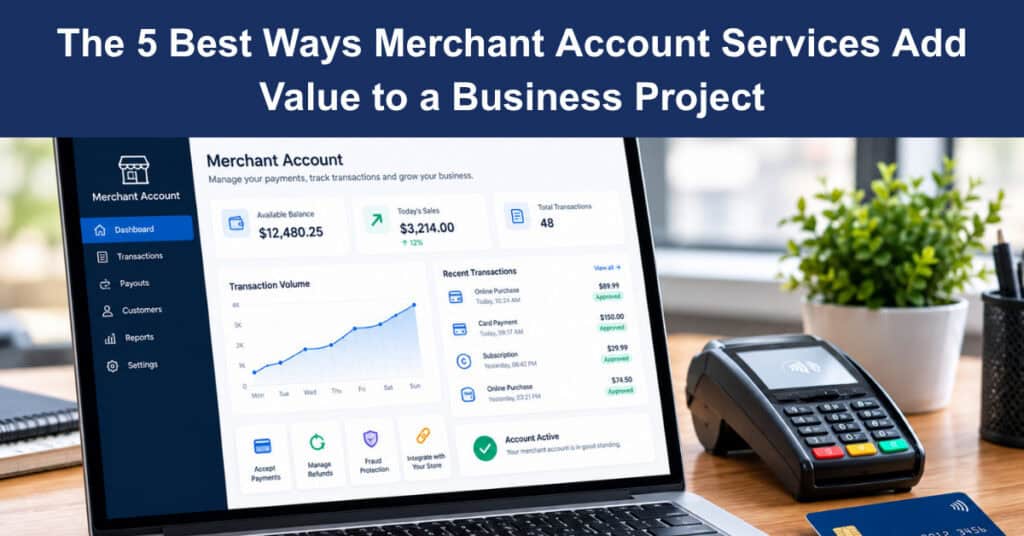
Every project eventually hits a moment where the work is fine, and the money is not. The build is on schedule, the client liked the last demo, and then an invoice sits unpaid for three weeks because the payment path is clumsy, or a card declines at the wrong hour and a supplier order stalls. Nobody wrote that risk into the plan, yet it lands on the project manager anyway.
Payments are infrastructure, and infrastructure only gets noticed when it breaks. A merchant account sits underneath the checkout page, the deposit link, the monthly retainer, and the technician taking a card on a phone in a parking lot. Set that layer up well, and it vanishes into the background.
So it is worth asking what a payments provider actually contributes to a project, beyond the bare ability to take a card. Five things stand out.
1. Payment Acceptance That Matches How Clients Actually Pay
The payment mix keeps moving. The Federal Reserve has tracked that shift for years through the Federal Reserve Payments Study, its recurring measurement of national noncash payment trends, and the pattern holds: electronic methods keep absorbing volume that used to travel as paper. A project that accepts one payment method is quietly betting against that, and the bet rarely pays off.
A merchant account widens the front door instead. Cards, digital wallets, tap to pay on a phone, a hosted link attached to the invoice. Good merchant account services put all of that under one account with one settlement schedule, so nobody on the team is reconciling four unrelated tools at month-end.
The effect shows up in the schedule, not just the ledger. Deposits clear before mobilization rather than after it, approved change orders get paid when they are approved, and the finance conversation stops sitting on the critical path.
2. Cash Flow That Makes the Budget Believable
A project budget forecasts timing as much as amounts, and timing is where most of them come apart. Work lands in week two, the invoice goes out in week three, terms eat another thirty days, and the team ends up funding the client’s convenience out of its own working capital. Business payments have been shifting toward faster rails for exactly this reason.
Nacha’s network statistics show that in 2025 the ACH Network moved 35.19 billion payments worth $93.00 trillion, with business-to-business volume reaching 8.08 billion payments and $63.11 trillion, up 9.9 percent year over year and described by Nacha as the network’s most significant growth segment. Same Day ACH grew faster still, climbing 16.7 percent to 1.45 billion payments.
A merchant account plugs a project into those rails. Faster funding windows shorten the gap between work delivered and cash received, recurring billing turns a retainer into a predictable line rather than a monthly chase, and stored credentials let a client approve an overage in a minute instead of a week. The budget starts describing reality, which is the only version worth presenting at a steering meeting.
3. Security That Protects the Project and the Client
Taking card data means taking on risk, and the risk does not scale down just because the project is small. One mishandled number, one unencrypted spreadsheet of details kept just for now, and a straightforward engagement turns into an incident with lawyers in it. This is where a proper provider does work the team should not be doing itself.
The PCI Security Standards Council maintains PCI DSS as a baseline of technical and operational requirements for protecting payment account data, and its scope covers every entity involved in card processing, merchants very much included. Tokenization, point-to-point encryption, and a hosted payment page shift most of that burden onto the processor’s systems, which shrinks what the project has to defend.
Clients notice too. Enterprise procurement teams routinely ask vendors about payment security during onboarding, often before a contract is signed. A clean, documented answer, backed by tokenization and PCI compliance, removes a common source of delay in contracting and signals that the project team has already handled a risk many vendors overlook.
4. Payment Data That Feeds Project Reporting
Money data and project data usually live in separate worlds, which is how a project ends up green on the dashboard and underwater in the accounts. The status report tracks tasks, the finance report tracks totals, and nothing connects a specific payment to the phase that earned it.
A merchant account with decent reporting closes part of that gap. Transactions carry references, descriptors, and line items, so revenue can be split by phase, client, or deliverable without a manual tagging session. That pairs naturally with the discipline of keeping invoices and expenses under control, where every cost carries a project reference and commitments are tracked alongside recorded spend. Inbound and outbound then describe the same job.
Over time, the pattern data earns its keep. You can see which methods clients actually choose, where declines cluster by card type or time of day, which invoices habitually go late, and which clients need different terms, tighter deposits, or a different payment method written into the next contract.
5. A Payment Experience That Earns the Next Project
Paying is the last interaction of a project and often the one a client remembers most clearly. A tidy, branded checkout that works on a phone signals a team with its house in order. A clumsy one, with a broken link and bank details pasted into an email, undercuts weeks of careful delivery. The details are small, and the returns are not.
Clear descriptors keep a client from disputing a charge they simply did not recognize. Saved payment methods make the second engagement almost frictionless. Flexible options, from installment plans to a split between deposit and milestone, let a buyer say yes at a price that made them nervous.
Repeat work is the cheapest pipeline any team can cultivate. Because the payment process experience is often the final touchpoint of a project, the quality of that experience quietly determines how much repeat business actually returns. A seamless transaction builds lasting trust and ensures that clients feel confident returning for future engagements.
Bringing It Together
None of this makes a payments provider the hero of a project. The work still gets delivered by people who know what they are doing, and no settlement speed rescues a bad scope. What a good merchant account does is remove a category of friction most plans never account for, and most teams absorb silently.
Broad acceptance means fewer stalled payments, faster funding means a budget that survives contact with reality, inherited security means less exposure, clean data means better estimates, and a decent checkout means the client comes back. Worth treating as a decision, then, rather than a form somebody fills in during week one. Choose the provider with the same care you would give any other dependency on the plan.
Suggested articles:
- Finix Reviews: What Businesses Are Saying About This Payment Processor
- Why Project Managers Are Choosing Clover for Modern Payment Rollouts
- How Project Teams Can Keep Invoices and Expenses Under Control

Daniel Raymond, a project manager with over 20 years of experience, is the former CEO of a successful software company called Websystems. With a strong background in managing complex projects, he applied his expertise to develop AceProject.com and Bridge24.com, innovative project management tools designed to streamline processes and improve productivity. Throughout his career, Daniel has consistently demonstrated a commitment to excellence and a passion for empowering teams to achieve their goals.