
Most project teams do not struggle with planning; they struggle with fragmentation. Tasks sit in one tool, documents in another, and key decisions disappear into chat threads no one can retrieve. ClickUp aims to unify all of this in a single workspace, but its scale, new 2026 pricing plans, and AI credit system make the decision more complex than it first appears.
This review explains what ClickUp does well, where it falls short, what it costs, and who it fits best in 2027. It covers the new Core, Business, and Max plans, the Brain² AI launch, and what more than 15,000 G2 reviewers say. We checked every price and feature on ClickUp’s own pages and help center in November 2026.
- All-in-One Work Platform: ClickUp combines tasks, docs, chat, whiteboards, dashboards, and time tracking in one workspace. Teams that use it well can replace several separate apps with a single source of truth.
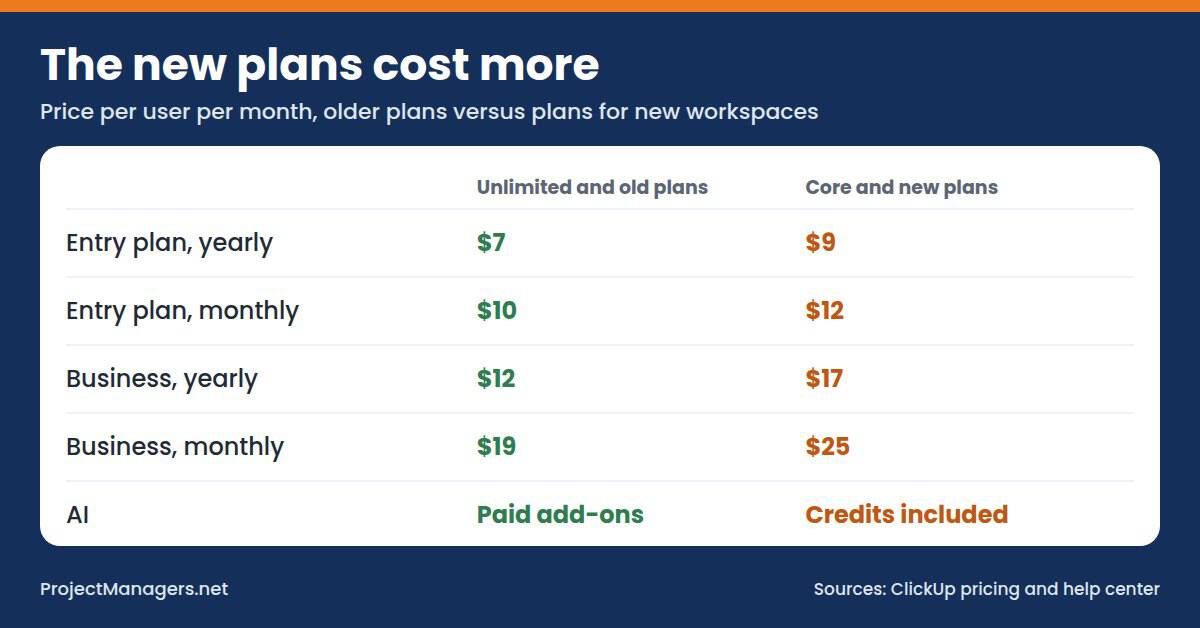
- New Plans and Higher Prices: New ClickUp workspaces now start on Core at $9 or Business at $17 per user per month, billed yearly, up from $7 and $12 on the older plans. Existing workspaces move over gradually, and ClickUp says their price updates begin no earlier than January 2027.
- AI Included, but Metered: Every ClickUp plan now includes Brain² AI and a pooled monthly allowance of AI credits. Super Agents, AI fields, and image generation draw on those credits, and extra credits cost $10 per 10,000.
- Drawbacks and Best Fit: ClickUp fits teams that want one flexible, customizable workspace and will invest time in setup. Its main weaknesses are a steep learning curve, rising costs at scale, reported lag and bugs, and rigid billing changes.
ClickUp: An All-in-One Project Management Platform
ClickUp is a work management platform founded in 2017 and headquartered in San Diego, California. It describes itself as a “converged AI workspace” and says more than 20 million people use it. Teams use it to plan projects, manage tasks, write docs, chat, run sprints, and report on progress.
ClickUp changed a lot in 2026. On June 22, 2026, it launched Brain², a rebuilt AI agent that routes each request to models from Anthropic, OpenAI, and Google. Later in the year, it rolled out new plans that fold AI into every tier, renamed Unlimited to Core, and added a $100 Max plan.
According to the ClickUp help center, new workspaces start on the new plans, and existing workspaces are being moved over gradually. The pros and cons below reflect the product and prices that a new customer sees in November 2026.
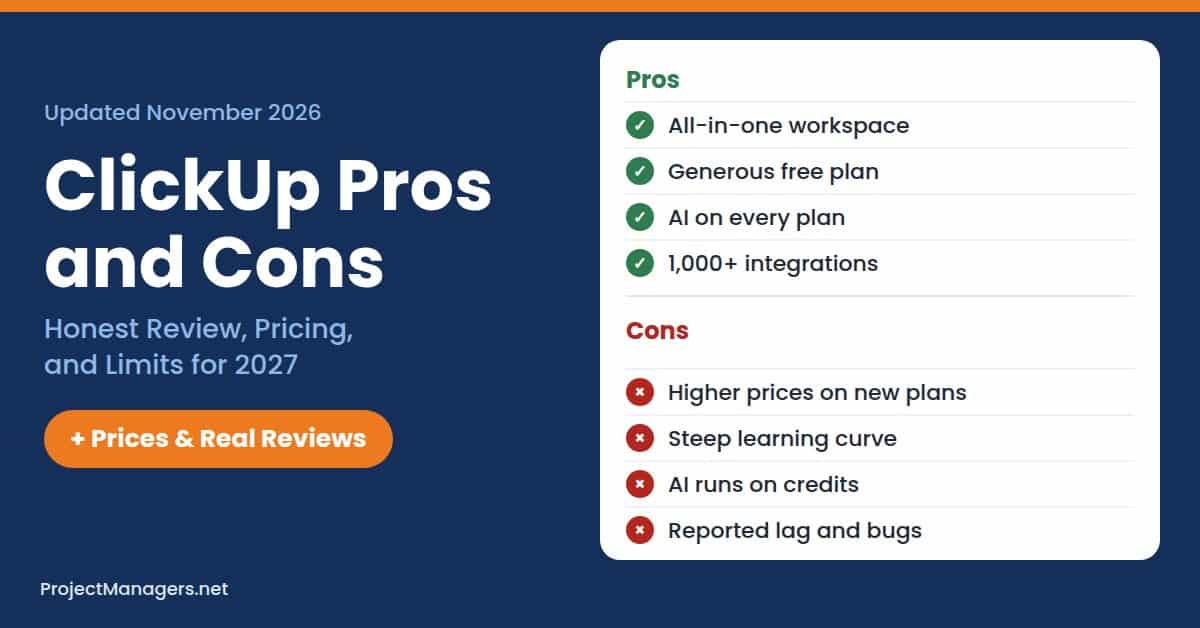
ClickUp Pros and Cons at a Glance
Pros
- Tasks, docs, chat, whiteboards, and dashboards in one place
- Free Forever plan with unlimited members and tasks
- Brain² AI and AI credits included on every plan
- 15+ views, custom statuses, fields, and task types
- Up to 10,000 automation actions a month on Business
- 1,000+ integrations and MCP connections
- Dashboards, workload, and time in status reports
- Enterprise controls, data residency, and HIPAA support
Cons
- New plans cost more than the old Unlimited and Business plans
- Steep learning curve and a crowded interface
- AI features draw on a monthly credit allowance
- Free plan capped at 60MB storage and 100 automation actions
- Reported lag, bugs, and slow loading in large workspaces
- Rigid seat and billing changes, per recent reviews
- Timesheet approvals and SAML SSO need Enterprise
- Notification overload without careful setup
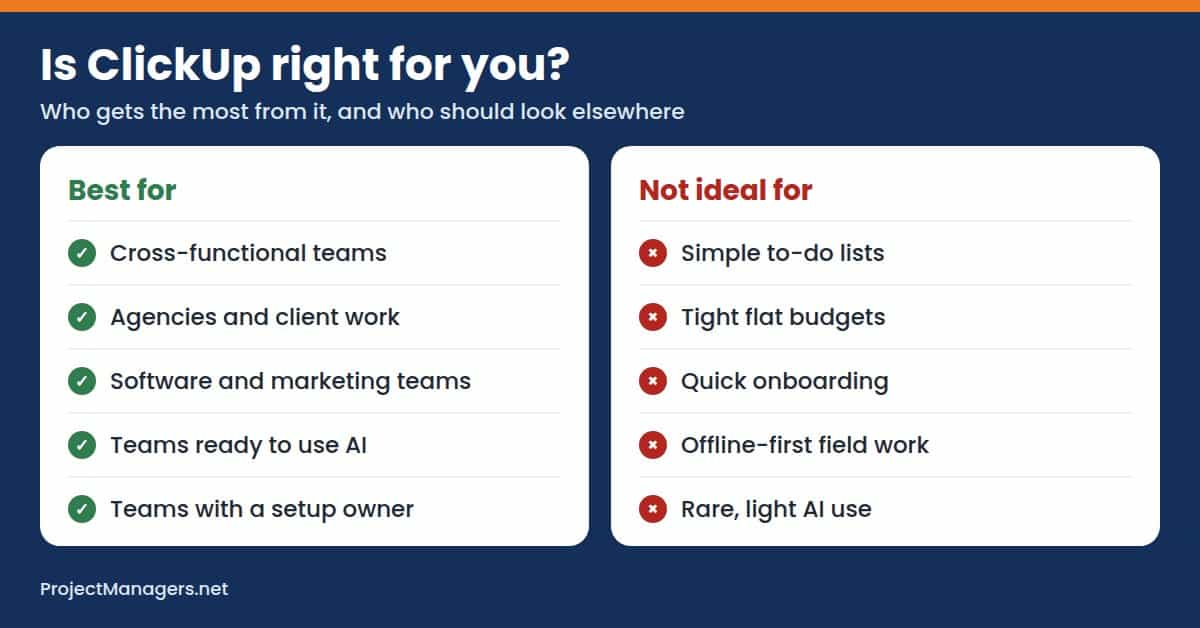
Best For: small to large teams that want one customizable workspace for projects, docs, and chat, and that will invest time in setup.
Look Elsewhere If: you need a simple to-do app, predictable flat pricing, quick onboarding, or heavy offline and mobile use.
Checked November 5, 2026, against ClickUp pricing, the ClickUp help center, and ClickUp’s Brain² announcement.
The Pros or Advantages of ClickUp
ClickUp brings project management, documents, chat, and AI into one workspace. Its notable pros include:
1. One Workspace for Tasks, Docs, and Chat
ClickUp combines tasks, docs, chat, whiteboards, forms, dashboards, SyncUps video calls, and time tracking. Teams that move everything into it stop switching between separate apps and gain one place to see all work. Because tasks, docs, and conversations sit side by side, it is easier to link a decision to the work it affects. That shared context also feeds ClickUp’s AI, which can answer questions about the whole workspace.
2. A Generous Free Forever Plan
The Free Forever plan includes unlimited tasks, unlimited free members, collaborative docs, Kanban boards, calendar view, sprints, and 24/7 support, according to ClickUp pricing. It also comes with 500 AI credits per workspace, so small teams can try Brain² without paying. Paid features such as Gantt charts, custom fields, and time tracking appear on Free as trials with limited uses. This lets teams test advanced features with real work before they upgrade.
3. AI Built into Every Plan
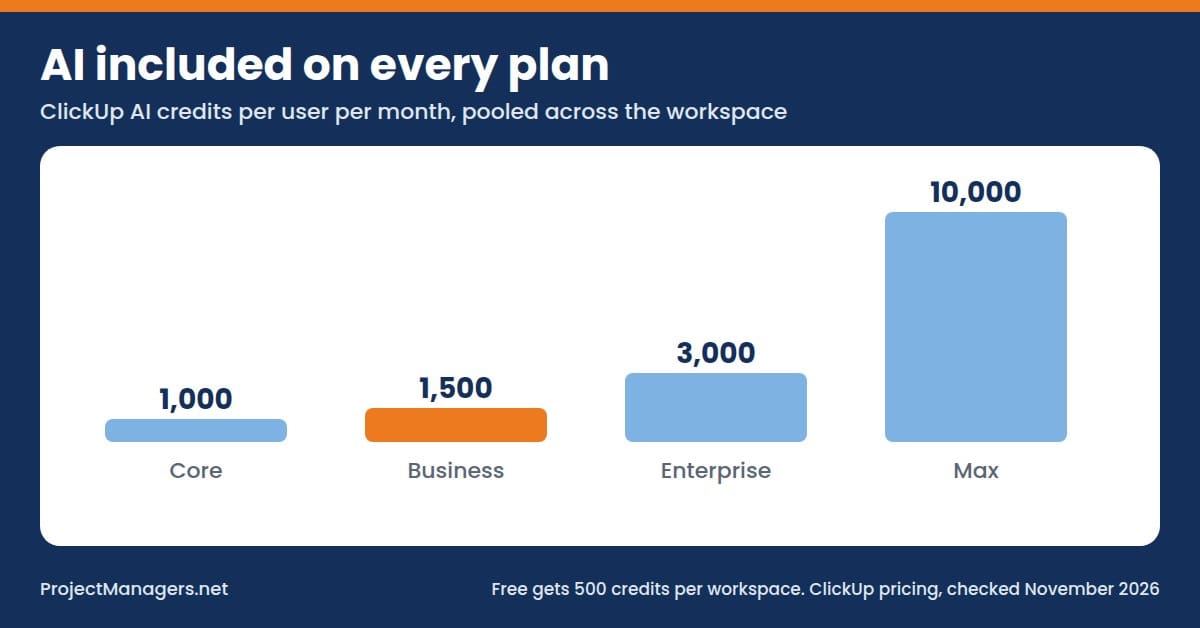
Brain² can draft docs, write status reports, update many tasks at once, and research across the workspace and connected apps. ClickUp says it routes each task to models from Anthropic, OpenAI, or Google, so users do not pick a model themselves. On the new plans, AI is no longer a separate add-on. Core includes 1,000 AI credits per user per month, Business 1,500, Enterprise 3,000, and Max 10,000, all pooled across the workspace.
4. Highly Customizable Views and Workflows
ClickUp offers list, board, calendar, table, Gantt, timeline, workload, mind map, and map views, among others. Teams can add custom statuses, custom fields, and custom task types to match their own process. Its hierarchy of Spaces, Folders, and Lists lets a marketing team, a software team, and an operations team each work their own way in the same workspace.
5. Powerful Automation
Built-in automations move tasks, assign owners, change statuses, and send updates without manual work. Free allows 100 automation actions a month, Core 1,000, Business 10,000, and Enterprise 1 million. Business also adds webhooks, email, SMS, and integration actions, so automations can reach other systems. AI automations let teams describe a rule in plain language instead of building it step by step.
6. 1,000+ Integrations and MCP Connections
ClickUp’s integrations page says it connects with more than 1,000 tools. Native integrations include Jira, Microsoft Teams, Figma, Zapier, Make, and Google Calendar on every plan. Paid plans add Google Drive, Dropbox, Box, and OneDrive, and higher tiers add Confluence, Salesforce, and Azure DevOps. Brain² can also reach other apps through MCP, such as GitHub and Gmail.
7. Strong Reporting and Dashboards
The Business plan introduces advanced dashboards, timesheets, and time-in-status reports alongside a dedicated workload view. These tools allow project managers to monitor team capacity and identify where tasks stall in real time. By providing deep insights into sprint trends and resource allocation, these features eliminate the need to export data into external spreadsheets for analysis.
8. Scales from Freelancers to Enterprises
Enterprise adds SAML SSO, SCIM provisioning, audit trails, custom permissions, US, EU, and APAC data residency, and HIPAA support with a BAA. That range lets a company start on Free and grow into enterprise controls without moving to another tool. ClickUp also offers a 30-day refund on a first paid subscription and discounts for nonprofits, students, educators, and startups.
The Cons or Disadvantages of ClickUp
ClickUp’s depth is also the source of its main drawbacks. Weigh these disadvantages before you commit:
1. The New Plans Cost More
New workspaces now cost $9 per user per month for Core and $17 for Business, billed yearly. The older Unlimited and Business plans cost $7 and $12. Billed monthly, Core is $12, and Business is $25, compared with $10 and $19 before. A 10-person team on Business now pays $2,040 a year on annual billing, up from $1,440. The help center says upgraded workspaces get more features and that their price updates begin no earlier than January 2027, but some may see no change.
2. A Steep Learning Curve
With dozens of views, ClickApps, custom fields, and AI tools, ClickUp can overwhelm new users. Even ClickUp’s own getting-started video says that seeing everything at once “can feel overwhelming.” Teams often need a person to own the setup, plus a few weeks of training, before ClickUp feels faster than the tools it replaces.
3. AI Runs on a Credit Meter
Brain² chat with standard models is unlimited on Business and above, but Super Agents, AI fields, AI automations, and image generation use AI credits. Free workspaces get 500 credits in total, and paid plans get a pooled monthly allowance. Heavy AI users can buy more credits at $10 per 10,000. That makes AI costs harder to predict than a flat add-on, especially for large teams that build many agents.
4. Free Plan Limits Bite Quickly
The Free Forever plan includes only 60MB of file storage, 100 automation actions a month, 5 active automation rules, and 90 days of chat history. Trial features have a fixed number of uses that do not reset. In an October 2026 Trustpilot review, one team said chat stopped working after it passed the storage and message limits. Teams that plan to share files or use chat heavily should expect to upgrade.
5. Reported Lag, Bugs, and Slow Loading
Users with large workspaces, many tasks, or heavy dashboards sometimes report lag and slow loading. A July 2026 Trustpilot reviewer praised ClickUp’s pace of innovation but said some bugs had broken the app for their team. ClickUp publishes uptime and incidents on its status page. Test performance with your own data during the free plan or the first month.
6. Rigid Billing and AI-First Support
Upgrades apply to the whole workspace, and every member from inside your organization counts as a paid user. Several October 2026 Trustpilot reviewers said seat reductions needed at least 30 days’ notice before renewal and that billing tickets went unanswered. Another reviewer said an AI chatbot handled their support request and that they canceled as a result. Check the renewal terms before you commit to an annual plan.
7. Key Admin Controls Need Enterprise
While the Business plan offers Google SSO and basic timesheets, more advanced requirements like timesheet approvals, SAML, Okta SSO, audit trails, custom permissions, and HIPAA support are exclusive to the Enterprise tier. Because Enterprise uses custom pricing, regulated industries and large organizations must contact the sales team to receive a comprehensive quote for their specific needs.
8. Notification Overload and Interface Clutter
Because so many features, views, and AI tools are active, users often report an overwhelming amount of notifications and a cluttered interface. Without strict rules for custom statuses, fields, and alert settings, a workspace can quickly become difficult to navigate. This complexity may actually make the platform harder to manage than the simpler tools it was meant to replace.
ClickUp Key Features
ClickUp groups hundreds of features into tasks, views, docs, collaboration, automation, reporting, and AI. Here are the key features:
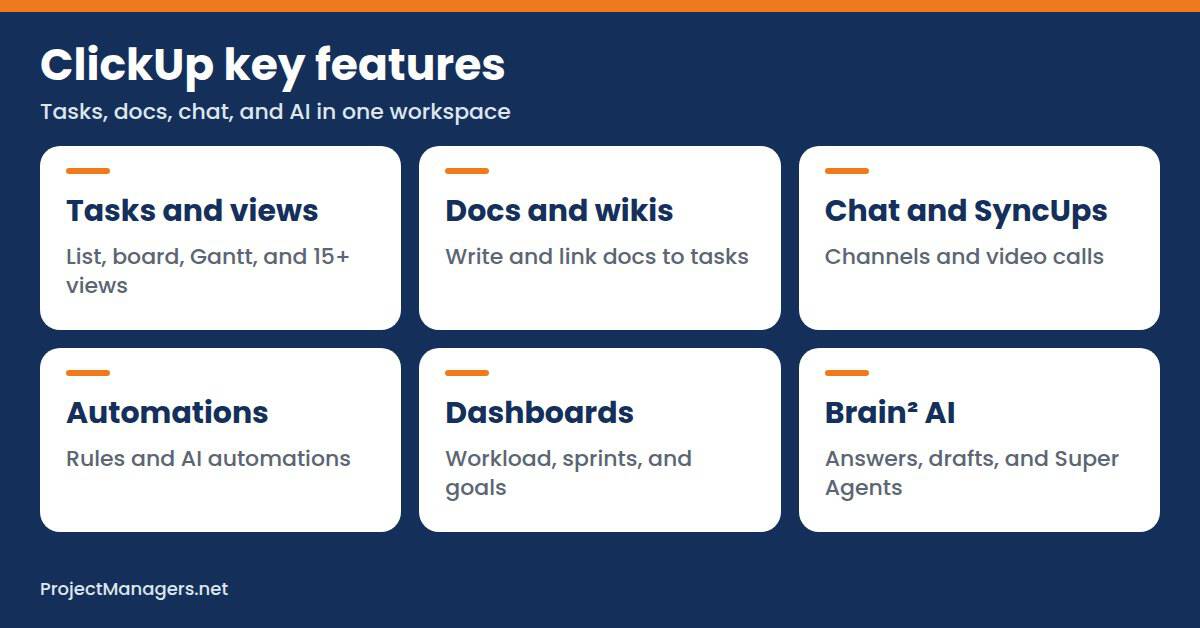
- Hierarchy and Custom Tasks: Organize work into Spaces, Folders, and Lists, and add custom statuses, fields, and task types.
- 15+ Views: Switch between list, board, calendar, table, Gantt, timeline, workload, mind map, and whiteboard views.
- Docs and Wikis: Write collaborative docs, link them to tasks, and turn a doc into a wiki.
- Chat and SyncUps: Message the team in channels and start SyncUps video calls without leaving ClickUp.
- Automations: Run rule-based and AI automations, from 100 actions a month on Free to 1 million on Enterprise.
- Brain² AI: Ask questions about the workspace, draft content, update tasks in bulk, and build Super Agents.
- Dashboards and Reporting: Track sprints, workload, time in status, and goals in custom dashboards (advanced reporting on Business).
- Time Tracking and Timesheets: Track time on tasks in Core, and add timesheets in Business Plan and approvals in Enterprise.
- Goals and Sprints: Set goals, tie them to tasks, and run sprints with sprint points.
- Forms: Collect requests with forms that create tasks, with conditional logic on Enterprise.
- Security and Administration: Add SAML SSO, SCIM, audit trails, custom permissions, and data residency on Enterprise.
- Integrations, API, and MCP: Connect more than 1,000 tools, build on the API, or connect AI tools through MCP.
ClickUp Pricing and Plans
ClickUp offers a Free Forever plan, three paid plans with list prices, and custom Enterprise pricing. Prices are per user, and upgrading applies to every member of the workspace.
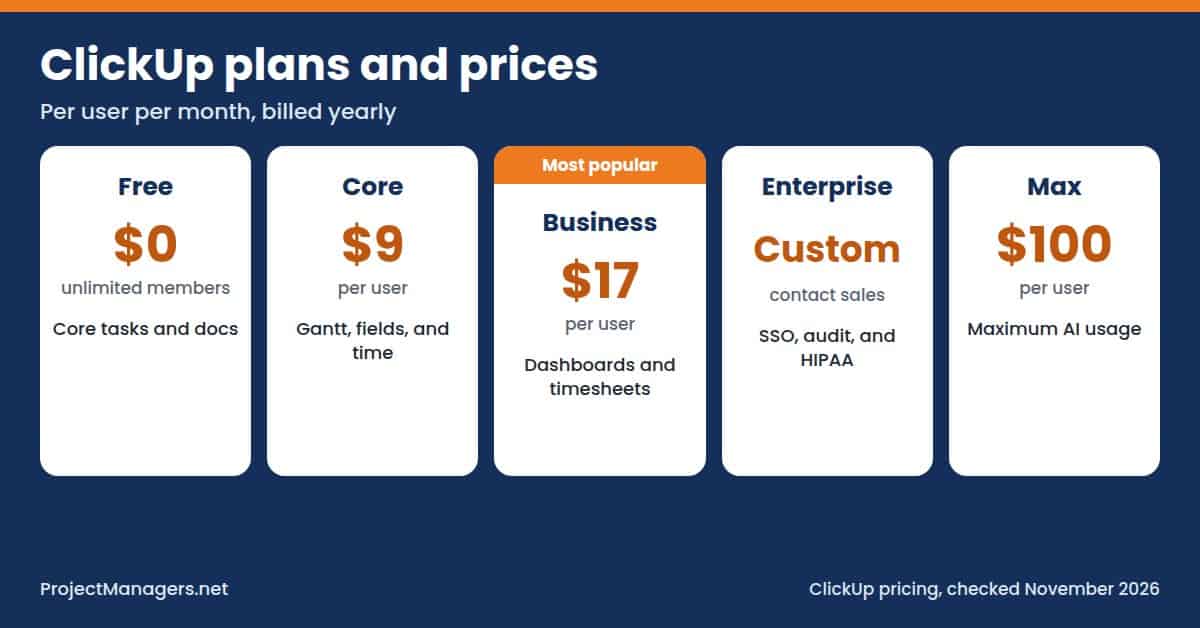
ClickUp Plans Compared (November 2026)
Prices are per user per month in US dollars, before tax. Each plan includes everything in the plan before it, except that Max builds on Enterprise.
| Plan | Billed Yearly | Billed Monthly | Key Additions | Best For |
|---|---|---|---|---|
| Free Forever | $0 | $0 | Unlimited tasks and members, docs, Kanban, sprints, 60MB storage, and 500 AI credits | Individuals and small teams testing ClickUp |
| Core | $9 | $12 | Unlimited storage, Gantt charts, custom fields, time tracking, 1,000 AI credits, and 1,000 automations | Small teams that need core project tools |
| Business | $17 | $25 | Advanced dashboards, timesheets, resource management, Google SSO, 1,500 AI credits, and 10,000 automations | Growing teams that report on work |
| Enterprise | Custom | Custom | SAML SSO, SCIM, audit trails, white labeling, HIPAA support, and 3,000 AI credits | Large or regulated organizations |
| Max | $100 | $120 | Everything in Enterprise, 10,000 AI credits, custom skills, and unlimited AI fields and agents | AI-heavy teams |
Extra AI credits cost $10 per 10,000. Existing workspaces on the older Unlimited ($7) and Business ($12) plans keep their price until ClickUp moves them to the new plans. First paid subscriptions have a 30-day refund guarantee. Sources: ClickUp pricing and the ClickUp help center, checked November 5, 2026.
For a plan-by-plan breakdown, see our ClickUp Pricing Plans and Costs Guide. If per-user pricing adds up too fast for your team, look at AceProject. It charges one price per account instead of per user, so the bill does not grow with every new hire.
What ClickUp Users Say
ClickUp has one of the largest review bases in project management software. Most reviewers praise its flexibility and AI, while complaints focus on complexity, performance, billing, and support.
What ClickUp Users Say
- 4.6/5
G2 rating, from 15,376 reviews
- 4.6/5
Capterra rating, from more than 4,500 reviews
- 4.1/5
Trustpilot score, from 716 reviews
What Reviewers Like
- One place for tasks, docs, and chat
- Deep customization
- Built-in AI that knows the workspace
- Frequent new features
What Reviewers Dislike
- Steep learning curve
- Lag and bugs in large workspaces
- Rigid seat and billing changes
- AI chatbot support
From the Field
“It’s a great app, and they’re constantly innovating…”
Aaron S., in a low-rated Trustpilot review that also criticized bugs and performance (July 2026).
Sources: G2 ClickUp reviews and Trustpilot ClickUp reviews, checked November 5, 2026. Capterra blocks automated checks, so its figure comes from Capterra’s listing in search results. Trustpilot notes that ClickUp has not invited reviews recently, so read each score as a signal, not a verdict.
Who Should Use ClickUp?
ClickUp fits best where teams want one flexible workspace and are willing to invest in setup. Typical use cases include:
- Cross-Functional Teams: Give marketing, product, and operations their own Spaces while leaders see all work in one dashboard.
- Agencies: Manage client projects, intake forms, guest access, and time tracking in a single workspace.
- Software and Product Teams: Run sprints, track bugs, link docs to tasks, and connect GitHub or Jira.
- Marketing Teams: Plan campaigns and content calendars, and use Brain² to draft briefs and status updates.
- AI-Ready Teams: Build Super Agents and AI automations that triage requests, write reports, and update tasks.
It is a weaker fit for people who want a simple to-do list, teams that need flat and predictable pricing, and field teams that rely on offline mobile work. Those teams should test ClickUp against their must-haves on the Free Forever plan before they pay.
Video: The First Setup Step for New ClickUp Users
Want to see how to tame ClickUp’s interface? This short official video shows the first setup change ClickUp recommends for new users.
New to ClickUp 4.0? Set This up First (Official, 3 Minutes)
ClickUp’s team shows how to customize the sidebar so only the work that matters stays visible. It was published in June 2026, before the new plans launched, so it does not cover pricing or Brain² credits.
ClickUp FAQ
Is ClickUp Free?
Yes. ClickUp’s Free Forever plan includes unlimited tasks and members, docs, Kanban boards, sprints, and 24/7 support. It is limited to 60MB of storage, 100 automation actions a month, and 500 AI credits per workspace (ClickUp pricing).
How Much Does ClickUp Cost?
Billed yearly, ClickUp costs $9 per user per month for Core, $17 for Business, and $100 for Max, and Enterprise uses custom pricing. Billed monthly, Core costs $12, Business $25, and Max $120 (ClickUp pricing, checked November 5, 2026).
What Changed in ClickUp’s Pricing in 2026?
ClickUp replaced its Unlimited plan with Core, raised list prices for new workspaces, included AI credits in every plan, and added a Max plan. Existing workspaces are moved over gradually, and the help center says their price updates begin no earlier than January 2027.
Does ClickUp Include AI?
Yes. Every plan includes Brain² and a pooled AI credit allowance, from 500 credits on Free to 10,000 per user per month on Max. Super Agents, AI fields, and image generation use credits, and extra credits cost $10 per 10,000.
Does ClickUp Offer a Refund?
Yes. ClickUp offers a 30-day satisfaction guarantee on a first paid subscription, including add-ons bought with it. Because the Free Forever plan has no time limit, most teams test ClickUp there before they pay.
Is ClickUp Hard to Learn?
ClickUp has a steep learning curve because it offers many views, fields, and settings. Start with one Space and a few views, assign one person to own the setup, and add features as the team gets comfortable.
What Is a Good Alternative to ClickUp?
If per-user pricing adds up too fast, AceProject charges one price per account instead of per user. For a plan-by-plan view of ClickUp’s costs, see our ClickUp Pricing Plans and Costs Guide.
Conclusion
ClickUp is still one of the most complete work platforms available. Its tasks, docs, chat, views, automations, and Brain² AI let one workspace replace several tools, and its Free Forever plan is generous for small teams. In return, you accept higher prices on the new plans, a steep learning curve, metered AI, and reports of lag and rigid billing.
Understanding these pros and cons is the key to deciding whether ClickUp fits your organization. Start on the Free Forever plan, run one real project through it, and check your own must-haves rather than rely on any review, including this one.
Suggested Articles:
- ClickUp Pricing Plans & Costs Guide
- The Pros and Cons of Using Monday.com Software
- The Pros and Cons of Using Wrike Software

Peter Kanai is a Google-certified freelance writer with over a decade of experience crafting high-quality content for business websites, blogs, and SEO & email marketing campaigns. His on-demand writing services are all about helping businesses expand their online presence and achieve their objectives. With a proven track record in delivering results-driven content, Peter is the go-to freelance writer for business owners seeking a strategic partner to help them grow their brand online.