
Poor time tracking can quietly eat into a business’s revenue. When employees record hours from memory at the end of the week, billable work goes uninvoiced, project budgets become harder to control, and payroll discrepancies take longer to resolve. Many teams pick Clockify to fix these challenges because it is easy to start and cost-effective. However, its pricing plans and features changed significantly in 2026, making it worth taking a closer look at what each plan offers.
This review explains what Clockify does well, where it falls short, what it costs, and who it fits best in 2027. It covers the April 2026 cuts to the free plan, the features that sit on each paid tier, and what thousands of reviewers say. We checked every price and feature on Clockify’s own pages and help center in November 2026.
- Free Plan with Limits: Clockify’s free plan still includes unlimited time tracking, timesheets, and apps. Since April 2026, however, it covers only 5 active users and 31 days of reports.
- Prices and Features by Tier: Clockify’s paid plans cost $3.99 to $11.99 per seat per month when billed annually, and monthly billing costs about 25% more. Invoicing and approvals start on Standard, while expenses, scheduling, and profit reports need Pro.
- Broad Platform Coverage: Clockify runs on the web, desktop, and mobile, and it connects with more than 100 apps. Its browser extension adds a timer inside more than 90 web tools.
- Drawbacks and Best Fit: Clockify fits freelancers, agencies, and small teams that need simple, low-cost time tracking. Its main weaknesses are the smaller free plan, basic invoicing, reports that some teams outgrow, and no built-in AI yet.
Clockify: Time Tracking Software for Teams
Clockify is a time tracking and timesheet app made by CAKE.com (formerly COING), a software company based in Palo Alto, California. It launched in 2017 and passed 1 million registered users in 2019. Today, CAKE.com reports more than 10 million users across Clockify, Pumble, and Plaky.
People use Clockify to track work hours on projects and tasks, fill in timesheets, and report on where time goes. Paid plans add billable rates, invoicing, approvals, attendance, scheduling, expenses, and labor cost reports. It runs in the browser, as a desktop app, as a mobile app, and as a browser extension.
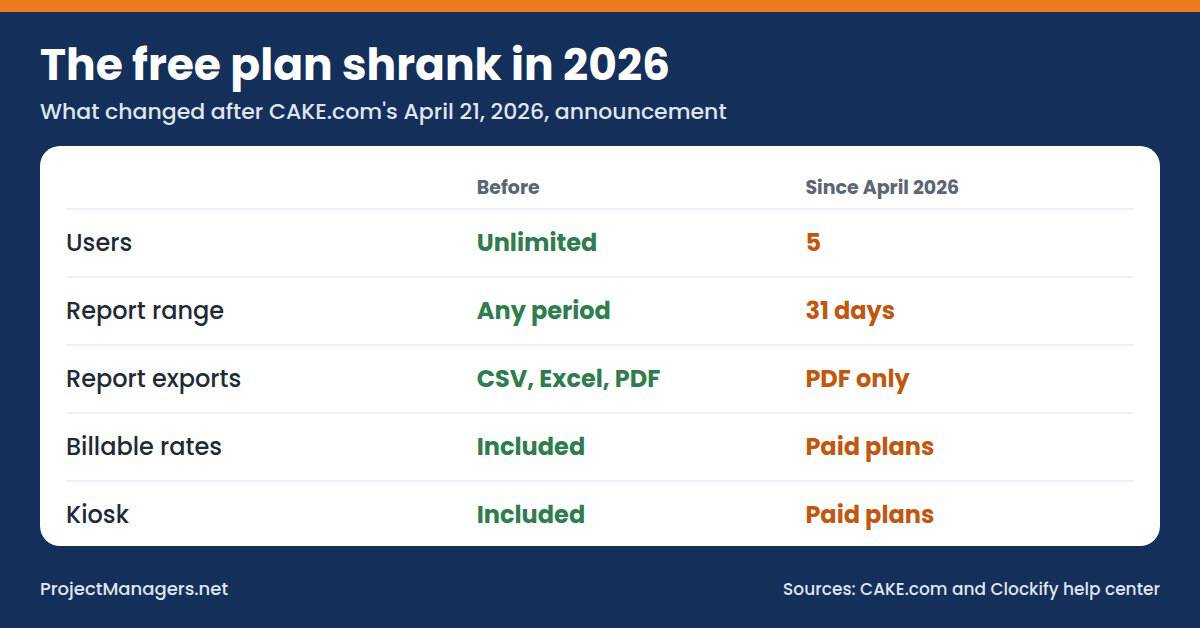
For years, Clockify’s calling card was a free plan for unlimited users. That changed on April 21, 2026, when CAKE.com announced free plan changes that cap free workspaces at 5 users and move several features to paid plans. The pros and cons below reflect the product as it stands after that change.
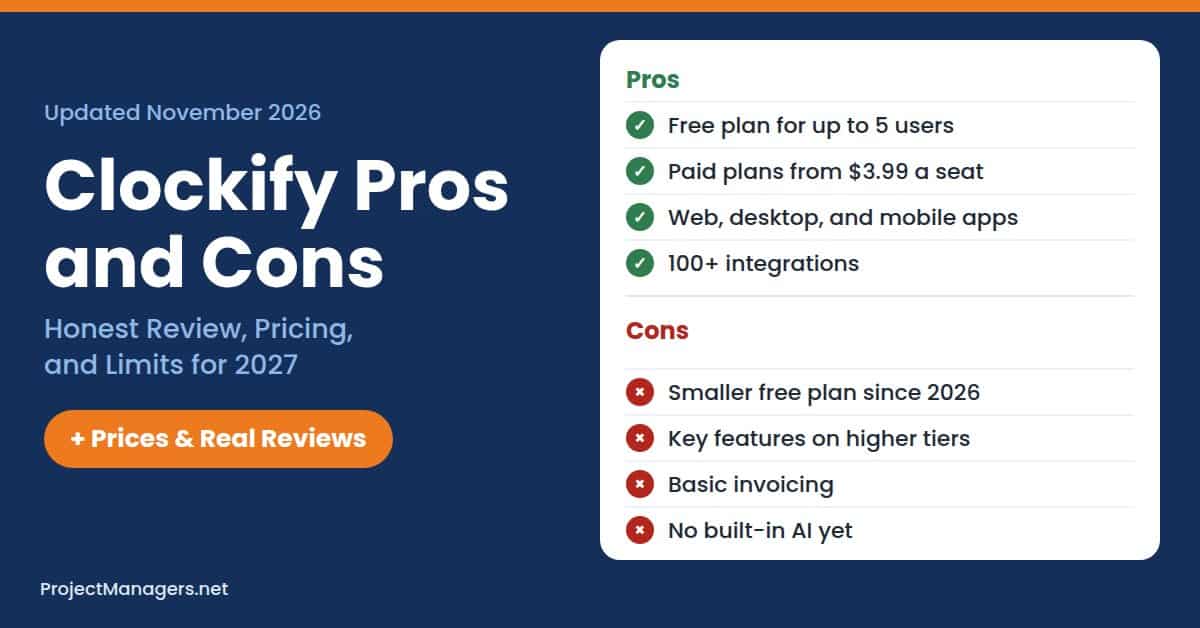
Clockify Pros and Cons at a Glance
Pros
- Free plan with unlimited tracking for up to 5 users
- Paid plans from $3.99 per seat per month
- Timer, timesheet, calendar, and kiosk time entry
- Web, desktop, and mobile apps, plus 100+ integrations
- Invoicing, approvals, and QuickBooks sync on Standard
- Budgets, scheduling, expenses, and profit on Pro
- Attendance, breaks, time off, and kiosk for shift teams
- 24/7 support by email, chat, and phone on every plan
Cons
- Free plan cut to 5 users and 31 days of reports in 2026
- Invoicing, expenses, and profit tools need paid tiers
- Reports and exports that some teams outgrow
- Invoicing too basic for complex billing
- Reported lag, freezes, and sync glitches in the apps
- Activity monitoring and screenshots raise privacy concerns
- No built-in AI assistant yet (MCP server coming soon)
- Manual entry for calls and offline work
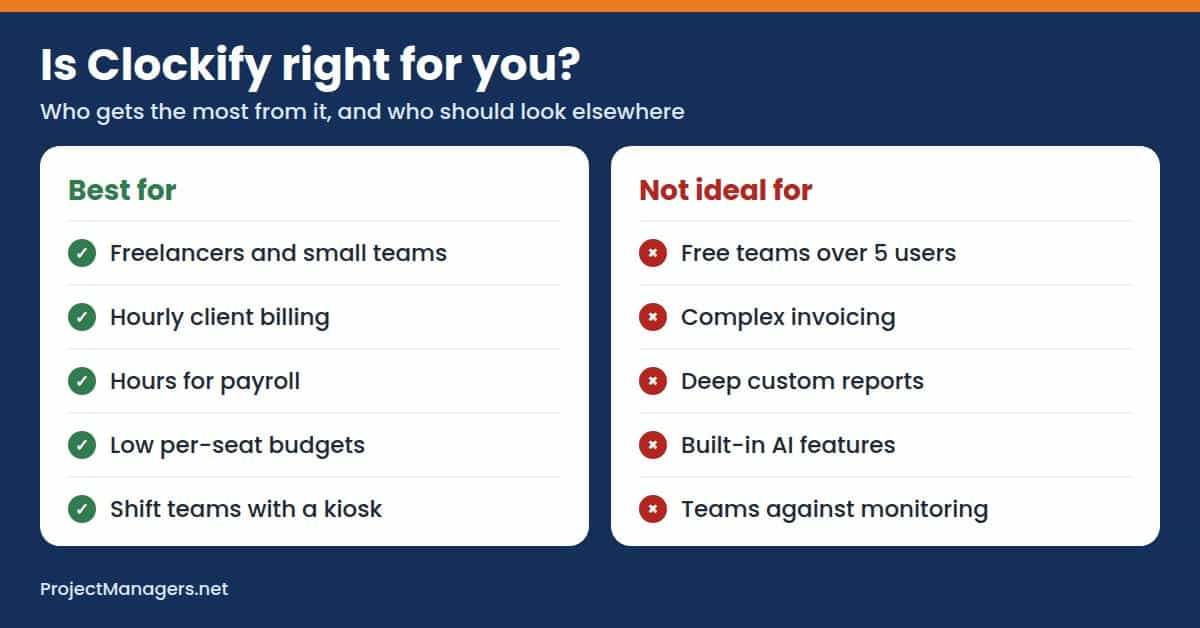
Best For: freelancers, agencies, and small to midsize teams that bill by the hour or track hours for payroll and want a low price per seat.
Look Elsewhere If: you need a large free team plan, advanced invoicing, deep custom reports, or AI features built into the app.
Checked November 4, 2026, against Clockify pricing, the Clockify help center, and CAKE.com’s free plan announcement.
The Pros or Advantages of Clockify
Clockify remains one of the most affordable ways for a team to track time accurately. Its notable pros include:
1. A Free Plan That Still Covers Core Time Tracking
The free plan includes unlimited tracking, the time tracker, timesheets, the calendar, the auto tracker, Pomodoro timer, idle detection, and the mobile and desktop apps. Freelancers and teams of up to 5 people can track time properly without paying anything. Clockify also offers a 7-day trial of all Pro features with no credit card required, according to Clockify pricing. That gives teams time to test paid features with real projects before they commit.
2. Low Per-Seat Prices on Paid Plans
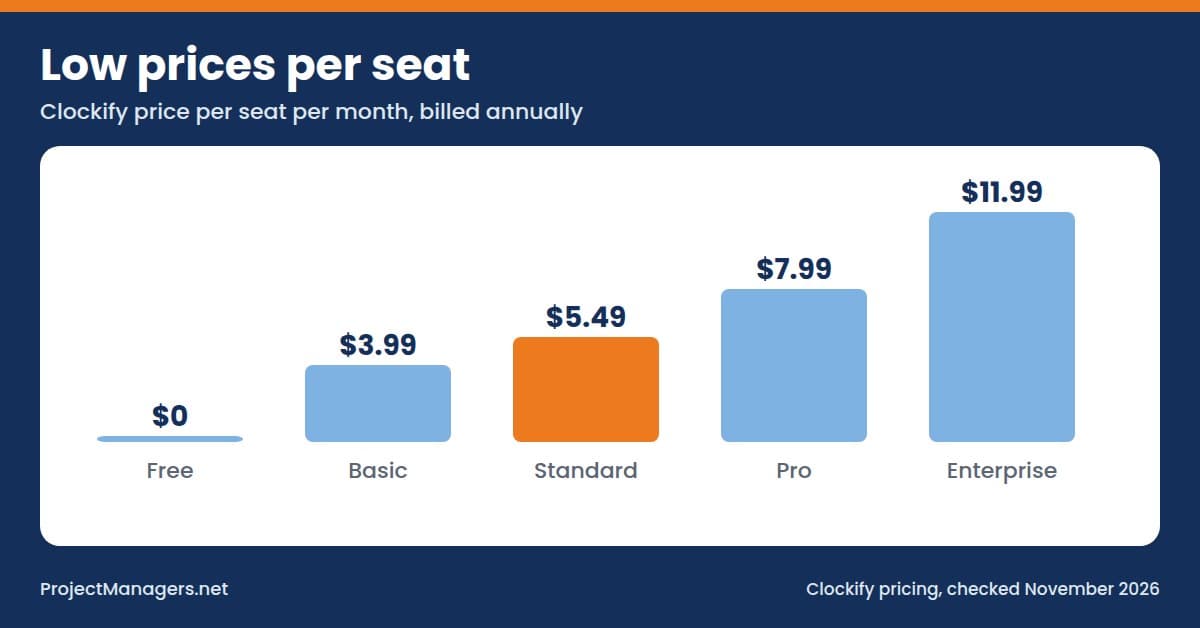
Paid plans cost $3.99 (Basic), $5.49 (Standard), $7.99 (Pro), and $11.99 (Enterprise) per seat per month, billed annually. Monthly billing costs $4.99 to $14.99. A 10-person team on Standard pays $658.80 a year, which is modest for a tool that also invoices. Annual plans save 20%, and you can deactivate a user to free up a seat for someone else. Canceling moves you back to the free plan, and Clockify says you keep your data.
3. Simple, Fast Time Entry
Users can start a timer with one click, fill in a weekly timesheet, drag entries on a calendar, or clock in at a shared kiosk. Favorite entries, split time, and bulk edit save clicks on paid plans, which helps busy teams log hours faster. Reviewers on G2 and Capterra often name ease of use as Clockify’s main strength.
4. Apps on Every Platform and 100+ Integrations
Clockify runs on the web, Windows, Mac, Linux, iOS, and Android. Its integrations page lists more than 100 connections, including Jira, Asana, Trello, ClickUp, QuickBooks, Xero, Google Calendar, Outlook, and Zapier. The browser extension adds a start button inside more than 90 web apps. The extension is open source, so developers can add their own integrations.
5. Invoicing, Approvals, and QuickBooks on Standard
The Standard plan adds invoicing, recurring invoices, timesheet approval, time locking, task rates, rounding, and a QuickBooks integration. Managers can approve submitted hours, lock the pay period, and bill clients straight from the same tracked data. This cuts double entry and costly billing errors, which helps agencies and consultants turn logged time into accurate invoices faster.
6. Budgets, Scheduling, and Profit Reports on Pro
Pro adds labor cost and profit tracking, budgets and estimates, scheduling, forecasting, expenses, custom fields, multiple currencies, and alerts. Project managers can see whether a project is on budget, spot overruns early, and plan who works on what next week, all inside Clockify without needing a separate scheduling or budgeting tool.
7. Kiosk and Attendance Tools for Shift Teams
Paid plans turn a shared tablet into a kiosk where staff clock in with a PIN or QR code, so no personal device is needed. Standard adds attendance, overtime, and time off tracking, while Pro adds kiosk photo capture and GPS tracking to verify who clocked in and where. These tools suit retail, field service, and other shift-based teams.
8. 24/7 Human Support on Every Plan
Clockify offers 24/7 support by email, chat, and phone on every plan, including the free one, so even solo users can reach a real person at any hour. Its pricing page claims a 95% customer satisfaction score. Some Trustpilot reviewers praise quick help from real people, while others describe replies as templated and slow to address specific issues.
The Cons or Disadvantages of Clockify
Clockify covers the basics well, but it is important to weigh its drawbacks before you commit. The main disadvantages are:
1. The Free Plan Shrank in 2026
In April 2026, Clockify capped free workspaces at 5 active users, including the owner. According to the help center, free reports now cover a maximum of 31 days, and exports are PDF only. Billable rates, kiosk, shared reports, and project estimates moved to paid plans. Free workspaces are also limited to 30 API requests per hour and 3 webhooks. Many long-time users on Trustpilot say they missed the advance notice, although Clockify says it sent in-app notifications about a month ahead.
2. Key Features Sit on Higher Tiers
Invoicing and approvals require the Standard plan, while expenses, scheduling, budgets, and profit reports are locked behind Pro, and single sign-on needs Enterprise. These gaps push growing teams toward costlier tiers. A 20-person team on Pro pays $1,917.60 a year when billed annually, or $2,397.60 when billed monthly.
3. Reports That Some Teams Outgrow
Clockify’s summary, detailed, and weekly reports cover most needs, and paid plans add custom exports and email reports. Several reviewers on G2 and Capterra, however, say filtering and advanced reporting feel limited as teams grow. Teams with complex reporting needs often export the data to a spreadsheet or a BI tool.
4. Invoicing That Is Basic for Complex Billing
Invoicing covers hourly billing, recurring invoices, and QuickBooks or Xero sync, but it is not a full billing system. One Trustpilot reviewer wrote in June 2026 that invoices were not customizable enough for a growing business, and another noted weak multi-currency support. Firms with retainers, milestones, or complex tax rules may still need separate invoicing software.
5. Reported Lag, Freezes, and Sync Glitches
Some reviewers describe the apps as sluggish at times, and a Trustpilot reviewer reported freezes and a disabled button in October 2026. Because Clockify syncs entries in real time, slow connections can cause delays. These reports are a minority, but they are worth testing during the trial.
6. Activity Monitoring Raises Privacy Questions
Pro’s activity monitoring records apps and websites, keyboard and mouse activity, and optional screenshots. Admins choose how often screenshots are taken and whether they are blurred. Employees cannot see their own monitoring results, and the agent cannot be paused manually. Some teams value this oversight, but others see it as surveillance. If you turn it on, write a clear policy and check local privacy laws first.
7. No Built-In AI Assistant Yet
Many competitors now offer AI summaries or automatic time suggestions that save users hours of manual work. Clockify’s pricing page lists no AI features, and its MCP server, which lets an AI agent log time and pull reports, was marked “coming soon” when we checked in November 2026. Teams wanting smart automation may need to look elsewhere for now.
8. Manual Entry for Calls and Offline Work
Clockify does not log phone calls automatically, so teams that bill for calls must start a timer or add the time afterward. This creates extra work for consultants, support staff, and agencies that spend hours on the phone. Adding or editing many entries by hand can also feel slow, which one Capterra reviewer named as their main complaint.
Clockify Key Features
Whether you work alone or manage a large team, Clockify groups its tools into time tracking, reporting, and management. Here are the key features:
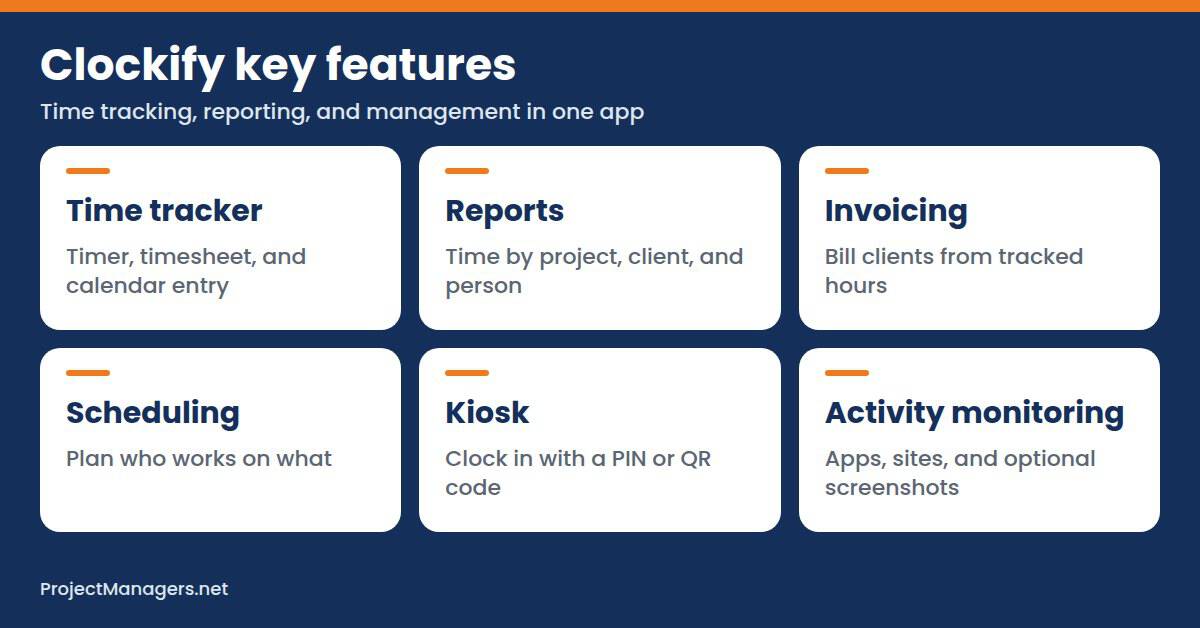
- Time Tracker and Timesheets: Start a timer, enter hours in a weekly timesheet, or drag entries on a calendar.
- Auto Tracker and Idle Detection: Record the apps and sites you use on desktop, and get reminders when you stop tracking or go idle.
- Kiosk: Let staff clock in and out on a shared device with a PIN or QR code (paid plans).
- Reports and Dashboard: See time by project, client, task, and person, with PDF exports on Free and CSV or Excel exports on paid plans.
- Billable Rates and Invoicing: Set hourly and task rates, then create one-time or recurring invoices from tracked time (Standard and up).
- Approval and Locking: Submit timesheets for approval and lock past periods to stop late edits (Standard and up).
- Time Off, Attendance, and Overtime: Track breaks on Basic, and track leave, attendance, and overtime for payroll on Standard.
- Scheduling and Forecasting: Assign work, plan capacity, and forecast project completion (Pro).
- Expenses, Budgets, and Profit: Record expenses, set budgets and estimates, and compare labor cost with revenue (Pro).
- Activity Monitoring and GPS: Capture app and website activity, optional screenshots, and location data (Pro).
- Security and Administration: Add single sign-on, SCIM provisioning, a custom subdomain, and audit logs (Enterprise).
- Integrations and API: Connect more than 100 apps, use the browser extension, or build on the API and webhooks.
Clockify Pricing and Plans
Clockify offers a free plan, four paid plans, and a CAKE.com bundle. Prices are per seat, and every active or invited user on a paid plan needs a seat.
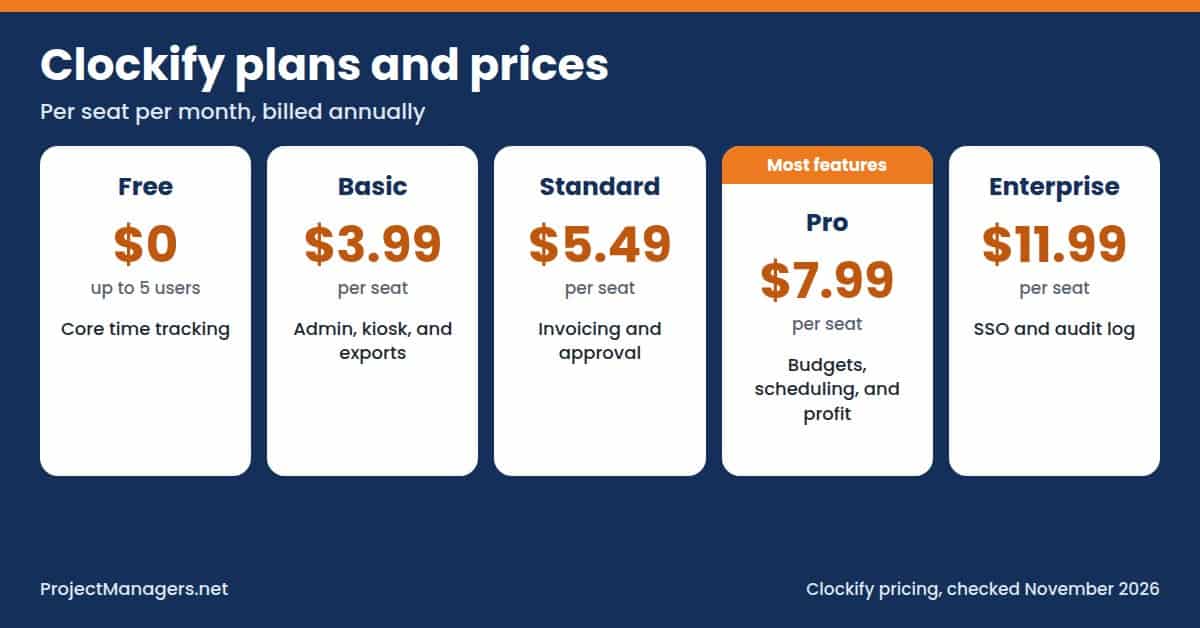
Clockify Plans Compared (November 2026)
Prices are per seat per month in US dollars, before tax. Each plan includes everything in the plan before it.
| Plan | Billed Annually | Billed Monthly | Key Additions | Best For |
|---|---|---|---|---|
| Free | $0 | $0 | Unlimited tracking, timesheets, apps, and PDF reports for up to 5 users | Freelancers and very small teams |
| Basic | $3.99 | $4.99 | Kiosk, breaks, billable rates, CSV and Excel exports, and project templates | Teams that need admin control |
| Standard | $5.49 | $6.99 | Invoicing, approval, time off, attendance, and QuickBooks | Agencies and teams that bill clients |
| Pro | $7.99 | $9.99 | Scheduling, expenses, budgets, labor cost, and activity monitoring | Project-based teams that track profit |
| Enterprise | $11.99 | $14.99 | Single sign-on, SCIM, custom subdomain, and audit log | Larger companies with IT rules |
| CAKE.com Bundle | $12.99 | $15.99 | Clockify Enterprise, Plaky, and Pumble together | Teams that also want chat and project boards |
Annual billing saves 20%. Clockify offers a 7-day Pro trial with no credit card and does not offer refunds. Source: Clockify pricing, checked November 4, 2026.
For a plan-by-plan breakdown, see our Clockify Pricing Plans and Costs Guide. If per-seat pricing adds up too fast for your team, look at AceProject. It charges one flat price per account instead of per user, so the bill does not grow with every new hire.
What Clockify Users Say
Clockify has one of the largest review bases of any time tracker. Most reviewers praise its simplicity and value, while recent complaints focus on the 2026 free plan changes.
What Clockify Users Say
- 4.8/5
Capterra rating, from more than 9,000 reviews
- 4.5/5
G2 rating, from 205 reviews
- 3.0/5
Trustpilot score, from 86 reviews, with 31% one-star ratings
What Reviewers Like
- Easy to learn and quick to use
- Strong value for the price
- Apps on every device
- Clear reports for client updates
What Reviewers Dislike
- Free features moved to paid plans in 2026
- Reporting and filtering limits
- Occasional lag and bugs
- Invoicing that is not very flexible
From the Field
“Fantastic value for money and simplicity of this software…”
David V., lead developer, in a five-star review shown on Clockify’s pricing page (October 2025).
Sources: Capterra Clockify reviews, G2 Clockify reviews, and Trustpilot Clockify reviews, checked November 2026. Trustpilot holds far fewer reviews, many written after the free plan change, so read each score as a signal, not a verdict.
Who Should Use Clockify?
Clockify fits best where people need to log hours quickly and a low price per seat matters. Typical use cases include:
- Freelancers: Track billable hours across clients on the free plan, and upgrade when you need billable rates or invoices.
- Agencies and Consultancies: Track time per client and project, approve timesheets, and invoice from the same data on Standard.
- Project Teams: Compare estimates, budgets, and labor cost with actual hours on Pro, and schedule upcoming work.
- Shift and Field Teams: Use the kiosk, GPS, and attendance reports to record clock-ins, breaks, and overtime for payroll.
- Remote and Hybrid Teams: See who works on what across time zones, with optional activity monitoring on Pro.
It is a weaker fit for groups of more than 5 people who want to stay free, firms with complex billing, and teams that want AI built into the app. Those teams should test Clockify against their must-haves during the free trial.
Video: Getting Started with Clockify
Want to see it in action? This official guide from Clockify walks through setup, time tracking, and reports in about 13 minutes.
Getting Started with Clockify (Official, 13 Minutes)
Clockify’s team shows how to set up a workspace, add team members, create projects, track time, and run reports. It was recorded in September 2025, before the free plan changes, so some features shown now need a paid plan.
Clockify FAQ
Is Clockify Free?
Yes. Clockify’s free plan includes unlimited time tracking, timesheets, apps, and PDF reports. Since April 21, 2026, though, free workspaces are capped at 5 active users and 31 days of reports, and several features moved to paid plans (Clockify Help).
How Much Does Clockify Cost?
Billed annually, Clockify costs $3.99 per seat per month for Basic, $5.49 for Standard, $7.99 for Pro, and $11.99 for Enterprise. Monthly billing costs $4.99 to $14.99 per seat, and every active or invited user on a paid plan needs a seat (Clockify pricing, checked November 4, 2026).
What Changed in Clockify’s Free Plan in 2026?
On April 21, 2026, CAKE.com announced that free Clockify workspaces would be limited to 5 users and that several features would move to paid plans (CAKE.com announcement). Larger teams that relied on the free plan now need a paid plan or another tool.
Does Clockify Have a Free Trial?
Yes. Clockify offers a 7-day trial of the Pro plan that does not require a credit card. Clockify does not offer refunds, so test your must-have features during the trial before you pay.
Can Clockify Create Invoices?
Yes, on the Standard plan and above. Standard adds invoicing, timesheet approval, time off, attendance, and the QuickBooks integration. Invoicing is basic, so firms with complex billing rules should test it against their needs first.
Does Clockify Monitor Employee Activity?
Only if you turn it on. The Pro plan includes optional activity monitoring, which some teams see as a privacy concern. Tell employees what is tracked and check local privacy laws before you enable it.
What Is a Good Alternative to Clockify?
If per-seat pricing adds up too fast, AceProject charges one flat price per account instead of per user. For a plan-by-plan view of Clockify’s costs, see our Clockify Pricing Plans and Costs Guide.
Conclusion
Clockify is still one of the easiest and cheapest ways to get a team tracking time. Its timer, timesheets, apps, and integrations are strong on every plan, and its paid tiers add invoicing, approvals, scheduling, and profit reports at low per-seat prices. In return, you accept a much smaller free plan since 2026, basic invoicing, reports that some teams outgrow, and no built-in AI yet.
Understanding these pros and cons is the key to deciding whether Clockify fits your organization. Start with the free plan or the 7-day Pro trial, run one real project through it, and check your own must-haves rather than relying on any review, including this one.
Suggested Articles:
- The Pros and Cons of Using Time Doctor Software
- The Pros and Cons of Using TimeCamp Software
- The Pros and Cons of Using Toggl Track Software

Peter Kanai is a Google-certified freelance writer with over a decade of experience crafting high-quality content for business websites, blogs, and SEO & email marketing campaigns. His on-demand writing services are all about helping businesses expand their online presence and achieve their objectives. With a proven track record in delivering results-driven content, Peter is the go-to freelance writer for business owners seeking a strategic partner to help them grow their brand online.