
Picture the Bank of Japan’s 2025 shock: USD/JPY plunged hundreds of pips in minutes. Some traders panicked; the hedged stayed calm (Edge-Forex). The takeaway is blunt—either accept risk with stops, sizing, and diversification, or transfer it by paying for protection. In this guide, we unpack five low-risk FX tactics. You’ll see hard numbers, like a 33 percent carry-trade wipe-out (Euromoney), and practical tools such as brokers that guarantee your stop price for a small fee (Investingoal).
By the end, you’ll know which mix fits your temperament, so the next price spike finds you steady, not scrambling.
1. The 1 Percent Rule: Position Sizing and Stop-Loss Discipline
Think of each trade as one brick in a long wall. If one brick cracks, the wall still stands. That is the spirit behind the 1 percent rule. Risk no more than 1 percent of your account on a single idea. On a ten-thousand-dollar account, that is one hundred dollars of downside, full stop. Price can wobble and gaps can open, but your pre-set stop closes the trade before the crack spreads.
Why accept such a small slice? Strings of losses happen. Ten losing trades at 1 percent each cut equity by about 9.5 percent after compounding—painful yet survivable. The same streak at 5 percent risk erases nearly half your capital and most of your confidence.
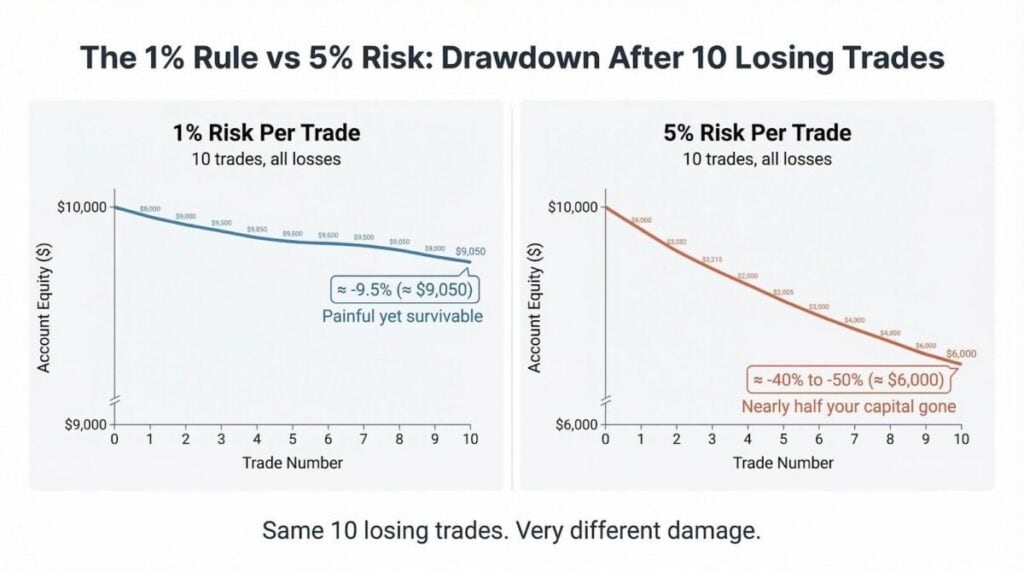
The math is simple; the execution trips people up. Many traders anchor to entry levels instead of dollar risk, then wedge a stop wherever it fits on the chart. Flip that habit. Start with the dollar amount you can afford to lose. Divide it by the distance in pips or points between entry and a logical exit. The result is your position size, and platforms like MetaTrader or TradingView will calculate it in seconds.
A logical exit is a level that proves the trade thesis wrong. Park your stop behind a recent swing high or low, or outside an Average True Range band. Skip paper-thin five-pip stops that daily noise will shred. Once the order is live, treat the stop like a fire door. Do not push it farther from the flames. Move it only to lock in profit as price moves in your favor, never the other way around.
A broker-side stop also lowers the urge to watch every tick because you have already capped the worst case. Pair this sizing discipline with liquid, tight-spread major pairs whenever possible. Lower friction keeps the capped loss predictable, and majors rarely suffer the wild slippage seen in thin exotics.
Australian prop-firm educator N P Financials frames retail forex like a mission-critical operation; in their guide Trading as a high-stakes project, they stress that every position deserves a pre-defined dollar limit long before the order goes live. Building on that mindset, the firm’s free Trading Plan template tightens the sizing rule even further—risk capped at 0.3 percent of account equity per position, with daily, weekly, and monthly drawdowns limited to 1, 2, and 3 percent.

NP Financials Forex Trading Plan Template Screenshot
The worksheet walks you through stake, stop distance, and lot size, then leaves a column for ‘reason to exit early,’ so your numbers and your psychology line up when you review the trade later. Follow the rule long enough and something subtle happens. You stop obsessing over single trades. Wins feel like steps forward, losses feel like tuition, and your wall of equity grows brick by carefully measured brick.
2. Hedging With Options: Transfer Risk Like Insurance
How an FX Option Hedge Works
Insurance is the clearest way to picture an option. You pay a small, known premium up front, so a large, unknown hit never reaches your balance sheet. Assume you are long GBP/USD at 1.3000 ahead of a Bank of England meeting. You buy a three-month GBP put with a 1.3000 strike for about 1.4 percent of notional, roughly USD 1,400 on a standard lot, according to CME price data.
If the pound falls to 1.2500, the option’s value swells and offsets almost the entire loss on the spot trade. Your maximum damage is the premium you paid, nothing more.
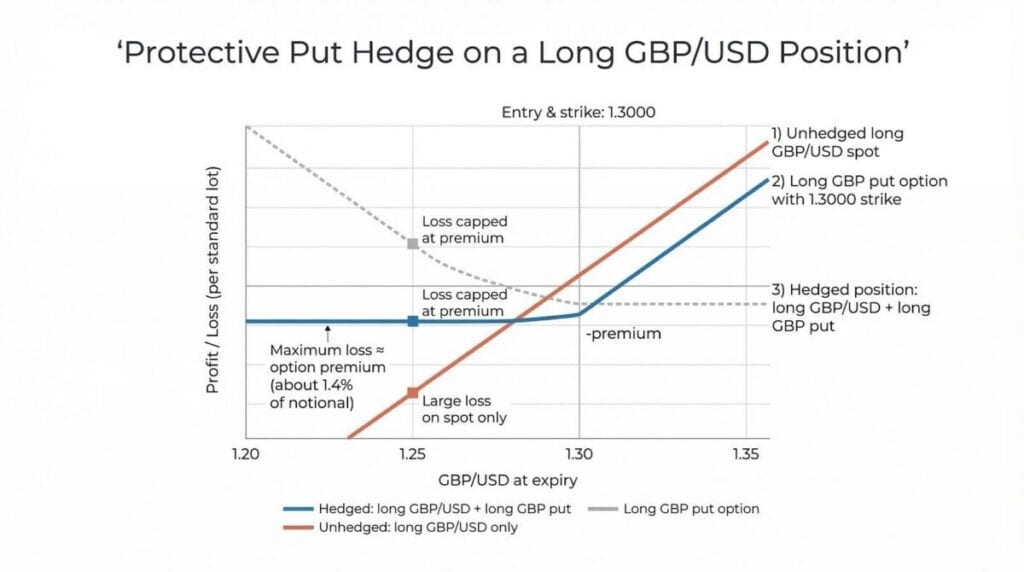
That premium buys certainty. It converts open-ended risk into a fixed, digestible cost. Airlines cap fuel prices with swaps, multinationals lock in exchange rates with forwards, and brokers offer a similar safety net called a guaranteed stop-loss order, which fills at your chosen price for an added fee (see Investingoal’s broker list).
With the downside limited, your mindset changes. You can hold through data releases without sweating every tick, and you can increase position size without fearing a ruinous tail event. In short, you trade the market’s next move, not its worst nightmare.
3. The Carry Trade: Let Interest Pay You, Then Pull the Ripcord
Yield is the quiet profit many traders ignore. When you hold a high-rate currency against a low-rate one, the broker credits the difference to your account each night. That drip, called the swap, compounds while you sleep. Picture AUD/JPY when Australian cash rates sit near five percent and Japan stays at zero. A single mini-lot can earn four to five dollars a day. Small numbers snowball over months, and a few lots start to feel like rental income.
Carry is not a free lunch. History shows the feast ends fast. In one notorious unwind, a broad carry basket fell thirty-three percent, worse than the 2008 crisis, erasing years of interest in weeks (Euromoney). The lesson is blunt: collect the yield, but cap the disaster.
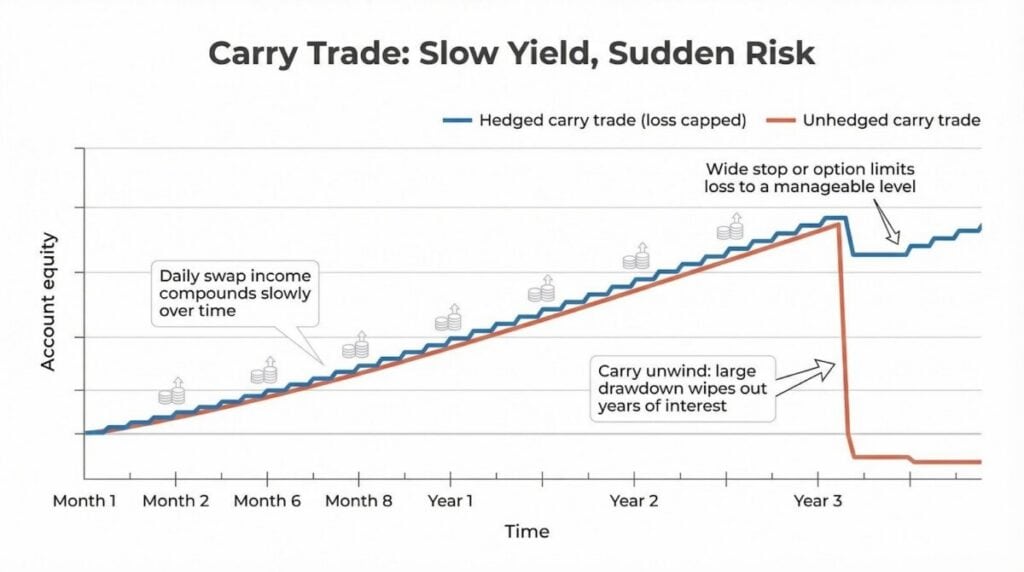
Do that with a wide, pre-planned stop or a low-cost option. Suppose you target an eight percent annual return from the swap. A protective stop ten percent below entry means a sudden reversal cannot cost more than a little over a year of income. If that still feels steep, buy a deep out-of-the-money put; its small premium acts like hurricane insurance on a beachfront property.
Timing matters. Carry thrives in calm, risk-on periods when volatility and correlations behave. Before major events such as central bank meetings or geopolitical shocks, scale down or activate the hedge. Close the storm shutters before the wind rises. Position size matters too. Trade on a modest margin so daily swings never flirt with a margin call.
The swap keeps dripping in, and you avoid the anxiety that pushes many traders to exit just before the payoff arrives. Treat the carry trade like a bond that sometimes swings wildly in price. Earn the coupon, but refuse to ride out a full crash. That single rule turns a once-dangerous tactic into a steady source of income.
4. Diversify With Currency Baskets and ETFs: Spreading the Load
Concentration feels thrilling until it turns frightening. One oversized position lives or dies on a single story. A basket diffuses that drama. Think of a basket as a mini-portfolio inside your trading account. Instead of wagering everything on EUR/USD, you spread exposure across three or four majors such as EUR/USD, USD/JPY, and AUD/USD. When one pair slips, another often steadies the ship. Volatility falls, and your equity curve smooths into something you can sleep beside.
There is an even simpler path: currency ETFs. Buy shares of UUP, and you hold a slice of the U.S. Dollar Index, a mix of the Euro, Yen, Pound, and more. No margin call, no 3 am phone buzzing about a stop-out. If the dollar drifts two percent lower, your account drifts the same amount—annoying, not life-changing. True, the returns look tame next to a ten-to-one margin spot trade. That is the trade-off. You swap adrenaline for resilience.
Many traders use ETFs as a core holding, then layer modest spot trades on top when a short-term edge appears. The core cushions the swings; the satellite trades chase the extra yield. Costs stay friendly. A well-known currency ETF charges about one-half percent a year, and spreads on majors remain tight. Compare that with the hidden price of panic selling a single oversized position: slippage, missed rebounds, and shattered confidence.
Implementation is straightforward. Stock brokers such as Interactive Brokers, Charles Schwab, and most app-based platforms list currency ETFs alongside equities. Inside MetaTrader, you can mimic an index by opening equal-dollar longs and shorts across several pairs. The math takes a minute, but the principle is the same: many small ripples beat one rogue wave. Diversification will never erase loss, yet it turns the game from Russian roulette into chess, still competitive but far less sudden.
5. Hedged Pair Trading: Balancing One Currency Against Another
Some risks are easier to shrink than to escape. Pair trading does that by pitting two related currencies against each other and letting shared forces cancel out. Imagine you believe the euro will outperform the pound over the next quarter. Instead of buying EUR/USD outright, you go long EUR/USD and short GBP/USD in equal dollar value. The United States dollar is the common leg, largely neutralised. What moves the needle is the relative dance between the Euro and the Sterling Pound.
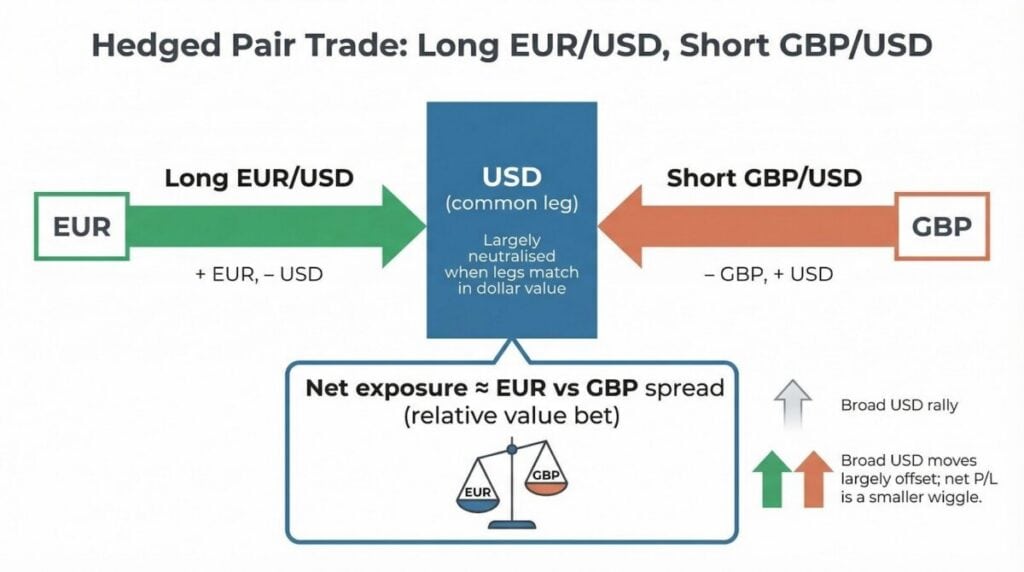
Volatility drops at once. If a broad dollar rally erupts, both legs move in the same direction: one position gains while the other loses, and the net effect is a muted wiggle rather than a hard snap. Your true exposure is the spread between the two European economies, not every headline about the Federal Reserve. Execution is straightforward. Open both trades, size them so the dollar value on each side matches, then track the combined profit and loss.
Many traders set a single stop that closes both legs if the divergence grows too wide. Others use an equity-guard script that watches the basket and exits when the cushion shrinks to a preset figure. The edge often comes from mean reversion. Closely linked currencies stretch apart on temporary news, then drift back once emotion settles. Capturing that snap-back can feel like picking pennies; the pennies add up, and blowups are rare when correlations behave.
Correlations are promises, not guarantees. A Brexit-scale shock can send GBP spinning while EUR dozes, blowing the spread wide open. That is why we combine the pair with our old friend, the stop. Set it tight enough to contain a regime change, yet loose enough for everyday noise. Done well, hedged pair trading turns the market into a set of scales. You are not betting on which side rises; you are betting on how they balance. And balance, in trading and in life, often proves the safer bet.
Choosing the Right Risk Approach
Risk Tolerance and Trading Style
Every trader has a different stress threshold. Some shrug at a five percent drawdown; others feel queasy at two. Pinpointing that comfort zone is step one. Picture a scale from one to ten. One means you check positions once a week and dislike surprises. Ten means you thrive on news-minute excitement. If you sit under five, lean toward transfer tactics such as options, guaranteed stops, or broad ETFs; they swap capped costs for calm nights.
If you score above five, tight acceptance methods like the one percent rule or pair trading can satisfy your need for action while still guarding the downside. Trading rhythm matters too. Swing traders who hold for days can justify a small premium on a protective put. Scalpers darting in and out during the London open gain nothing from a three-month option; their shield is the hard stop. Long-term carry fans often split the difference, pairing wide stops with occasional options around key policy meetings. If short-term, high-frequency trading like this sounds like your style, it’s worth weighing the pros and cons of forex day trading before committing capital to it full-time.
Match your emotional bandwidth and time horizon first, then pick the strategy.
A Two-Minute Decision Snapshot
- How hands-on do you want to be?
- Check Positions Once a Day: diversify with ETFs or a balanced basket.
- Crave Screen Time and Fast Feedback: rely on position sizing or hedged pairs.
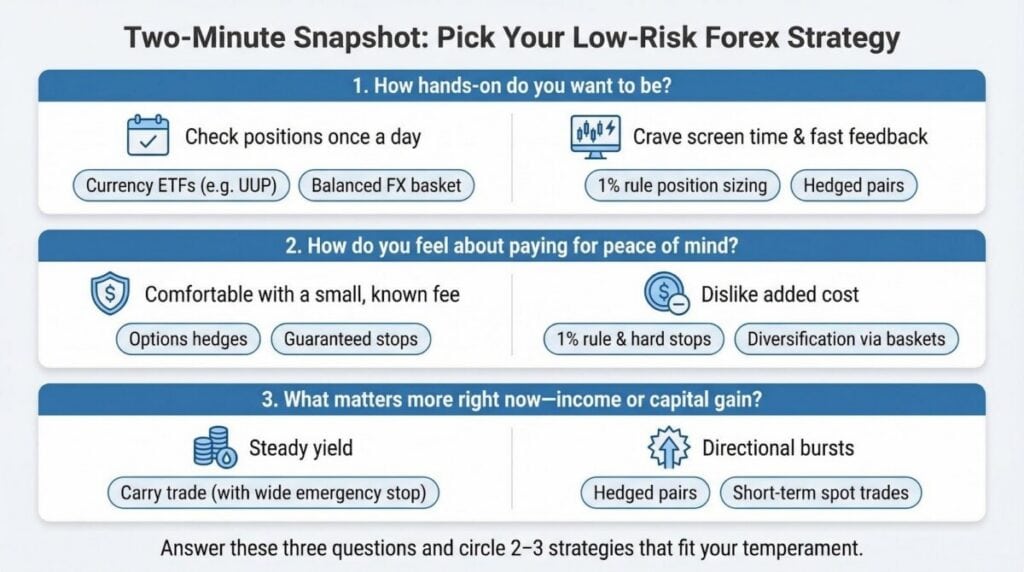
- How do you feel about paying for peace of mind?
- Comfortable With a Small, Known Fee: add option hedges or guaranteed stops.
- Dislike Added Cost: lean on acceptance tools such as the one percent rule.
- What matters more right now—income or capital gain?
- Steady Yield: consider the carry trade, but keep a wide emergency stop.
- Directional Bursts: use pairs or short-term spot trades.
Answer these prompts aloud, and the right approach usually reveals itself. What felt like a maze turns into a marked trail.
FAQ: Your Forex Risk Questions Answered
Can I ever trade forex risk-free?
No. Even cash in a pillow loses buying power. Our goal is controlled, limited risk—not zero. Options, stops, and baskets all shrink danger, but nothing erases it.
What is a realistic amount to risk per trade as a beginner?
One percent of account equity. Smaller keeps emotions cool and survival odds high; larger invites the blown-account stories we all read online.
How does a guaranteed stop differ from a regular stop?
A regular stop fires at your chosen price but can slip if the market gaps. A guaranteed stop fills at that price because the broker absorbs any gap for an added fee.
Is hedging legal for U.S. retail traders?
You cannot hold both long and short on the same spot pair in one account, but you can hedge with options, futures, or a second account.
Which forex pair is the safest to start with?
EUR/USD. It offers deep liquidity, tight spreads, and lower daily swings than exotics such as USD/TRY.
How do I calculate position size using the one-percent rule?
Divide your dollar risk by the stop distance. A one-hundred-dollar risk and a fifty-pip stop on EUR/USD equal 0.20 standard lots because each pip is about ten dollars.
These answers clear the fog around common stumbling blocks. If a new question pops up, add it to your risk log; the habit keeps small doubts from snowballing into costly mistakes.
Suggested articles:
- Top 10 Features That Make a Forex Broker Trustworthy
- Top 10 Pros & Cons of Using a Forex Trade Broker
- Top 10 Best Ways to Manage Trading Projects

Daniel Raymond, a project manager with over 20 years of experience, is the former CEO of a successful software company called Websystems. With a strong background in managing complex projects, he applied his expertise to develop AceProject.com and Bridge24.com, innovative project management tools designed to streamline processes and improve productivity. Throughout his career, Daniel has consistently demonstrated a commitment to excellence and a passion for empowering teams to achieve their goals.