
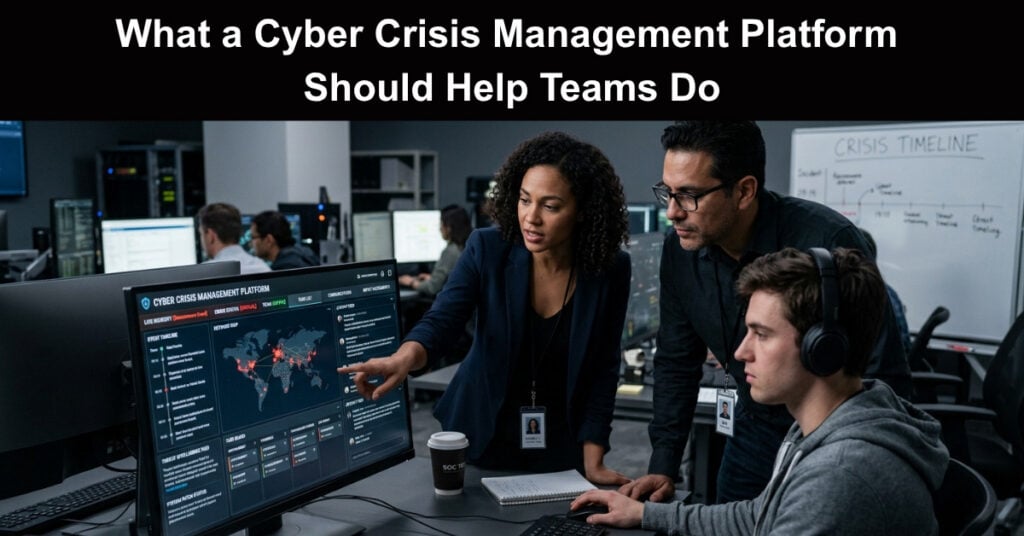
Cyber incidents test more than just technical defenses. They expose gaps in authority, communication, documentation, and recovery planning. A crisis management platform should help teams turn scattered procedures into coordinated action before pressure peaks. The strongest capability set provides leaders with a shared operating picture, assigns clear duties, protects sensitive information, and records decisions.
It also supports practice, measurement, and improvement, so each exercise produces evidence that strengthens the next response under demanding conditions and changing priorities.
Define the Control Center
During preparation, leaders need one place to map stakeholders, response stages, contact paths, and approval points. A crisis management platform should connect incident records with communication tools, role guides, secure documents, and activity logs. This structure reduces delays because participants can see assigned work, confirm updates, and escalate blocked tasks without having to search across disconnected systems during the response phase.
Beyond mapping the basics, the control center works best when it reflects how the organization actually operates under stress, not just how it looks on an org chart.
- A well-built control center should flex to different incident types, since a ransomware event and a supplier outage rarely activate the same stakeholders or approval chains.
- Version control on the control center itself matters, since outdated contact paths or stale approval hierarchies quietly undermine response speed long before anyone notices.
- Integrating the control center with identity and access systems lets leaders instantly see who currently holds authority, which prevents delays caused by approvers who have since changed roles.
Create a Single Operating Picture
Leaders require immediate visibility into incident status, business impact, open tasks, and response ownership. Dashboards should summarize active events without overwhelming users with lengthy reports that bury urgent details. Role-based views can show executives the decisions awaiting approval, coordinators the next actions, and technical specialists the affected services. Clear timestamps are important because outdated information can send teams toward the wrong priority during a rapidly developing outage.
A strong operating picture does more than display current status; it also needs to signal how confident the team should be in what it’s seeing.
- Confidence indicators next to each data point help leaders distinguish verified facts from early, unconfirmed reports, which matters most in the first hour of an incident.
- A single operating picture should support offline or degraded-network access, since major incidents often disrupt the very systems teams rely on to monitor them.
- Historical comparison views, showing how similar past incidents unfolded, give leaders a faster reference point for pacing decisions instead of starting every judgment call from zero.
Define Roles Before Pressure Rises
Effective cyber response depends on named owners. A platform should let coordinators build teams by skill, availability, location, and incident severity. Each participant needs a defined duty, backup contact, escalation route, and decision boundary. External counsel, insurers, communications advisers, vendors, and recovery specialists should also follow the same structure. Clear assignments prevent duplicated work and reveal coverage gaps before an exercise or live event exposes them.
Once roles are defined, the harder challenge is keeping them accurate as people change jobs, take leave, or become unreachable mid-incident.
- Automated role validation, run on a set schedule, catches stale assignments before an incident forces the team to discover a vacant seat in real time.
- Cross-training visibility, showing which backups have actually rehearsed their role, helps coordinators judge whether a substitution will slow the response or barely register.
- Time-zone-aware staffing views matter for organizations with distributed teams, since a “24/7 response” claim only holds up if someone is genuinely awake and authorized at every hour.
Turn Plans Into Repeatable Actions
Written plans often fail because they describe intent without guiding behavior. Strong playbooks break down response strategies into ordered tasks, entry conditions, evidence requirements, and completion checks. Teams should be able to adapt steps for ransomware, identity compromise, cloud disruption, or supplier failure while retaining a consistent method. Built-in frameworks can support preparation, tabletop practice, coordination, and after-action reviews. Cycles should produce improvements, owners, deadlines, and closure evidence.
Playbooks earn their value only when they’re used often enough to stay current, which means the platform should make updating them as easy as following them.
- Playbook analytics that flag which steps teams routinely skip or reorder reveal where the written plan no longer matches real-world practice.
- Conditional branching within a playbook, triggered by incident severity or affected system type, keeps a single template useful across many scenarios instead of forcing teams to maintain dozens of near-duplicate versions.
- Linking each playbook step to the specific tool or system it depends on shortens onboarding for new responders, who otherwise have to learn both the process and the toolset at the same time.
Keep Communications Available
Communication breakdowns rank among the most common crisis blockers, especially when normal channels become unreliable. Teams need secure alerts, mobile notifications, incident chat, and rapid activation of external responders. A central contact directory should verify internal and external details, record preferred channels, and limit sensitive information to authorized users. Message templates can speed updates, while status summaries keep executives, employees, customers, and partners aligned around confirmed facts.
Communication tools also need to account for audiences outside the response team itself, whose information needs shift as the incident progresses.
- Pre-approved messaging tiers, separated by audience sensitivity, let communications staff issue a public statement and an internal technical update within minutes of each other without cross-contaminating detail levels.
- Out-of-band channels, activated automatically when primary systems go down, prevent the common failure mode where the incident itself disables the tools meant to coordinate the response.
- Read-receipt and acknowledgment tracking on critical alerts gives coordinators a way to confirm that key personnel actually saw an escalation, rather than assuming a message sent equals a message received.
Preserve Evidence During Response
Incident records should show what happened, who acted, which systems were affected, and when decisions changed. Real-time activity logs create an accountable history for leaders, investigators, auditors, and legal teams. Task assignments should retain owners, timestamps, notes, and completion status. Secure document storage is also important because recovery plans, vendor contacts, insurance details, and technical instructions must remain accessible during downtime without exposing confidential material to unauthorized parties.
Evidence handled well during the incident becomes far easier to defend later, especially once regulators or insurers start asking questions.
- Tamper-evident logging, using write-once records or cryptographic timestamps, strengthens the organization’s position if evidence integrity is ever challenged in litigation or regulatory review.
- Chain-of-custody tracking for any evidence pulled by external investigators helps legal teams demonstrate that records were handled consistently from capture through disclosure.
- Automatic redaction tools that separate sensitive personal data from operational logs let organizations share incident records with regulators or partners without a slow, error-prone manual review each time.
Test Readiness With Evidence
Tabletop exercises should include business leaders, technical responders, communications staff, vendors, and decision-makers. Scenarios need realistic triggers, timed injects, measurable objectives, and documented gaps. A readiness platform can compare expected actions with actual performance, then assign remediation. Useful measures include alert delivery time, decision latency, contact accuracy, task completion, recovery progress, and unresolved dependencies after each session.
The real value of testing shows up months later, when the platform can prove whether earlier gaps actually got fixed.
- Trend tracking across multiple exercises reveals whether a specific weakness, such as slow executive sign-off, is genuinely improving or simply resurfacing under a new label each time.
- Surprise or partially scripted injects, unknown to most participants in advance, produce a more honest picture of readiness than fully choreographed tabletop sessions.
- Benchmarking results against industry or peer-group averages helps leaders judge whether their response times are actually competitive, rather than just better than last year’s internal baseline.
Connect Business Impact
Incident teams need impact maps that link affected identities, applications, sites, suppliers, employees, and customer services. Leaders can then set containment priorities based on business harm, regulatory duties, safety needs, and recovery targets. Shared views also help technical groups explain risk in plain language. That connection supports faster approvals and keeps restoration focused on essential services.
Business impact mapping becomes far more powerful once it’s tied to financial and contractual stakes, not just technical dependencies.
- Linking impact maps to service-level agreements and contractual penalty clauses lets leaders quantify the cost of delay in dollars, not just severity labels, which speeds up executive decision-making.
- Dependency mapping that extends to fourth-party vendors, not just direct suppliers, catches impact chains that would otherwise surface only after restoration efforts stall unexpectedly.
- Customer segment tagging within the impact map helps prioritize recovery order when full restoration isn’t immediately possible, focusing effort on the accounts and services that carry the greatest business risk.
Support Recovery and Improvement
Teams should review impact, decisions, communications, technical actions, and missed dependencies. A complete record helps identify which safeguards failed and where owners need better preparation. Recovery planning should include identity services, critical applications, data access, suppliers, and employee guidance. Post-incident findings become useful only when leaders assign priorities, fund corrective work, track deadlines, and confirm that changes reduce future exposure materially.
Recovery efforts hold up best when the lessons from one incident are structurally fed back into the tools and plans used for the next one.
- Closed-loop tracking, which links each after-action finding directly to a funded remediation task, prevents the common pattern where reports get written but recommendations quietly stall.
- Recovery time comparisons against pre-set business continuity targets give leaders an objective measure of whether the response met its own recovery commitments, not just whether the incident eventually ended.
- Feeding post-incident findings back into the playbooks and role definitions themselves closes the loop, so the next response starts from a genuinely improved baseline rather than the same plan with new notes attached.
Conclusion
A cyber crisis management platform should help organizations prepare people, processes, and technology as one operating system. The practical test is simple: Can leaders identify the incident, reach the right participants, assign work, protect records, communicate clearly, and measure recovery? Capable tools make those actions visible and repeatable. With clear roles, up-to-date documents, secure communications, reliable logs, and measurable exercises, teams can make disciplined decisions when business continuity is at risk during critical events.
Suggested articles:
- 10+ Cyber Incident Response Tips for Businesses
- Cybersecurity Strategies in Threat Intelligence Software
- Why Project Managers Need Cyber Skills Now

Daniel Raymond, a project manager with over 20 years of experience, is the former CEO of a successful software company called Websystems. With a strong background in managing complex projects, he applied his expertise to develop AceProject.com and Bridge24.com, innovative project management tools designed to streamline processes and improve productivity. Throughout his career, Daniel has consistently demonstrated a commitment to excellence and a passion for empowering teams to achieve their goals.