
Parametric estimating is a quantitative technique used in project management to estimate project cost and duration based on statistical relationships between variables. This method relies on historical data and known parameters to calculate reliable estimates for both individual activities and entire projects. When applied correctly, parametric estimating produces more accurate results than purely subjective methods.
Parametric estimating is typically used during the planning phase to determine project budgets and schedules. It uses a formula that relates historical cost or time values to historical parameter values, then applies that relationship to current project parameters. This guide presents three worked examples of parametric estimating, compares it with analogous estimating, and examines the advantages and disadvantages of the technique.
Understanding Parametric Estimating in Project Management
Estimating project costs and timelines is rarely straightforward. Project managers frequently contend with shifting project scopes, tight deadlines, and unexpected variables that make static forecasting difficult. In these environments, having a data-backed estimation method is essential for making sound strategic decisions.
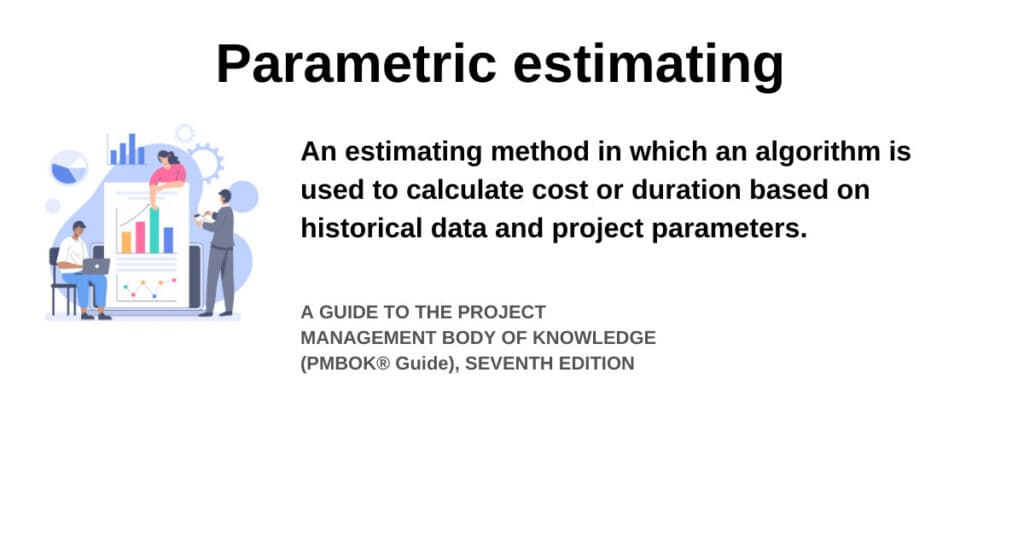
At its core, parametric estimating relies on parameters—measurable variables within a project model—to determine total costs or durations. These parameters use rates derived from historical data, which can be analyzed using statistical techniques like linear regression to establish baseline cost models.
Project managers can apply parametric estimates to an entire initiative or to specific individual work packages. It can also be combined with other estimation techniques (such as bottom-up or analogous estimating) when different phases of a project require varying levels of detail and precision.
Parametric Estimating Formula Examples
The parametric estimating formula expresses a linear relationship between historical data and current project parameters. The core formula is E equals a_old divided by p_old multiplied by p_curr, where E represents the parametric estimate, a_old is the historical amount of cost or time, p_old is the historical value of the parameter, and p_curr is the value of that parameter in the current project.
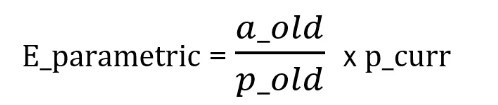
Image source: Parametric Estimating Formula PMP
This formula assumes a linear relationship between the parameter and the cost or time being estimated. When the relationship is nonlinear, more complex statistical models such as regression analysis may be required. The following examples apply the basic formula to realistic project scenarios involving cost, duration, and parameter estimation.
Example 1: Parametric Cost Estimating (Wall Painting)
Scenario Context: You are a commercial contractor preparing a bid for a new commercial space. Your client wants to know the cost to paint a large interior facility. Instead of guessing or estimating from scratch, you pull actual financial logs from a recently completed renovation job that used the same paint grade and crew structure.
- Historical Data: Painting a wall area of 1,500 sq ft cost $10,000.
- Current Scope: The new project requires painting 3,000 sq ft.
- Variables:
- Historical Cost (a_old) = $10,000
- Historical Parameter (p_old) = 1,500 sq ft
- Current Parameter (p_curr) = 3,000 sq ft
Step-by-Step Calculation
- Calculate the Unit Rate: Unit Rate = $10,000 ÷ 1,500 sq ft = $6.67 per sq ft
- Calculate the Target Estimate: Parametric Estimate = $6.67 per sq ft × 3,000 sq ft = $20,000

Parametric Cost estimating example
Key Insight: This linear model assumes that labor rates, material prices, and application speeds remain constant regardless of job size.
Example 2: Parametric Duration Estimating (Furniture Assembly)
Scenario Context: As a shop floor manager, you need to schedule labor shifts for a major custom furniture order. To meet delivery deadlines without incurring unnecessary overtime, you must calculate the total effort hours needed by evaluating production records from a small pilot batch completed last week.
- Historical Data: Constructing 2 wooden tables took 5 labor hours.
- Current Scope: The new client order requires building 14 identical tables.
- Variables:
- Historical Time (a_old) = 5 hours
- Historical Parameter (p_old) = 2 tables
- Current Parameter (p_curr) = 14 tables
Step-by-Step Calculation
- Calculate the Production Rate: Production Rate = 5 hours ÷ 2 tables = 2.5 hours per table
- Calculate Total Estimated Duration: Parametric Estimate = 2.5 hours/table × 14 tables = 35 hours

Parametric Duration estimating example
Key Insight: While the total effort required is 35 labor hours, the calendar duration can be compressed by assigning multiple carpenters in parallel, provided space and tools allow.
Example 3: Multi-Variable Parametric Estimating (Software Development)
Scenario Context: A software project manager is estimating the budget for an enterprise software module. Unlike simple physical tasks, software development includes fixed setup costs and variable complexity depending on regulatory constraints. A simple unit rate is insufficient, so the PM uses a multi-variable parametric regression model.
- Historical Data: Standard software modules cost $500 per Function Point (FP) to develop, plus a baseline infrastructure setup fee of $5,000.
- Current Scope: The new project consists of 100 FPs, but strict financial data security requirements introduce a Complexity Adjustment Factor of 1.25.
- Formula: Parametric Estimate = Fixed Setup + (Current Scope × Base Rate × Complexity Factor)
Step-by-Step Calculation
- Multiply Variable Scope with Complexity: 100 FP × $500/FP × 1.25 = $62,500
- Add Fixed Overhead: $5,000 + $62,500 = $67,500
Key Insight: Incorporating fixed overhead and risk/complexity multipliers prevents the severe underestimation that often happens when applying simple linear rates to complex scope items.
Parametric vs Analogous Estimating
Analogous estimating is a related technique that uses historical data from similar projects to estimate the current project’s cost, duration, or scope. While both methods rely on past project information, they differ fundamentally in how they apply that data. Analogous estimating compares the current project to a single similar past project and adjusts for known differences.
Parametric estimating uses statistical relationships derived from multiple data points to calculate estimates based on specific parameters. Analogous estimating is faster and less costly to perform, making it suitable for early-stage planning when detailed data is unavailable. Parametric estimating requires more data and analysis but produces more accurate and defensible results.
Differences
The key differences between parametric and analogous estimating relate to their methodology, data requirements, and accuracy levels. Understanding these distinctions helps project managers choose the appropriate technique for each estimation scenario. Here are the main differences between the two estimating methods:
- Data Foundation: Parametric estimating uses statistical relationships from multiple data points, while analogous estimating relies on a single similar project for comparison.
- Accuracy Level: Parametric estimating produces more precise results because it accounts for specific parameter variations, whereas analogous estimating provides broad approximations.
- Time Investment: Parametric estimating requires more time to build models and gather historical data, while analogous estimating can be completed quickly with limited information.
Similarities
Despite their differences, parametric and analogous estimating share several important characteristics. Both techniques depend on historical data from past projects and require professional judgment to apply correctly. Neither method guarantees perfect accuracy, but both provide a structured approach to estimation. Here are the key similarities between parametric and analogous estimating:
- Historical Dependency: Both methods rely on data from completed projects to inform estimates for current work, making accurate record-keeping essential.
- Scalability: Both techniques can be applied to individual activities, project phases, or entire projects depending on the available data.
- Expert Judgment Required: Both methods require experienced project managers to assess whether historical data is relevant and to adjust estimates for known differences between projects.
Advantages and Disadvantages of Parametric Estimating
Parametric estimating offers measurable benefits but also carries limitations that project managers must understand. The technique is widely recognized in project management standards including the PMBOK Guide and is commonly tested on the PMP certification exam. Evaluating its strengths and weaknesses helps teams decide when to apply it.
Advantages
Parametric estimating provides several advantages over less rigorous estimation methods, particularly when reliable historical data is available. The technique is valued for its accuracy, repeatability, and defensibility in stakeholder discussions. Here are the main advantages of parametric estimating:
- Higher Accuracy: Because the technique uses statistical relationships rather than subjective judgment, parametric estimates are generally more accurate than analogous estimates.
- Repeatable Process: Once a parametric model is built, it can be reused for similar projects, saving time and ensuring consistency across multiple estimates.
- Stakeholder Confidence: The use of data-driven formulas and historical evidence makes parametric estimates easier to defend during budget approvals and project reviews.
Disadvantages
Parametric estimating also has limitations that can reduce its effectiveness in certain situations. Project managers should be aware of these drawbacks before committing to the technique as their primary project estimation method. Here are the main disadvantages of parametric estimating:
- Data Dependency: The accuracy of parametric estimates depends entirely on the quality and relevance of historical data. Unreliable data produces unreliable estimates.
- Time and Cost to Build Models: Developing a parametric model requires significant effort to collect data, validate relationships, and test the model, which may not be justified for small projects.
- False Sense of Precision: Because parametric estimates are mathematically derived, project stakeholders may place excessive confidence in their accuracy without considering underlying assumptions.
Video About Parametric Estimation
Conclusion
Parametric estimating is a powerful technique that brings statistical rigor to project cost and duration estimation. When reliable historical data is available and the relationship between parameters is well understood, it produces estimates that are more accurate and defensible than methods relying solely on judgment. The three examples demonstrate how the formula applies to cost, duration, and parameter estimation scenarios.
Project managers should combine parametric estimating with other techniques such as analogous or three-point estimating to cross-validate results and account for uncertainty. The key is recognizing when sufficient data exists to support a parametric model and when simpler methods are more appropriate. Investing in accurate historical record-keeping today builds the foundation for better parametric estimates on future projects.
Frequently Asked Questions
What is the difference between analogous and parametric estimating techniques?
Parametric estimating uses statistical relationships and algorithms based on multiple data points to calculate estimates. Analogous estimating compares the current project to a single similar past project and adjusts for known differences using expert judgment.
What is the parametric estimating formula?
The basic parametric estimating formula is E equals a_old divided by p_old multiplied by p_curr, where a_old is the historical cost or time, p_old is the historical parameter value, and p_curr is the current project parameter value.
When should I use parametric estimating instead of analogous estimating?
Use parametric estimating when you have sufficient historical data, the relationship between parameters and cost or time is well understood, and a higher level of accuracy is required. Use analogous estimating when detailed data is unavailable or a quick early-stage estimate is needed.
Is parametric estimating used on the PMP exam?
Yes, parametric estimating is a recognized technique in the PMBOK Guide and appears on the PMP certification exam. Candidates should understand the formula, when to apply it, and how it differs from analogous and bottom-up estimating.
Can parametric estimating be combined with other estimation methods?
Yes, parametric estimating is often used alongside analogous, three-point, or bottom-up estimating. Combining methods cross-validates results and provides a range of estimates that account for different levels of uncertainty and data availability.
Suggested articles:
- Why You Need to Use Top-Down Analogous Estimating
- Bottom-Up Estimating in Project Management
- Common Cost Tracking Mistakes That Lead to Budget Overruns

Shane Drumm, holding certifications in PMP®, PMI-ACP®, CSM, and LPM, is the author behind numerous articles featured here. Hailing from County Cork, Ireland, his expertise lies in implementing Agile methodologies with geographically dispersed teams for software development projects. In his leisure, he dedicates time to web development and Ironman triathlon training. Find out more about Shane on shanedrumm.com and please reach out and connect with Shane on LinkedIn.