
Every project starts with a question executives ask before any detailed plan exists: how much will this cost, and how long will it realistically take to finish? Analogous estimating answers that question fast. Also called top-down estimating, this technique pulls duration and cost figures from comparable past projects, then applies expert judgment to adjust for scope, size, and complexity differences in the new effort.
Because it relies on historical data rather than detailed task breakdowns, analogous estimating works best during the earliest stages of project initiation, when scope details remain fuzzy and stakeholders still need a defensible number. It trades precision for speed, making it the fastest of the major estimating techniques, though also the least accurate. Understanding when and how to use it correctly starts with the fundamentals below:
Analogous Estimating (Top-Down Estimating)
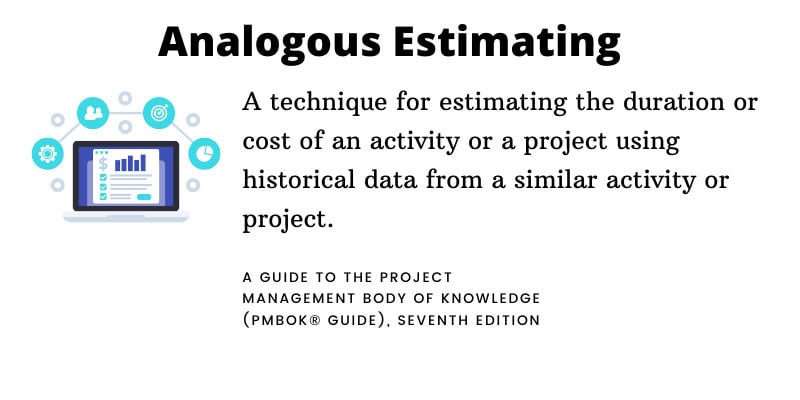
Analogous estimating gets its name from the direction the analysis flows. Instead of building an estimate piece by piece from the bottom of a work breakdown structure, the project manager starts with the whole project and works downward. The Project Management Institute describes it as a technique that uses historical values from a comparable activity or project as the basis for the current estimate. It is most often used early in a project, when information is limited but decisions about time and cost still need to be made.
Key characteristics of analogous estimating include:
- Top-Down Approach: The estimate begins with the overall project or major deliverable, then is refined as needed, rather than being built from detailed task-level data.
- Reliance on Historical Data: Actual time, cost, or effort from a genuinely similar past project or activity is used as the starting point for the new estimate.
- Need for True Similarity: The reference project should match the new one in scope, complexity, technology, and context so that the estimate fits naturally into the current project plan.
- Adjustments for Scale and Differences: The project manager adjusts the historical figures to reflect differences in size, duration, team capability, or other known variables.
- Strong Dependence on Experience: Because judgment is central to this method, it works best when the project manager understands both the estimating process and the domain well enough to recognize real similarities and important differences.
- Low Upfront Effort: Analogous estimating requires relatively little detailed planning or data collection, which saves time and money compared with bottom-up analysis.
- Best Use When Details Are Unclear: It is especially useful when requirements, design, or delivery processes are not yet fully defined, but the organization has broadly similar past projects available for reference.
- Good for Early-Stage Decisions: The technique provides quick, reasonable figures for budgeting, feasibility analysis, and high-level planning, with the understanding that estimates will be refined as more information becomes available.
Analogous Estimating Project Management Definition
Time and cost estimates sit at the center of effective project execution. For a project manager to judge whether an activity will finish early, on schedule, or late, they need a working estimate of how long the task should take given its complexity and risk profile. These two factors, complexity and risk, largely determine both task duration and overall execution success.
Analogous estimating gives project managers a quick way to generate that baseline duration. Consistently misjudging time on essential tasks wastes budget and can push an entire project past its deadline. Because the technique is fast rather than precise, it works best as a first pass that gets refined once more project detail becomes available later.
Analogous Estimating Technique Example
Seeing the analogous estimating technique applied to real scenarios makes the logic easier to internalize than reading a definition alone. The examples below show analogous estimating used for a physical engineering deliverable and a software services engagement, illustrating how the same core method adapts across very different industries, budgets, and project types encountered in daily practice.
- A project manager needed to estimate the design time for a new tractor model built to meet updated government regulations. The new tractor was nearly identical to a standard model except for being slightly larger and heavier. The manager reviewed a past project involving a tractor with larger wheels, found the design took nine months, and used that figure as the baseline for the current estimate.
- Bob was recently promoted to head a software project team and had to present a new project’s cost and duration to a client. He had never handled this exact type of project, but his agency had delivered similar campaigns before. Bob used analogous estimating to pull data from those past campaigns, adjusted for the differences he identified, and built his presentation around the resulting figures.
Uses of Analogous Estimating in Project Management
Analogous estimating earns its place in a project manager’s toolkit during specific moments when speed matters more than pinpoint precision. It suits situations where a defensible number is needed quickly, detailed scope documentation does not yet exist, and the organization has enough historical project data on hand to support a meaningful comparison for planning purposes.
The following situations show when this technique delivers the most value:
- Early Initiation Phase Planning: Teams reach for analogous estimating when a project has just been proposed and detailed requirements have not yet been documented, since a rough figure is still needed for approval.
- Rough Order of Magnitude Requests: Executives and sponsors often need a ballpark number quickly to decide whether a project idea is worth pursuing further before committing analyst time to detailed planning.
- Proposal and Bid Development: Organizations bidding on contracts use historical project data to generate competitive cost estimates fast, especially when the bid deadline leaves no time for bottom-up analysis.
- Portfolio Prioritization Decisions: Leadership comparing multiple candidate projects for a limited budget often relies on quick analogous figures to rank opportunities before deeper business cases are built.
Analogous Estimating Pros and Cons
Every project estimation technique involves tradeoffs between speed, cost, and accuracy, and analogous estimating sits firmly on the fast and inexpensive end of that spectrum. It rewards project managers who need a quick figure early on, but it also carries real limitations that become more visible once a project moves past the initiation phase and into detailed execution planning.
Weighing the following advantages against the limitations helps clarify when to use it:
- Minimal Resource Requirement: The technique can be performed with limited data and little dedicated staff time, since it draws on records the organization already holds from previous projects.
- Speed During Initiation: Analogous estimating produces a usable figure almost immediately, which supports the high-level estimation typically required during a project’s initiating phase before detailed planning begins.
- Refinable Starting Point: Estimates generated this way are not meant to be final. They get refined as parametric or bottom-up data becomes available later in the planning process.
- Dependence on Historical Accuracy: The technique relies entirely on assumptions and historical records. If that underlying data or the assumed similarity between projects is wrong, the resulting estimate becomes unreliable.
- Lower Overall Precision: Estimates calculated this way are rough by design and should never substitute for a definitive estimate once the project reaches detailed planning and execution stages.
Parametric vs Analogous Estimating
Parametric and analogous estimating both rely on historical data, but they differ in how precisely that data is applied to the current project. Understanding the distinction helps project managers choose the right technique for the level of accuracy needed at a specific point in the project timeline and budget cycle.

Key differences:
- Use of Mathematical Models: Parametric estimating uses a defined formula built from historical data and measurable parameters. For example, painting 100 square feet at five dollars per square foot produces a calculated estimate of $500. Analogous estimating, by contrast, compares whole projects or major tasks instead of applying a per-unit formula.
- Level of Precision: Parametric estimates tend to be more precise because they are grounded in quantifiable units (such as cost per square foot, per hour, or per item). Analogous estimates are generally less precise but faster to produce, making them useful when only high-level information is available.
- Data Requirements: Parametric estimating requires reliable, detailed historical data and clearly defined parameters. Analogous estimating can work with broader historical figures, such as the total cost or duration of a similar past project, even when detailed breakdowns are not available.
- Effort and Speed: Parametric estimating usually demands more upfront analysis to build and validate the model. Analogous estimating is quicker and cheaper to perform, which is why it is often favored during early project planning.
How analogous estimating works in practice:
- Starting from a Comparable Project: If an organization completed a similar project for $50,000 in the past, the project manager might start with that figure as the baseline estimate for a new, comparable effort.
- Adjusting for Known Differences: The initial figure is then adjusted for differences in scope, complexity, timing, or other relevant factors so the estimate better reflects the new project’s reality.
- Relying on Expert Judgment: Subject matter experts refine the estimate by applying their experience with similar work. For a merchandise shipment, that could mean consulting the person who regularly manages shipments of similar size and weight so their practical insight can shape the final estimate.
- Recognizing Limitations: Because analogous estimating lacks a formal mathematical model, it depends heavily on the quality of historical data and the judgment of the experts involved. It is best used when speed is more important than exact precision and when stakeholders understand that estimates will be refined later.
How to Calculate an Analogous Estimate
Turning the concept into a repeatable process helps teams apply analogous estimating consistently rather than treating each estimate as a one-off judgment call made under time pressure. A defined sequence of steps also makes it easier to train new project managers on the method and to audit past estimates once actual project results come in.
The following steps outline a practical workflow for any new estimate:
- Identify a Comparable Past Project: Search organizational process assets, project archives, or team memory for a completed project that shares meaningful similarities in scope, industry, or deliverable type.
- Gather the Historical Data Points: Pull the actual duration, cost, and resource figures from that past project, confirming the numbers reflect what actually happened rather than what was originally planned.
- Assess the Degree of Similarity: Compare scope, complexity, size, and risk between the two projects, noting any meaningful differences that will require an adjustment to the raw historical figure.
- Apply Expert Judgment to Adjust: Bring in experienced team members or subject matter experts to scale the historical figure up or down based on the differences identified in the previous step.
- Document Assumptions for Future Reference: Record why the estimate was adjusted the way it was, since this documentation becomes valuable organizational process asset data for future analogous estimates.
Common Mistakes to Avoid With Analogous Estimating
Even experienced project managers can undermine an otherwise sound estimate by skipping a critical validation step or leaning too heavily on convenience rather than genuine similarity between projects. These missteps rarely show up immediately. They tend to surface later, once actual costs or timelines diverge sharply from the numbers that were originally presented to stakeholders.
Watching for these common missteps keeps analogous estimates credible and useful:
- Choosing a Weak Comparison Project: Selecting a past project mainly because records exist, rather than because it genuinely resembles the new work, produces an estimate built on a false foundation.
- Skipping the Adjustment Step: Copying historical figures directly without accounting for scale, inflation, or scope differences leaves the estimate disconnected from the realities of the current project.
- Treating the Estimate as Final: Presenting a rough order of magnitude figure as a locked budget sets unrealistic expectations that later planning phases will struggle to correct.
- Ignoring Market and Cost Changes: Failing to adjust for shifts in labor rates, material costs, or technology since the historical project was completed skews the estimate significantly.
Analogous Estimating Vs Parametric Estimating
Deciding between these two related techniques comes down to how much data is available and how precise the estimate needs to be at that particular stage of the project timeline. Neither approach is universally better than the other. The right choice depends on timeline pressure, data maturity, and how much accuracy stakeholders genuinely require before funding gets approved.
The comparison below summarizes the practical differences between analogous and parametric estimating that should guide the choice:
| Factor | Analogous Estimating | Parametric Estimating |
|---|---|---|
| Data Basis | Whole-project historical comparison | Mathematical model using unit parameters |
| Typical Accuracy | Rough order of magnitude | More precise, model-dependent |
| Speed | Fastest of the common techniques | Moderate, requires parameter data |
| Best Project Phase | Initiation, early planning | Planning, once units are known |
The analogous method works best when little information about the project is available, and the new effort broadly resembles previously completed work. Different organizations and industries tend to favor different estimating methods depending on their culture and data maturity, and government agencies in particular often rely on highly experienced estimators regardless of which technique gets applied.
Organizations that bill clients by the hour still see meaningful variation between team members who favor precise, model-driven methods and those who lean on analogical comparison instead. Building a strong internal library of past project data, sometimes called organizational process assets, makes every future analogous estimate more accurate regardless of who ends up performing the analysis.
Video Explaining Analogous Estimating Vs Parametric Estimating
Watch this short video to see analogous and parametric estimating explained side by side. You’ll learn when to use each technique, how they differ in accuracy and data needs, and how to combine them to build stronger, more realistic project estimates for your stakeholders.
Conclusion
Analogous estimating remains one of the fastest, most practical ways to put a credible number in front of stakeholders before a project has a fully detailed scope. By comparing a new initiative against similar completed work and applying expert judgment, project managers generate a rough order of magnitude estimate without the time investment that bottom-up methods typically demand from the team.
The tradeoff is accuracy, so treat the resulting figure as a useful starting point rather than a final locked budget. As the project moves through planning, refine early analogous numbers with parametric or bottom-up techniques once scope, resources, and risks become clearer to the team. Start every new estimate by asking which past project looks most similar to this one.
Frequently Asked Questions About Analogous Estimating
Why is analogous estimating less accurate?
Analogous estimating relies on historical data and the assumed similarity between two projects rather than a detailed breakdown of the current work. When that assumed similarity is wrong, or when the historical data itself was flawed, the resulting estimate inherits those errors, which keeps its accuracy lower than parametric or bottom-up methods.
Is analogous estimating accurate?
No, analogous estimating is generally the least accurate of the common estimating techniques because it skips many of the factors that influence actual task duration and cost. It works well as a fast, early-stage approximation, but project managers should treat the figure as a starting point rather than a number to rely on for final budgeting decisions.
What is the most reliable form of estimating?
Bottom-up estimating is typically the most reliable form of estimating because it builds the total figure by aggregating detailed estimates for every component of the work breakdown structure. This method demands significantly more time and data than analogous estimating, so it works best once a project has enough detail to support that level of analysis.
How does analogous estimating differ from parametric estimating?
Analogous estimating compares whole projects or tasks based on overall similarity and expert judgment, while parametric estimating applies a mathematical model to measurable unit parameters, such as cost per square foot. Parametric estimating generally produces a more precise figure, but it requires reliable parameter data that may not exist during a project’s earliest planning stages.
When should you use analogous estimating instead of bottom-up estimating?
Analogous estimating fits best during project initiation, when detailed scope information does not yet exist, and stakeholders need a quick rough order of magnitude figure to support a go or no-go decision. Bottom-up estimating becomes the better choice once the project reaches detailed planning and a full work breakdown structure has been developed.
Suggested articles:
- SWAG Estimates in Project Management
- 3 T-Shirt Sizing Agile Methods for Better Team Estimates
- Free Project Estimation Template with 6 Options

Shane Drumm, holding certifications in PMP®, PMI-ACP®, CSM, and LPM, is the author behind numerous articles featured here. Hailing from County Cork, Ireland, his expertise lies in implementing Agile methodologies with geographically dispersed teams for software development projects. In his leisure, he dedicates time to web development and Ironman triathlon training. Find out more about Shane on shanedrumm.com and please reach out and connect with Shane on LinkedIn.