
In project management, a schedule is more than a list of dates. It is the operational backbone that keeps teams aligned, resources allocated, and deadlines within reach. Without a reliable schedule, even well-funded projects drift, tasks pile up, and accountability becomes difficult to enforce across teams.
The good news is that there is no single correct way to build a project schedule. Several proven methods exist, each suited to different project types, team sizes, and risk profiles. This article walks through eight of the most widely used scheduling methods, explains when each one works best, and helps you decide which approach fits your next project.
Challenges in Project Scheduling
Project scheduling is rarely as clean as it looks on paper. Competing priorities, shifting deadlines, and resource constraints all create friction that even the most thorough planning cannot fully prevent. Understanding the most common obstacles is the first step toward managing them well. Here are the core challenges that project managers face most often:
- Resource Conflicts: Team members frequently work across multiple projects at the same time, which means their availability is rarely guaranteed. A task that looks unblocked on the schedule can stall the moment a key contributor gets pulled onto a higher-priority initiative.
- Task Duration Uncertainty: Many tasks take longer than initially estimated, especially when technical complexity or stakeholder feedback is involved. Underestimating duration is one of the most common reasons projects miss their deadlines.
- Scope Changes: New information often surfaces mid-project, requiring adjustments to deliverables, timelines, or both. These changes ripple through the schedule and can invalidate work already done if they are not managed carefully.
- Dependency Bottlenecks: Some tasks cannot start until others are complete, and a delay in one area cascades through the plan. Identifying and monitoring these dependencies early reduces the risk of schedule compression later.
- Communication Gaps: When team members are not aligned on priorities or deadlines, tasks fall through the cracks. A schedule only works when the people responsible for it understand it and trust it.
8 Best Project Scheduling Methods
There are several useful scheduling methods, each one with its own usefulness and purpose. Choosing the right one depends on the nature of the project, the level of uncertainty involved, and what the team needs most from the schedule. Here are 8 of the best methods for project scheduling:
1. Critical Path Method
The Critical Path Method (CPM) is one of the most widely used scheduling techniques in project management. It identifies the longest sequence of dependent tasks in a project, which determines the earliest possible completion date. Any delay in a task on the critical path directly delays the entire project, which makes it a powerful tool for prioritization.
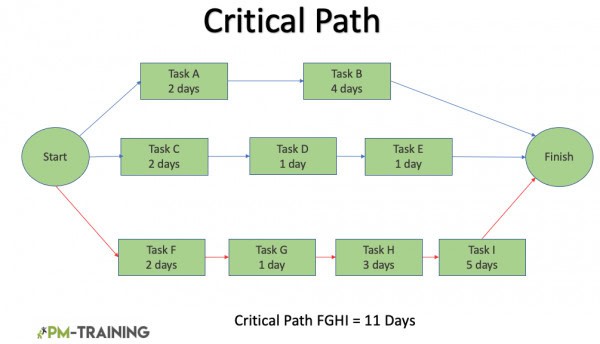
CPM works best when task durations are predictable, and the project has clear, well-defined deliverables. Construction projects, manufacturing timelines, and product launches all tend to benefit from this approach. Key benefits and practical tips for using CPM effectively include the following:
- Minimum Duration Calculation: CPM calculates the shortest possible project duration by mapping every dependency chain, giving managers a realistic baseline for scheduling commitments.
- Priority Clarity: Because CPM highlights which tasks are critical and which have float, teams can direct attention and resources to the work that actually affects the deadline.
- Float Management: Non-critical tasks have a schedule float, meaning they can be delayed slightly without pushing the finish date. Tracking float gives managers flexibility when resources are temporarily unavailable.
- Software Compatibility: Most project management platforms, including MS Project, Primavera, and Monday.com, support CPM modeling, which makes it accessible even on complex projects.
- Limitation to Watch: CPM does not handle variability in task duration well. If estimates are wrong, the critical path can shift without warning. Pairing CPM with regular schedule reviews reduces this risk.
2. Program Evaluation and Review Technique (PERT)
The Program Evaluation and Review Technique (PERT) was developed in the 1950s for complex US Navy military projects where task durations were difficult to estimate with confidence. Unlike CPM, PERT uses three time estimates for each task: optimistic, most likely, and pessimistic. These are combined into a weighted average that accounts for uncertainty.
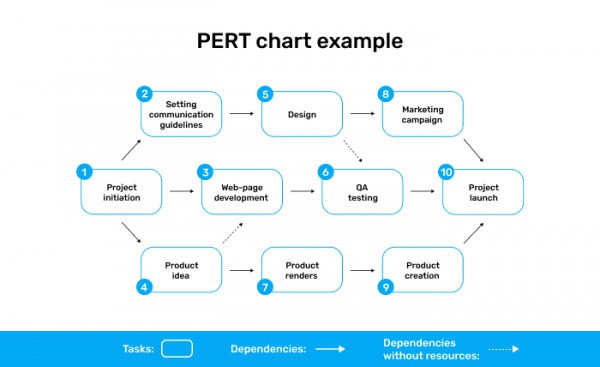
PERT is particularly useful when you are working on a project type your team has not done before, where historical data is limited, and estimates carry a wide margin of error. These features make PERT a strong choice for the right context:
- Three-Point Estimation: Using optimistic, most likely, and pessimistic estimates produces a more realistic duration than a single-point guess, especially for research, software development, or innovation-led projects.
- Risk Visibility: PERT surfaces the tasks with the widest estimation range, which signals where risk is concentrated. Managers can then apply more oversight or buffer time to those areas.
- Network Diagram Integration: PERT uses network diagrams to show task dependencies visually, making it easier to spot bottlenecks and plan around them before work begins.
- Best Use Case: PERT is most effective when the project involves a high degree of uncertainty and when the cost of missing a deadline is significant enough to justify the additional planning effort.
3. Gantt Charts
Gantt charts are among the most recognizable tools in project management, and for good reason. They present the project timeline as a horizontal bar chart, where each bar represents a task and its duration. This format makes it easy for anyone, from the project team to executive stakeholders, to understand the schedule at a glance.
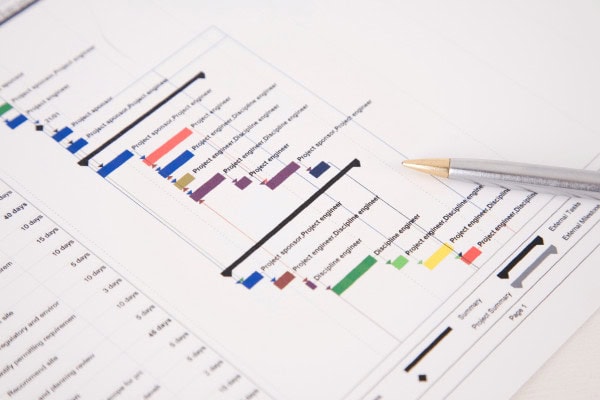
Gantt charts are especially effective for communicating timelines, tracking progress, and identifying overlapping tasks during planning. Here are the key strengths and known limitations of Gantt charts:
- Visual Clarity: The bar format translates complex schedules into a readable layout that non-technical stakeholders can follow without needing a briefing on project methodology.
- Progress Tracking: Most Gantt chart tools allow you to shade completed portions of each bar, giving a real-time view of how far along each task is relative to the plan.
- Dependency Mapping: Arrows between bars show which tasks depend on others, helping teams understand the knock-on effects of any delay before it happens.
- Easy Updates: When scope or timelines change, Gantt charts are relatively quick to update, which keeps the schedule accurate without requiring a full rebuild.
- Limitation to Watch: Gantt charts require substantial upfront planning and can become unwieldy on large projects with hundreds of tasks. They also do not adapt well to projects where requirements change frequently.
4. Simulation
In project scheduling, simulation is the process of running a probabilistic model of the project multiple times to understand the range of possible outcomes. The most common form is Monte Carlo simulation, which uses random variation in task durations to generate a distribution of potential completion dates.

This approach is most valuable when the project involves significant uncertainty and when stakeholders need a realistic picture of the risk around the delivery date. Simulation offers several advantages that traditional scheduling methods do not:
- Probability-Based Forecasting: Rather than committing to a single finish date, simulation gives you a probability distribution, such as a 70% chance of completion by a certain date, which supports more honest stakeholder conversations.
- Bottleneck Identification: Running multiple simulations reveals which tasks most often delay the project, allowing managers to focus risk mitigation on the areas that matter most.
- Scenario Testing: You can model the impact of different decisions, like adding resources to a task or reordering activities, before committing to any course of action.
- Limitation to Watch: Building an accurate simulation model is time-consuming and requires good historical data on task duration variability. For smaller projects, the effort may not be justified.
5. Fast Tracking and Crashing
Fast tracking and crashing are both schedule compression techniques, but they work in different ways. Fast tracking overlaps tasks that would normally run in sequence, starting a later task before the earlier one is fully complete. Crashing adds resources to critical path tasks to complete them faster, typically at additional cost.
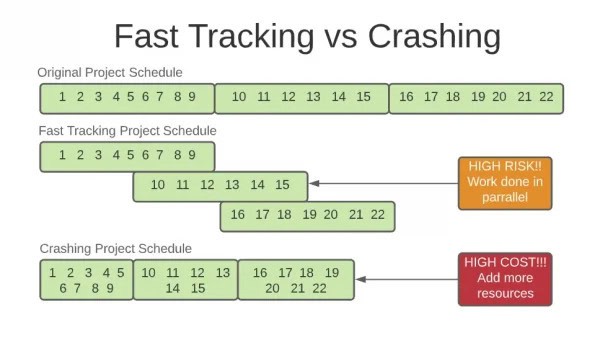
Both methods are used when a project is behind schedule and needs to recover lost time without reducing scope. These practical points help teams use fast tracking and crashing responsibly:
- Fast Tracking Use Case: Fast tracking works best when tasks are partially independent, meaning the second task can begin before the first is fully done without creating unacceptable rework risk.
- Crashing Trade-Offs: Adding people to a task does not always speed it up proportionally. Some work has coordination overhead that increases with team size, so crashing must be applied selectively.
- Risk of Errors: Both methods compress the time available for reviews, handoffs, and quality checks. Teams using these techniques should increase their monitoring frequency to catch mistakes early.
- Cost vs. Time Analysis: Before crashing, calculate the cost of the additional resources against the cost of missing the deadline. The decision should be based on data, not pressure alone.
- Combined Use: Fast tracking and crashing are often used together to maximize schedule recovery. Applying both at once requires close coordination to avoid compounding complexity.
6. Duration Compression
Duration compression is the practice of shortening the total time required to complete a project without removing any of the agreed-upon scope. It is the broader category that includes both fast tracking and crashing as specific techniques. Managers turn to duration compression when a deadline cannot be moved, but the original schedule no longer fits.
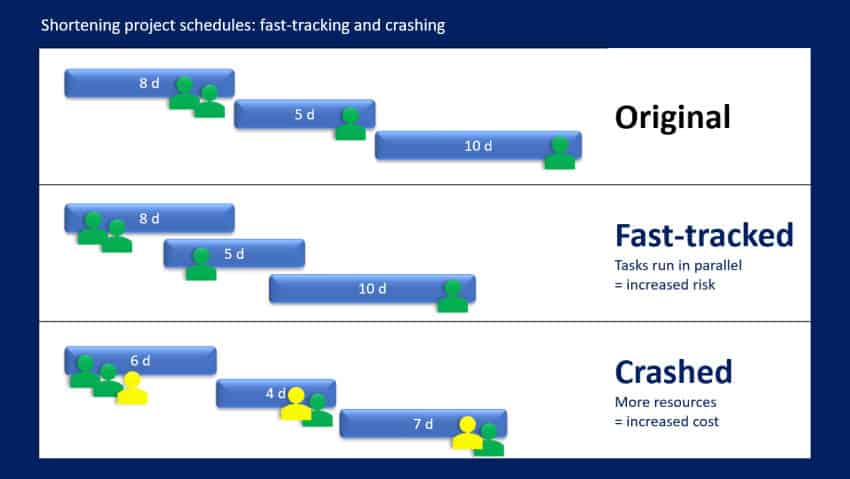
Used carefully, duration compression can recover meaningful time. Used carelessly, it increases cost, stress, and the likelihood of quality issues. The following considerations are worth reviewing before applying duration compression:
- Scope Integrity: Duration compression, by definition, should not reduce deliverables. If time savings are achieved by quietly removing scope, that is a different and more significant problem that needs to be addressed separately.
- Cost Impact: Rushing work almost always costs more, whether through overtime, additional contractors, or expedited procurement. Budget implications should be assessed before the decision is made.
- Team Capacity: Sustained pressure on a team to work faster degrades quality and increases turnover. Duration compression is a short-term measure, not a default mode of operation.
- Stakeholder Alignment: Any decision to compress the schedule should be communicated to key stakeholders, particularly if it affects cost or quality, so expectations remain calibrated.
7. Resource Leveling
Resource leveling is a scheduling technique that adjusts the timing of tasks to smooth out peaks and troughs in resource demand. Rather than scheduling all resource-intensive tasks at once, resource leveling spreads them over time to avoid overloading any individual or team. The trade-off is that the overall project duration may extend slightly.
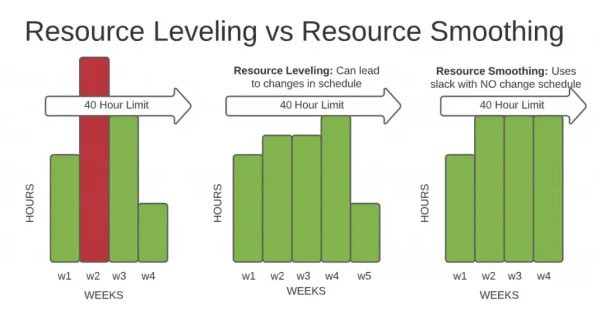
This method is especially useful when resources are shared across projects or when team members are already operating near full capacity. Here is what project managers should understand about resource leveling:
- Overallocation Prevention: Without resource leveling, it is common to schedule tasks optimistically without accounting for the fact that the same person is needed for multiple activities at the same time.
- Morale and Quality: Teams that are not chronically overloaded make fewer mistakes and produce better work. Resource leveling is as much a workforce management decision as it is a scheduling one.
- Schedule Extension Risk: Leveling resources can push the project completion date back if critical tasks get delayed to avoid overallocation. This trade-off needs to be weighed against the cost of burnout and rework.
- Difference from Resource Smoothing: Resource leveling may change the project end date; resource smoothing does not. Smoothing works only within the available float, while leveling adjusts the schedule as needed to balance the load.
- Tool Support: Most project management software includes resource leveling features, but the automated results should always be reviewed manually, as the algorithm does not always account for business priorities.
8. Calendar
The Project Calendar Scheduling method builds the project timeline around specific calendar dates, accounting for working days, public holidays, team availability windows, and organizational blackout periods. It starts with the project’s fixed start and end dates, then assigns tasks to specific days within that window.

This method is practical for projects where external deadlines are fixed, and team availability is a primary constraint. These points capture the key strengths and practical limits of calendar-based scheduling:
- Date-Anchored Planning: Assigning tasks to specific calendar dates makes it immediately clear when work needs to start and finish, reducing ambiguity for team members managing their own workloads.
- Holiday and Leave Integration: By building non-working days directly into the schedule, calendar scheduling avoids the common mistake of planning work during periods when the team is unavailable.
- Stakeholder Communication: A calendar-based schedule is one of the easiest formats to share with clients or executives who want to know what is happening and when, without needing to understand project methodology.
- Limitation to Watch: Calendar scheduling can create a false sense of precision. Assigning a task to a specific date does not guarantee it will be completed on time, and schedules that do not build in contingency time tend to unravel when disruptions occur.
How to Choose the Best Scheduling Method for Your Project
Choosing a scheduling method is not a one-size-fits-all decision. The right choice depends on how well-defined the project is, how much uncertainty exists, what resources you have available, and what the team needs most from the schedule to stay organized and accountable. A practical starting point is to assess these four factors before committing to any single method:
- Project Complexity: More complex projects with many interdependencies benefit from methods like CPM or PERT that explicitly model task relationships and surface the longest delivery chains.
- Estimation Confidence: If your team has done similar work before and estimates are reliable, CPM is a strong fit. If the project involves significant unknowns, PERT or simulation will give you a more honest picture.
- Resource Constraints: When team members are shared across initiatives or availability is inconsistent, resource leveling should be part of the scheduling approach, either as a standalone method or layered onto another.
- Stakeholder Communication Needs: If you need to present the schedule to non-technical audiences regularly, Gantt charts offer the clearest visual format and are worth using alongside any other method.
Combining methods is also legitimate and often practical. Many project managers use a Gantt chart for communication while running CPM in the background for deadline management. The goal is not methodological purity; it is a schedule that the team can follow and that stakeholders can trust.
What Are the Most Commonly Used Scheduling Methods?
Among the different scheduling methods available, CPM, PERT, Gantt charts, and fast tracking with crashing are the most widely used in practice. Their popularity comes from their adaptability: each can be applied across industries ranging from construction and manufacturing to software development and marketing campaigns.
That said, popularity does not mean universal fit. Each method has a specific profile of strengths and trade-offs that project managers should understand before selecting it for a given project. These points summarize when each of the most common methods performs best:
- Critical Path Method (CPM): Best for projects with clearly defined tasks, stable requirements, and a fixed deadline where the sequence of work is well understood in advance.
- PERT: Best for research-heavy or first-of-a-kind projects where task duration estimates carry wide uncertainty and probabilistic planning adds meaningful value.
- Gantt Charts: Best as a communication and tracking tool for any project type, particularly when regular reporting to stakeholders is required throughout the delivery period.
- Fast Tracking and Crashing: Best as a recovery measure when a project falls behind schedule and needs to catch up without reducing scope, with full awareness of the cost and quality trade-offs involved.
Video About Project Scheduling
Watch this quick overview to see how project scheduling techniques work in practice. The video breaks down key methods and how they are applied to keep projects on track and on time.
Conclusion
Effective project scheduling is not about choosing the most sophisticated method available. It is about selecting the approach that gives your team clarity, keeps dependencies visible, and matches the level of uncertainty your project actually carries. The methods covered in this article each serve a different purpose, and the best project managers know which tool to reach for depending on what the project needs.
As your projects grow in complexity, it is worth revisiting your scheduling practices regularly. A method that worked well for a small team initiative may not hold up for a cross-functional delivery with shifting stakeholder demands. Building familiarity with multiple techniques means you will always have a reliable approach ready, regardless of what the next project brings.
FAQs
What is the most important scheduling method in project management?
There is no single most important method. CPM is the most widely taught and broadly applied, but the right choice depends on the project type, the level of uncertainty involved, and what the team needs to stay on track. Most experienced project managers draw from several methods depending on the situation.
What is the difference between fast tracking and crashing?
Fast tracking overlaps tasks that would normally run in sequence, meaning a later task starts before the earlier one finishes. Crashing adds resources to tasks already on the critical path to shorten their duration. Both compress the schedule, but fast tracking relies on resequencing, while crashing relies on additional investment.
Can you use more than one scheduling method on the same project?
Yes, and it is often the right approach. Many teams use Gantt charts for communication and progress tracking while applying CPM logic in the background to manage deadline risk. Layering methods is acceptable as long as the schedule remains clear and the team understands how it works.
How does resource leveling affect the project end date?
Resource leveling may extend the project end date if tasks need to be delayed to avoid overloading team members. Unlike resource smoothing, which works only within available float, leveling adjusts the schedule as needed to balance demand. The resulting delay is often worth it to avoid burnout and quality issues from an overloaded team.
When should simulation be used in project scheduling?
Simulation is most useful when the project involves significant uncertainty and when stakeholders need an honest view of delivery risk rather than a single committed date. Monte Carlo simulation, the most common form, is best applied to large or complex projects where the effort of building an accurate model is proportionate to the stakes involved.
Suggested articles:
- The Basics of Project Scheduling for Project Management
- Critical Path Method Scheduling: What? Why? and How?
- 9 Ways to Avoid Scheduling Conflicts

Shane Drumm, holding certifications in PMP®, PMI-ACP®, CSM, and LPM, is the author behind numerous articles featured here. Hailing from County Cork, Ireland, his expertise lies in implementing Agile methodologies with geographically dispersed teams for software development projects. In his leisure, he dedicates time to web development and Ironman triathlon training. Find out more about Shane on shanedrumm.com and please reach out and connect with Shane on LinkedIn.