

Product backlog prioritisation is one of the most demanding responsibilities a product owner faces in any Agile environment. Balancing stakeholders’ expectations, development teams’ capacity, and a product’s long-term vision requires a structured, repeatable approach. The MoSCoW prioritisation method offers exactly that: a clear, category-based framework that brings order to what can otherwise become an overwhelming decision-making process.
This article explores how MoSCoW prioritisation works in practice, from the perspective of a product owner who has applied it across multiple Agile projects. It covers the four core categories, practical application steps, key benefits, common pitfalls, and answers to the questions product teams ask most frequently about this technique.
When MoSCoW Works — and When It Gets Complicated
The MoSCoW method is a practical prioritisation approach well-suited to backlog refinement in Agile settings. When applied to a newly formed product team defining its minimum viable product, the framework delivers immediate clarity. It helps everyone from developers to stakeholders agree on what must ship, what can wait, and what falls outside the current scope entirely.
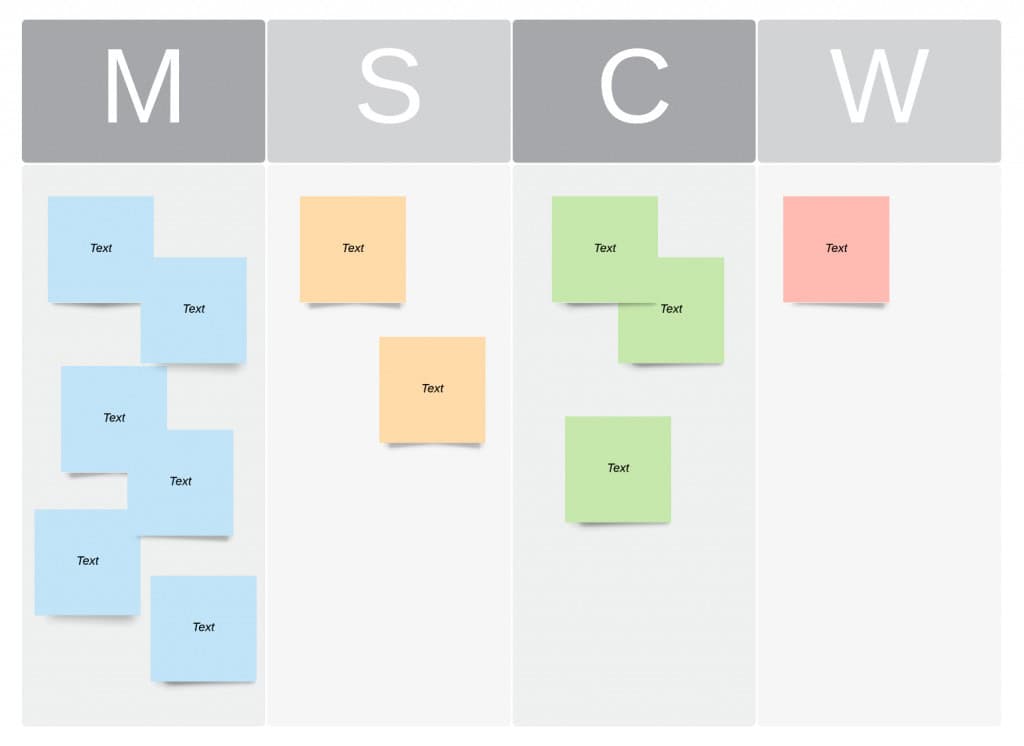
A simple free MoSCoW Table in Lucidchart
However, there are scenarios where MoSCoW is less straightforward, particularly when working with a mature product with an established user base. In those cases, prioritisation must account for market demands, customer feedback, compliance requirements, and accumulated technical debt, all of which introduce complexity that the basic framework alone cannot resolve.
History of MoSCoW
The MoSCoW technique was created by Dai Clegg, a software developer working at Oracle. He intended to give development teams a practical tool for prioritising tasks across the lifecycle of a software release. The method was designed to be simple enough for any team member to understand while being rigorous enough to support meaningful product decisions.
MoSCoW prioritisation organises requirements into four distinct categories, each representing a different level of urgency and importance. Although it was not originally conceived as an Agile project management technique, it has been widely adopted within Agile frameworks because it aligns naturally with iterative development cycles and sprint-based planning.
The four MoSCoW categories are the foundation of the entire prioritisation process:
- Must Have: These requirements represent the absolute minimum the product needs to function and launch. They define the core of the MVP and carry the highest priority in every planning session.
- Should Have: Features in this category are important and add significant value, but the product can technically function without them. They are scheduled with serious intent but can be deferred if necessary.
- Could Have: These are desirable additions that enhance the product experience but have a low impact if omitted. They are typically addressed when time and resources allow.
- Won’t Have This Time: This category captures ideas that are acknowledged but deliberately excluded from the current release cycle. They may be revisited in future iterations.
Must Have Requirements
Must Have requirements form the non-negotiable foundation of every release in Agile development, defining the product’s Minimum Viable Product. They represent the features and capabilities without which the product cannot be delivered to users in a functional and usable state. Correctly identifying these requirements is the single most critical step in the entire prioritisation process.
A clear Must Have list provides the team with focus and removes ambiguity about what success looks like for the current sprint or release. Product owners should validate these requirements against the product vision and confirm them with key stakeholders before any development work begins. Misclassifying a critical requirement as lower priority can delay launches and erode team confidence.
Should Have Requirements
Should Have requirements occupy a space between essential and optional in any product roadmap. They are features that users would expect and appreciate, but the product would still function without them in a reduced capacity. The test for this category is straightforward: would the absence of this feature significantly degrade the user experience or product value?
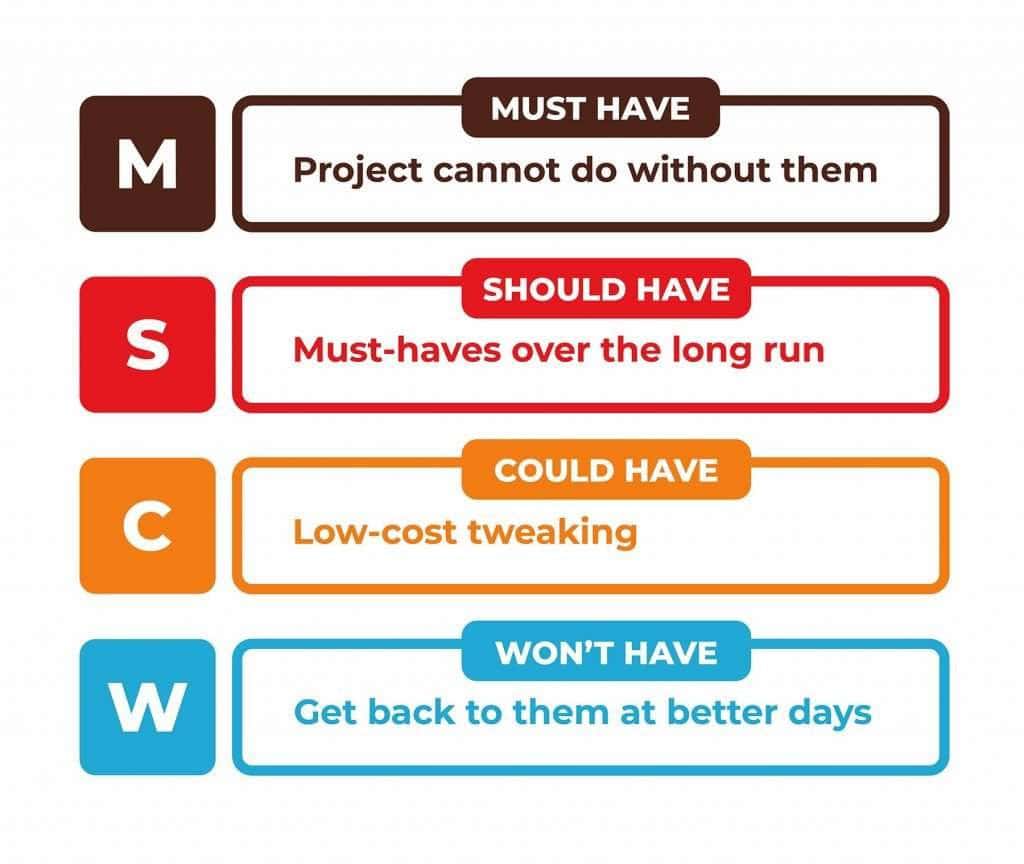
Created by Prioritization with MoSCoW: Rules and How to Use | Railsware Blog
A useful example of a Should Have feature is the ability to access certain software functions in an offline mode. Users benefit meaningfully from it, and its absence would be noticed, but the core product remains operational. Correctly identifying Should Have features prevents teams from over-engineering a release while ensuring valuable improvements are not permanently deprioritised.
Could Have Requirements
Could Have requirements are the refinements and enhancements that make a product more polished but are not critical to its performance or usability. These features contribute to user satisfaction when present but generate little friction when absent. They are often the first items removed from scope when timelines tighten or resources are reallocated.
A practical example of a Could Have feature is adding a live chat widget to a web application. It improves the experience for some users, but its absence does not compromise the product’s core functionality. Keeping these requirements clearly labelled prevents scope creep and ensures the team does not inadvertently treat nice-to-haves as essentials during sprint planning.
Won’t Have or Will Not Have
The Won’t Have category is one of the most strategically valuable parts of the MoSCoW framework because it makes exclusion explicit and intentional. Rather than leaving low-priority ideas in an unreviewed backlog, this category formally acknowledges them while confirming they will not be addressed in the current cycle.
Within this category, product owners can make a further distinction between items that are simply deferred and those that will never be built. The two sub-types within this initiative are:
- Won’t Have This Time: Features that are viable and worth revisiting but are explicitly out of scope for the current release due to time or resource constraints.
- Will Never Have: Ideas that have been evaluated and determined to be misaligned with the product vision, technically infeasible, or simply not worth the investment at any point.
Prioritise Product Backlog with MoSCoW Technique
Applying MoSCoW extends well beyond simply categorising product features. The method can be used to prioritise any variable that affects a product’s development and delivery, from budget allocation to team capability assessments. Recognising this flexibility allows product owners to get significantly more value from the framework.
In practice, most product backlogs involve multiple overlapping variables that must be weighed simultaneously. The following areas represent the most common applications of MoSCoW beyond feature categorisation:
- Product Features: When prioritising features, alignment with the product vision and roadmap is essential. The MVP must contain a usable subset of functionality that delivers genuine value to the end user, so Must Have features should reflect what users need to accomplish their core tasks.
- Project Budget Limitations: When a constrained budget is a factor, MoSCoW helps product owners make defensible decisions about where investment goes. Must Have and Should Have items receive funding first, with Could Have items addressed only if the budget allows.
- Team Expertise: If the development team lacks specific technical skills, prioritisation must account for what the team can realistically deliver. Assigning Must Have status to features that require unavailable expertise is a common source of sprint failure and should be avoided.
- Regulatory and Compliance Requirements: In industries subject to legal or compliance obligations, certain features or data-handling processes may be non-negotiable. These should be classified as Must Have regardless of their perceived user-facing value, as non-compliance carries significant risk.
- Technical Debt: Accumulated technical debt can constrain what is buildable within a given cycle. Assigning prioritisation labels to debt-reduction tasks helps teams justify the time spent on non-visible improvements to stakeholders who may otherwise push for feature development exclusively.
Applying MoSCoW Prioritisation in Agile
Successfully implementing MoSCoW in an Agile environment requires more than simply assigning labels to backlog items. A structured process ensures that prioritisation decisions are informed, consistent, and defensible across the team and with stakeholders. The following steps provide a repeatable workflow for applying MoSCoW effectively in sprint planning and backlog refinement sessions.
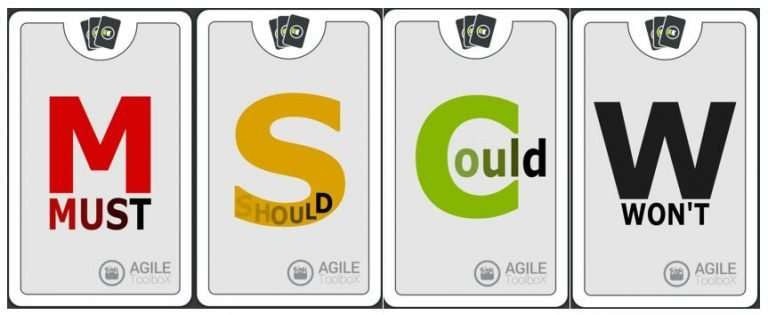
Agile Planning cards for MoSCoW by ScrumDesk
These steps represent the recommended sequence for a disciplined MoSCoW implementation:
- Identify Stakeholders: Limiting the number of stakeholders involved in prioritisation decisions prevents the process from becoming chaotic. A focused group with clear decision-making authority produces faster, more consistent outcomes and reduces conflicting input during backlog refinement.
- Determine Arbitration: Even with a limited group, disagreements will arise when assigning priorities to contested features. Establishing a conflict resolution mechanism in advance, such as a structured vote or a designated decision-maker, prevents stalled sessions and keeps the prioritisation process moving forward.
- Assign Team Resources: Allocating resources according to priority categories ensures that Must Have items receive the time and effort they require. This step also supports timeline estimation, as resource allocation directly informs how long each category of work will take to complete.
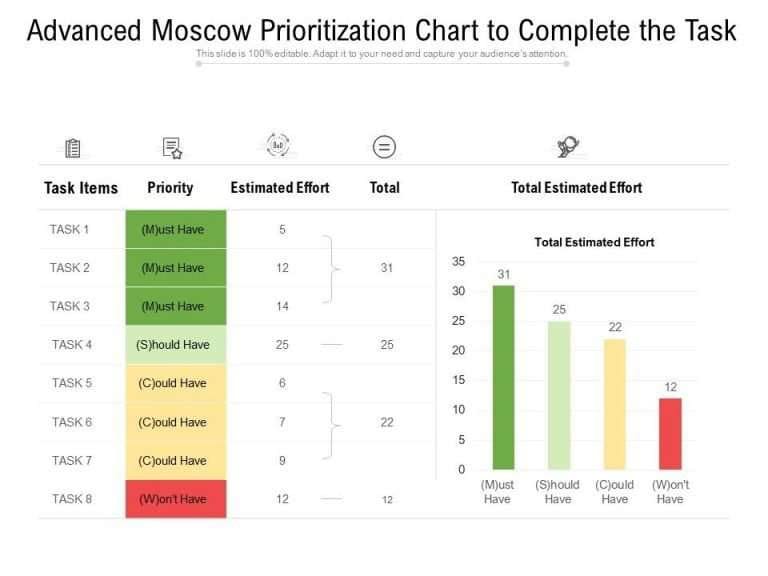
- Determine Product Timeline: Must Have tasks typically consume around 60 percent of a team’s time and effort, with Could Have tasks accounting for roughly 20 percent. Establishing this distribution before sprint planning begins gives the team a realistic workload model and reduces the risk of overcommitment.
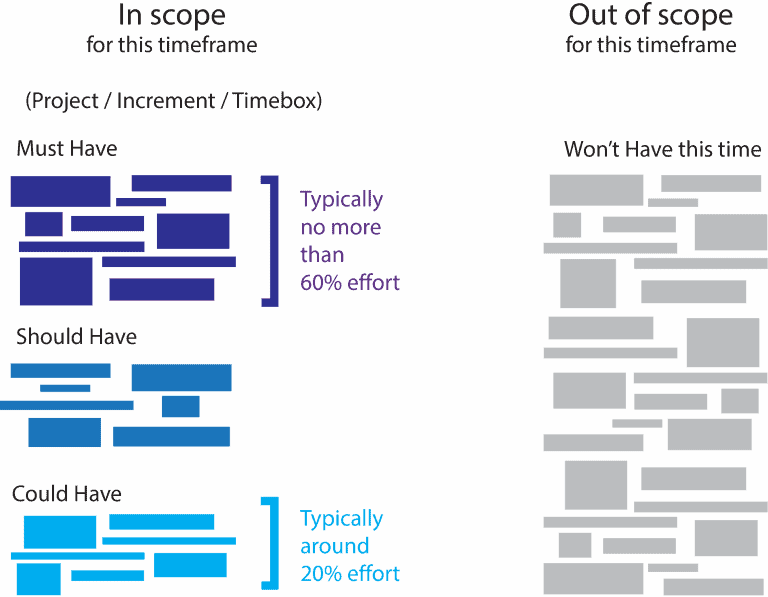
Chapter 10: MoSCoW Prioritisation (agilebusiness.org)
Benefits of the MoSCoW Prioritisation in Agile
The MoSCoW technique provides structured advantages that are relevant across both new product development and ongoing delivery cycles. Its value is not limited to a single phase of a project; it can be applied at any point where competing priorities need to be resolved quickly and transparently. Teams that use it consistently report clearer backlogs and more productive sprint planning sessions.
The following benefits reflect the most impactful ways MoSCoW improves Agile team performance:
- Set Priorities at Different Levels: The framework works across multiple levels of the development pipeline, from high-level strategic planning to individual sprint refinement. This flexibility means product owners can apply the same mental model regardless of where they are in the product lifecycle.
- Resolve Stakeholder Complaints: MoSCoW creates a visible, structured record of why certain features were prioritised over others. When stakeholders raise concerns about missed functionality, the categorisation provides a clear, objective basis for explaining those decisions without lengthy debates.
- Minimise Agile Team Distractions: A clearly maintained MoSCoW structure keeps the entire team focused on what matters most in the current cycle. It reduces the frequency of scope changes mid-sprint and limits the cognitive load of constantly re-evaluating what to work on next.
- Accelerate MVP Definition: For teams launching a new product, MoSCoW provides the fastest path to identifying the minimum viable product. By separating Must Haves from everything else, product owners can define a shippable scope with confidence and communicate it clearly to both the team and stakeholders.
Pitfalls of the MoSCoW Prioritisation in Agile
Like any prioritisation framework, MoSCoW is not without its limitations. Understanding where the method can break down is as important as knowing how to apply it correctly. Product owners who are aware of these pitfalls can implement safeguards that reduce the likelihood of poor prioritisation decisions affecting delivery outcomes.
The following pitfalls represent the most frequently encountered challenges when using MoSCoW in Agile environments:
- Scoring Inconsistencies to Project Requirements: Without agreed criteria for what qualifies a requirement as Must Have versus Should Have, team members may apply their own judgment inconsistently. This leads to backlog categories that do not accurately reflect business priorities and can distort sprint planning.
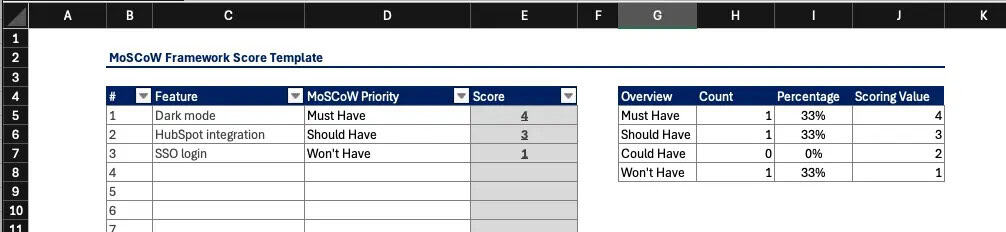
- Not Objective Means vs Opinions: MoSCoW does not include a built-in scoring mechanism, which means categorisation relies on consensus rather than objective data. Features that should belong in the Won’t Have category can be elevated based on enthusiasm rather than evidence of user need or business value.
- Removing Key Stakeholder Input: When key stakeholders are excluded from the prioritisation process, features may be categorised in ways that conflict with business strategy or customer expectations. The downstream consequences of this misalignment often emerge late in the development cycle, when changes are costly and disruptive.
- Product Team Bias: Team members may favour features they find technically interesting or professionally relevant, regardless of their actual product value. This bias can result in Could Have features receiving Must Have treatment, pulling time and resources away from genuinely critical requirements.
- Lack of Weighting Between Categories: The MoSCoW framework does not guide how to rank items within the same category. Two Must Have requirements may have very different levels of urgency, but the method treats them equally, which can create ambiguity when the team must decide what to address first within a single sprint.
Free MoSCoW Prioritization Excel Template
Video About MoSCoW Prioritization Method
Watch this short video for a clear overview of the MoSCoW Prioritization Method, covering its core categories, how it works in practice, and key best practices for product teams.
Conclusion
MoSCoW prioritisation is one of the most accessible and effective tools available to product owners working within Agile frameworks. When applied with discipline and the right stakeholder involvement, it brings clarity to complex backlog decisions, aligns teams around shared priorities, and provides a transparent record of why certain features were included or excluded from a given release cycle.
Like any framework, its effectiveness depends on how consistently and thoughtfully it is used. Product owners who understand both its strengths and its limitations are better positioned to apply it where it adds the most value and supplement it with additional techniques where it falls short. Used well, MoSCoW remains a reliable foundation for structured, stakeholder-aligned product prioritisation.
MoSCoW Prioritisation Agile FAQs
What does MoSCoW stand for in Agile?
MoSCoW is an acronym that stands for Must Have, Should Have, Could Have, and Won’t Have This Time. The lowercase letters in the name are included to make the acronym pronounceable. Each category represents a distinct level of priority assigned to requirements, features, or tasks during product backlog refinement and sprint planning sessions.
What are the must-have requirements in MoSCoW?
Must-Have requirements are the non-negotiable features or capabilities that a product must include to launch and function as intended. They define the minimum viable product and carry the highest priority in any planning session. Without them, the product cannot be delivered to users in a usable state, making their correct identification critical to the success of any sprint or release.
How do you implement MoSCoW in an Agile project?
Implementing MoSCoW in Agile begins with identifying key stakeholders and establishing a clear process for resolving disagreements. The team then reviews each backlog item and assigns it to one of the four categories based on its impact, feasibility, and alignment with the product vision. Resources and timelines are then mapped against the categories, with Must Have items receiving the largest share of capacity in each sprint cycle.
How is MoSCoW different from other prioritisation frameworks?
Unlike frameworks such as RICE scoring or weighted scoring matrices, MoSCoW does not use numerical values to rank requirements. Instead, it relies on structured consensus to assign categorical labels. This makes it faster and easier to apply, but also more vulnerable to subjective bias. It works best when paired with clear criteria for each category and a disciplined stakeholder engagement process.
When should a product owner use MoSCoW prioritisation?
MoSCoW is most effective when a team is defining the scope of a new product or planning a major release and needs to establish clear boundaries quickly. It is also useful during backlog refinement sessions where the volume of competing requirements makes it difficult to determine where to focus. For mature products with complex interdependencies, it may need to be supplemented with additional prioritisation methods to account for technical debt and regulatory constraints.
Suggested articles:
- Top 10 Customer Value Prioritisation Methods in Agile
- Agile Roles And Responsibilities Matrix Made Simple
- Agile Project Management Guide (Skills & Methodologies)

Shane Drumm, holding certifications in PMP®, PMI-ACP®, CSM, and LPM, is the author behind numerous articles featured here. Hailing from County Cork, Ireland, his expertise lies in implementing Agile methodologies with geographically dispersed teams for software development projects. In his leisure, he dedicates time to web development and Ironman triathlon training. Find out more about Shane on shanedrumm.com and please reach out and connect with Shane on LinkedIn.