
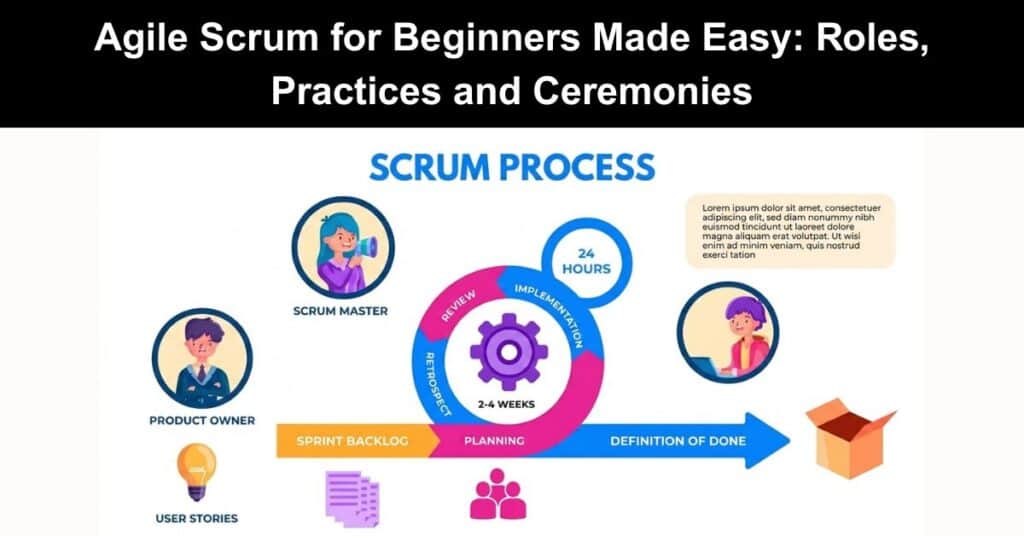
Scrum is an iterative and incremental software development methodology built around a simple set of clearly defined roles and responsibilities. Despite its unusual name, Scrum has no connection to rugby. The framework is centred on prioritising a structured backlog of work and committing to completing a defined set of tasks within a short, fixed time period, with no additional work introduced during that cycle. This approach emerged as a direct response to the limitations of the traditional waterfall methodology, which offered little capacity to accommodate change once a project was underway.
Because Scrum teams commit only to two to four weeks of work at a time, they are well-positioned to respond quickly to evolving requirements and shifting business priorities. Each Scrum team is supported by a Scrum Master, whose role is to guide the team in implementing the methodology correctly and upholding its core practices. The business is represented by a Product Owner, who is responsible for prioritising the backlog and serving as the primary point of contact between the organisation and the development team.
Scrum also defines a set of essential ceremonies that must be observed for the framework to function as intended. These include the Daily Stand-Up, Sprint Planning, Sprint Review, and Sprint Retrospective. For insight into how Scrum is scaled across large organisations, the Large-Scale Scrum (LeSS) framework is a valuable reference.
Scrum Development Methodology Framework
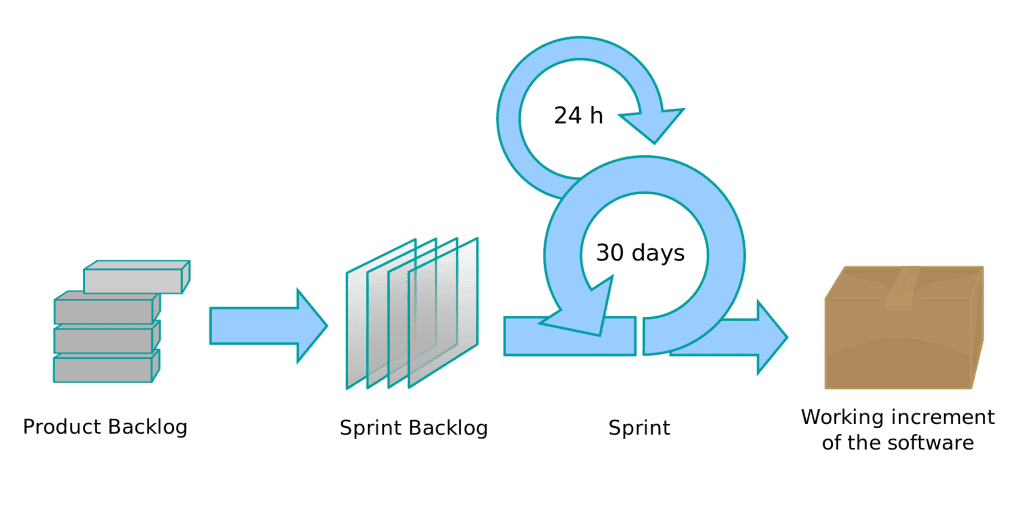
Scrum is a process framework used for managing product development, not a prescriptive technique for building specific products. It provides structure through defined roles, events, and artifacts that teams can adapt to their context. The framework does not dictate which engineering practices to use, but it does establish clear boundaries and responsibilities that keep development focused and accountable.
3 Pillars of Scrum
Scrum is grounded in empirical process control theory, which holds that knowledge comes from experience and that decisions should be based on what is actually known. It employs an iterative, incremental approach to optimise predictability and manage risk. Every implementation of Scrum rests on three foundational pillars that keep the process honest and effective:
- Transparency: All aspects of the process must be visible to those responsible for the outcome, ensuring there are no hidden problems or undisclosed risks affecting the team’s ability to deliver.
- Inspection: Artifacts and progress should be inspected frequently enough to detect undesirable variances, but not so frequently that the act of inspection itself disrupts the development work.
- Adaptation: If inspection reveals that any aspect of the process or product has deviated from acceptable limits, the team must adjust as quickly as possible to minimise further deviation.
Scrum Development Methodology Roles
The Scrum framework defines three distinct roles, each with clear responsibilities and boundaries. These roles work together to ensure the team remains focused, the backlog stays prioritised, and the process is followed with integrity. Understanding who does what is essential before attempting to implement Scrum in any team environment.
Product Owner
The Product Owner is the person responsible for managing the product backlog and representing the interests of the business. They prioritise work according to business needs and serve as the single point of contact for requirements. The business must respect and support the Product Owner’s decisions and should not attempt to contact or direct the development team independently.
The following responsibilities fall within the Product Owner’s remit:
- Creating User Stories: Writing requirements from the perspective of the end user, using a structured format that communicates what is needed and why without prescribing how it should be built.
- Ensuring Story Clarity: Reviewing stories with the team to confirm that requirements are understood, acceptance criteria are clear, and there is no ambiguity before work begins.
- Prioritising the Product Backlog: Ordering backlog items to reflect current business priorities, ensuring the team always works on the highest-value items first.
- Maintaining Backlog Visibility: Keeping the product backlog accessible and up to date so that all stakeholders and team members can see what is planned and in what order.
Development Team
The development team is a self-organised group empowered by the organisation to manage and execute its own work. This autonomy is intentional, as it creates a sense of ownership and accountability that drives higher-quality output. Teams are cross-functional, meaning they collectively hold all the skills needed to deliver a releasable product increment without depending on external resources.
The following responsibility defines the development team’s core commitment:
- Delivering Releasable Increments: Producing a working, potentially shippable product increment at the end of every sprint, meeting the agreed Definition of Done without exception.
Scrum recognises no titles for team members other than developer and no sub-teams within the development group. Teams should remain small, with a recommended maximum of nine developers to preserve communication efficiency and collective accountability.
Scrum Master
The Scrum Master acts as a servant-leader for the development team, supporting rather than directing the people they work with. Their primary responsibility is to ensure the team understands and practises Scrum correctly, removing anything that impedes progress and shielding the team from external interference that could disrupt the sprint.
The following responsibilities fall within the Scrum Master’s remit:
- Assisting the Product Owner: Supporting backlog management activities and helping the Product Owner communicate requirements clearly so that stories are sprint-ready.
- Understanding Empirical Planning: Helping the team and organisation navigate product planning in an environment where requirements evolve, and certainty is built through iteration rather than upfront definition.
- Facilitating Scrum Events: Ensuring all ceremonies take place as scheduled, remain time-boxed, and achieve their intended purpose without unnecessary interruption to development work.
- Coaching the Team: Building the team’s understanding of Scrum principles, practices, and techniques so that adherence improves over time without constant supervision.
- Removing Blockers: Identifying and resolving impediments that prevent the development team from making progress, whether those blockers are technical, organisational, or interpersonal in nature.
Scrum Development Methodology Ceremonies

Scrum ceremonies create regularity and structure within a sprint cycle, reducing the need for ad hoc meetings that disrupt development flow. Each Scrum ceremony has a defined purpose and a maximum duration to ensure it adds value without consuming excessive time. Together, they form a rhythm that keeps the team aligned, the work visible, and the process continuously improving.
Backlog Refinement/Grooming
Duration: 1–2 Hours
Backlog refinement, also referred to as backlog grooming, story time, or estimation session, prepares the product backlog for the upcoming sprint planning meeting. The Product Owner identifies stories likely to feature in the next sprint, and the team reviews them to confirm they are correctly estimated and ready for selection. The Scrum Master may introduce estimating techniques to support this process, including:
- Planning Poker: A consensus-based estimation technique where team members simultaneously reveal effort estimates using numbered cards, then discuss differences until agreement is reached.
- Estimating Games: Structured collaborative activities designed to make estimation more engaging and to surface assumptions or misunderstandings about story complexity early in the process.
After the refinement session, stories should be fully prepared and ready to be selected during the next sprint planning meeting.
Sprint Planning
Duration: Maximum 8 hours for a one-month sprint
Sprint planning is the process of deciding what work will be completed in the upcoming sprint. The Scrum Master is responsible for ensuring the session takes place and remains within its time-box. Sprint planning is structured around two core questions that the team must answer before the session concludes:
- What can be delivered in the upcoming sprint? The Product Owner presents the sprint goal, and the team selects backlog items they are confident they can complete within the sprint duration.
- What work is needed to deliver the sprint? The team breaks selected stories into tasks, estimates the effort involved, and organises the sprint backlog in the sequence they plan to work through it.
The sprint goal is set by the Product Owner and defines the objective the sprint is intended to achieve. The team is responsible for selecting a realistic volume of work that can be completed without accumulating technical debt.
The Sprint
Duration: Minimum 2 weeks, maximum 4 weeks
The sprint is the core unit of delivery in Scrum and the ceremony where the actual development work takes place. Each sprint runs for a fixed duration that must be respected regardless of whether all work is completed, with any remaining items returned to the backlog for re-prioritisation. A new sprint begins immediately after the previous one ends, maintaining a continuous development rhythm.
Sprints consist of sprint planning, daily stand-ups, development work, sprint review, and the sprint retrospective. Only the Product Owner holds the authority to cancel a sprint, which should only occur if the sprint goal has become obsolete. As a general rule, sprints should not be cancelled, as doing so disrupts momentum and undermines team confidence.
Daily Scrum/Stand-Up
Duration: 15 minutes
The daily stand-up is a short, focused event held each morning at the team area, designed to synchronise the team and surface blockers quickly. Only team members should speak during the stand-up, a rule enforced by the Scrum Master to keep the session on track. Each team member answers the following three questions, spending no more than a few minutes on their update:
- What I did yesterday: A brief summary of completed work that confirms progress against the sprint backlog and keeps the team informed of what has moved forward.
- What I plan on doing today: A clear statement of intended work for the day that helps the team identify dependencies and coordinate effort across the sprint.
- Any blockers to report: Any impediments preventing progress that the Scrum Master can act on immediately to prevent delays from compounding across the sprint.
Sprint Review/Demo
Duration: Maximum 4 hours for a one-month sprint
The sprint review is an opportunity for the team to demonstrate the work completed during the sprint to all relevant stakeholders. The Product Owner opens by explaining the sprint goal, after which the development team describes any challenges encountered and how they were resolved. The session closes with a live demonstration of the product increment built during the sprint, giving stakeholders direct visibility of progress.
Sprint Retrospective
Duration: Maximum 3 hours for a one-month sprint
The sprint retrospective is held after the sprint review and before the next sprint planning session, giving the team dedicated time to reflect on the process rather than the product. It is one of the most important ceremonies in Scrum because it creates a structured mechanism for continuous improvement. The purpose of sprint retrospectives is as follows:
- Inspect the Previous Sprint: Review the sprint with regard to people, relationships, processes, and tools to form an honest picture of what actually happened during the cycle.
- Identify Potential Improvements: Surface specific areas where changes could meaningfully improve team performance, collaboration, or delivery quality in future sprints.
- Create an Improvement Plan: Agree on concrete actions to implement the identified improvements in the next sprint so that retrospective outcomes translate into measurable change.
The Scrum Master plays the leading role in retrospectives, as they are best positioned to facilitate honest reflection and ensure the team treats continuous improvement as a non-negotiable part of the process.
Scrum Development Methodology Artifacts
Scrum artifacts represent work, value, and progress in a transparent and accessible way. They give the team and stakeholders a shared view of what has been committed to, what is in progress, and what has been completed. Each artifact serves a specific purpose within the framework and should be kept current at all times.
User Story
User stories are how the business or Product Owner documents requirements for a product. Each story is written from the perspective of the end user and follows a consistent format that keeps the focus on user value rather than technical implementation:
As a [role], I want [feature] so that [benefit].
Examples include:
- As a user, I want to download videos so that I can store them on my device.
- As a systems administrator, I want to monitor uploaded photos so that I can confirm they are appropriate.
Stories are reviewed during refinement sessions to ensure the development team understands the user requirements and the expected behaviour of the completed feature.
Epics
Epics are collections of related user stories grouped together because they contribute to the same business goal or product outcome. They provide a higher-level view of the roadmap and help the Product Owner organise the backlog into meaningful themes before breaking work down into sprint-ready stories.
Product Backlog
The product backlog is an ordered list of all user stories and requirements created by the business. It captures every known requirement, improvement, and change request and is never considered complete. As the product evolves and new information emerges, stories are continuously added, revised, or removed to reflect current priorities.
Sprint Backlog
The sprint backlog is the subset of product backlog items selected by the development team for the upcoming sprint. It represents the team’s forecast of what can be completed within the sprint duration and is owned entirely by the development team. Only the development team may add to or change the sprint backlog once a sprint is underway.
Scrum Board

The Scrum board provides a visual representation of sprint progress that the entire team can see and interact with at any time. It reflects the current state of all work items and makes bottlenecks visible before they become serious problems. A typical Scrum board consists of the following columns:
- Committed Backlog Items: Stories accepted into the sprint that have not yet been broken into active tasks or assigned to a developer for work.
- Tasks Not Started: Individual tasks derived from sprint backlog items that are queued for development but have not yet been picked up by a team member.
- Tasks in Progress: Work that is currently being actively developed, giving the team a real-time view of who is working on what at any given moment.
- Tasks Completed: Finished tasks that meet the Definition of Done, confirming that the associated work has been delivered to the required standard.
Some teams use a physical whiteboard with sticky notes, while others use tools such as Jira, which replicates the board digitally with added backlog management and reporting capabilities.
Burndown Chart
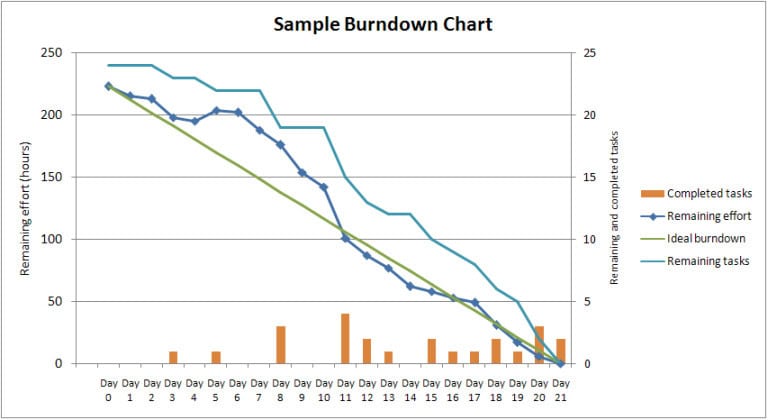
The burndown chart provides a quick visual indication of whether a sprint is tracking to plan. A diagonal line running from the total sprint commitment down to zero represents the ideal rate of progress, and the team’s actual completed work is plotted against it daily. The gap between the two lines signals whether the team is ahead, on track, or at risk of not completing the sprint.
Release Plan
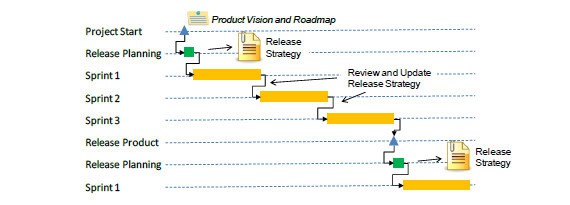
Release planning is performed by the Product Owner at a high level across multiple sprints. Releases consist of several sprint increments combined into a shippable product version. To create an accurate release plan, the Product Owner requires the following inputs:
- Prioritised Backlog: A current, ordered list of stories that reflects business priorities and provides the foundation for deciding what features will be included in each release.
- Team Velocity: A measure of how much work the team consistently completes per sprint, which is used to forecast how many sprints will be needed to deliver a given scope.
- Conditions of Satisfaction: Agreed goals covering schedule, scope, and resources that define what a successful release looks like from the business perspective.
Like the product backlog, the release plan is not a fixed document. It is updated regularly as new information becomes available and priorities shift.
Definition of Done
The Definition of Done is the agreed standard that determines when a product backlog item can be considered complete. Because what counts as done varies between teams and organisations, every Scrum team must define and document it explicitly. Where multiple Scrum teams are working on the same product, all teams must agree on a shared Definition of Done to ensure consistency of quality across every increment delivered.
More Information on Scrum Development Methodology
Conclusion
Scrum provides a clear, structured approach to managing complex development work through defined roles, time-boxed ceremonies, and transparent artifacts. When implemented correctly, it gives teams the discipline to deliver consistently, the flexibility to respond to change, and the process to improve continuously. For beginners, understanding these foundations is the essential first step toward effective Agile practice.
The value of Scrum lies not in following its rules mechanically but in understanding why each element exists and how it contributes to better outcomes. Teams that invest in learning the framework properly, supporting their Scrum Master, and engaging honestly in every ceremony will find that Scrum delivers far more than a structured way to manage work. It builds the culture and habits that make high performance sustainable.
FAQs
What is the difference between Scrum and Agile?
Agile is a broad philosophy for software development that values flexibility, collaboration, and iterative delivery. Scrum is a specific framework that puts Agile principles into practice through defined roles, ceremonies, and artifacts. All Scrum is Agile, but not all Agile is Scrum. Other Agile frameworks include Kanban, Extreme Programming, and Lean.
How long should a Scrum sprint be?
Sprints run for a minimum of two weeks and a maximum of four weeks. Most teams settle on two-week sprints as a practical balance between delivering value frequently and allowing enough time to complete meaningful work. The duration should remain consistent from sprint to sprint to build a reliable team rhythm.
Who can cancel a sprint?
Only the Product Owner has the authority to cancel a sprint, though they may do so after consulting with the business, the Scrum Master, or the development team. Cancellation should only occur if the sprint goal has become obsolete. As a general rule, sprints should not be cancelled because doing so disrupts team momentum and delivery confidence.
How many people should be on a Scrum team?
The development team should be kept small, with a recommended maximum of nine developers. Smaller teams communicate more efficiently, make decisions faster, and are easier to coordinate. The total Scrum team, including the Product Owner and Scrum Master, typically ranges from five to ten people in most practical implementations.
What tools can teams use to manage a Scrum board?
Teams can use a physical whiteboard with sticky notes or a digital tool such as Jira, which supports backlog management, sprint planning, and burndown reporting in one platform. Other popular options include Trello, Azure DevOps, and Monday.com. The right tool depends on team size, remote working arrangements, and the level of reporting detail required.
Suggested articles:
- What Are the 5 Scrum Ceremonies?
- The 5 Scrum Phases and Their Benefits
- Scrum Master vs. Product Manager: Roles and Responsibilities Defined

Shane Drumm, holding certifications in PMP®, PMI-ACP®, CSM, and LPM, is the author behind numerous articles featured here. Hailing from County Cork, Ireland, his expertise lies in implementing Agile methodologies with geographically dispersed teams for software development projects. In his leisure, he dedicates time to web development and Ironman triathlon training. Find out more about Shane on shanedrumm.com and please reach out and connect with Shane on LinkedIn.