
This Feasibility Study Template helps you find out whether a project can actually be delivered before anyone commits the money. It tests every option against your requirements, rates each one on seven feasibility dimensions, and ranks them with a weighted score it calculates for you. Fill it in below, free, with no sign-up. Your answers save automatically as you type.
See all 50+ PM Templates.
- Custom version ($)
- Word template ($)
- How to use the templates
- What is inside
- What is a feasibility study?
Loading the interactive form. If this message stays on screen, JavaScript is switched off or blocked in this browser.
Your answers are stored in this browser only and are not sent anywhere. Clearing your browsing data, or using a different device or a private window, will start a blank form.
What is inside the template
The study follows the order in which a sponsor needs the evidence, from the question, through the requirements and the options, to a ranked conclusion:
- Executive summary. The question, the options tested, the most feasible one and the evidence behind it, on one page.
- Study scope and approach. The question the study must answer, what is in and out of scope, and the methods used to test each option.
- Business context. The processes, technology, data, people and rules any solution must fit into, and the problem or opportunity itself.
- Requirements. Business drivers, requirements prioritised with MoSCoW and a test for each, and the fixed constraints.
- Options identified. Every realistic option, including doing nothing, screened against the must-have requirements.
- Feasibility assessment. A panel for each option: description, tests with success criteria and results rated on seven dimensions, other considerations, scored risks, issues and assumptions.
- Feasibility ranking. Weighted criteria and a pass mark agreed in advance, with the weighted totals, lowest ratings and pass mark check calculated for you.
- Conclusion and recommendation. The most feasible option, why the others were rejected, the conditions, the remaining uncertainty and what goes into the business case.
- Next steps, supporting documentation, and the approval block.
What is a feasibility study?
A feasibility study is a document that tests whether a proposed change can actually be delivered before anyone commits to it. It takes the realistic options for solving a problem or taking an opportunity, checks each one against the requirements, and assesses how likely it is to succeed. It ends by naming the most feasible option, or by concluding that none of them is.
Its defining feature is evidence. An option does not become feasible because a vendor says so or because the team likes it. It becomes feasible when a trial, a prototype, a survey, a reference visit or a data audit shows that it works, with a success criterion set before the test was run. A study built on opinion only moves the argument to a later, more expensive stage.
The questions it has to answer are practical. Does the technology work at our scale, with our systems? Will the people who must use it be able and willing to? Is the data good enough? Can it be delivered by the date that matters? Is it affordable within the budget we have? And is there any legal, privacy or contractual obstacle that would stop it?
How each option is assessed
The template follows the same assessment cycle for every option, so the options can be compared fairly. The key discipline is deciding what “good enough” looks like before the test runs, not after the results are in.
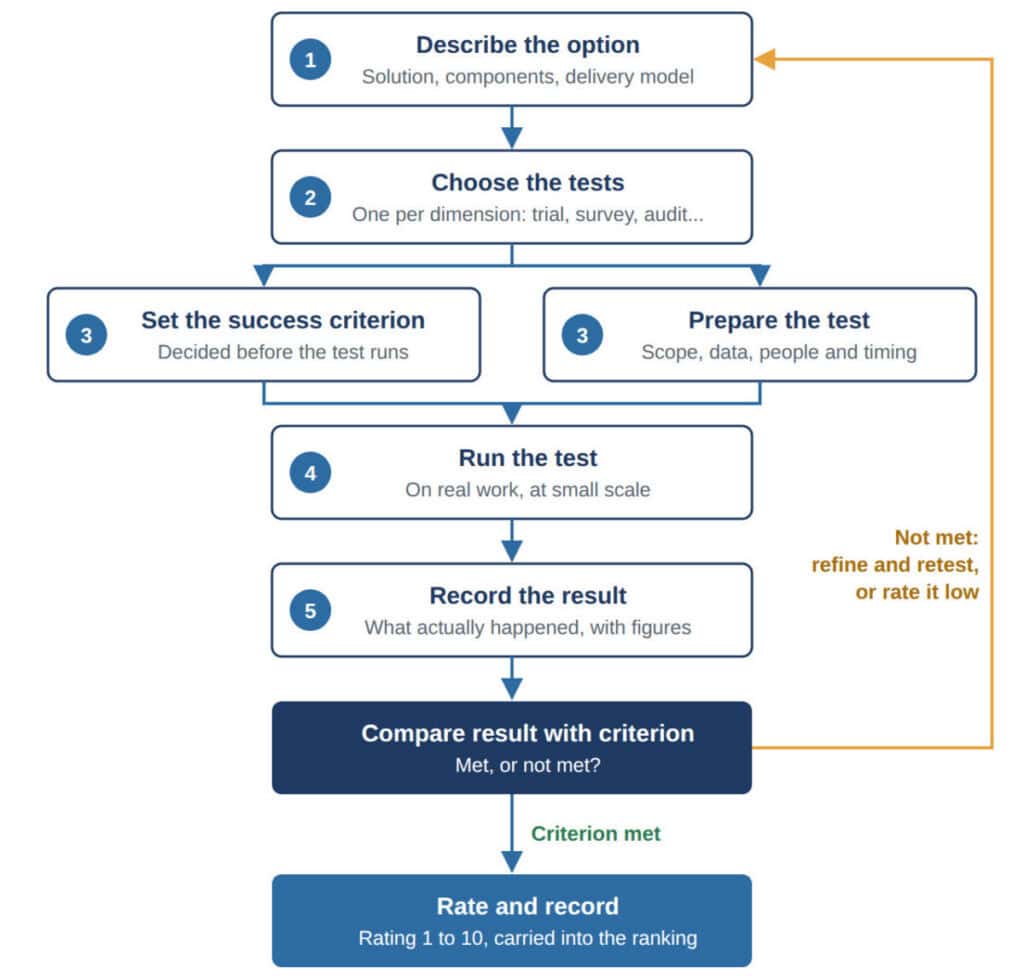
Steps 1 and 2 correspond to the Description and the Test or method column in each option panel. Step 3 fills the Success criterion column; step 5 fills the Result column. Every dimension ends with a rating from 1 to 10, and the ratings flow into the weighted ranking in section 7.
When a result falls short, there are two honest choices. Either the option is refined and tested again (more training, a data clean-up, a different supplier), or the shortfall is recorded as a low rating. A low rating is still useful: it tells the business case exactly where the risk sits, and a rating below the pass mark can rule the option out on its own.
Proposal, feasibility study or business case?
These documents are easy to confuse because they cover similar ground. The difference is the question each one answers.
- The proposal comes first. It establishes that the problem is worth solving and secures agreement to investigate solutions.
- The feasibility study follows. It asks whether each candidate solution can realistically be delivered, and narrows the field to those that can.
- The business case comes next. It takes the feasible options, including doing nothing, and justifies the preferred one financially. Its feasibility ratings, indicative costs, risks and assumptions come straight from the study.
- The project charter comes last, once the business case is approved. It defines scope and authority and formally starts the project.
On small or low-risk projects, feasibility is often covered by a short section inside the business case. Write a separate study when the options are uncertain, new to the organisation, or expensive to get wrong. See our Project Proposal Template and Business Case Template; the worked examples in all three follow the same fictional project, so you can see how they connect.
When to write one
Write the feasibility study after the proposal has been accepted and before the business case asks for money. You need one when:
- The preferred solution uses technology, a process or a supplier the organisation has not used before
- Several options look plausible and nobody can yet say which one will work
- A regulatory date, a seasonal peak or a fixed budget leaves little room for error
- The organisation depends on data or skills whose quality is unknown
- Feasibility is disputed, and the sponsor needs evidence rather than opinion
Agree the question, the criteria and the pass mark before any evidence is gathered. A study whose criteria are chosen after the results are known will not be trusted, however good its conclusion. And treat “none of the options is feasible” as a valid result: finding that out in a six-week study is far cheaper than finding it out halfway through delivery.