
Real estate software projects look simple on a whiteboard: a property search, a client portal, and a few dashboards. In practice, they depend on listing data with strict usage rules, busy agents with little time for training, regulated transactions, and personal financial information that attackers want. A project manager who treats the build like a generic app often discovers these constraints after the budget is committed. The result is late data integrations, rework on compliance details, and a launch that agents quietly ignore. This guide explains how to manage a real estate software development project from the first business case to adoption after go-live.
- Start the project with one measurable business outcome and named user groups, not a long feature list.
- Confirm listing data sources, MLS access, and licensing terms before the development team estimates the work.
- Turn market rules, privacy, and security into acceptance criteria that testers can check in every release.
- Release a focused MVP, train agents and staff by role, and measure adoption against the baseline after go-live.
Most of these projects combine real estate knowledge with engineering capacity that the business does not have in-house. Some organizations build with their own developers, while many work with a partner that delivers a real estate software development solution such as a CRM, a property management platform, MLS and IDX integrations, or AI features for pricing and lead scoring. Either way, the project manager owns the same questions: what problem the software solves, which data it depends on, who approves each release, and how the business will know the project worked.
Below are seven steps that keep a real estate software project on scope, on schedule, and useful to the people who will rely on it every day.
1. Define the Business Outcome and the Users
Real estate software serves very different people: buyers, sellers, tenants, agents, brokers, property managers, investors, maintenance contractors, and the finance team that reconciles rent or commissions. Each group asks for features, and a project that tries to please all of them at once rarely finishes. Before anyone discusses screens or technology, agree on the business result the project must deliver and the users who matter most in the first release.
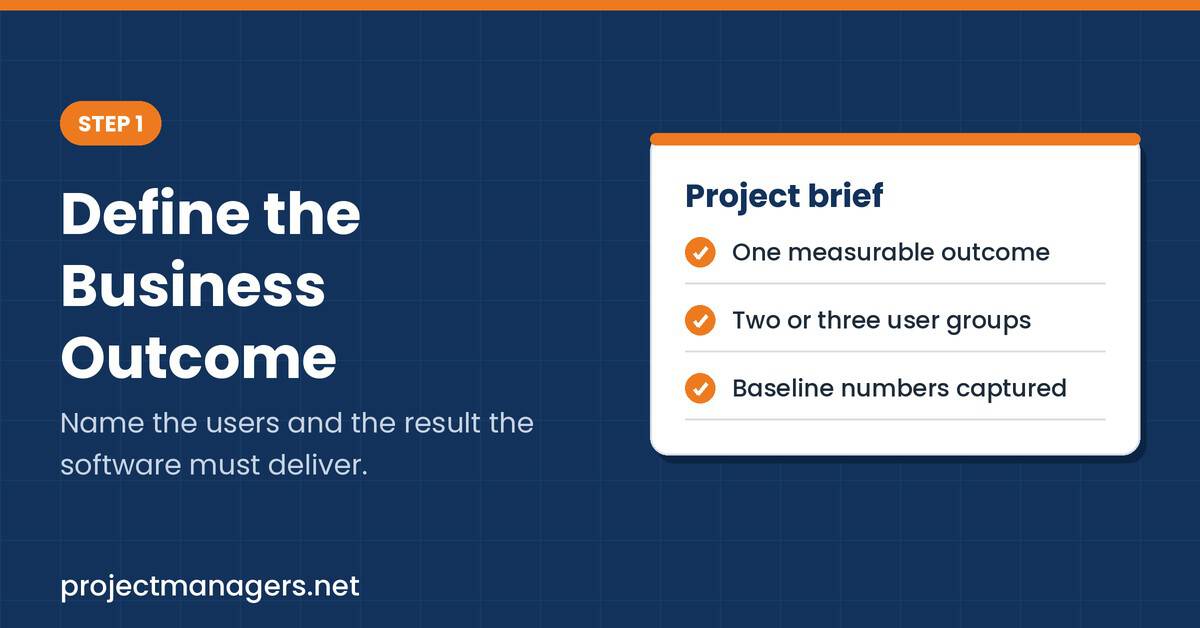
- Business outcome: one sentence with a number, such as reducing lease approval time from five days to two, or increasing qualified leads per agent.
- Primary users: the two or three user groups the first release must serve well, with a short description of how each one works today.
- Success measures: baseline figures captured before development starts, so the project can prove its value later.
- Decision owner: one sponsor who resolves conflicting requests between sales, operations, and finance.
Write these points into the project charter and revisit them at every steering meeting. When a new feature request arrives, the first question becomes simple: does it move the agreed outcome for the agreed users?
Example: A regional property management company asked for a tenant app. Discovery workshops showed that the real cost was maintenance requests arriving by phone, text, and email, with no record of status. The project team narrowed the first release to a maintenance request portal with photo uploads and status updates. Rent payments, community news, and amenity booking moved to the backlog.
2. Map the Data Sources and Integrations Early
Most real estate software is only as good as the data behind it. Listings come from one or more Multiple Listing Services (MLSs), contacts live in a CRM, transactions move through e-signature and document tools, and money flows through accounting or rent payment systems. Each of these is a dependency the project manager should track like a supplier, not a technical detail left to the developers.
The way listing data moves has also changed. The Real Estate Standards Organization (RESO) deprecated the older RETS standard and replaced it with the RESO Web API, and it reports that at least 90% of MLSs in the industry now offer RESO-certified Web API services. The switch is not complete, though: RESO’s tracker shows that converted MLS feeds cover about 62% of U.S. subscribers. New projects should plan around the Web API, and any project that inherits a RETS integration should treat the migration as a scoped piece of work with its own estimate.
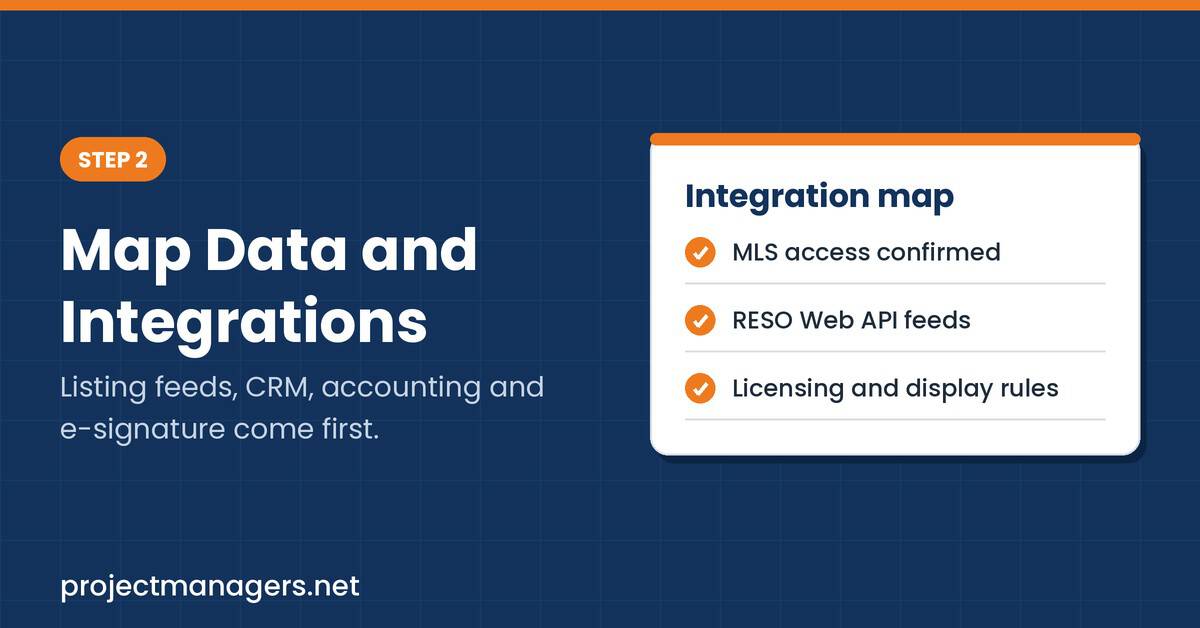
- Data inventory: list every source, its owner, the fields the product needs, and how often the data must refresh.
- Access and licensing: confirm data agreements, credentials, and display rules with each MLS or data provider, and schedule these approvals as milestones because they depend on people outside the team.
- Common field names: agree on a data dictionary, ideally based on the RESO Data Dictionary, so that every market maps to the same structure.
- Failure handling: decide what users see when a feed is late, a listing is duplicated, or a photo fails to load.
Example: A brokerage building a property search site for two markets assumed both MLSs delivered identical data. During discovery, the business analyst found that the second MLS used different fields for association fees and applied stricter display rules for sold listings. The project manager added a mapping task and a separate acceptance test for that market, instead of discovering the gap during user acceptance testing.
3. Turn Market Rules and Compliance Into Requirements
Real estate is a regulated industry, and the rules change. In the United States, the NAR practice changes that took effect on August 17, 2024 prohibited offers of compensation on MLSs and required agents working with a buyer to sign a written agreement before the buyer tours a home. Software that displayed compensation fields or let buyers book tours without that step needed changes, often on short notice.
Similar rules apply in other areas: fair housing requirements for advertising and tenant screening, privacy laws that govern personal and financial data, record retention for transaction files, and accessibility for public websites. The project manager does not need to interpret these rules alone. The job is to make sure someone qualified does, and that their decisions become requirements the team can build and test.
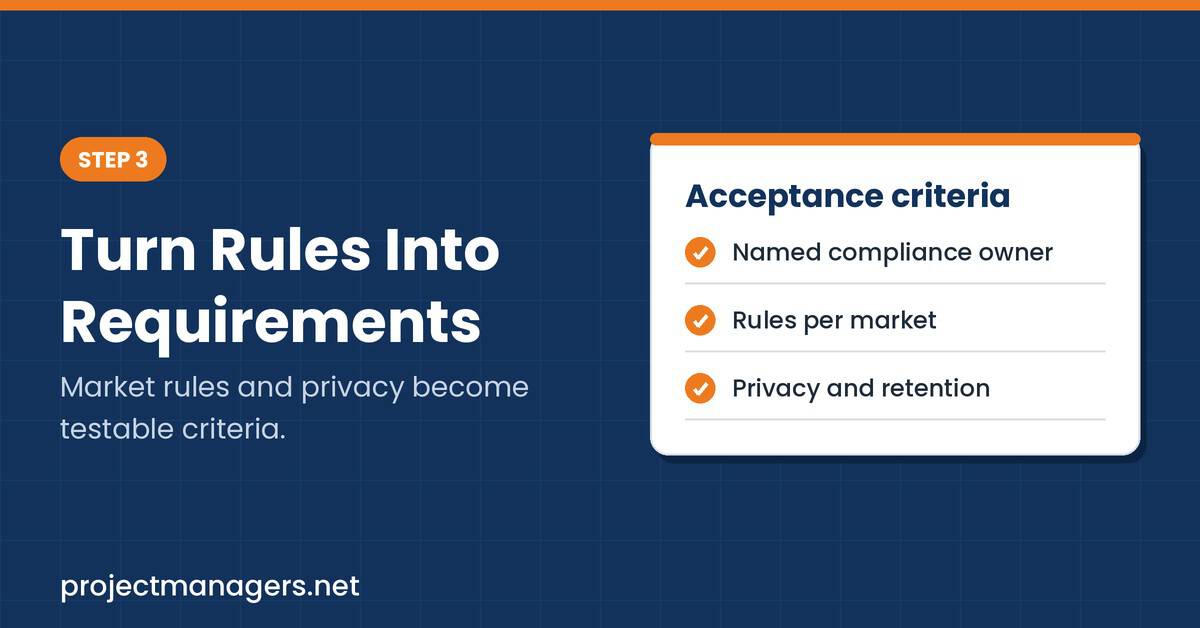
- Compliance owner: a named person from legal, compliance, or the brokerage who reviews requirements and attends key sprint reviews.
- Rules as acceptance criteria: each rule written as a testable statement, such as a tour request cannot be submitted until a signed buyer agreement is on file.
- Market configuration: rules that differ by state, province, or country stored as settings, not hard-coded logic.
- Change watch: a recurring item on the project agenda to review new regulations and MLS policy updates.
Example: A team building a buyer portal added a check that blocks tour scheduling until the buyer agreement is signed in the e-signature tool. Because the rule was stored as a market setting, the brokerage could switch it on for each office as local policies were confirmed, without a new code release.
4. Choose the Delivery Approach and the Development Team
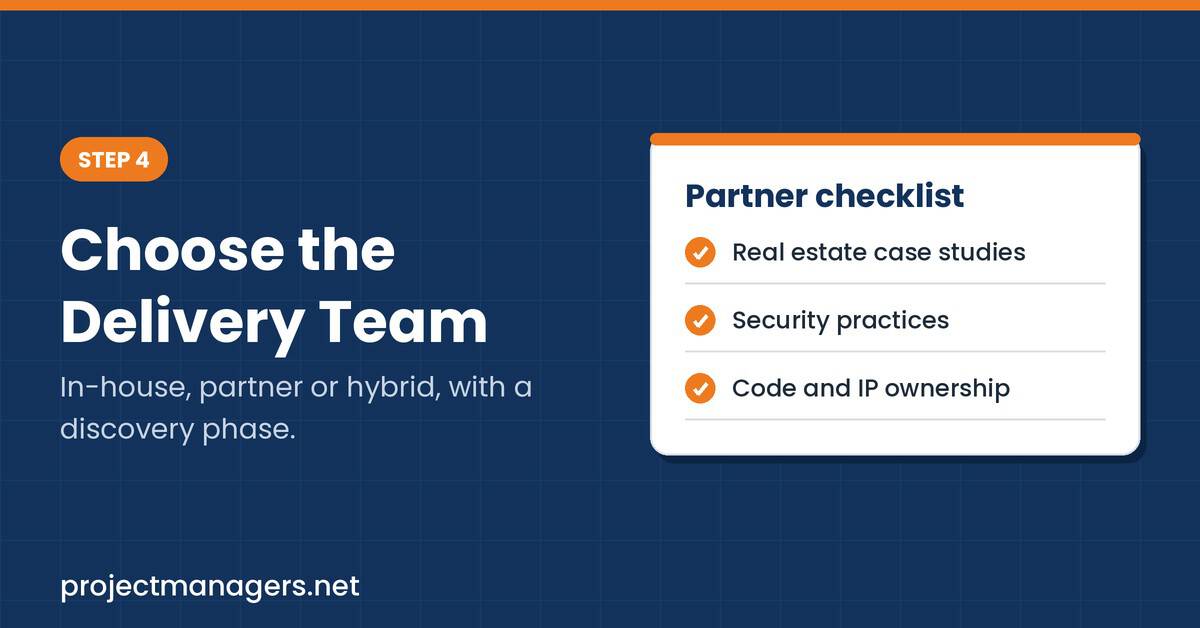
The next decision is who builds the product and how the work is organized. Some organizations hire an internal team, some use a development partner, and many combine both, with a partner building the first release and an internal team taking over later. The right choice depends on budget, timeline, and whether the software is a core long-term asset or a supporting tool.
When evaluating a partner, look past the sales presentation. Ask for case studies with MLS integrations, property management, or transaction workflows, and ask to speak with a past client. Review how the partner handles security, testing, and documentation, and confirm in the contract who owns the source code, the cloud accounts, and the data.
- Discovery phase: a short, paid phase that produces a clickable prototype, a prioritized backlog, an architecture outline, and an estimate before the full build is approved.
- Team composition: a product owner from the business, a project manager, a business analyst, a designer, developers, and quality assurance, with clear roles for each.
- Working cadence: sprint demos every two weeks, a shared backlog, and a weekly status report that covers risks, not only progress.
- Ownership and exit: code repositories, credentials, and documentation held in accounts the business controls.
Example: A commercial real estate investor wanted an investor portal but had no internal developers. Instead of signing a fixed-price contract based on a feature list, the project manager ran a four-week discovery with a development partner. The prototype revealed that investors cared most about distribution statements and document access, which cut the planned scope by a third before any production code was written.
5. Scope a Focused MVP and a Release Roadmap
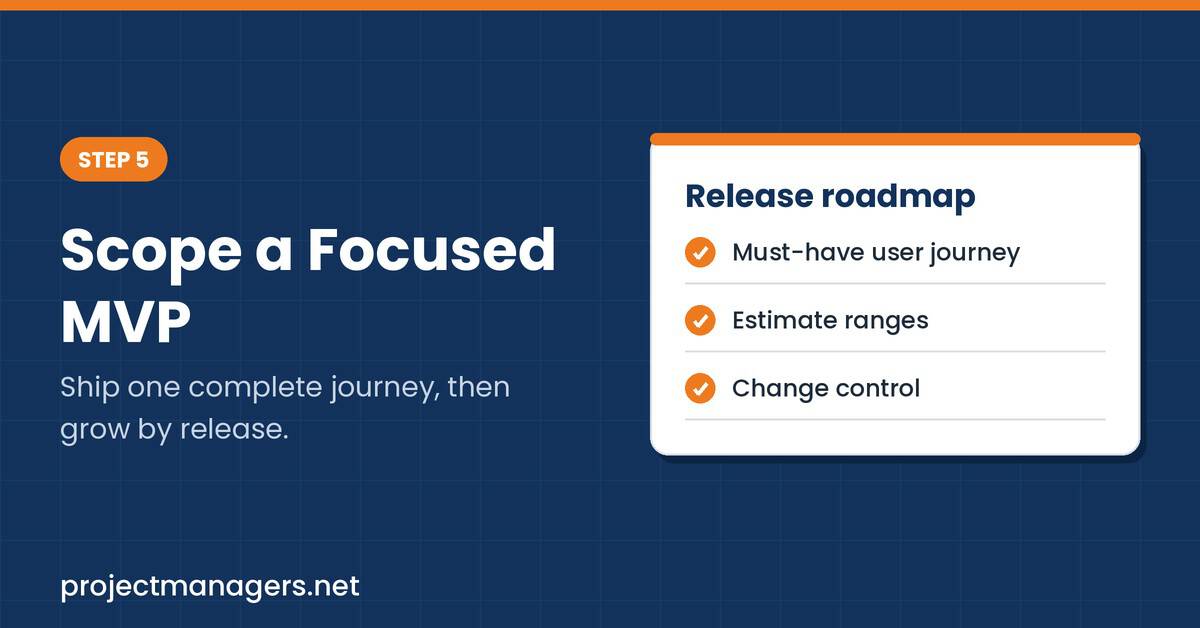
The temptation in real estate technology is to build everything at once: search, CRM, transaction management, analytics, and AI features in a single launch. A minimum viable product (MVP) that completes one important journey from start to finish is easier to test, easier to train, and faster to prove. Later releases can add the features that users actually ask for once they are using the product.
- Must-have journey: the single workflow the first release must complete end to end, such as search, save, and contact an agent.
- Prioritization: a clear method, such as MoSCoW, to separate must-have, should-have, could-have, and won’t-have items.
- Estimate ranges: estimates shown as ranges with assumptions, especially for integrations that depend on third parties.
- Change control: new requests logged, sized, and approved by the decision owner, with the impact on date and budget made visible.
Publish the roadmap as a sequence of releases with goals, not dates for every feature. Stakeholders then see where their request fits, and the team keeps the freedom to adjust as it learns.
Example: A real estate startup planned a launch with listing search, a mortgage calculator, an AI valuation tool, and an agent chat. The project manager and product owner cut the MVP to listing search with saved searches and lead capture into the CRM. The valuation tool moved to the second release, once the team had enough data from real users to train and test it.
6. Protect Data and Test Real Scenarios
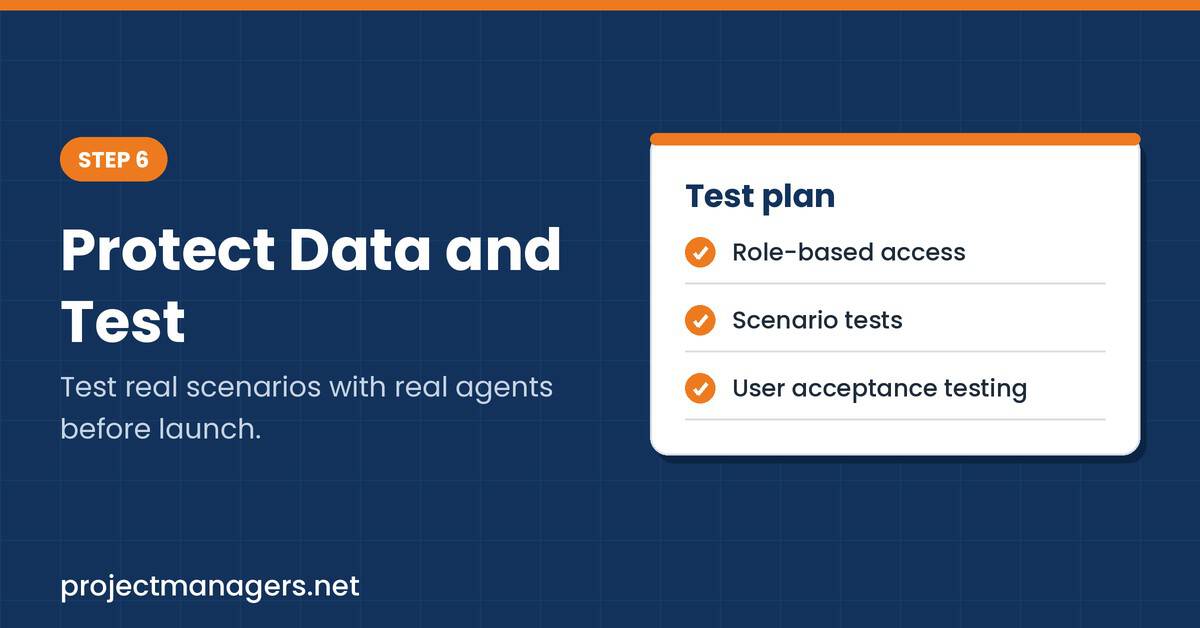
Real estate platforms store identity documents, bank statements from rental applications, signed contracts, and payment details. That makes them attractive targets for fraud and data theft. IBM’s Cost of a Data Breach Report 2026 puts the global average cost of a breach at a record $4.99 million, up 12% in a year, and the United States average at $11.5 million. Security has to be part of the requirements and the test plan, not a review at the end.
Record each security and data risk in a project risk register with an owner and a response, and review it at every sprint planning session. Typical entries include unauthorized access to tenant documents, a compromised agent account, a third-party feed that exposes private remarks, and payment instructions changed by an attacker.
- Security by design: role-based access, encryption of sensitive data, multi-factor authentication for staff and administrators, and audit logs for document access.
- Scenario tests: realistic cases such as a listing that goes pending, a tenant who pays late, an agent who changes brokerages, and a data feed that stops overnight.
- User acceptance testing: sessions with real agents, property managers, or tenants, using production-like data and the devices they use every day.
- Performance checks: load tests for photo-heavy listing pages and peak periods, such as the first day of the month for rent payments.
Example: Before launching a rental application portal, the team ran user acceptance testing with five leasing agents. Agents found that phone photos of identity documents were too large to upload on a slow connection, a problem that never appeared with the test files used by developers. The fix took two days, compared with a flood of support calls had it reached applicants.
7. Launch, Train Users, and Measure Adoption
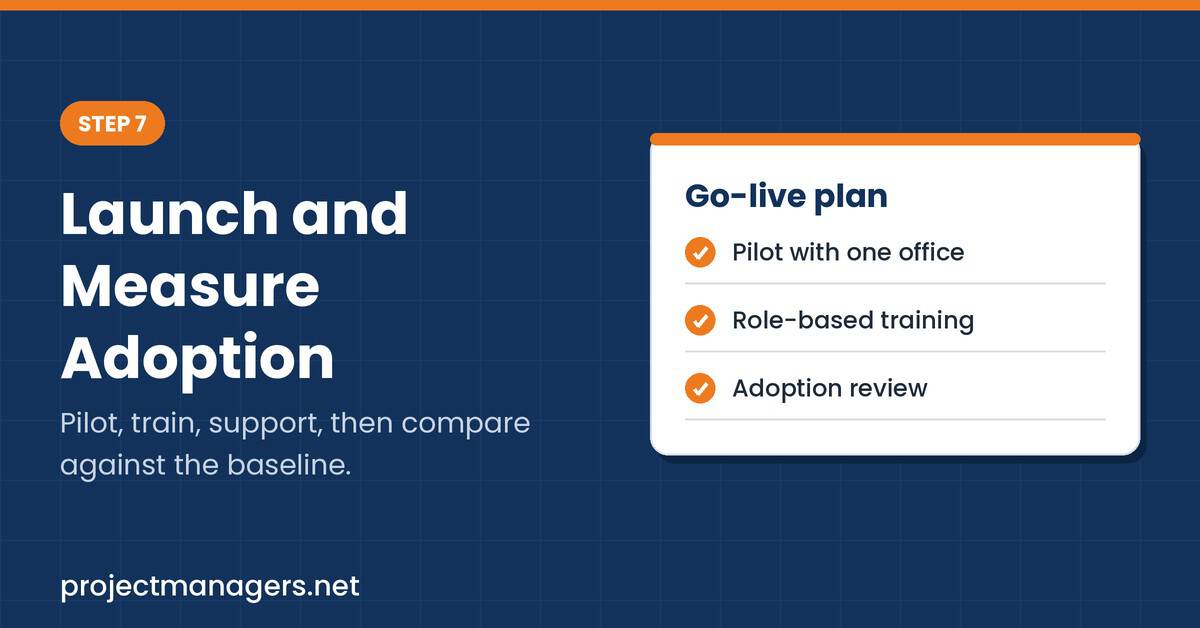
A real estate software project is not finished when the code goes live. Agents and property managers already have ways of working, and new software only succeeds if it saves them time quickly. Plan the launch as carefully as the build, with a pilot, training, support, and a review of the results.
- Pilot rollout: launch with one office, one market, or one property portfolio before the full rollout.
- Role-based training: short sessions and two-minute videos for each role, focused on the tasks people perform every day.
- Hypercare period: two to four weeks of extra support with a clear channel for questions and a fast route for fixes.
- Benefits review: compare results with the baseline from Step 1, then hand the product, roadmap, and support model over to operations.
Example: A brokerage with 120 agents launched its new CRM in one office first, supported by two agent champions. Usage reports showed that agents rarely turned on saved-search alerts for clients, even though the feature drove the most leads in testing. A short video and a default setting change doubled alert use before the second office went live.
Warning Signs Your Real Estate Software Project Is Off Track
Problems in real estate software projects usually show early. Watch for these signals and raise them with the sponsor before they turn into missed dates or budget overruns.
- No one can state the business outcome of the project in one sentence.
- Development has started, but MLS access or data licensing is still not confirmed.
- The compliance owner has not attended a sprint review in more than a month.
- Demos only use clean sample data, never real listings or real customer records.
- Agents or property managers have not seen the product before user acceptance testing.
- Scope grows every sprint while the launch date and budget stay the same.
Common Mistakes to Avoid
- Treating data integration as a technical detail: feeds, licensing, and field mapping drive the schedule and belong in the project plan.
- Copying a competitor’s feature list: a feature that works for a national portal may not fit a local brokerage or a property manager.
- Ignoring mobile use: agents and maintenance staff work in the field, so the main tasks must work well on a phone.
- Leaving no budget after launch: feeds change, regulations change, and security updates never stop, so plan for ongoing support.
- Measuring the launch date instead of adoption: a project that goes live on time but is not used has not delivered its outcome.
Pre-Launch Checklist for Real Estate Software Projects
- Business outcome, baseline figures, and success measures approved by the sponsor
- Data agreements and production credentials confirmed for every MLS and data provider
- Compliance rules written as acceptance criteria and signed off by the compliance owner
- Security review completed, including access roles, encryption, and audit logs
- User acceptance testing passed with real users on real devices
- Training materials and a support channel ready for each role
- Pilot group, rollout plan, and rollback plan agreed
- Owner named for the product, the roadmap, and ongoing support after handover
Video: How to Start a New Software Project
How to Start a New Software Project (Modern Software Engineering, 15:43)
Dave Farley explains how to start a software project in a way that improves its chances of success: small steps, fast feedback, and learning from real users. The same principles apply to a real estate MVP and its release roadmap.
FAQs About Managing Real Estate Software Projects
Managing a real estate software project: FAQ
What makes real estate software projects different from other software projects?
They depend on outside data sources with their own licensing and display rules, such as MLS feeds. They also handle regulated transactions and sensitive personal and financial data, and their main users, agents and property managers, have little time for training. These factors shape the schedule, the requirements, and the launch plan.
How long does a real estate software development project take?
It depends on scope and integrations. A focused MVP that completes one journey often takes a few months, while a platform with several MLS integrations, payments, and AI features can take a year or more. A short discovery phase gives a more reliable estimate than a feature list alone.
Should a new project use RETS or the RESO Web API?
New projects should plan around the RESO Web API. RESO has deprecated RETS, and most MLSs now offer certified Web API services. If the project inherits an existing RETS integration, treat the migration as a separate piece of work with its own estimate and test plan.
Who should own requirements on the business side?
A product owner from the business, such as an operations leader or a senior broker, should own the backlog and priorities. The project manager runs the process, tracks risks and dependencies, and makes sure decisions are made on time.
What should a discovery phase deliver?
A good discovery phase delivers a clickable prototype, a prioritized backlog, an outline of the architecture and integrations, a list of key risks, and an estimate shown as a range. It gives the sponsor enough information to approve, adjust, or stop the project.
How do you get agents to use the new software?
Involve agents early in testing, launch with a pilot group, and train by role with short sessions. Agent champions, a clear support channel, and usage reports during the first weeks help the team spot and fix problems before the full rollout.
Which security measures matter most for real estate software?
Role-based access, encryption of sensitive data, multi-factor authentication for staff and administrators, audit logs for document access, and a security review or penetration test before launch. Payment and wire instructions deserve extra controls because they are a common target for fraud.
Conclusion
A real estate software development project succeeds when it is managed as a business change, not only as a technical build. Define the outcome and the users, treat data and compliance as first-class requirements, choose a delivery team that knows the domain, and ship a focused MVP that real users have tested.
The project manager’s role is to keep those pieces connected from the first workshop to the benefits review. With clear ownership, honest estimates, and a launch plan built around adoption, the software becomes a tool agents, property managers, and clients actually use.
Suggested articles:
- How to Structure a Software Development Process for Early-Stage Products
- The 5 Best Ways the Development Team Extension Improves Project Resource Planning
- The 5 Best Ways to Use Security Posture Control in a Project

Daniel Raymond, a project manager with over 20 years of experience, is the former CEO of a successful software company called Websystems. With a strong background in managing complex projects, he applied his expertise to develop AceProject.com and Bridge24.com, innovative project management tools designed to streamline processes and improve productivity. Throughout his career, Daniel has consistently demonstrated a commitment to excellence and a passion for empowering teams to achieve their goals.