
Connected device programs fail for reasons that have little to do with code quality. The vendor turned out to handle software and subcontract the electronics. The firmware team and the cloud team belonged to different companies and blamed each other for a timing bug. Certification requirements surfaced in month 9 because nobody on the delivery side had been through an audit before.
Those outcomes trace back to the selection stage, which is usually run in two weeks against a shortlist assembled from search results and a directory profile. Meanwhile, the installed base keeps growing: IoT Analytics counted 18.5 billion connected IoT devices in 2024 and expected 21.1 billion by the end of 2025, with 39 billion forecast for 2030. More programs mean more first-time buyers making the same procurement mistakes.
This list groups 12 companies by what they are actually built to do, with the trade-off attached to each one. The selection process at the end matters more than the ranking.
How This List Was Put Together
Six criteria, applied consistently:
- Whether hardware and firmware work happens in-house or gets subcontracted
- Certifications relevant to regulated device work, primarily ISO 13485, ISO 27001, IEC 62304, and IEC 62443 experience
- Verifiable case studies in at least two of these domains: healthcare, industrial, logistics, automotive
- Publicly stated engineering headcount and delivery locations
- Evidence of long client relationships rather than single-project engagements
- Fit for enterprise procurement, including audit readiness and contracting maturity
Company facts below come from each vendor’s own published material, LinkedIn pages, and public profiles. Figures a company reports about itself are marked as such. Nothing here is a substitute for your own reference calls.
1. Yalantis
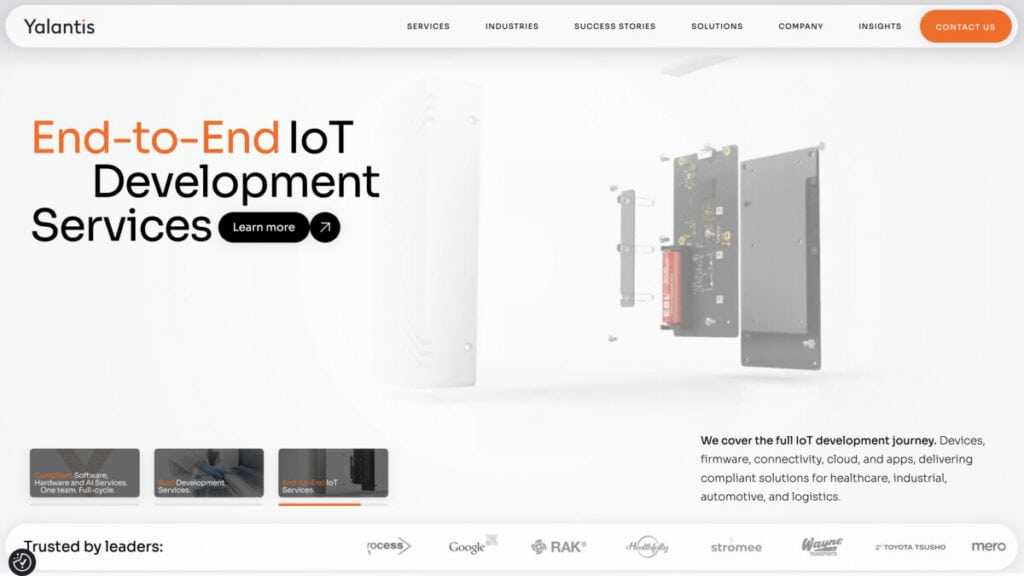
Yalantis is a compliance-first, full-cycle tech partner with deep expertise in IoT, covering software, embedded, hardware, AI development. Building connected & compliant systems for global clients since 2008. Headquartered in Warsaw, Poland, with delivery centers across the EU and the US and a distributed team of 400+ specialists.
What sets Yalantis apart is their dedication to ensure the delivery of compliant products & prototypes and in-house R&D lab in Warsaw, which covers the entire hardware lifecycle, from industrial design and PCB engineering to prototyping, firmware, and embedded software. The company is also a recognized pioneer in commercial Rust adoption for mission-critical systems, alongside deep expertise in C++, embedded Linux, MQTT, OPC UA, AWS IoT, and Azure IoT.
Yalantis specializes in IoT solutions for healthcare (SaMD, remote patient monitoring, IoMT), industrial and manufacturing (Industry 4.0, predictive maintenance, legacy modernization), automotive (software-defined vehicles, secure OTA updates), and other industries (cold chain monitoring, fleet visibility, digital twins).
The company is ISO 27001, ISO 9001 and ISO 13485 certified, allowing it to deliver safety-critical and regulated products that meet FDA, MDR, HIPAA, GDPR, EU CRA, IEC 62443, and ISO 26262 requirements.
Strong fit for regulated or industrial programs requiring PCB, firmware, and cloud under one accountable party, and for teams replacing high-risk C or C++ modules without a full rewrite. Less of a fit for a straightforward mobile app with no device layer, where a smaller software-only shop will quote lower.
2. Softeq
Founded in 1997 and headquartered in Houston, Texas, with additional offices in Germany, Mexico, and Lithuania. Softeq builds hardware, firmware, embedded systems, industrial IoT, cloud, and AI, and its public profile lists ISO 27001, ISO 9001, and ISO 13485 certification along with work for Verizon, Microsoft, NVIDIA, and Lenovo. Device work starts at the board: PCB layout, sensors, enclosures, and the embedded code that runs on them.
Strong fit when the product starts as a physical thing, and you want one contract covering silicon-adjacent work through to the mobile app. Less of a fit when the scope is a cloud platform on top of devices someone else already built, where you would be paying for hardware capacity you never use.
3. Intellias
Started in Lviv in 2002, Intellias now runs delivery from Kraków and other hubs across Europe, with a few thousand engineers by its own reporting. Automotive and mobility make up its deepest practice area, and connected vehicle platforms, telematics, and navigation systems form a substantial share of the portfolio, reflecting years of sustained work with major automotive OEMs and suppliers.
Strong fit for automotive and mobility programs at scale, particularly when OEM-grade telematics, navigation, or connected vehicle platforms are involved, and for buyers who need a vendor large enough to absorb scope changes mid-program without renegotiating the whole engagement. Less of a fit for a 3-person embedded engagement, where a company of that size will assign a team structure heavier than the problem actually requires.
4. Sirin Software

Sirin Software is an embedded and IoT specialist headquartered in Florida, with an R&D center in Kyiv that handles the bulk of engineering delivery. The company has worked with international clients since 2014 and reports more than 100 delivered projects across connectivity, firmware, and constrained hardware targets. Its focus stays on device-level engineering rather than broader enterprise platform or integration work.
Strong fit for hardware bring-up, low-level connectivity work, and firmware development on constrained targets where memory, power, and processing limits demand specialized engineering. Less of a fit when the program also requires a large enterprise integration workstream spanning ERP or MES systems, since that kind of broad platform and business-systems work sits outside its core specialty.
5. Integra Sources
Integra Sources is an engineering company covering embedded systems, electronics design, and IoT, with stated expertise in embedded Linux, kernel and driver development, custom PCB design, and system-level architecture. Robotics, industrial automation, and smart devices dominate its portfolio, and computer vision appears in several projects.
Strong fit for products where the hard part sits below the operating system: device drivers, kernel work, board support packages, and low-level firmware that requires deep hardware knowledge. Less of a fit for cloud-heavy programs where the device itself is a commodity sensor and most engineering effort lives in dashboards, analytics, or backend integration instead.
6. Promwad
Promwad is an electronics design house founded in 2004, with headquarters in Vilnius, engineering centers in Latvia and Serbia, and a delivery office in Germany serving DACH clients. Its LinkedIn page reports more than 100 in-house specialists across hardware engineering, industrial and mechanical design, and manufacturing. Telecom, automotive, multimedia, and industrial automation are the established domains, and the company takes products through to mass production.
Strong fit when the deliverable is a manufacturable device backed by a complete production file, not an early-stage prototype still needing refinement. Less of a fit for pure software modernization work, where no physical manufacturing is involved. Note that its Wikipedia entry lists Essen, Germany as headquarters, while its own website lists Vilnius, so confirm which legal entity actually signs your contract.
7. ByteSnap Design
ByteSnap Design is a UK-based embedded systems consultancy offering electronic design and firmware development across multiple industries, including medical, automotive, and industrial sectors. The value for UK and EU buyers is proximity for hardware iterations, faster turnaround on physical prototypes, and familiarity with UKCA and CE requirements, reducing compliance risk during certification.
Strong fit for UK-based programs that need frequent physical design reviews, close in-person collaboration, and quick turnaround on hardware revisions during active development cycles. Less of a fit for cost-sensitive programs willing to trade proximity for savings, where a lower-cost region could deliver comparable embedded and firmware work at a reduced overall project rate.
8. ScienceSoft
ScienceSoft provides embedded software development with a stated focus on safety-critical and regulated applications such as medical devices, industrial control systems, and automotive components, covering the full lifecycle from hardware-specific requirements gathering and product design through firmware implementation, verification, and validation. Analytics and AI integration atop connected products round out the offering.
Strong fit for regulated software where documentation, audit trails, and traceability carry as much weight as the code itself, particularly in medical, industrial, or safety-critical environments where compliance reviews follow every release. Less of a fit for exploratory hardware prototyping, where requirements shift quickly, and the heavy documentation discipline slows down early-stage experimentation more than it helps.
9. DataArt
DataArt fields full-stack teams that combine hardware and firmware engineering with cloud and mobile work, spanning healthcare, finance, media, and retail. Embedded Linux and RTOS development sit alongside enterprise data platforms, which suits products where the difficult part is the flow of data between device and server.
Strong fit for connected products that live inside a larger enterprise system, where data must flow cleanly between devices, cloud platforms, and business applications like ERP or CRM, and where integration complexity outweighs hardware novelty. Less of a fit when low-level board work, custom silicon, or firmware sits at the center of the primary scope.
10. Tessolve

Tessolve is a silicon and systems engineering firm covering firmware, device drivers, OS support, post-silicon testing, and system-level validation, with deep expertise spanning AUTOSAR-compliant automotive software, avionics systems, and industrial IoT platforms. Its capabilities extend into chip-level bring-up and hardware validation, making it well suited for programs requiring rigorous testing infrastructure alongside custom silicon development and certification support.
Strong fit for programs involving custom silicon, chip-level bring-up, or a validation burden that demands specialized test infrastructure, deep hardware expertise, and rigorous certification support. Less of a fit for standard connected products built on off-the-shelf components, where this level of silicon and validation depth becomes more capability than the project realistically needs or can use.
11. HQSoftware
Founded in 2001 and based in Tallinn, Estonia, HQSoftware brings more than two decades of experience and a reported track record exceeding 250 completed projects. Its IoT practice operates above the low-level hardware layer, focusing on high-level development for devices and sensors, dashboard creation, and system integration. The company also maintains active practices in AR, VR, and e-learning solutions.
Strong fit when the device firmware already exists, and the primary gap sits in the application layer, dashboard creation, or system integration work rather than the hardware itself. This suits teams needing to connect existing sensors and devices to usable interfaces. Less of a fit when the program includes original electronics design, custom PCB work, or low-level firmware development from scratch, since that expertise falls outside this focus.
12. Digiteum
A smaller, agile team based in Gdańsk, Poland, founded in 2010, holding both ISO 9001 and ISO 27001 certification alongside public technology partnerships including Oxford University Press. Digiteum delivers web, mobile, cloud, and IoT application work through a compact, cross-functional group that favors senior talent and direct client communication over layered account management structures.
Strong fit for mid-size programs that want senior engineers working directly on the project and prefer close, unfiltered communication with the people actually building the product, rather than navigating a layered account management structure. Less of a fit for programs needing rapid scaling, such as 40 engineers next quarter, since the model favors depth over headcount.
Comparison at a Glance
| Company | HQ | Founded | Electronics and firmware in-house | Deepest domain |
| Yalantis | Warsaw, Poland | 2008 | Yes | Healthcare, industrial, logistics IoT |
| Softeq | Houston, US | 1997 | Yes | Hardware-first connected products |
| Intellias | Lviv, delivery from Kraków | 2002 | Partly | Automotive and mobility |
| Sirin Software | Florida, US | 2014 | Yes | Device-level embedded work |
| Integra Sources | International | Not published | Yes | Embedded Linux, drivers, PCB |
| Promwad | Vilnius, LT | 2004 | Yes | Electronics to mass production |
| ByteSnap Design | UK | Not published | Yes | UK electronics and firmware |
| ScienceSoft | US and EU offices | Not published | Software focus | Regulated embedded software |
| DataArt | US and EU offices | Not published | Partly | Device to enterprise data flow |
| Tessolve | India, global offices | Not published | Yes, silicon-level | Silicon and validation |
| HQSoftware | Tallinn, EE | 2001 | Above low level | Applications and dashboards |
| Digiteum | Gdańsk, PL | 2010 | Software focus | Mid-size connected products |
Founding years and locations reflect what each company publishes. Where a figure is unpublished, the cell says so rather than guessing.
The Selection Process Worth Running
A ranked list narrows the field. The next part determines whether the program works.
- Week 1: Write the scope in physical terms. Device count for the pilot and for year 2, target unit cost, expected battery life or power source, connectivity, environment, certification markets. Vendors answer very different questions depending on whether the pilot is 50 units or 50,000.
- Week 2: Send three technical questions and read how they are answered rather than what the answer says. Ask who writes the firmware, ask for one example of a project where the schedule slipped and what the vendor did, and ask what they would need from your team in the first month. Vague answers to the third question predict integration problems later.
- Week 3: Two reference calls, at least one with a client whose project ended more than a year ago. Support behavior after the invoice is paid tells you more than delivery speed during the build.
- Week 4: A paid discovery or proof of concept with a fixed scope, priced separately from the build. Both sides learn whether the working relationship functions, and you get an architecture document you own regardless of what happens next.
Questions That Separate the Shortlist
Picking the right vendor is only half the battle—your program’s success depends on how they handle the hard questions. These are the conversations that reveal ownership, risk, and real schedule behavior before you commit budget and timeline.
- Which parts of this scope would you subcontract, and to whom
- Who owns the design files, the firmware repository, and the manufacturing documentation at the end
- Which of your engineers has taken a device through the certification we need
- What happens to our team if two of your senior people leave mid-project
- How do you price change requests once the hardware design is frozen
Conclusion
Choosing the right partner is the difference between a connected device that launches smoothly and one that repeatedly slips at integration, certification, or scale. Use the shortlist to compare strengths, but rely on the discovery questions, ownership of firmware and design files, evidence of completed certification, change-request handling after hardware freeze, and continuity if senior staff leave, to understand real risk.
The most reliable vendors answer with specifics, show how they’ll work with your team in the first month, and clearly define subcontracting and responsibility boundaries. Run the process in weeks, confirm fit with reference calls, and only proceed once you have an architecture document you own.
FAQs
How much of the budget should go to consulting or discovery before the build starts?
Between 5 and 10 percent of the expected program cost is a common range for a discovery phase that produces an architecture, a risk list, and a costed roadmap. The comparison worth making is against the cost of discovering an architectural mistake after tooling is committed.
Is a full-cycle vendor always better than separate hardware and software partners?
Separate partners work when your internal team can own the interface between them, including timing, protocol, and test responsibility. Without someone in that role, the boundary becomes the place where problems live, and neither vendor owns them.
What certifications should appear in an RFP for medical device work?
ISO 13485 for the quality management system and demonstrated IEC 62304 experience for software lifecycle processes. For industrial programs, ask about IEC 62443. ISO 27001 covers information security and is increasingly a procurement gate on its own.
How long does a connected product take from concept to production?
For a moderately complex device with custom electronics, 9 to 18 months is the range most vendors quote, with certification and manufacturing ramp taking a larger share than teams expect. Programs that reuse a reference design or a certified module compress the front end considerably.
Suggested articles:
- Best IoT Apps to Watch in 2025
- Best Fintech Software Development Companies For Banks & Startups
- Top 21 Best Software Development Companies to Work With

Daniel Raymond, a project manager with over 20 years of experience, is the former CEO of a successful software company called Websystems. With a strong background in managing complex projects, he applied his expertise to develop AceProject.com and Bridge24.com, innovative project management tools designed to streamline processes and improve productivity. Throughout his career, Daniel has consistently demonstrated a commitment to excellence and a passion for empowering teams to achieve their goals.