

Geocoding sounds simple until you read the invoices. Two teams transforming the same million addresses can face wildly different bills, because providers price per request, per record, per seat, or per subscription bucket. The headline rate is rarely the real cost, and the generous free tiers that attract new users often disappear the moment your volume starts to grow in earnest.
This comparison walks through the major providers, the pricing models they use, and what each choice actually costs at realistic volumes. It also covers the free-tier catch, the contract language about storing results, and the support and service guarantees that rarely appear in a pricing table. By the end, you should be able to match a provider to your own usage pattern.
Overview of Popular Geocoding API Providers
Four Geocoding API providers dominate most commercial comparisons, and each has a distinct commercial personality. Google and HERE lead on data breadth and brand trust, Mapbox balances developer experience with generous free volume, and OpenCage leans on open data with transparent plans. Understanding where each one is genuinely strongest prevents an expensive mismatch that only becomes obvious once the integration is live in production.
Google Maps Geocoding API
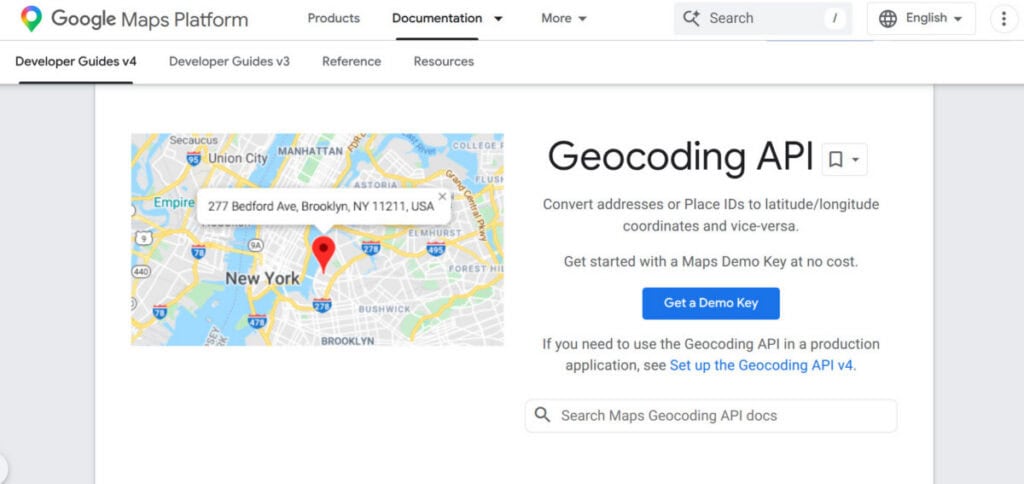
Google offers the broadest address coverage and the strongest normalization, and the familiar Google Maps experience sets accuracy expectations. Pricing is pay-as-you-go under a single geocoding SKU, and the old two hundred dollar monthly credit ended in 2025. Each account now gets a fixed monthly free allowance, after which rates fall steadily as volume grows.
OpenCage Geocoding API
OpenCage builds on a wide set of open data sources and publishes straightforward subscription bands rather than per-request billing. You know the monthly figure before you commit, which removes the bill-shock risk that per-request models carry. Its terms also allow you to store results permanently, a meaningful advantage when you need to cache geocodes across many repeated requests.
Mapbox Geocoding API
Mapbox pairs production-grade data with the most generous free allowance of the major commercial providers, covering the first hundred thousand geocoding requests each month. The Mapbox pricing tiers then step down rather than jumping, so growth is gradual rather than brutal. Its permanent geocoding option for stored results is priced separately and aimed at longer-lived datasets.
Here Geocoding & Search API
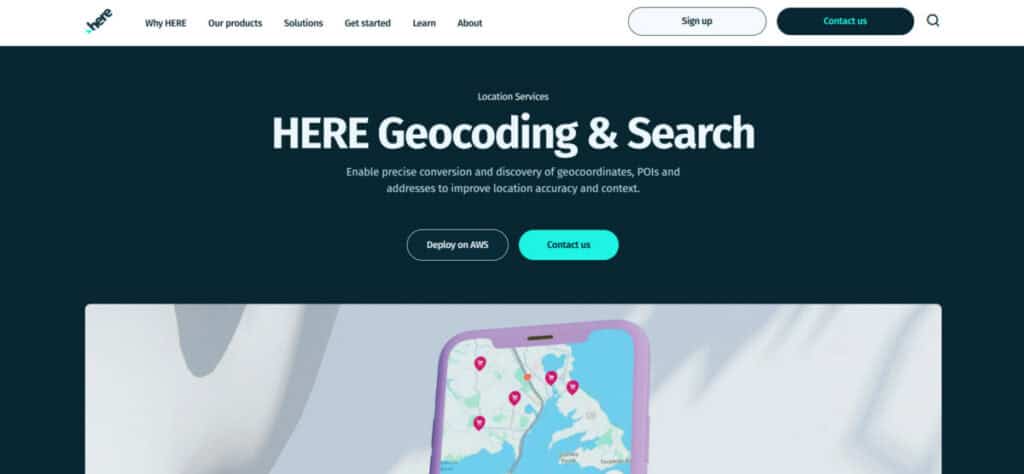
HERE competes on automotive-grade accuracy and enterprise contracts, and it turns up frequently in logistics, fleet, and mobility work. Its tiering is more complex than most rivals, spanning freemium, base, standard, and enterprise levels that each carry different limits and contractual terms. The engineering time spent interpreting those tiers is itself a real cost worth weighing.
Key Differences in Pricing Models and Features
Pricing models matter more than list prices, because the model decides how your bill grows. Per-request billing scales linearly and rewards caching, while a subscription band protects against spikes but wastes capacity in quiet months. When comparing the differences between Mapbox and Google Maps, you’ll note that Google charges about $300 at 100,000 requests while Mapbox stays free.
Pay-As-You-Go vs. Subscription-Based Models
Pay-as-you-go charges for each call, which suits unpredictable or low-volume workloads and makes prototyping cheap. The risk is that a runaway script or duplicate retries turn into an unexpected invoice, because every test and every retry costs real money. Subscription bands invert that trade-off, offering predictable spend and a fixed capacity ceiling that suits steady production traffic.
Feature Sets and Added Value
Price tables rarely capture the features that actually decide real projects, so compare them deliberately. Forward and reverse geocoding, batch endpoints, address normalization, timezone data, and confidence scoring all vary considerably by provider and plan. Contract terms about storing and reusing results are equally important, because licensing can quietly change the effective cost of otherwise identical data.
Evaluating Free Vs. Paid Tiers for Small Projects
Free tiers are the biggest source of confusion in geocoding procurement, because quotas are measured differently by every provider. Some reset daily, others monthly, and the practical limit depends on whether you need batch processing. Reading the quota period prevents burning a whole month of allowance in one afternoon, and Geocodio’s pricing page shows how dramatically those reset periods differ between vendors.
Advantages of Free Tiers
Free tiers become genuinely useful once you understand how their structure works:
- No Procurement Friction: A free allowance lets developers validate an integration, test edge cases, and prove the business case before any budget approval is required.
- Cheap Prototyping: Early experiments, side projects, and internal tools can run entirely within the free quota, which keeps the cost of learning close to zero.
- Vendor Comparison: Running the same sample dataset through two providers on free tiers gives you real accuracy and latency data before you commit to a contract.
Limitations of Free Plans
The limits that catch teams out are rarely about raw volume:
- Different Quota Periods: Some allowances reset daily and others monthly, so a generous-sounding monthly quota can vanish in one afternoon of batch processing.
- Batch Often Excluded: Batch endpoints frequently sit outside the free tier, which matters greatly if your workload is bulk address cleansing rather than live lookups.
- No Guarantees Attached: Free and entry tiers usually carry no service level agreement, so an outage at the wrong moment is unfortunate rather than compensable.
Understanding SLAs and Support Options in Pricing
Service guarantees and support rarely appear in a comparison table, yet they decide whether an outage becomes a serious incident. When geocoding sits inside a checkout flow or a routing engine, downtime becomes lost transactions. The support tier you choose is part of the true cost, not an afterthought, and comparing per-request pricing makes that gap visible before you sign anything.
Importance of SLAs
A service level agreement defines the uptime and response times that a provider formally commits to in the contract. Free and entry tiers often exclude guarantees entirely, meaning a failure is unfortunate rather than compensable. At production scale, an SLA is what turns availability from a hope into a contractual obligation, and it belongs in the total cost comparison.
Evaluating Customer Support
Support quality varies far more than headline pricing suggests. Self-service documentation suits simple, well-understood integrations, while dedicated account management and fast escalation matter for complex or high-volume deployments. Ask how incidents are reported, how quickly first replies arrive, and whether a named engineer or an anonymous ticket queue handles your case at two in the morning.
What Changed in Geocoding Pricing Recently
The pricing landscape shifted meaningfully in 2025, and any older comparison will mislead you. Google retired the credit model that made small projects free, and free allowances are now fixed monthly quotas. Volumes that were comfortably free two years ago now generate a monthly bill, so the arithmetic deserves a fresh look before your next renewal.
Quick Comparison: Cost at 100,000 Requests Per Month
Abstract rates become clearer at a concrete volume, so price a realistic workload rather than a theoretical one. The table below compares monthly cost at one hundred thousand requests, a sensible benchmark for a mid-sized application. It shows why the cheapest headline rate is rarely the cheapest outcome. You can also explore the https://distancematrix.ai/geocoding-api-pricing offered by DistanceMatrix.ai for a more comprehensive breakdown of pricing structures
| Provider | Free Tier | Approx. Cost at 100K/Month |
|---|---|---|
| Google Maps | 10,000 requests/month | About $300 |
| Mapbox | 100,000 requests/month | Free at this volume |
| OpenCage | 2,500 requests/day | Low fixed plan |
| HERE | Roughly 1,000/day | $300 to $600 depending on tier |
| Nominatim (self-hosted) | Software free | Hosting only |
Conclusion
Choosing a geocoding provider is a procurement decision disguised as a technical one. Rates, quota periods, storage terms, and support guarantees all feed into the real cost, and the cheapest headline number often loses once volume and reliability are priced in. Comparing on total cost rather than sticker price is what prevents an expensive surprise later.
Start by modelling your actual monthly volume, then check the free allowance period and the cost of the next tier up. Confirm whether you can store results, because caching changes everything at scale. Match the pricing model to your traffic shape, and you will choose a provider that still looks affordable when the usage graph turns upward.
Frequently Asked Questions About Geocoding API Pricing
Is the Google Geocoding API still free?
Only within a fixed monthly allowance now. Google retired its two hundred dollar monthly credit in early 2025, and the Geocoding API includes around ten thousand free requests each month. Beyond that, the rate begins near five dollars per thousand requests and falls with volume, so heavy users should model the full monthly cost before committing to the platform.
Which geocoding API is cheapest at scale?
Self-hosted Nominatim has no licence fee but requires substantial hardware, and commercial alternatives vary by volume band. Mapbox includes a large monthly free allowance, OpenCage uses predictable subscription bands, and specialized providers undercut all of them for batch work. The genuinely cheapest option depends on your volume pattern, required coverage, and whether you can cache results between calls.
Can I store geocoded results long term?
It depends entirely on the provider’s terms, and this clause often changes the true cost more than the per-request rate. Some providers restrict persistent storage or charge a premium for it, while open-data providers generally permit it. Always check the licence carefully before caching a large dataset, because re-geocoding everything from scratch later is expensive.
Do I need an SLA for a geocoding integration?
If geocoding sits inside a customer-facing flow such as checkout or delivery routing, yes. Free and entry tiers usually exclude uptime commitments, so an outage is not compensable. A service level agreement converts availability from a vague expectation into a firm contractual obligation, and it should therefore be part of the comparison from the very start.
How much does self-hosted geocoding really cost?
The software is free, but a full planet import needs substantial memory and storage, and that specification is what actually drives the bill. Cloud hosting for that specification typically runs into the hundreds of dollars every month, before any maintenance time is counted at all. Self-hosting wins on control, data sovereignty, and privacy rather than on raw cost.
Suggested articles:
- The Most Powerful Mapping Software for Teams
- Understanding Geofencing: The Future of Targeted Advertising
- Top 10 Pros & Cons of Using GIS Mapping Software

Daniel Raymond, a project manager with over 20 years of experience, is the former CEO of a successful software company called Websystems. With a strong background in managing complex projects, he applied his expertise to develop AceProject.com and Bridge24.com, innovative project management tools designed to streamline processes and improve productivity. Throughout his career, Daniel has consistently demonstrated a commitment to excellence and a passion for empowering teams to achieve their goals.