
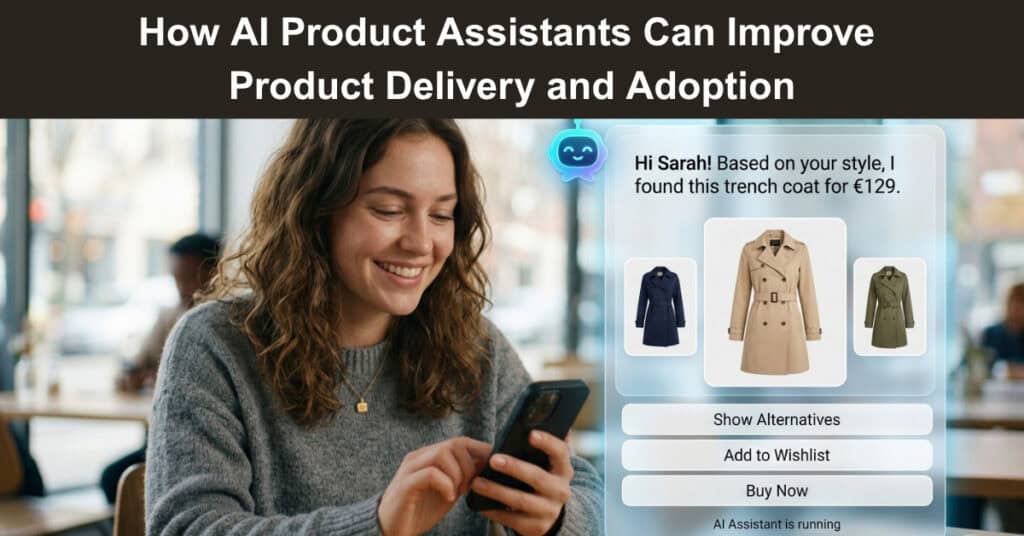
Project delivery doesn’t end when a product goes live. For many digital projects, launch is when a new set of challenges begins. Customers need to learn how the product works. Sales and customer success teams need to explain it clearly. Internal teams need to understand how different users will interact with the product. If that information is unclear, a project can be completed successfully but still struggle to achieve its business goals.
AI product assistants can help solve this challenge. They can answer product questions, guide users through workflows, and provide support based on what someone is trying to accomplish. For project teams, this creates a smoother transition between building a product and helping people use it.
The Communication Problem After Launch
Many projects experience a communication gap after release. Developers understand the product because they built it. Product managers understand the goals and expected use cases. Sales teams often focus on the value for customers. Users, however, usually have a simpler question: how does this product help me complete my work?
Traditional resources such as documentation, videos, and training sessions are still important, but they are not always enough. Users often need answers at a specific moment while they are trying to complete a task. An AI product assistant gives users another way to get support.
Instead of searching through multiple documents or watching an entire demo, they can ask a question and receive guidance related to their situation. For project managers, this can reduce repeated explanations between product teams, customer-facing teams, and end users.
Making Product Demos More Useful
Most product demos are created for a general audience. However, different users usually care about different parts of a product. A finance manager may want to understand reporting features. A team leader may want to see workflow automation. A new customer may simply want to know how to complete the setup process.
A single presentation cannot always address every need. AI can make product exploration more flexible by allowing users to focus on the areas that matter most to them. Instead of following a fixed demo path, users can ask questions and explore specific workflows. Platforms built around interactive AI-powered product demonstrations can help prospects and customers explore products while receiving guidance based on their questions and goals.
This approach makes product demonstrations more practical because users can focus on the information that is most relevant to them. For project teams, this can also reduce unnecessary follow-up meetings and help customer-facing teams communicate product value more consistently.
Reducing Friction During Project Handoffs
Handoffs are one of the areas where project information can become fragmented. A development team may complete a feature and pass it to implementation. The implementation team may then train customer success teams, who later explain it to users. During each step, important details can be lost or communicated differently.
An AI product assistant can provide a shared layer of product knowledge when it is connected to accurate and approved information. After a software feature is released, an assistant could explain what the feature does, who should use it, how to complete a workflow, and what actions should happen next.
This does not replace documentation or human support. Both remain essential parts of a strong product experience. Instead, it gives teams another way to make product knowledge available when people need it most, offering timely, contextual guidance that complements existing resources rather than substituting for the human expertise behind them.
Helping Users After Launch
Many teams view the product launch day as the end of a project. Customers often see it as the beginning of their experience with the product. A product only creates value when people can use it effectively. If onboarding is confusing, users may avoid important features or continue using older processes. AI-guided support can help users find answers while they are actively using the product.
Instead of waiting for a training session or submitting a support request, they can get assistance immediately. This also gives project managers additional ways to measure success. Schedule, budget, scope, and quality remain important. Teams can also look at onboarding completion, feature adoption, common questions, and areas where users experience difficulty.
These insights can reveal whether the delivered product is truly achieving its intended outcome. By tracking onboarding completion, feature adoption rates, and recurring user questions, project managers gain a clearer picture of real-world usage. This data helps teams validate success beyond launch, ensuring the product delivers lasting value to its users.
Using User Questions as Feedback
The questions users ask can reveal opportunities for improvement. If many users struggle with the same workflow, the process may need to be simplified. If customers repeatedly ask about a feature that already exists, the documentation or onboarding process may need improvement. AI assistants can help collect these patterns by showing what users need help with most often.
For project managers, this creates a more continuous feedback loop. Instead of relying only on surveys or scheduled reviews, teams can learn from real interactions with the product. This information can support future improvements, better training materials, and stronger product decisions.
Keeping Human Judgment Involved
AI assistants should support project teams, not replace them. Project managers still need to manage priorities, communicate with stakeholders, handle risks, and make decisions when problems require human judgment. Teams should also ensure that the information provided by an AI assistant is accurate and updated.
Clear guidelines are needed to determine which questions can be answered automatically and when a user should be connected with a person. Human oversight remains important, especially for products involving sensitive information or complex business decisions.
A Practical Role for AI in Project Success
The most useful AI solutions are often the ones that improve specific parts of a workflow. For project teams, AI product assistants can reduce repetitive explanations, improve product handoffs, support onboarding, and help identify where users need more assistance. A successful project is not only about delivering a completed product.
It is also about ensuring that people understand the product and can use it effectively. As more companies build digital products and software platforms, adoption will become an increasingly important part of project success. AI product assistants provide a practical way for teams to continue supporting users beyond the launch date and create better experiences after delivery.
Suggested articles:
- How AI-Powered Virtual Assistants Are Changing the Customer Support Landscape
- The 3 Best AI Virtual Assistants for HR to Optimize Workforce Decisions
- What AI Can Do for Your Company

Daniel Raymond, a project manager with over 20 years of experience, is the former CEO of a successful software company called Websystems. With a strong background in managing complex projects, he applied his expertise to develop AceProject.com and Bridge24.com, innovative project management tools designed to streamline processes and improve productivity. Throughout his career, Daniel has consistently demonstrated a commitment to excellence and a passion for empowering teams to achieve their goals.