
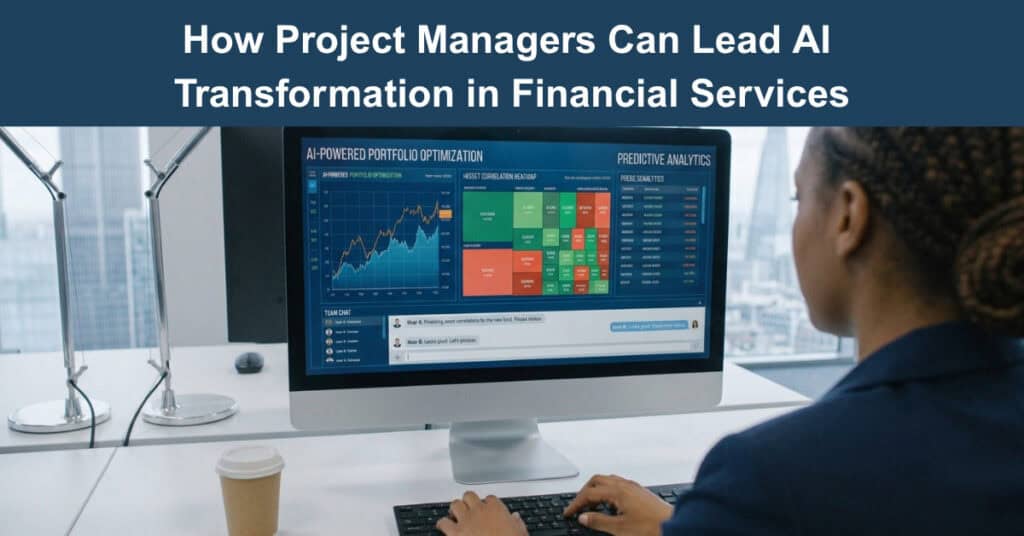
Artificial intelligence is moving from isolated experiments to a practical, everyday part of financial services. Institutions are increasingly relying on it to strengthen customer support, streamline repetitive processes, and improve the accuracy and speed of routine operations. This shift is creating new opportunities for banks and financial firms to enhance service quality while reducing operational costs, provided the technology is implemented thoughtfully and responsibly.
Project managers researching intelligent agents for financial institutions can use the NiCE resource to understand how agentic AI is being applied to financial services customer experience, including autonomous customer journeys, implementation strategies, governance considerations, and use cases such as fraud disputes and account servicing. Turning these capabilities into reliable business solutions, however, requires project managers who can connect technology, people, processes, and regulatory responsibilities from the beginning.
Start With a Clear Business Problem
AI projects can quickly become technology-led initiatives when teams become more interested in what a new system can do than in the problem it is supposed to solve. Project managers can prevent this by defining a specific business challenge and identifying the outcome that would make the project worthwhile. In financial services, this could involve reducing customer waiting times, improving fraud response, simplifying account servicing, or removing repetitive administrative work.
Clear objectives also make it easier to decide how success will be measured once the technology is introduced. A project intended to improve customer support might track resolution times, customer satisfaction, escalation rates, or the percentage of suitable requests completed without manual intervention. Establishing these measures early gives stakeholders a shared definition of success and prevents the project from drifting toward vague goals.
Bring the Right Stakeholders Together
Financial services AI projects rarely belong to a single department because the technology can affect customer experience, operations, compliance, security, legal processes, and IT infrastructure at the same time. Project managers should identify these stakeholders early and give them meaningful opportunities to influence requirements and decisions. Bringing different perspectives into planning can reveal risks and dependencies that a technical team might otherwise discover much later.
Cross-functional collaboration is particularly important when an AI system is expected to interact with customers or access sensitive financial information. Compliance teams may need to establish regulatory requirements, while security specialists can define appropriate access controls and data protections. Customer service employees can contribute another valuable perspective by explaining how existing processes actually work and where customers regularly experience problems.
Build Governance Into the Project
Governance should be treated as part of the project design rather than a final approval exercise before launch. AI systems can introduce questions about accountability, privacy, decision-making, transparency, and the appropriate limits of automation. Project managers can help teams address these questions by making governance requirements visible within the project scope, milestones, testing plans, and acceptance criteria.
The level of control required may also depend on what the AI system is allowed to do. An agent that retrieves general information creates different risks from one that can access account records, change customer details, or initiate actions across connected systems. Defining permissions, escalation paths, audit requirements, and human approval points early can reduce uncertainty as development progresses.
Use Controlled Pilots Before Wider Deployment
Launching an AI system across an entire financial institution at once can create unnecessary operational and reputational risk. A controlled AI pilot allows the project team to evaluate performance within a narrower environment and identify unexpected problems before they affect a larger customer population. Project managers can select a suitable use case where outcomes are measurable, and the boundaries of the process are clearly understood.
Pilot results should be evaluated against the objectives established during planning rather than judged only by whether the technology functions correctly. Teams can examine accuracy, customer outcomes, employee feedback, escalation patterns, processing times, and any compliance issues that appear during real-world use. These findings provide evidence for deciding whether the system should be expanded, modified, or subjected to additional testing.
Prepare Employees for Changing Workflows
AI transformation changes more than technology because it can alter how employees perform everyday tasks and make decisions. Staff may move away from repetitive activities while becoming more involved in exceptions, complex customer situations, and oversight of automated processes. Project managers should therefore include communication, training, and workflow redesign within the implementation plan rather than assuming employees will simply adapt after launch.
Employees also need to understand where responsibility sits when they work alongside AI systems. Clear guidance should explain when staff should trust automated outputs, when additional verification is necessary, and when a case should be escalated. Involving employees during testing can make these procedures more practical because the people performing the work can identify situations that were overlooked during initial planning.
Manage Integration and Data Dependencies
An AI solution is unlikely to deliver much value if it operates separately from the systems employees and customers already use. Financial institutions may have customer records, transaction platforms, knowledge systems, fraud tools, and service applications that have developed over many years. Project managers need to identify these dependencies early because integration difficulties can significantly affect timelines, costs, security requirements, and project scope.
Data quality deserves similar attention because AI performance depends heavily on the information available to the system. Incomplete records, inconsistent terminology, outdated information, or poorly maintained knowledge resources can produce unreliable results even when the underlying technology performs as intended. Including AI data readiness assessment and preparation in the project plan can prevent teams from discovering these weaknesses shortly before deployment.
Measure Results and Improve Continuously
An AI project does not end when the system goes live because real customer interactions can reveal issues that testing environments never exposed. Project managers should establish ongoing monitoring so teams can compare actual performance with the original objectives and quickly identify areas that require adjustment. This is especially important when automated systems are responsible for increasingly complex customer journeys.
Feedback from customers, employees, compliance teams, and operational data can guide future improvements. Some processes may become suitable for greater automation, while others may require tighter controls or additional human involvement after real-world experience. Treating deployment as the beginning of an improvement cycle helps financial institutions develop AI capabilities carefully instead of assuming the first implementation represents the finished solution.
Conclusion
Leading AI transformation in financial services requires project managers to balance innovation with the practical realities of regulation, security, customer expectations, existing technology, and organizational change. Successful projects begin with clear business problems, involve the right stakeholders, establish governance early, test solutions carefully, and prepare employees for new ways of working.
By managing AI as an ongoing business transformation rather than a standalone technology installation, project managers can help financial institutions introduce useful capabilities while maintaining the control and accountability their customers expect.
Suggested articles:
- AI Agents in Finance Compliance & Risk Management: A Complete Guide
- AI TRiSM: 5 Finance Examples in Trust and Risk Management
- How Global Project Managers Can Avoid Financial Compliance Pitfalls

Daniel Raymond, a project manager with over 20 years of experience, is the former CEO of a successful software company called Websystems. With a strong background in managing complex projects, he applied his expertise to develop AceProject.com and Bridge24.com, innovative project management tools designed to streamline processes and improve productivity. Throughout his career, Daniel has consistently demonstrated a commitment to excellence and a passion for empowering teams to achieve their goals.