
Every project manager has given the same explanation more than once. How the stage-gate process works. Where the RAID log lives and how to update it. What “done” actually means for this team. You explain it at kickoff, again when a contractor rolls on in month three, again when a delivery lead takes over a workstream, and one more time when the program spins up a sister project that “just wants to copy what you did.” The knowledge is sound. The problem is that it lives in your head and in a deck nobody reopens — and re-delivering it by hand is quietly eating hours you don’t have.
That repetition is one of the least-discussed costs in project delivery, and it is exactly the kind of problem an AI lecture video maker is built to solve — letting you explain something once, properly, then reuse it for every new joiner without booking another meeting.
Why Process Knowledge Doesn’t Stick to a Project
Projects are, by design, temporary and staffed with rotating personnel. Contractors roll on and off. A workstream lead changes mid-flight. A program closes, and the team scatters to new initiatives, taking the unwritten context with them. Unlike a permanent operations team that absorbs “how we do things here” over years, a project team has to absorb it in days — usually while already behind schedule.
So every new joiner reconstructs the methodology from fragments: a template here, a half-remembered kickoff there, a Slack thread they were never on. They fill the gaps with whatever they did on their last project, and standardization erodes — not through rebellion, but through onboarding by osmosis. The cost shows up as rework, inconsistent status reporting, a skipped change-control step, and the PM fielding the same questions across three time zones. On a fixed-deadline project, that quiet drift is schedule risk.
Why the Handbook and the Recording Both Fail
The two default fixes each fail in a predictable way. The written project handbook is comprehensive and unwatched — people skim a forty-page PDF, miss the detail about when a change request needs CCB sign-off, and improvise. The recorded kickoff call is watchable in theory but unstructured in practice: one ninety-minute file, no chapters, the first twelve minutes spent on “can everyone see my screen,” and impossible to update without re-recording the whole thing.
Commissioning a proper onboarding video would fix the format, but it reintroduces a cost problem: professional production runs into the thousands and takes weeks, so it gets reserved for the annual all-hands and never touches the operational training that drives consistency. The methodology stays trapped between a document that gets filed and a recording that gets abandoned.
What an AI Lecture Video Maker Actually Does
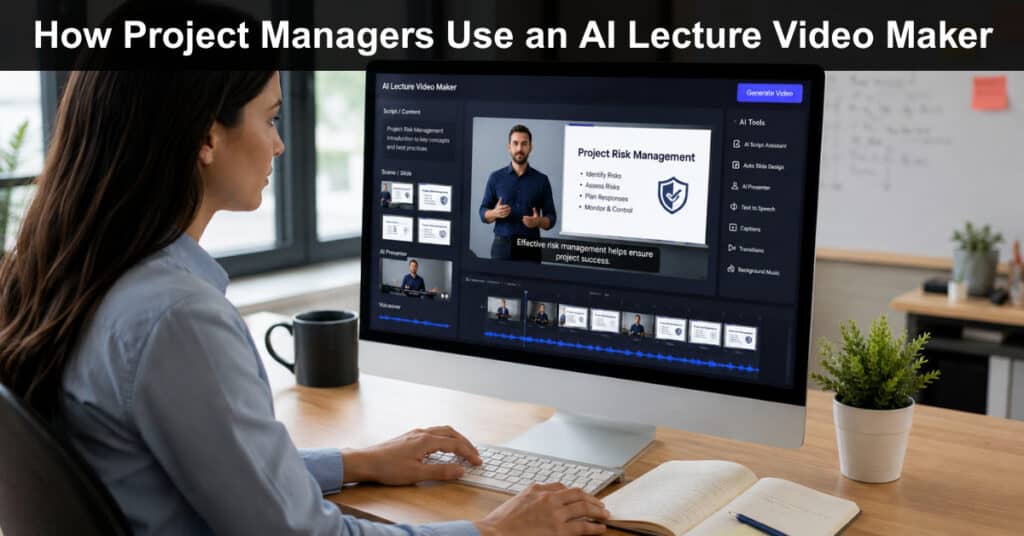
This is where the economics change. An AI lecture video maker like Leadde.ai converts the material a project manager already owns — a methodology PowerPoint, a process PDF, a Word runbook, or a pasted script — into a structured, narrated lecture video, with no production crew and no editing timeline. You upload the source (it accepts .pptx, .pdf, .doc, .docx, and .txt files up to 500MB), and the AI drafts an outline, builds the scenes and on-screen layout, and generates the voiceover. The deck your process lead already built becomes a paced explainer that a new joiner will actually watch to the end.
A few capabilities map directly to the realities of running a project:
- It Can Be Tuned to the Audience: You set the narrative style, explanatory and structured for a hands-on PM walkthrough, more formal for a governance overview aimed at sponsors, choose a level of detail from summary to comprehensive, and specify the audience and training objective so the generated script teaches rather than just summarizes.
- It Builds a Reusable Knowledge Base: You can batch-upload your source files and accumulate a searchable library over time, so onboarding becomes a curated path rather than a hunt across shared drives.
- It Reports Completion Analytics: Because watch-through is tracked per video, you can see which modules people actually finished — the difference between training that was assigned and training that was understood. At a gate review or an audit, that distinction is evidence that the process was genuinely rolled out, not just emailed around.
- It Handles Distributed Teams: With support for 88 languages and 175 dialects, a single methodology lecture can be reissued for a multinational team by translating a finished video into a new draft script and on-screen text together, instead of running localization as a separate project.
Five Ways Project Managers Put It to Work
For a working project manager, the practical uses surface quickly:
- Onboarding Mid-Project Joiners: Turn your project kickoff presentation or methodology deck into a ten-minute lecture every new team member watches on day one, so you stop re-running the same walkthrough each time someone arrives.
- Standardizing the Process Across the Team: Convert the intake, change-control, or gate-review procedure into a short module, so everyone applies the same steps the same way, regardless of who trained them.
- Tool and Template Training: Record how to use the RAID log, the status report, or the reporting dashboard once, and embed the lecture inside the template itself, where people meet it at the moment they need it.
- Stakeholder and Sponsor Briefings: Produce a clear, formal overview of governance or reporting cadence that sponsors can watch asynchronously, instead of sitting through another standing meeting.
- Knowledge Transfer at Handoff or Closure: Capture the reasoning behind key decisions before the team disperses, so the next phase, or the next project, does not relearn it from scratch.
How to Build Your First One
Building your first AI lecture video is straightforward when you approach it methodically. Follow these key steps to get from raw material to a finished, deployable training video efficiently.
- Start with the Right Topic: Choose a single, well-defined subject, ideally, the explanation you deliver most frequently, such as the intake process or gate review procedure. Work from the presentation deck you already have rather than creating something new from scratch.
- Prepare Your Source Material: Invest time refining the content before uploading. A clear, well-structured input is the single highest-leverage step in the process, since the quality of the output will only ever reflect the quality of what goes in.
- Upload and Configure: Upload your file, set the target audience to “new project manager,” select an explanatory narrative style, and generate the outline. The tool accepts .pptx, .pdf, .doc, .docx, and .txt files.
- Review and Refine: Review the generated outline critically, as you would a draft from a junior team member. Regenerate, expand, or condense sections until the structure is sound and the flow makes sense for your audience.
- Generate and Deploy: Select a presenter, generate the video, and deploy it where new joiners will encounter it naturally — the project workspace, the onboarding checklist, or directly alongside the template it supports. The initial build requires an afternoon at most, a fraction of the timeline a professionally commissioned video would demand.
Where It Falls Short
Honesty serves a project manager better than enthusiasm here. AI avatars, even high-quality ones, still register as synthetic under close scrutiny; for a sensitive reorganization message or a project sponsor’s strategic address, a real presenter on camera justifies the additional cost. The format excels at declarative, conceptual content, explaining how a gate review functions, or why an intake process exists, but is poorly suited to material that carries significant emotional weight.
Output quality is also constrained by input quality: an underdeveloped, heavily bulleted deck will yield an equally underdeveloped video. Similarly, methodology captured in dense swimlane diagrams or sprawling RACI matrices does not translate well to a narrated format; that material is better retained as a structured reference document and linked alongside the lecture rather than converted into it.
A Small First Test
Don’t migrate the whole playbook on day one. Take your most-asked topic, run it through a free tier, and put the result where new project managers will see it from the start. Watch the completion rates and the inbound questions over a couple of weeks. If it works for the topic you explain most, it will work for the long tail — and that is where a durable, transferable project methodology actually gets built, no matter how often the team rotates beneath you.
Suggested articles:
- The Impact of Video Production on Project Management
- Top 5 Ways an AI Video Extender Can Improve a Creative Project
- Top 5 Advantages of Using AI Video Generators

Daniel Raymond, a project manager with over 20 years of experience, is the former CEO of a successful software company called Websystems. With a strong background in managing complex projects, he applied his expertise to develop AceProject.com and Bridge24.com, innovative project management tools designed to streamline processes and improve productivity. Throughout his career, Daniel has consistently demonstrated a commitment to excellence and a passion for empowering teams to achieve their goals.