
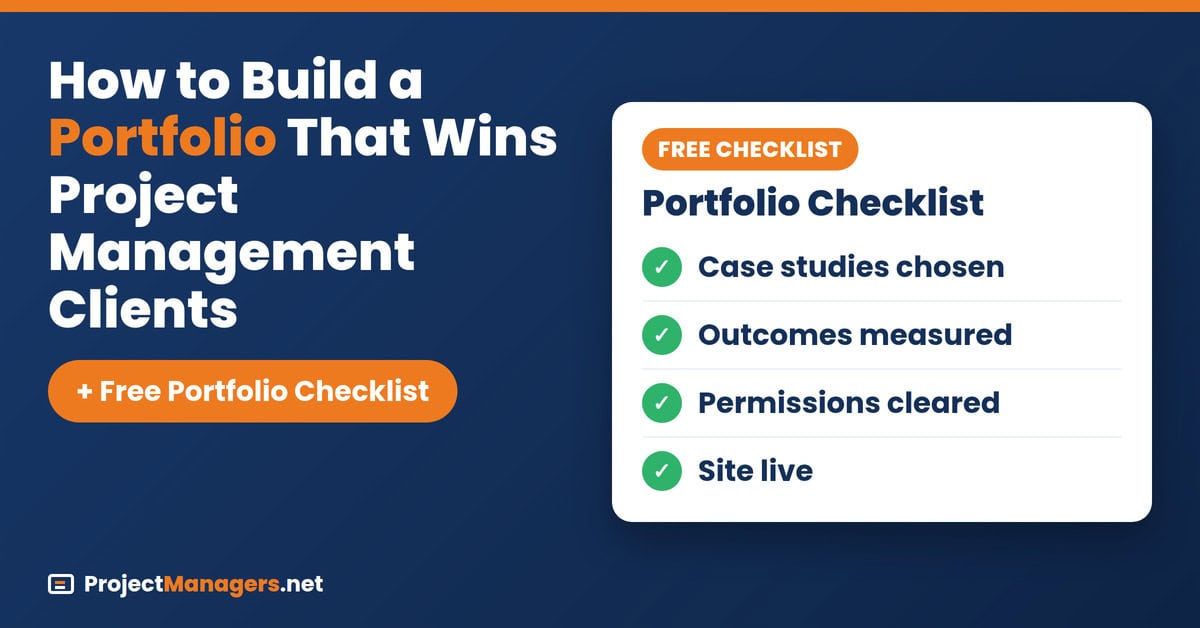
A prospective client reads three proposals, and each one promises strong stakeholder management and on-time delivery. None explains what changed for the last client, or by how much. The client calls the one project manager who attached a before-and-after story with real numbers. Freelancers and small consultancies keep that kind of story in a portfolio. A good one needs only a handful of well-chosen projects.
- Pick Fewer, Better Projects: Three to five case studies that match the clients you want beat a long list of everything you have run.
- Use One Structure Every Time: Problem, constraints, approach, results, and proof let a busy client compare projects in minutes.
- Lead with Outcomes: Replace process jargon with what changed, measured against a baseline the client understands.
- Publish It Online: A simple site gives each case study its own link for proposals, profiles, and follow-up emails.
Building that portfolio is a small project with a scope, a few hard choices, and a finish line. This guide covers why clients now hire on evidence, how to choose the right case studies, how to structure each one, and how to swap jargon for outcomes. It then explains how to publish online and handle confidential work, followed by a checklist, a video, and FAQs.
1. Why Clients Hire Project Managers on Evidence
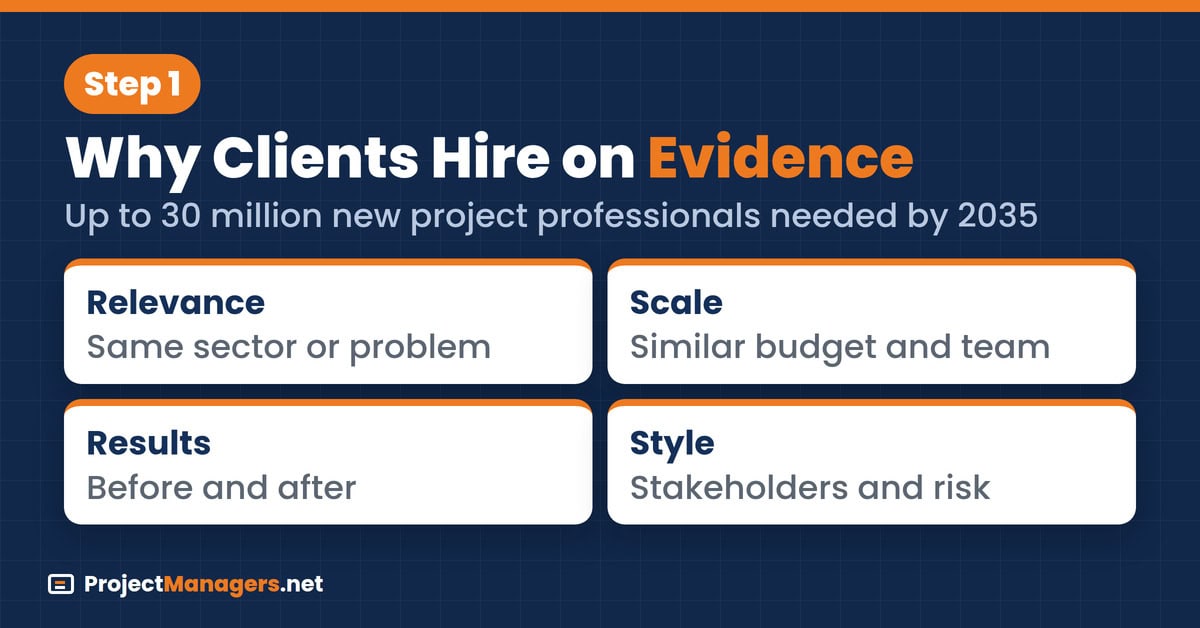
Demand for project talent keeps growing, and so does the field of people competing for it. PMI’s 2025 Global Project Management Talent Gap report estimates that up to 30 million new project professionals will be needed by 2035. For a client choosing between several freelancers with similar certifications, credentials stop separating the candidates, and proof of past results starts doing that job.
A resume lists roles and dates, while a portfolio shows how a project manager thinks under pressure. Clients rarely read every word. They scan for a project that looks like theirs, check whether the numbers are believable, and decide within minutes whether a call is worth booking. Before that call, most clients look for four signals in a portfolio:
- Relevance: A project in their sector, or one with the same kind of problem.
- Comparable Scale: Budget, team size, and duration close to the work they are planning.
- Measurable Results: Figures that show what improved and by how much.
- Working Style: How the project manager handled stakeholders, risks, and bad news.
Real-Life Example: A freelance project manager with ten years of software delivery sent the same resume to every lead and booked few calls. The pitch was rebuilt around three short case studies matched to the startups this freelancer wanted to serve. Within two months, prospects began quoting those case study results back on discovery calls, and the proposal acceptance rate rose noticeably.
2. Choose the Right Case Studies
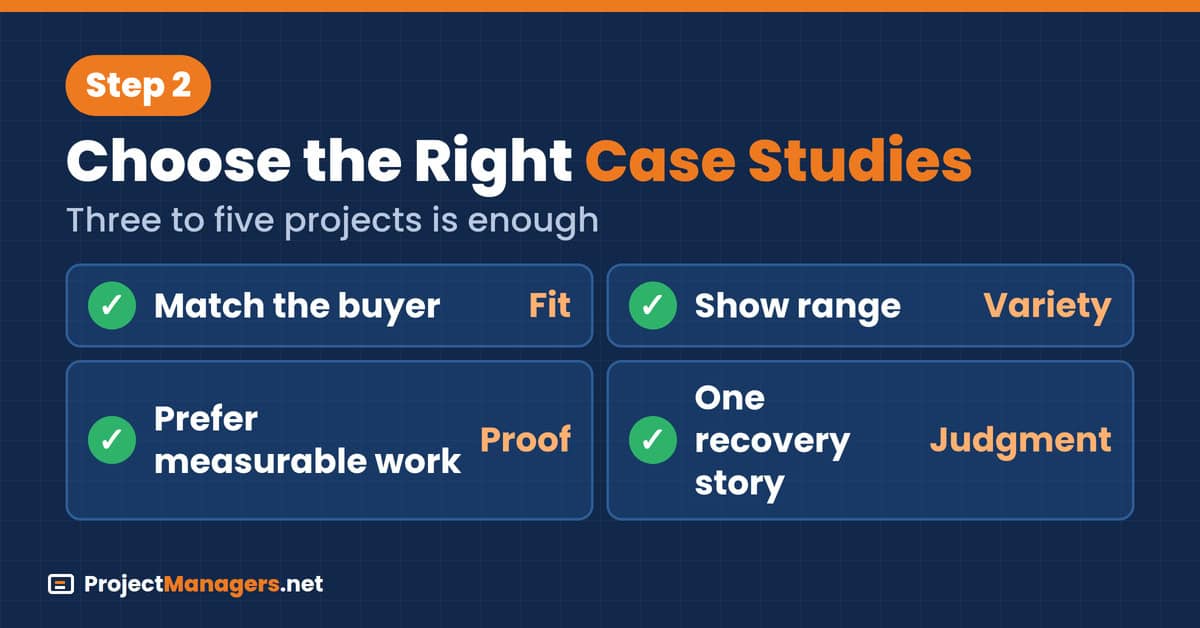
The strongest project management portfolio is a short one. Three to five case studies are enough for most freelancers, as long as each one earns its place by matching the clients you want next, not the clients you happened to have. A large program that bears no resemblance to a prospect’s project can do less for you than a modest project that mirrors their problem.
Start with a long list of every project from the last five years, then score each one against the type of client you are targeting. Keep the projects that show a clear result, a real constraint, and a role you can describe honestly. Drop work you cannot discuss in any detail. Use these filters when narrowing the list:
- Match the Buyer: Favor projects from the sector, size, or problem type you want more of.
- Show Range without Repeats: Pick projects that each prove a different strength, such as recovery, launch, or migration.
- Prefer Measurable Work: Choose projects where you can state a before-and-after figure.
- Include One Recovery Story: A troubled project you turned around shows judgment better than a smooth one.
- Retire Stale Work: Remove projects older than about five years unless they are still your best proof.
Real-Life Example: A two-person consultancy had delivered forty projects, and its first portfolio draft listed all of them in a table. The partners scored each project against their target client, mid-sized manufacturers planning system upgrades, and kept four. One was a rescued rollout that had slipped by two months before they joined. Prospects asked about that recovery story more than any other project.
3. Structure Each Case Study Around Problem, Constraints, and Results
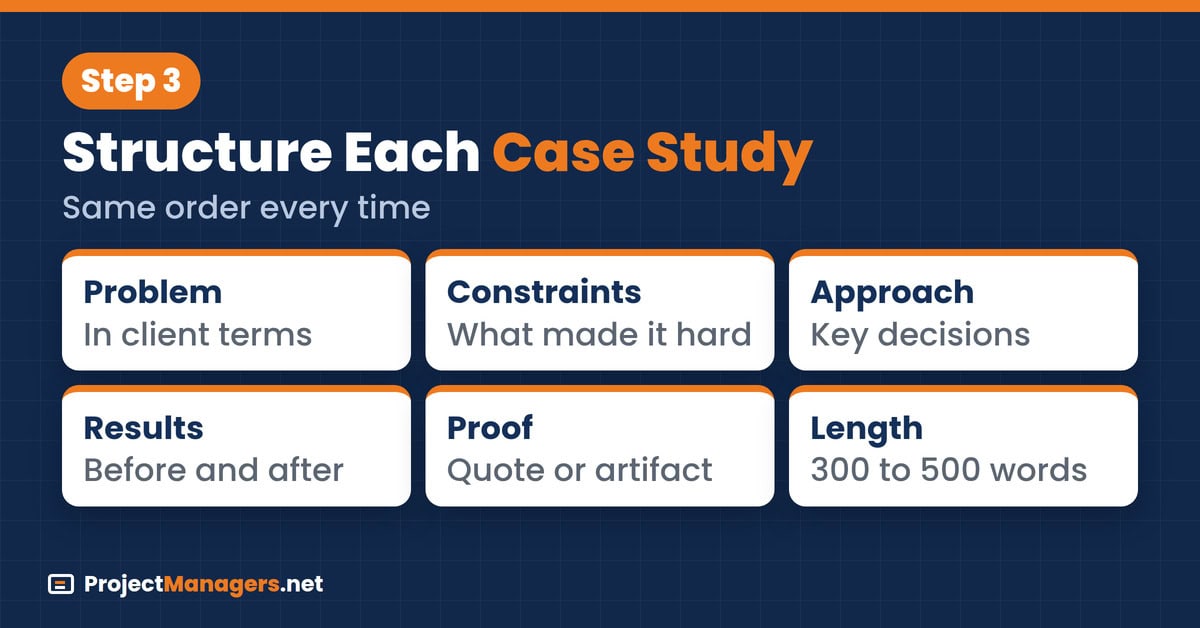
Clients compare case studies side by side, so every one should follow the same order. Start with the problem in the client’s terms, then the constraints that made it hard, the approach you took, the measurable results, and the proof behind them. A repeatable structure lets a reader jump straight to the part they care about, usually the constraints and the results:
Case Study Structure
| Part | What to Write | Example Line |
|---|---|---|
| Problem | The business issue in one or two sentences | Orders were shipping late, and churn was rising. |
| Constraints | Budget, deadline, team, and technical limits | Six weeks, no new hires, and a frozen budget. |
| Approach | The few decisions that changed the outcome | Cut scope to two warehouses and ran daily standups. |
| Results | Before-and-after figures with a timeframe | On-time shipping rose from 71% to 94% in a quarter. |
| Proof | Quote, artifact, or reference the client can check | A signed testimonial from the operations director. |
Constraints are the part most project managers skip, yet they are what make a result impressive. Hitting a deadline means little until the reader knows the team lost two developers in week three. Name your own role precisely as well, because clients notice when “we” and “I” blur together. A few habits keep each case study tight:
- Keep It Short: Aim for 300 to 500 words per case study, with the detail saved for the call.
- Put the Result in the Title: “Cutting Onboarding From 10 Days to 4” beats “Onboarding Project.”
- State Your Role Plainly: Say what you owned, what the team owned, and who sponsored the work.
- Add One Visual: A simple timeline, before-and-after chart, or redacted plan helps readers scan.
Real-Life Example: A freelance project manager rewrote a vague case study titled “ERP Implementation” using the five parts. The new version opened with a clear problem, then listed the constraints: a fixed go-live date, a team split across three time zones, and a vendor change mid-project. A prospect later said those constraints were exactly what made the result believable for a similar rollout.
4. Show Outcomes Instead of Jargon
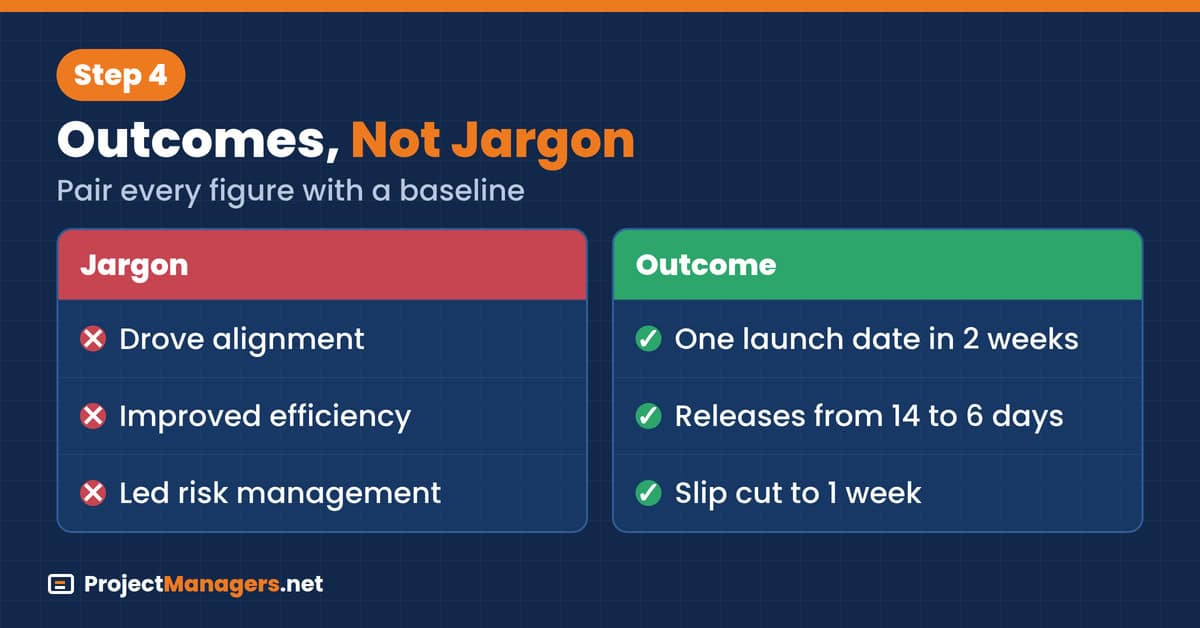
Project management vocabulary feels precise to the people who use it daily, but clients rarely hire for vocabulary. Phrases such as “drove cross-functional alignment” or “implemented agile governance” describe activity, not change. A client wants to know what was different when you left: faster delivery, lower cost, fewer defects, happier customers, or a launch that actually happened on the agreed date.
Rewrite every claim so it answers the question “so what?” Pair each figure with its baseline and timeframe, because a percentage without a starting point is hard to trust. Where a result came from a team effort, say so, and label any projected or modelled figure as an estimate. These rewrites show the difference between activity and outcome:
- Instead of “Managed Stakeholder Alignment”: “Got finance, operations, and IT to agree on one launch date within two weeks.”
- Instead of “Improved Delivery Efficiency”: “Cut average release time from 14 days to 6 over two quarters.”
- Instead of “Led Risk Management”: “Spotted a supplier delay early and moved the launch by one week instead of six.”
- Instead of “Drove Cost Savings”: “Finished 8% under a fixed budget by renegotiating two vendor contracts.”
Real-Life Example: A consultancy reviewed its portfolio and counted the word “alignment” nineteen times across four case studies. The partners replaced each instance with the decision that alignment had produced and the figure that followed. One line became “cut the approval cycle from three weeks to four days.” Their next prospect read it aloud on the first call and asked how they had managed it.
5. Put Your Portfolio Online
A portfolio stuck in a PDF attachment disappears into inboxes and cannot be updated once it is sent. A simple website gives every case study its own link to paste into proposals, profiles, and follow-up emails. A free website builder such as Wix lets a project manager start on a free plan with ready-made portfolio templates and move to a custom domain later.
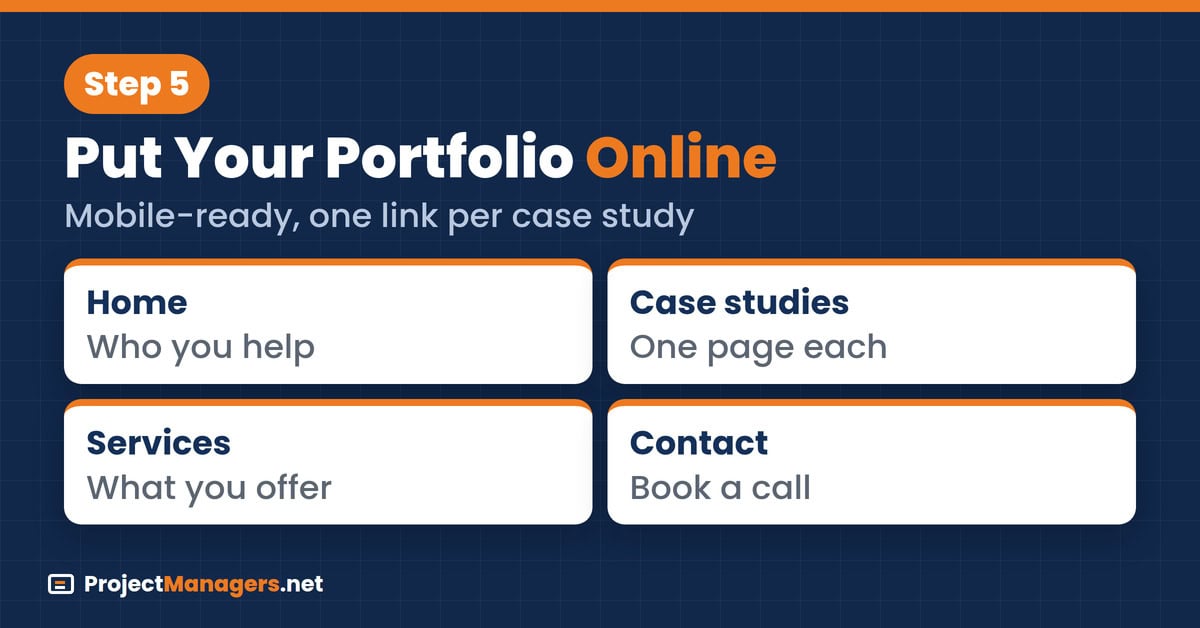
Keep the site small and focused on the clients you want. A home page with a one-line positioning statement, one page per case study, a short services page, an about page, and a contact page cover most needs. Check every page on a phone, give each one a clear title and description for search, and make booking a call the easiest action:
- Home Page: Who you help, the problems you solve, and links to your best two case studies.
- Case Study Pages: One page each, written in the problem, constraints, approach, results, and proof order.
- Services Page: The engagements you offer, such as project recovery, launch management, or PMO setup.
- Contact Page: A short form or booking link, plus the response time a client can expect.
Real-Life Example: A freelancer who specialized in clinic software rollouts had been emailing a twelve-page PDF to every lead. The freelancer moved it to a five-page site on a free plan, with one page per case study, and added a custom domain once the first new contract arrived. Prospects began clicking straight to the case study closest to their own rollout.
6. Handle Confidential Client Work
Much of a project manager’s best work sits behind a nondisclosure agreement, which makes portfolios harder to build than they look. Read every contract before publishing, because some clauses forbid naming the client, sharing figures, or even describing the project. When in doubt, ask in writing, and review the legal pitfalls in project resources that catch freelancers out.
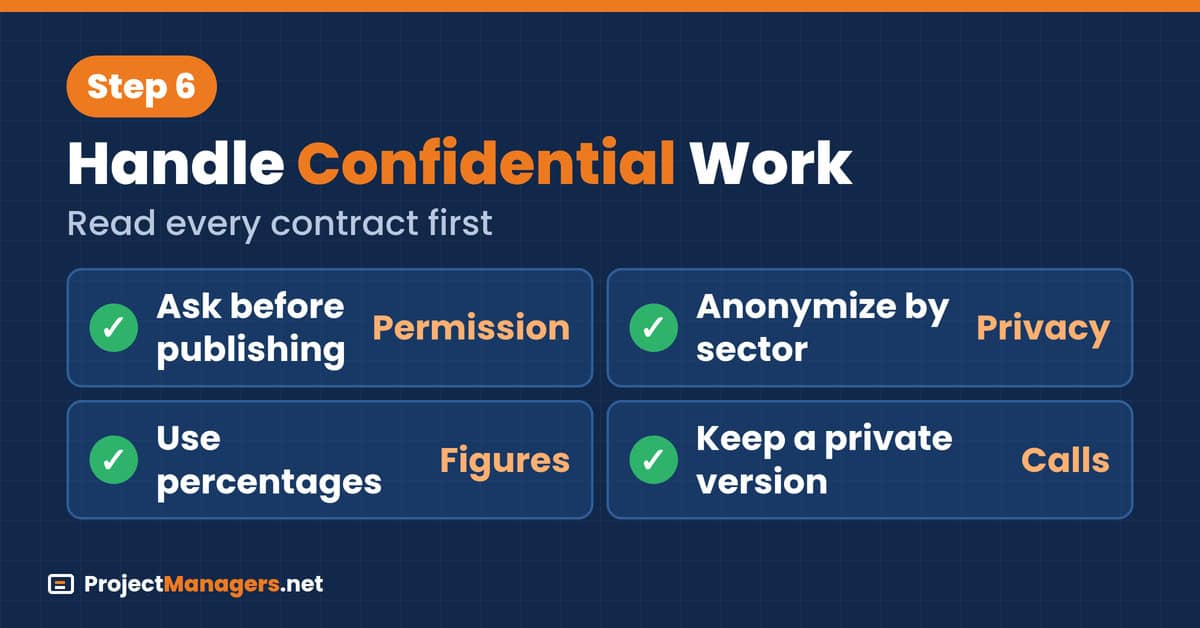
A confidential project can still become a strong case study. Describe the client by sector and size rather than name, share ranges or percentages instead of exact revenue figures, and strip internal names from any visual. Keep a fuller private version for discovery calls, where you can explain more under an agreement. These steps protect both you and past clients:
- Ask Before You Publish: Request written permission for names, logos, and figures at project close.
- Anonymize by Sector and Size: “A 200-person logistics firm” tells a prospect enough to judge relevance.
- Use Percentages and Ranges: Share improvement rates rather than revenue or contract values.
- Keep a Private Version: Save detailed artifacts for calls held under a nondisclosure agreement.
Real-Life Example: A consultancy that worked mostly for banks could name none of its clients. The partners rewrote each case study around sector, team size, and percentage improvements, and they added a line inviting prospects to request a detailed briefing under a nondisclosure agreement. Two of the next three enquiries asked for that briefing, turning the confidentiality limit into a reason to call.
7. Common Portfolio Mistakes to Avoid
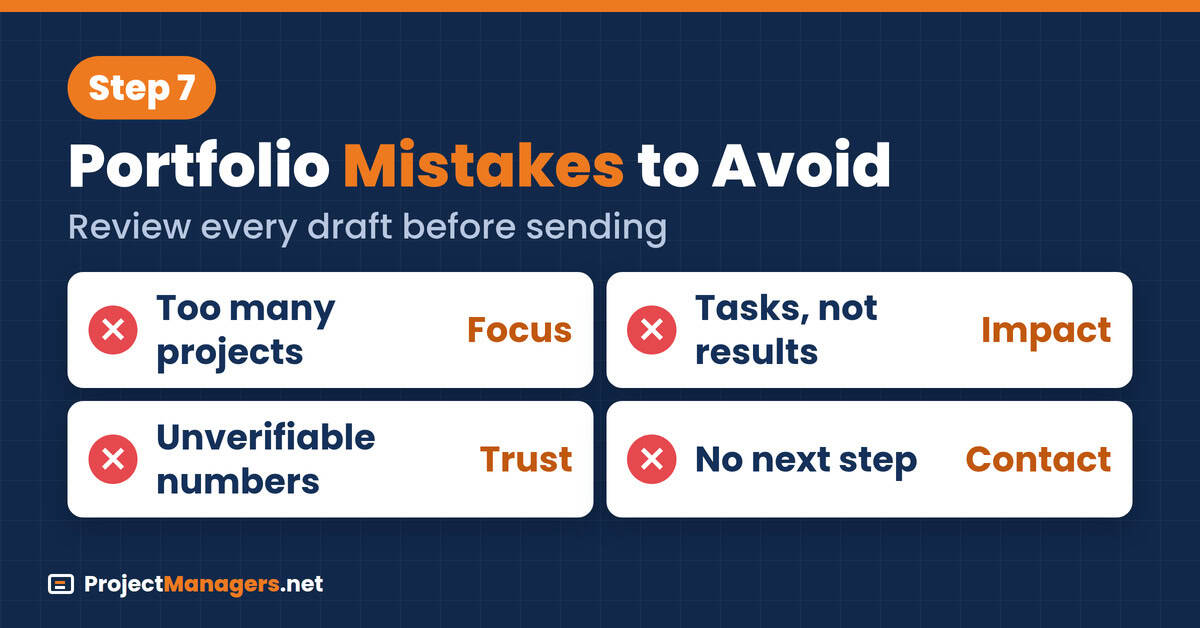
Most weak portfolios fail for the same handful of reasons, and none of them is a lack of experience. They usually come from treating the portfolio like a resume, listing everything and explaining little. Spotting these patterns early saves rewrites later, and it gives a project manager a quick way to review a draft before sending it to the next prospect:
- Too Many Projects: Twenty thin entries bury the three that would win the work.
- Tasks Instead of Results: Lists of duties say what you did, not what changed.
- Numbers Nobody Can Check: Round, unsourced figures such as “300% ROI” reduce trust.
- No Clear Next Step: A portfolio without a contact form or booking link stalls interest.
- Stale Work: Case studies that have not changed in years suggest the business has not either.
Real-Life Example: A freelance project manager asked three former clients to review a portfolio draft before launch. All three said the same thing: the results were buried under task lists, and the strongest project was on page four. The freelancer cut eleven entries, moved the recovery project to the top, and added a booking link to every page before publishing the new version.
Portfolio Readiness Checklist
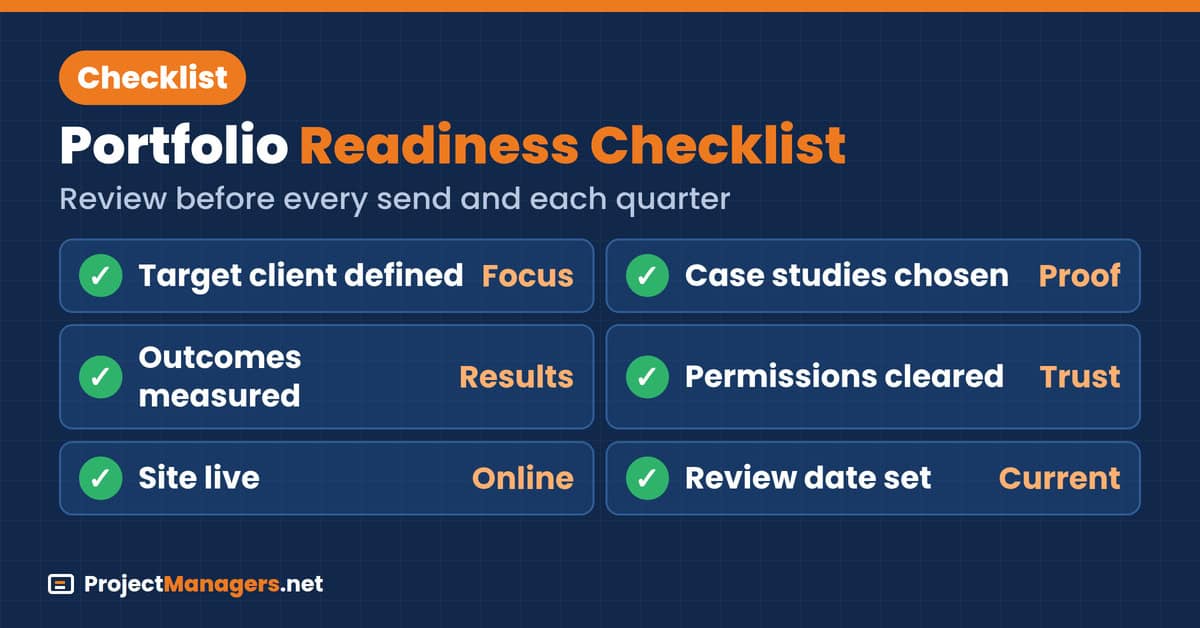
Work through this checklist before sending the portfolio to any prospect, and again every quarter. Each line matches one section of the guide, so an unticked item points straight to the part that needs work. Tick each line only when it is finished, not when it is mostly done, because an unfinished case study is the one a client will open first:
- Fewer Projects Read Faster: A short, consistent set makes it easier for a busy client to find the project that looks like theirs.
- Checked Figures Build Trust: Baselines and cleared permissions reduce the chance that a prospect doubts a result or a past client objects.
- A Live Site Keeps Work Visible: One link per case study helps proposals and follow-ups point to the right proof at the right moment.
Video: Building a Portfolio Website Step by Step
George Vlasyev’s tutorial, published in July 2026, builds a portfolio website on Wix from a blank template to a published site, covering page layout, project galleries, and mobile editing. It pairs well with section five of this guide, because it shows where each case study page, services page, and contact form actually goes once the written content is ready.
How to Make a Portfolio Website on Wix in 2026 (Step by Step) (George Vlasyev, 19:39)
A full walkthrough of building and publishing a portfolio site, from choosing a template to adding project pages and a contact form.
Project Management Portfolio FAQs
Project Management Portfolio FAQs
How Many Case Studies Should a Project Management Portfolio Include?
Three to five is enough for most freelancers and small consultancies. Choose projects that match the clients you want and that each prove a different strength, such as recovery, launch, or migration.
What Should a Project Management Case Study Include?
Use the same five parts every time: the problem, the constraints, your approach, the measurable results, and the proof. Keep each case study to roughly 300 to 500 words.
Can I Use Projects Covered by a Nondisclosure Agreement?
Often yes, if you anonymize them. Describe the client by sector and size, share percentages instead of revenue figures, and ask for written permission before naming anyone.
What If My Results Are Hard to Measure?
Look for a before-and-after you can state honestly, such as cycle time, approval days, defect counts, or customer complaints. Label any projected figure as an estimate.
Do I Need a Website, or Is a PDF Enough?
A PDF works as a backup, but a website gives each case study its own link, works on phones, and can be updated without resending files to every prospect.
How Often Should I Update My Portfolio?
Review it every quarter. Add finished projects while the figures are fresh, ask for permissions at project close, and retire work that no longer matches your target client.
Should Certifications Go in a Portfolio?
Yes, on the about page or in a short credentials line. Certifications show training, while case studies show results, so give the case studies most of the space.
Conclusion
A portfolio wins clients when it answers the question a buyer is really asking: has this person already solved a problem like mine, under limits like mine? Three to five honest case studies, written in one consistent structure, answer that question faster than any list of skills. The rest of the work, from the website to the permissions, simply makes that answer easy to find.
Pick the one project that most resembles the work you want next, and write it up this week using the five-part structure. Publish it on its own page before writing the second, so you have a live link for your next proposal. Then add one case study each month until the portfolio covers every type of client you want to serve.
Suggested Articles:
- Building a Project Management Consultancy from the Ground Up
- 8 Project Management Skills You Need to Succeed
- A Project Manager’s Guide to Organizing Personal Finances Like a Portfolio

Peter Kanai is a Google-certified freelance writer with over a decade of experience crafting high-quality content for business websites, blogs, and SEO & email marketing campaigns. His on-demand writing services are all about helping businesses expand their online presence and achieve their objectives. With a proven track record in delivering results-driven content, Peter is the go-to freelance writer for business owners seeking a strategic partner to help them grow their brand online.