
A product launch can have its website, sales talking points, and customer support ready down to the hour, yet its press plan may amount to little more than sending a release the night before and emailing a few journalists someone managed to find. This last-minute approach can cost a launch valuable media exposure and credibility. Editorial coverage carries more public trust than advertising, making earned media an important part of building confidence in a new product. It deserves the same planning and coordination as every other launch activity.
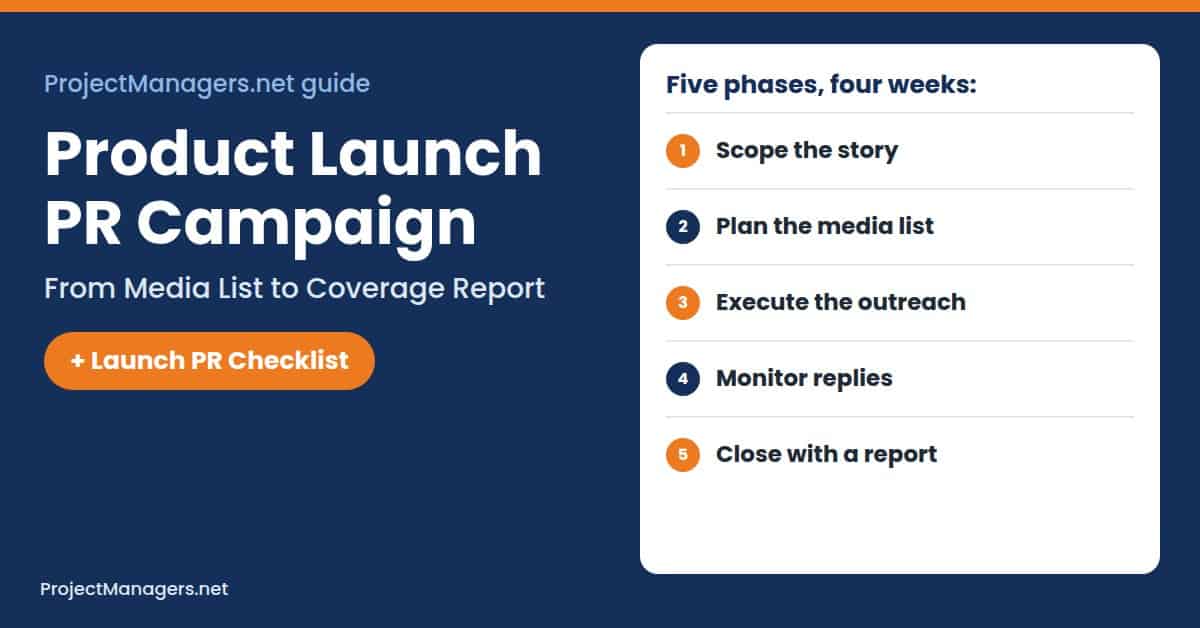
- Launch PR Is a Five-Phase Project: Scoping the story, planning the media list and timeline, executing outreach, monitoring replies, and reporting results gives press work the same deliverables and deadlines as the rest of a product launch project.
- The Media List Is the Key Deliverable: In Media List’s study of 2,993 news outlets, 46.1% had exactly one reachable journalist, so 25 to 50 well-chosen contacts usually beat a long list of names nobody checked.
- Timing and Length Shape Replies: PR Gun’s analysis of 178,863 press releases found 8 to 9 a.m. Eastern is the most crowded hour, and 69% of journalists in Muck Rack’s survey want pitches under 200 words.
- Follow-Ups and a Closing Report: Two scheduled follow-ups in the same thread and a short results report on who was pitched, who replied, and what ran turn one launch into lessons for the next.
Nielsen’s Global Trust in Advertising study found that 66% of people trust editorial content, such as newspaper articles, compared with 42% who trust online banner ads. Securing that trust requires more than distributing a press release. Businesses need to manage launch PR as a structured project, with a defined scope, clear timelines, planned activities, and measurable deliverables. This guide walks through each stage, from building a targeted media list and pitching journalists to tracking published coverage and preparing the final results report.
Why PR Needs a Project Plan

The odds are stacked against a last-minute pitch. The Bureau of Labor Statistics counts about 314,500 public relations specialists and 47,100 reporters and correspondents, roughly 6.7 PR people for every reporter. In Cision’s 2026 State of the Media survey of 1,899 journalists, 72% said fewer than a quarter of the pitches they receive are relevant to them.
The newsroom is also shrinking. A Pew Research Center analysis found newsroom employment fell 26% between 2008 and 2020. Yet journalists still depend on good pitches: in Muck Rack’s 2026 State of Journalism report, 86% said at least some of their stories began with one. The difference between being ignored and being covered is usually preparation, which project management does well.
Real-Life Example: A SaaS team launched a reporting feature with a release sent at midnight and no media list. It earned one mention in a roundup. For the next launch, the project manager gave PR its own workstream with a scope, a four-week timeline, and an owner. That campaign landed five relevant stories, including two trade publications its customers read every week.
Phase 1. Scope the Story
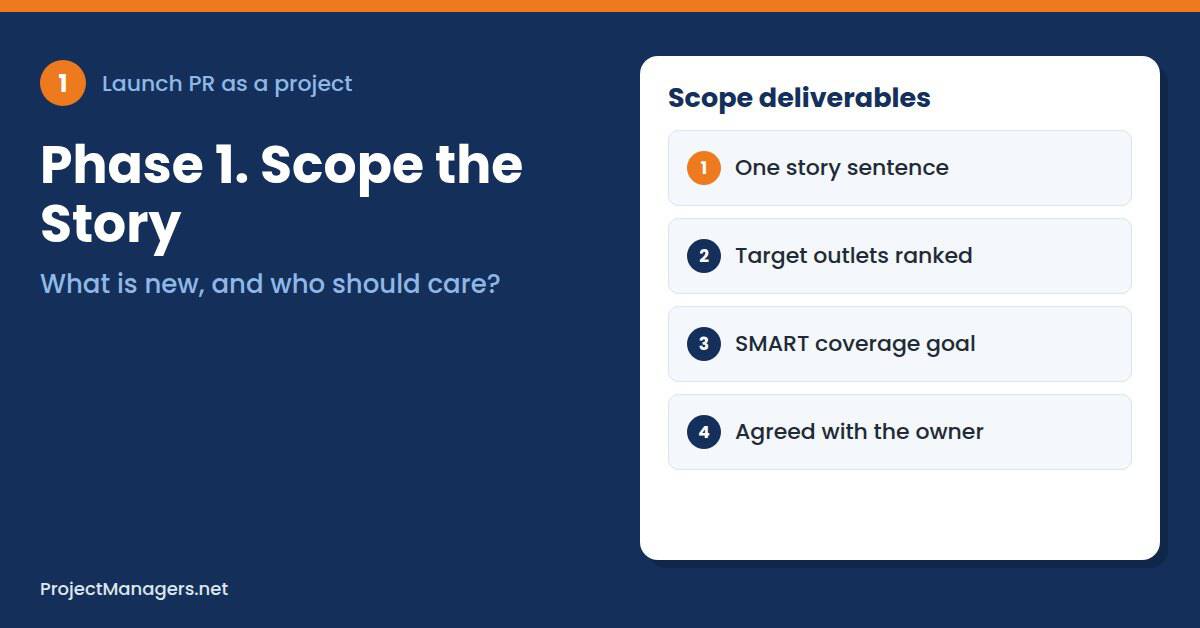
Every project starts with a clear goal. For launch PR, write one sentence that says what is new and who should care. “A scheduling app that cuts no-shows for small clinics” points you to health tech, small business, and local news. “A new feature for an existing product” may only be a story for trade press, which changes the whole media list.
Then set a realistic SMART target. Five pieces of relevant coverage are a good result for most launches. Write down which outlets would matter most to your customers, not which ones are most famous, and agree on that list with the product owner before anyone drafts a pitch, so the scope stays fixed when outreach begins.
Real-Life Example: A hardware startup wanted national headlines for a firmware update. The project manager wrote the story sentence with the team and realized the news mattered mainly to existing customers and two trade outlets. The team cut the target list from forty publications to twelve, set a goal of four stories, and hit it within three weeks.
Phase 2. Plan the Timeline and the Media List
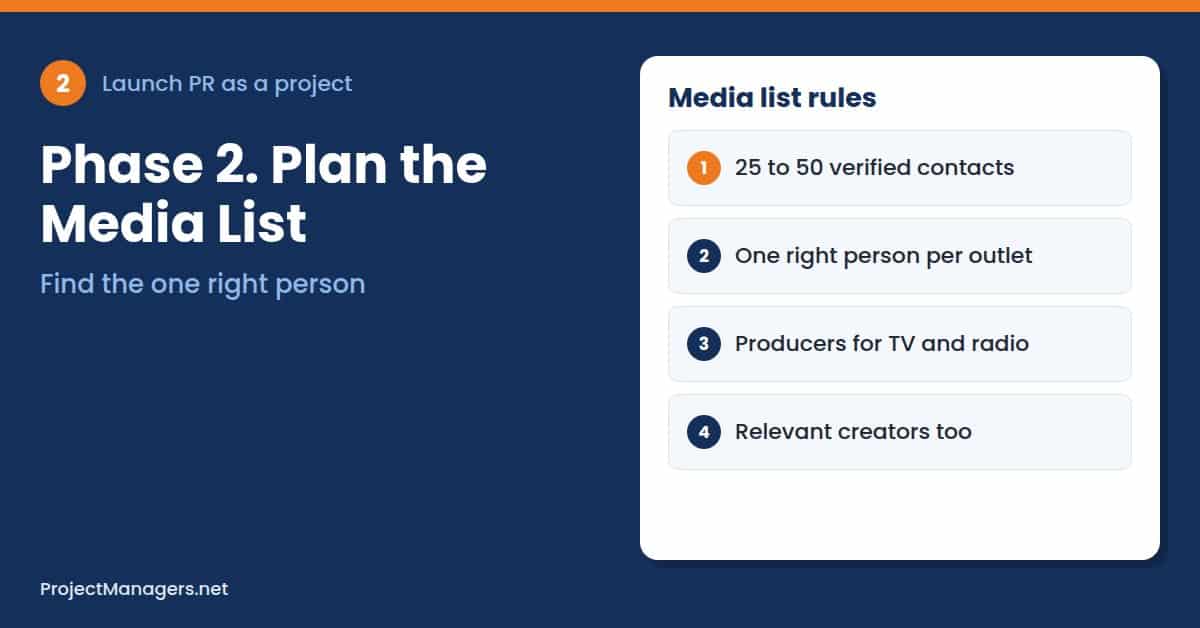
The core deliverable of the project’s planning phase is the media list: a short list of the journalists, editors, producers, and creators most likely to cover your story, with a working email for each. For one launch, 25 to 50 people is usually enough. Verify every address before outreach starts, because bounced pitches waste the busiest days of the campaign.
How newsrooms are staffed should shape that list. In Media List’s August 2026 study of 2,993 news outlets, 46.1% had exactly one reachable journalist, and the median outlet had two. Producers made up 23.5% of newsroom contacts, nearly as many as reporters at 31.5%. So find the one right person per outlet, and for TV or radio, pitch the producer who books the segment.
Creators belong on the list too. The Reuters Institute Digital News Report 2025 found six online networks now reach more than 10% of people weekly with news, compared with two a decade earlier. A simple four-week timeline keeps everyone on track:
Four-Week Launch PR Project Timeline
| Week | Phase | Deliverable |
|---|---|---|
| 1 | Scope and plan | Story sentence, target outlets, and a first draft of the media list |
| 2 | Plan | Final media list with verified emails, plus the pitch and follow-ups written |
| 3 | Execute | Pitches sent, and interviews and demos booked |
| 4 | Monitor and report | Coverage tracked, follow-ups sent, and the results report shared |
Real-Life Example: A fintech project manager built a 34-contact list for a card launch and checked each outlet’s masthead before adding names. At three regional outlets, the only reachable contact was a TV producer, so the pitch for those became a short segment idea with a customer available for interview. Two of the three producers booked the segment within a week.
Phase 3. Execute the Outreach
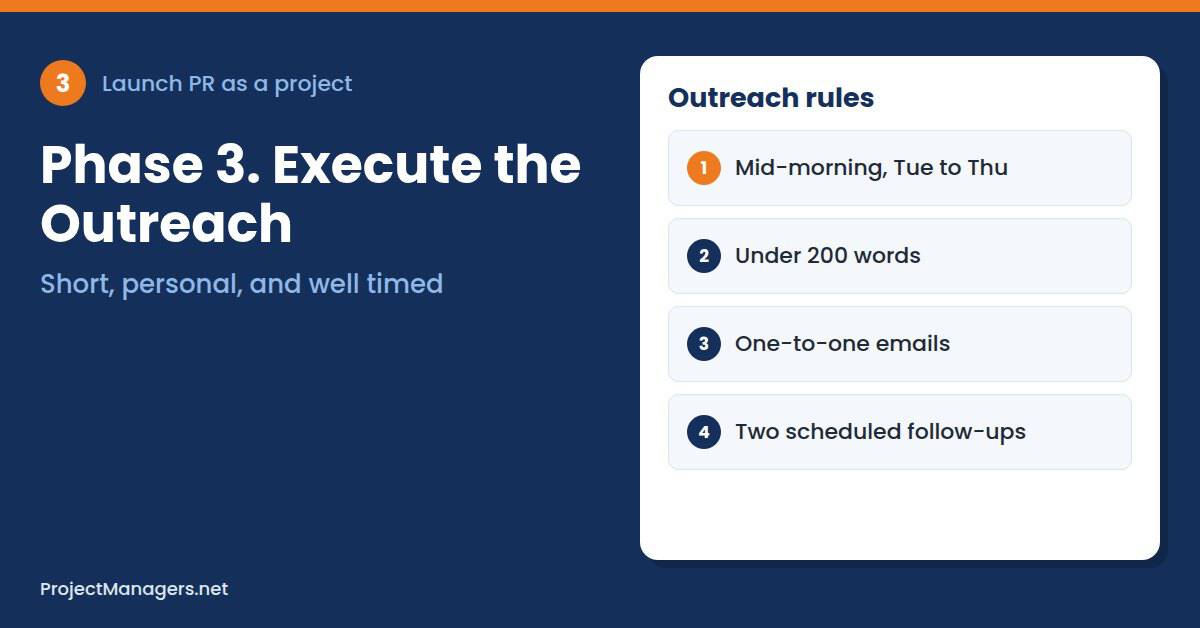
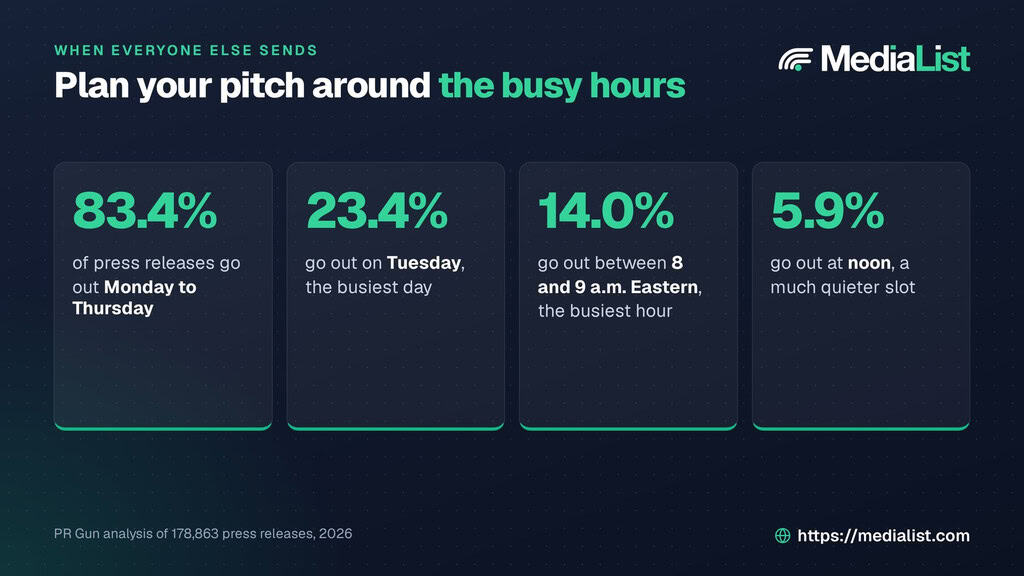
Timing is part of the plan. PR Gun’s 2026 analysis of 178,863 press releases from nine distribution services found that 83.4% go out Monday through Thursday, with Tuesday the busiest day at 23.4%. The busiest hour is 8 to 9 a.m. Eastern, with 14.0% of timed releases, while noon carries just 5.9%. Journalists prefer pitches before noon, so mid-morning works well.
Keep each pitch short and personal. In Muck Rack’s 2026 survey, 69% of journalists said they want pitches under 200 words, and 62% prefer a one-to-one email over a mass send. Mention one recent story the journalist wrote, and explain in a sentence or two why your news fits their beat. Write the follow-ups at the same time, so they are part of the plan.
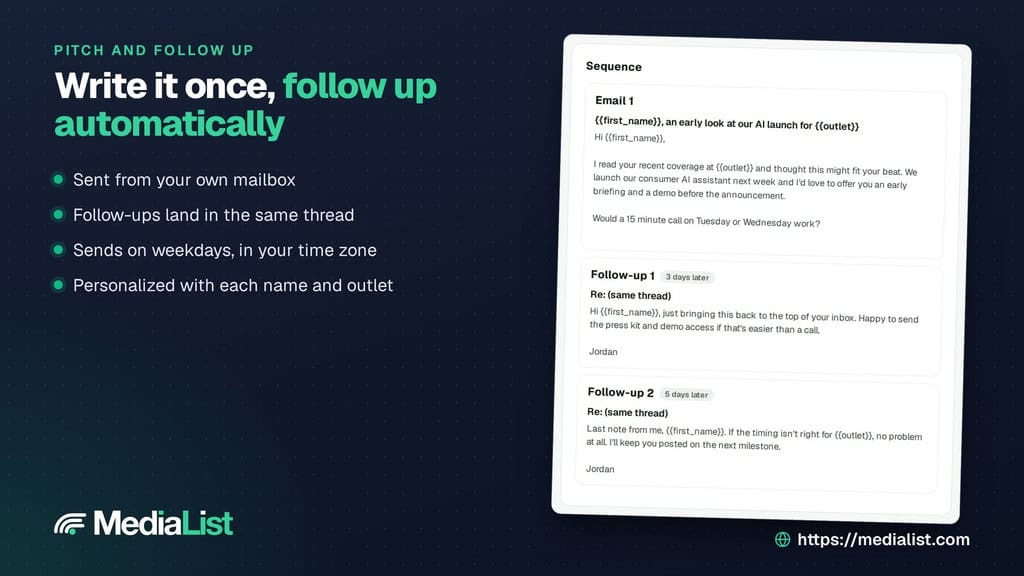
Two short follow-ups, a few days apart in the same thread, are usually enough. Tools can take the busywork out of this phase. Media List, for example, lets you search more than 1.5 million contacts, from journalists and TV producers to podcast hosts and YouTube creators. On its Professional plan, a saved list becomes a campaign that sends personalized pitches and follow-ups from your mailbox.
Real-Life Example: A B2B software team sent its first launch pitches at 8:05 a.m. on a Tuesday and heard nothing. For the next release, the project manager moved sends to mid-morning Wednesday, cut the pitch to 140 words, and scheduled two follow-ups four days apart. Reply rates roughly doubled, and the second follow-up produced the campaign’s only feature interview.
Phase 4. Monitor Replies and Coverage
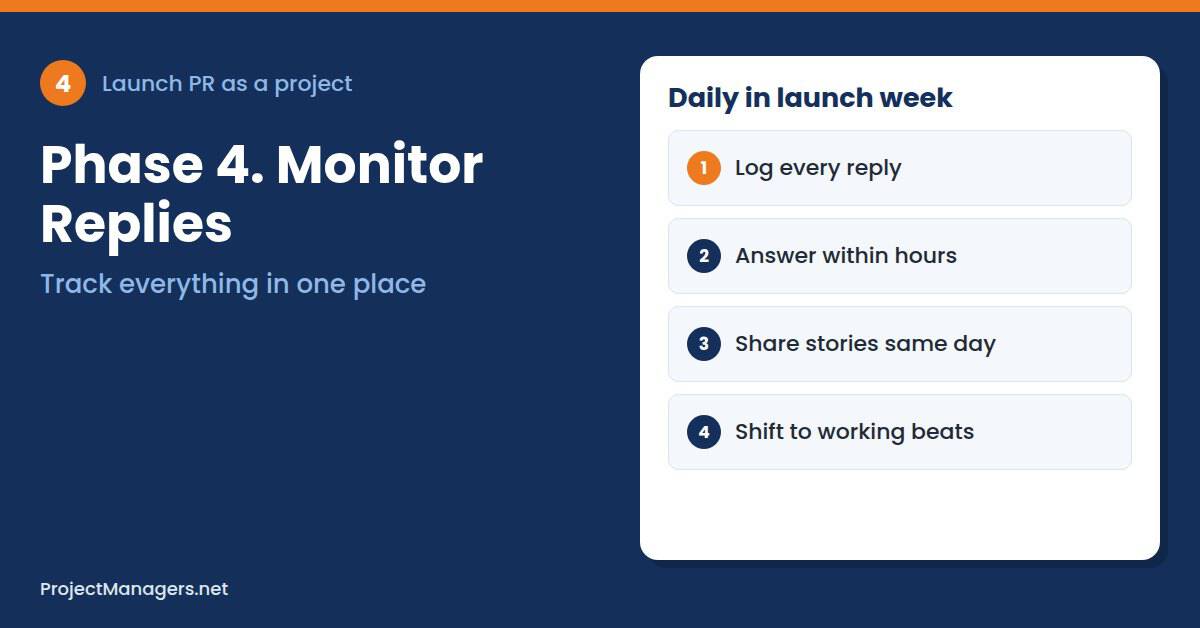
Track every reply, interview request, and published story in one project tracker. A simple sheet with the contact, outlet, status, and link works well. Answer replies quickly, since a journalist on deadline will often move on within hours. When a story goes live, thank the writer, and share it with your team and customers on the same day to extend its reach.
This is also the moment to adjust the plan. If one beat is responding and another is silent, shift your remaining effort toward what is working. Treat the tracking sheet like a project status board, review it daily during launch week, and record why each contact declined, because those reasons improve the media list for the next campaign more than any tool.
Real-Life Example: During a consumer app launch, the tracking sheet showed five replies from personal finance writers and none from general tech reporters. The project manager paused the remaining tech follow-ups, wrote a finance-specific angle, and sent it to eight more personal finance contacts. Three of them published stories within the launch week, which the team then shared with customers.
Phase 5. Close with a Report

Every project ends with a post-mortem review, and PR should too. A short report answers the questions your team or client will ask: how many people were pitched, which outlets covered the story, and what you would change next time. Borrow from sprint retrospective examples to structure the lessons section. Book it as a dated project deliverable.
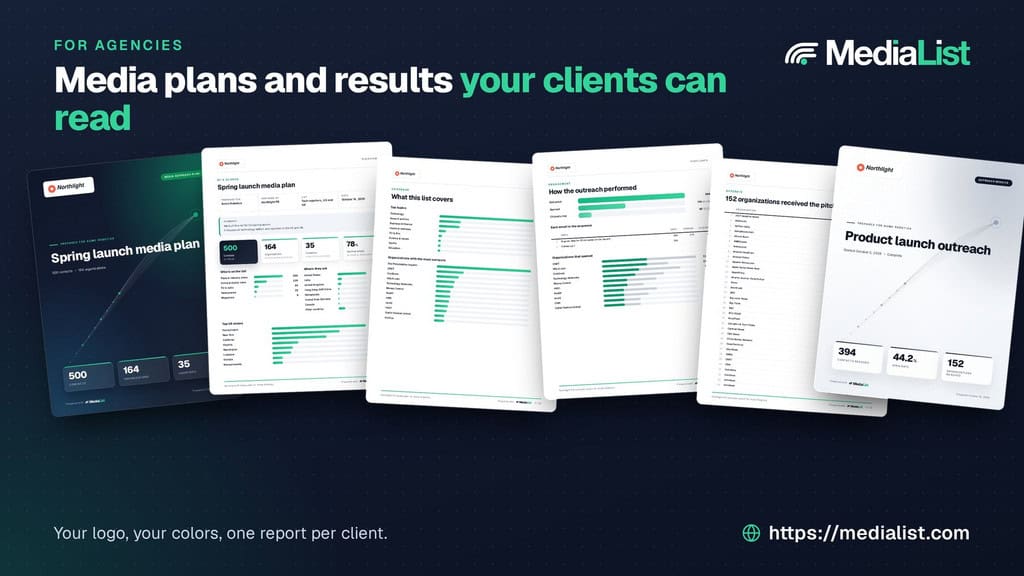
If you manage PR projects for clients, presentation matters as much as the numbers. Some tools now turn a saved list into a media plan and a finished campaign into a branded results report. Media List includes client reports on every plan, with full private label for up to three brands on Professional, so each client gets a report under its own logo.
Real-Life Example: An agency project manager closed a launch with a one-page report: 41 contacts pitched, 11 replies, six stories, and one lesson: producers responded faster than reporters. The client used the report in its board update. The agency kept the lesson in its template, so the next campaign started with producers already on the list.
Common Launch PR Mistakes

Most launch PR problems come from treating the press as an afterthought rather than a project workstream. The mistakes below appear in campaigns of every size, and each one maps to a phase in this guide. Check your plan against them before week three, when outreach starts and changes become expensive to make:
- Sending the Release the Night Before: Without a scope and a list, the release reaches people who never cover your market.
- Chasing Famous Outlets: Relevant trade and local titles usually convert better than big names that rarely cover launches.
- Mass Sends: 62% of journalists in Muck Rack’s survey prefer a one-to-one email, so blasts get ignored.
- No Follow-Up Plan: Follow-ups written in advance get sent, while improvised ones usually never happen.
- No Closing Report: Without a report, the next launch repeats the same list and the same mistakes.
Launch PR Checklist
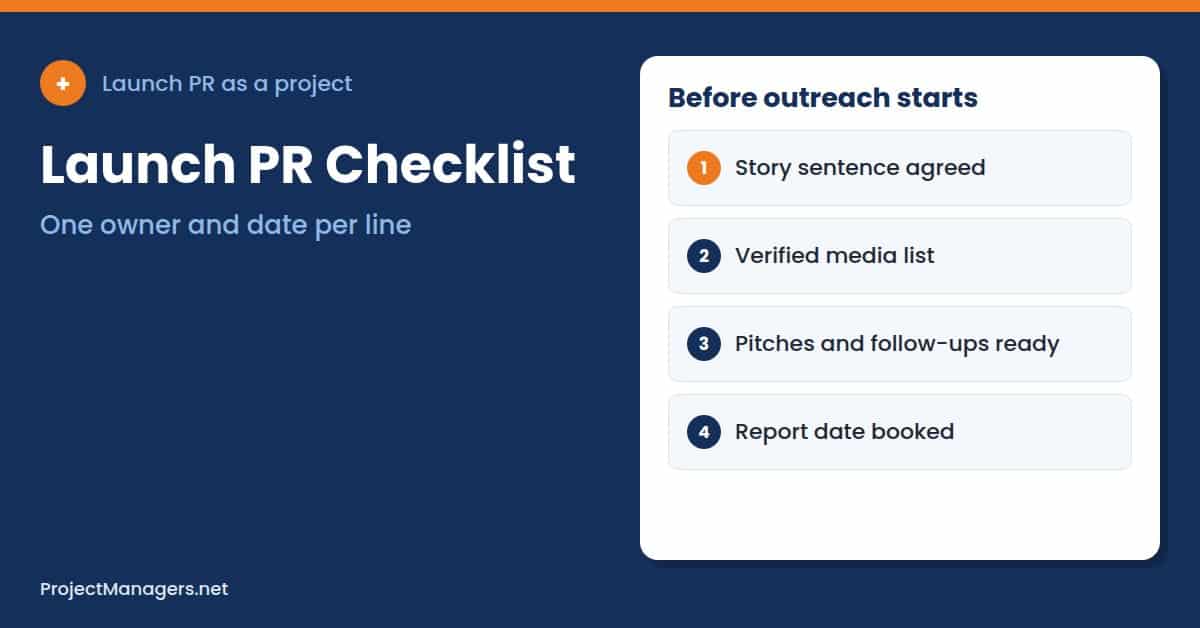
Use this checklist as the PR section of your launch project plan, and review it at each weekly project meeting. Every item maps to a deliverable in the four-week timeline above, so an unchecked item tells you exactly which phase is behind. Assign an owner and a date to each line before outreach begins:
- The story sentence says what is new and who should care.
- A SMART coverage target and a ranked list of outlets are agreed.
- The media list holds 25 to 50 verified contacts, producers included.
- Pitches are under 200 words and personalized to each contact.
- Sends are scheduled mid-morning, Tuesday to Thursday.
- Two follow-ups are written and scheduled in the same thread.
- A tracking sheet logs every reply, interview, and story.
- A results report is booked for the end of week four.
Where to Start
If you take one thing from this guide, make it this: give launch PR a plan, a media list, and a report, like every other part of the launch. I used Media List for the examples above because it covers journalists, producers, podcast hosts, and creators in one search, and its 3-day free trial lets you plan the next launch first.
Media List: Find journalists, TV producers, podcast hosts, and creators, build your media list, and send pitches with follow-ups from your own mailbox. Plans start at $99 a month, with a 3-day free trial, and client reports are included on every plan. It suits teams that run several launch projects a year. Visit https://medialist.com to learn more.
Sources:
- Nielsen, Global Trust in Advertising
- Bureau of Labor Statistics, Occupational Outlook Handbook
- Cision, 2026 State of the Media
- Muck Rack, 2026 State of Journalism, public summary
- Media List newsroom study, August 2026, 2,993 outlets
- PR Gun analysis of 178,863 press releases, 2026
- Media List product and pricing pages, October 2026
Video: How to Pitch a Journalist
This short video from the Media List channel, published in October 2026, shows how to write a pitch that a busy journalist will actually answer. It covers the subject line, the one-line reason the story fits the reporter’s beat, and when to follow up. Watch it before week three of your project timeline, while the pitch and both follow-ups are still in draft.
How to Pitch a Journalist (and Actually Get a Reply) (Media List, 2:21)
A quick walkthrough of short, personal pitches and the follow-ups that earn replies.
Launch PR Campaign FAQs
Launch PR Campaign FAQs
How Long Should a Launch PR Campaign Take?
For most launch projects, four weeks is enough: one for scoping, one for planning the media list and pitch, one for outreach, and one for follow-up and reporting.
How Many Journalists Should Be on a Launch Media List?
Usually 25 to 50 well-chosen people. Since nearly half of all outlets have one journalist worth reaching, that can cover 30 or more outlets.
When Is the Best Time to Send a Launch Pitch?
Tuesday through Thursday, in the morning before noon, avoiding the crowded 8 to 9 a.m. Eastern hour when the most releases go out.
How Do I Report PR Results to a Client?
Show who was pitched, who replied, which stories were published, and one lesson for the next project. A branded report makes the results easy to share.
How Long Should a Media Pitch Be?
Under 200 words. In Muck Rack’s 2026 survey, 69% of journalists said they want pitches that short, and 62% prefer a one-to-one email.
Should I Pitch Podcasters and Creators?
Yes, when they cover your market. News reaches more people through video and podcast platforms than a decade ago, so add relevant creators to the same verified list.
How Many Follow-Ups Should I Send?
Two short follow-ups, a few days apart and in the same email thread, are usually enough. Write them with the pitch so they are scheduled, not improvised.
Conclusion
The numbers in this guide point the same way: there are about 6.7 PR people for every reporter, most outlets have one reachable journalist, and most pitches miss. A campaign wins by being relevant, timed, and followed up, not by being loud. That is a planning problem, and planning is the part of a launch project managers already run every day.
For your next launch, add a PR workstream to the project plan before week one, with the story sentence, the media list, and the report as named deliverables. Run the checklist at each weekly meeting. Even if the first campaign lands only two stories, the closing report gives the second one a verified list and a head start.
Suggested Articles:
- Integrating Email Deliverability Into Product Launch Project Plans
- 18 x Product Launch Plan Templates
- How Project Managers Can Use Creator Insights in Campaigns

Daniel Raymond, a project manager with over 20 years of experience, is the former CEO of a successful software company called Websystems. With a strong background in managing complex projects, he applied his expertise to develop AceProject.com and Bridge24.com, innovative project management tools designed to streamline processes and improve productivity. Throughout his career, Daniel has consistently demonstrated a commitment to excellence and a passion for empowering teams to achieve their goals.