
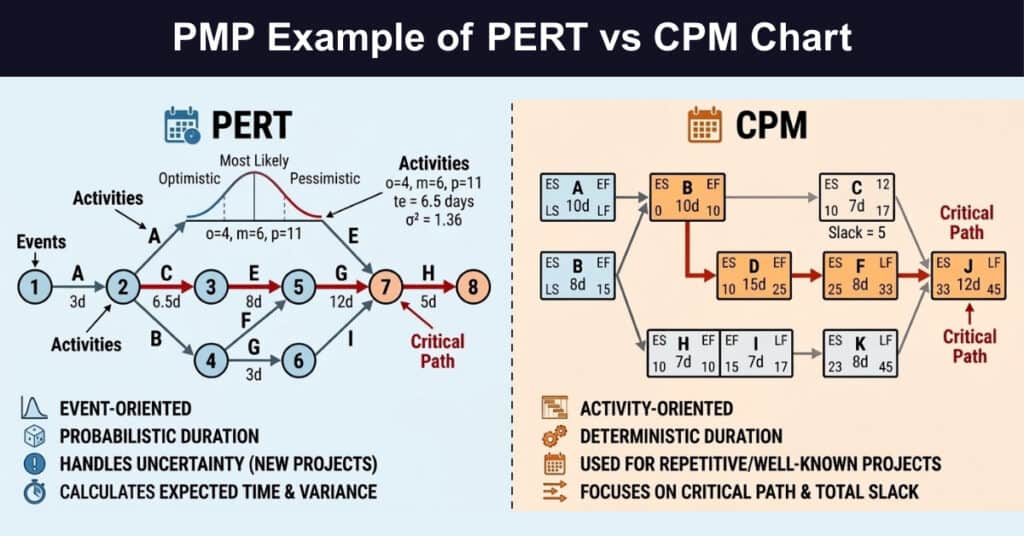
The PERT formula draws on principles from the Critical Path Method (CPM), a proven technique for determining the optimal sequence and timing of project activities. While CPM focuses on identifying the longest sequence of dependent tasks that sets the project’s minimum duration, PERT builds on that structure by introducing probabilistic time estimates. Which method to choose depends on your project’s needs: use PERT when you need a more precise, uncertainty-aware estimate that accounts for optimistic, most likely, and pessimistic durations; choose CPM when you need a fast, deterministic schedule to identify critical tasks and potential bottlenecks.
For complex, high-uncertainty projects, PERT provides richer insight into overall schedule risk, whereas CPM is efficient and practical for straightforward projects or when quick decision-making is essential. Transitioning now, let’s compare how each method works in practice and when to apply them.
PERT Formula Project Management
The PERT (Program Evaluation and Review Technique) formula is a project management tool used to estimate the time required to complete a project. It supports the creation of PERT charts—graphical timelines that show task sequences and dependencies. PERT charts are widely used in project planning because they clarify relationships between activities and help identify the sequence of tasks that affect project duration.
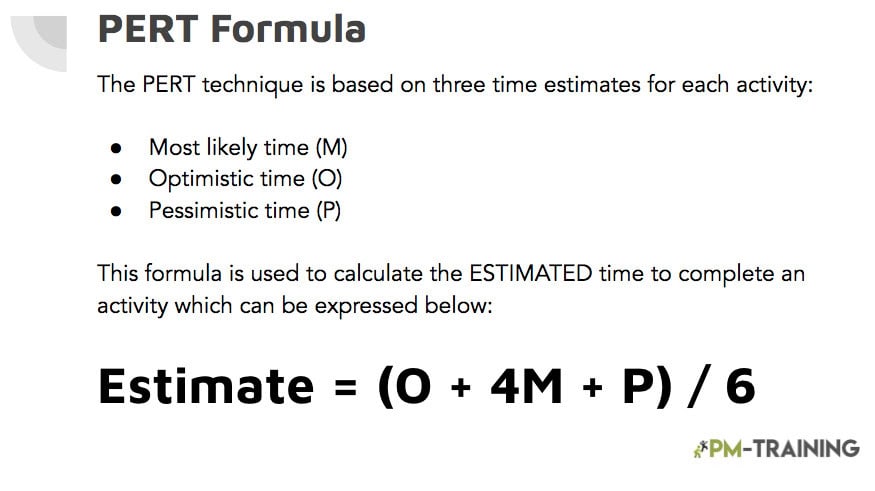
To apply the PERT formula, you gather three time estimates for each activity (optimistic, most likely, and pessimistic). These estimates are combined to calculate an expected duration for each activity and, ultimately, for the overall project schedule. Using these expected durations, you can build a PERT network, identify the critical path, and calculate the overall project completion time with greater confidence.
Benefits of PERT
Using the PERT formula helps project managers produce a clearer, more reliable estimate of a project’s timeline and budget. Estimating the time required for each activity can be difficult, but PERT mitigates that uncertainty by incorporating three time estimates, including optimistic, most likely, and pessimistic, into a single expected duration. This probabilistic approach yields a more realistic average and improves planning and budgeting accuracy.
Example of PERT Formula in Project Management
So how does the PERT formula work? Let’s take a look at an example.
- Say you are planning a party and you need to buy some supplies.
- You estimate that it will take you 3 hours to buy the supplies, but you want to account for any unforeseen delays.
- Using the PERT formula, you would first come up with an optimistic estimate (2 hours), a pessimistic estimate (4 hours), and a most likely estimate (3 hours).
Considering the formula above, it can be represented in this way.
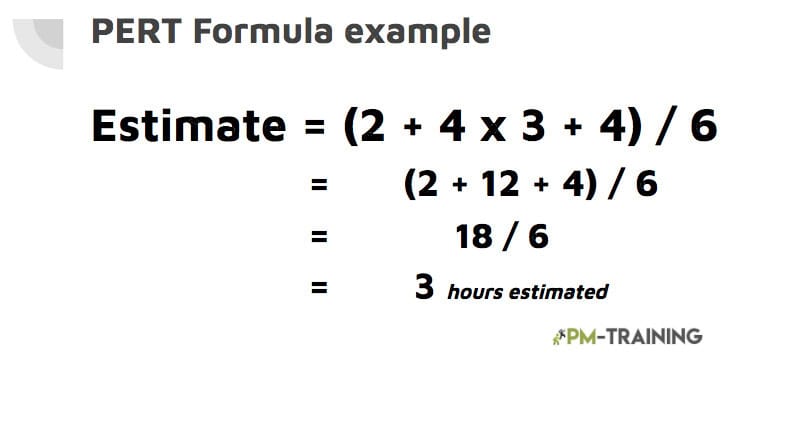
Therefore, 3 hours is the estimated amount of time your supplies for your party will be delivered using the average of the pert formula
CPM Formula Explained in Project Management
The Critical Path method is a popular project management technique used to schedule and organize complex projects. The method is based on the concept of the longest path through a network of activities. This path is referred to as the Critical Path, and it represents the minimum amount of time needed to complete the project. A critical path has the following attributes:
- It has no slack or float time.
- It consists of dependencies between tasks.
- It links together all the tasks in the project.
Benefits of CPM
The Critical Path Method (CPM) is a project-management technique for identifying the sequence of activities that determines a project’s minimum completion time. CPM highlights which tasks have zero slack and therefore cannot be delayed without extending the overall schedule. It also helps pinpoint activities most likely to cause delays, exposing potential bottlenecks and risks. With a clear understanding of the critical path, project managers can prioritize resources, monitor high-impact tasks more closely, and take targeted actions to keep the project on schedule.
Example of CPM
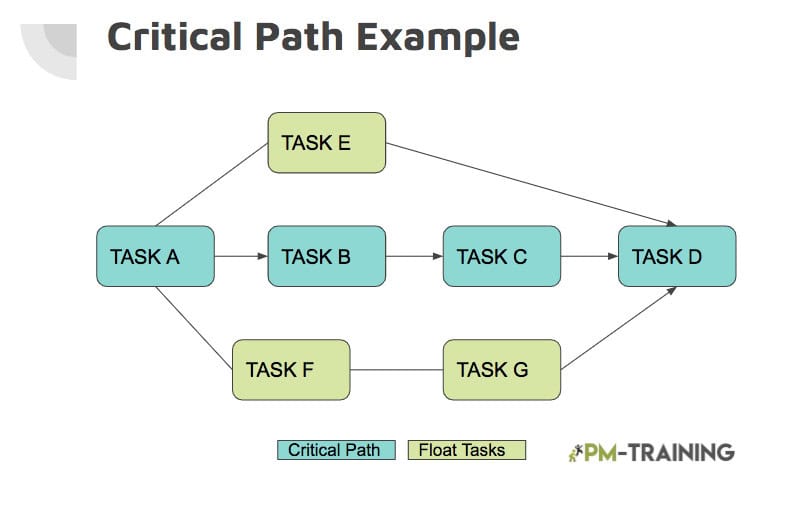
To create a critical path, first identify the dependencies between tasks and then sequence tasks according to those dependencies. Next, determine which activities have float (slack) and which are critical — critical tasks have zero float and directly affect the project’s minimum completion time. In the example below, there are four tasks: A, B, C, and D. The green elements indicate dependencies, while the yellow elements denote tasks that possess float.
- The critical path is the sequence A-B-C-D.
Task A cannot begin until Task B is finished. Task B must be completed before Task C can start, and Task D is dependent on the completion of Task C. This sequence illustrates a chain of finish-to-start dependencies. By contrast, Tasks E, F, and G have float (slack) and can be scheduled earlier or later without affecting the project’s overall duration.
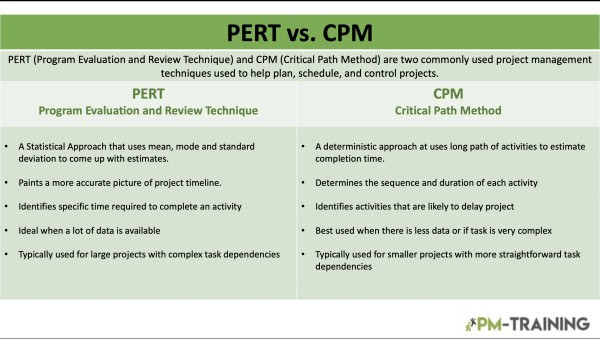
PERT vs CPM
Both of these methods can be useful in different situations, but there are also some key differences between PERT and CPM charts:
- PERT (Program Evaluation and Review Technique) is a probabilistic method that uses optimistic, most likely, and pessimistic estimates to calculate expected task durations and quantify schedule uncertainty. It is particularly useful when historical data or expert estimates are available for similar tasks and when projects involve significant uncertainty or complex dependencies.
- The Critical Path Method (CPM) is a deterministic scheduling technique that identifies the longest sequence of dependent activities (the critical path) to determine the project’s minimum completion time. CPM is well-suited to projects where task durations are more certain or when a clear, fixed schedule is required.
- In practice, PERT is often applied to larger, high-uncertainty projects with multiple interdependent tasks, because it captures variability and schedule risk. CPM is commonly used for smaller or more routine projects with straightforward dependencies, where a single, deterministic timeline is sufficient.
Video About the Difference Between PERT and CPM
Watch this concise explainer to quickly understand how PERT and CPM differ, when to use each method, and how they complement one another in project scheduling. The video breaks down key concepts with clear examples so you can apply them to your next project planning session.
Conclusion
PERT and CPM are complementary scheduling tools: PERT adds probabilistic estimates to account for uncertainty, while CPM identifies the deterministic critical path and highlights tasks with zero slack. Use PERT when project durations are uncertain or expert judgment and risk analysis are needed; choose CPM for clearer, routine projects where fixed durations and resource prioritization matter. In practice, combining both approaches often yields the best results—use PERT to quantify schedule risk and CPM to manage day-to-day execution and resource allocation.
By understanding each method’s strengths, project managers can create realistic timelines, anticipate delays, and focus attention on tasks that truly influence delivery. Applying these techniques thoughtfully improves planning accuracy, reduces surprises, and increases the likelihood of on-time project completion.
Frequently Asked Questions
What is the PERT formula?
The Program Evaluation and Review Technique (PERT) is a probabilistic network-analysis method used to estimate activity durations and overall project timelines. For each task, PERT uses three time estimates—optimistic, most likely, and pessimistic—to calculate an expected duration. Although PERT does not guarantee perfect accuracy, its three-point approach improves the reliability of schedule forecasts and helps project managers account for uncertainty.
What is the Critical Path Method?
The Critical Path Method (CPM) is a deterministic scheduling technique that identifies the longest sequence of dependent activities, which determines the minimum project duration. CPM models task dependencies and sequencing to reveal which activities are critical (have zero float) and therefore cannot be delayed without extending the project finish date.
What are the main differences between CPM and PERT?
- Focus: CPM is deterministic and emphasizes the critical sequence that sets the project’s minimum completion time. PERT is probabilistic and emphasizes estimating durations under uncertainty.
- Estimates: CPM typically uses single-point duration estimates. PERT uses three-point estimates (optimistic, most likely, pessimistic) to derive an expected duration and quantify schedule uncertainty.
- Typical use cases: CPM is commonly applied in projects with well-understood task durations (e.g., construction or routine engineering). PERT is better suited to research-driven or high-uncertainty projects where task durations are uncertain.
- Outcome: CPM highlights critical tasks and float for resource prioritization; PERT provides a probabilistic view of likely completion times and schedule risk.
How should I choose between CPM and PERT?
Use CPM when task durations are reliable, and you need a clear, deterministic schedule for execution and resource planning. Use PERT when activity durations are uncertain, and you want to quantify schedule risk and probable completion dates. In many projects, combining both approaches—using PERT to estimate durations and CPM to identify the critical path—yields the best results.
Suggested articles:
- PERT Formula Examples & PERT Calculator
- Critical Path Method Scheduling: What? Why? and How?
- Free Project Estimation Template with 6 Options

Shane Drumm, holding certifications in PMP®, PMI-ACP®, CSM, and LPM, is the author behind numerous articles featured here. Hailing from County Cork, Ireland, his expertise lies in implementing Agile methodologies with geographically dispersed teams for software development projects. In his leisure, he dedicates time to web development and Ironman triathlon training. Find out more about Shane on shanedrumm.com and please reach out and connect with Shane on LinkedIn.