
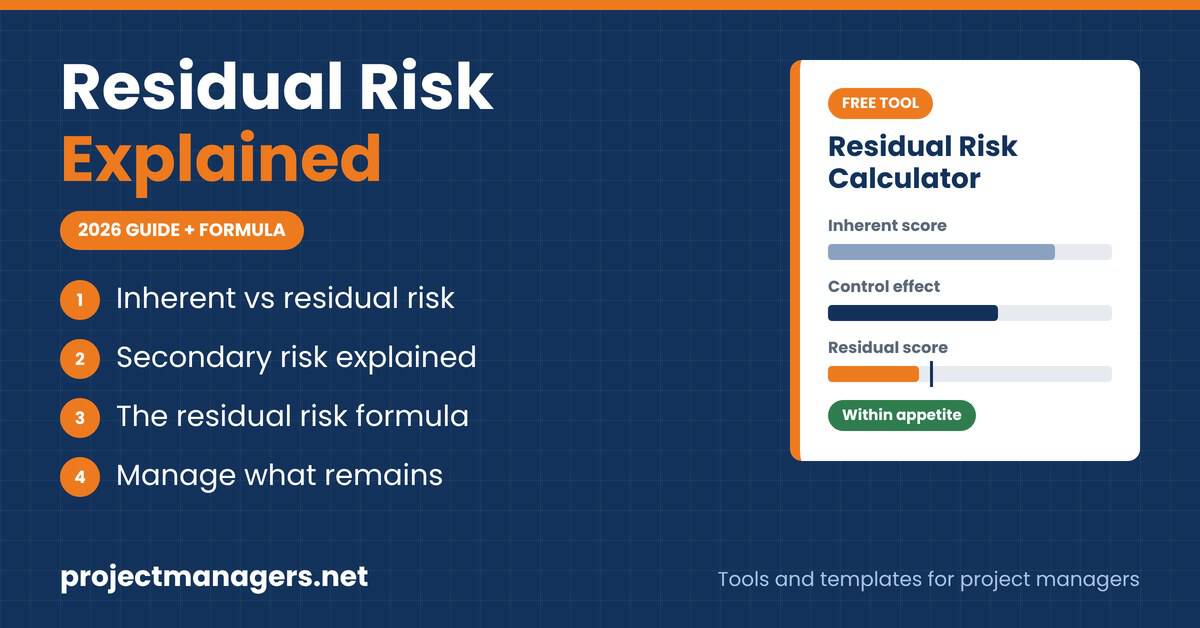
Within the field of project management, the assessment of risk exposure is crucial. It’s the most important process to ensure an optimal outcome. This article discusses residual risk, or threats that remain with that outcome after its development phase is complete.
- Residual risk is the risk left after your planned responses are in place, plus any risk you chose to accept. It is rarely zero, so a project manager has to decide what to do with it.
- Secondary risk is different: it is a new risk created by the response itself, like a worker falling into the trench dug to keep animals out.
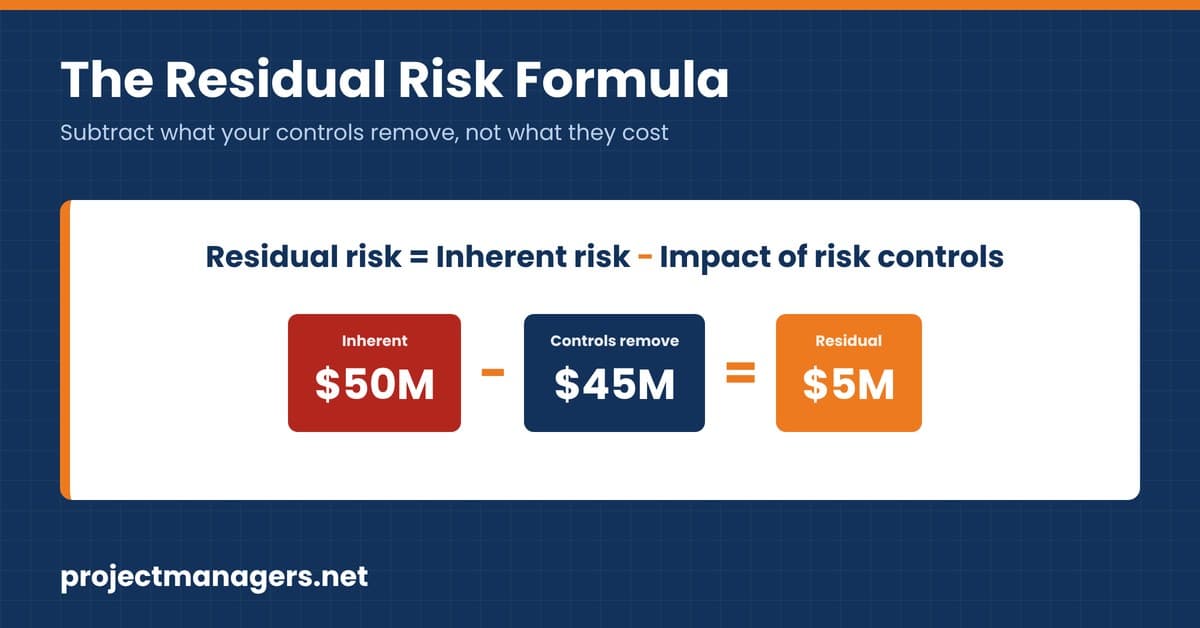
- Residual risk = inherent risk minus the impact of risk controls. Subtract what the controls remove, not what they cost.
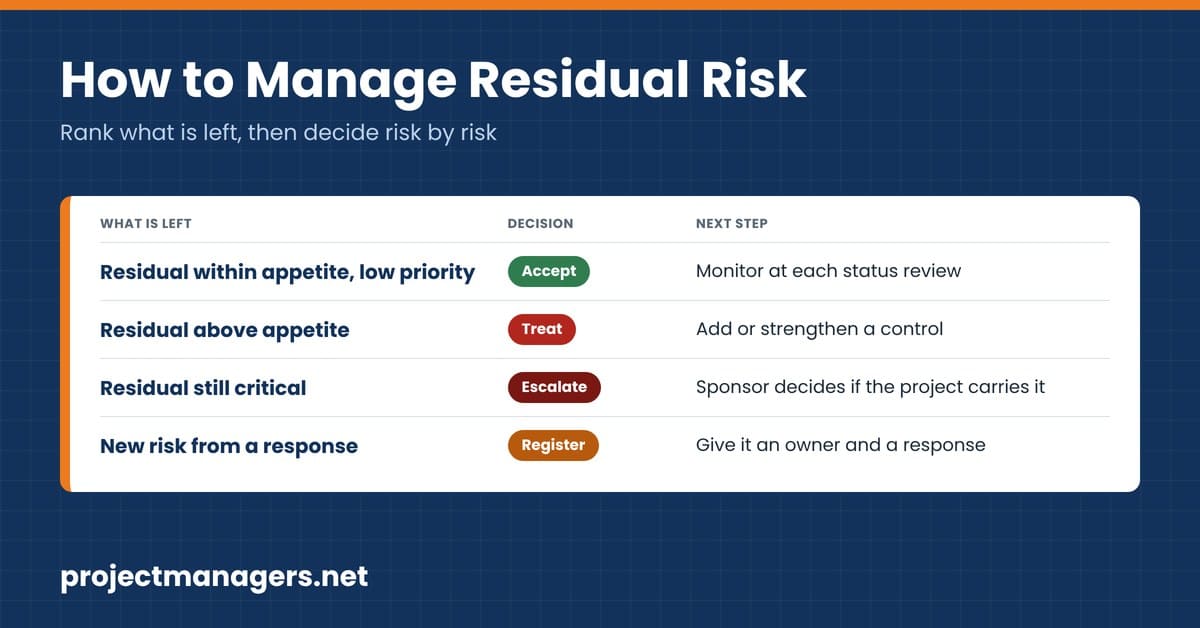
- Compare each residual risk with your risk appetite, then accept and monitor it, treat it again or escalate it. The free Residual Risk Calculator below does this for every risk on your project.
Project Management Institute (PMI) defines residual risk as:
Residual risks that are expected to remain after planned responses have been taken, as well as those that have been deliberately accepted
PMBOK® Guide, 6th edition, ch. 11.5.3.3
Inherent Risk vs Residual Risk
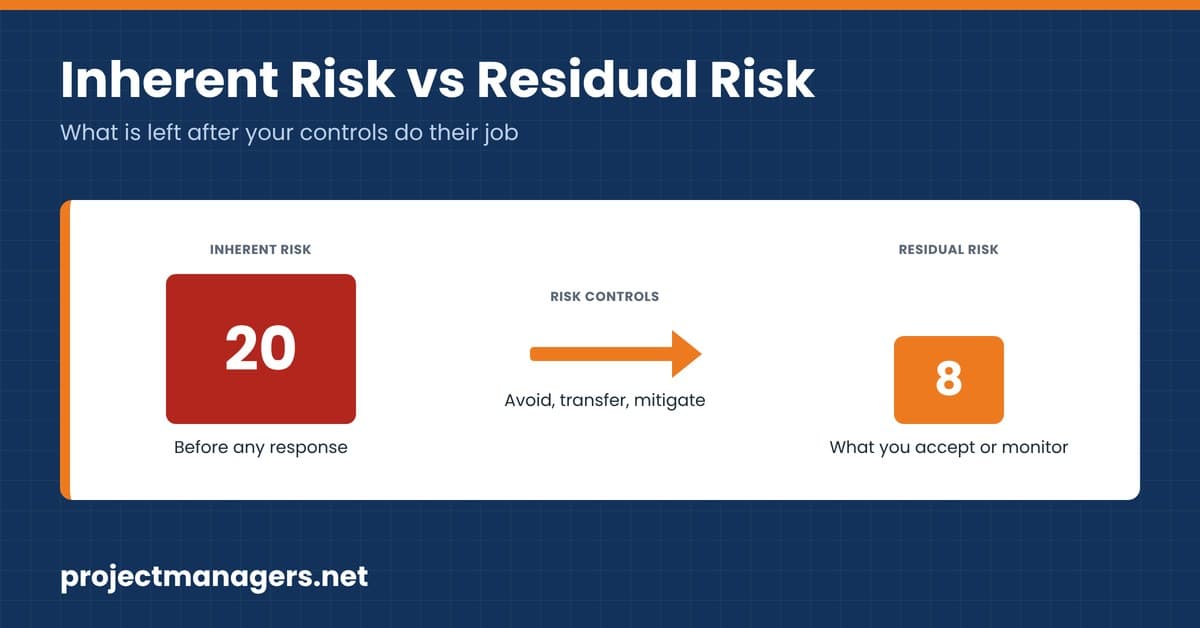
While the inherent risks to any given project are as numerous as they are diverse, a project manager must possess a firm understanding of the key risks that remain after the project is finalized. This type of risk that remains after every action was taken to address all preventable threats to a project’s outcome is known as residual risk.
As a project manager, the first task at hand is to deliver the anticipated and promised results while identifying and mitigating risks that could potentially derail those results from being rendered successfully.
Concerning risk to outcome, a project manager is expected to identify and eliminate threats to the project wherever possible. If certain risks cannot be eliminated entirely, then the security controls introduced must be effective in reducing the negative impact should any threat to the project occur.
Once the inherent risks are mitigated, the sum of the remaining risks is residual risk, or any potential threats that remain after all possible measures and controls have been implemented to secure a project.
Real-life example
Fukushima Daiichi: designed for one tsunami, hit by a larger one
TEPCO first set the design basis tsunami for Fukushima Daiichi at 3.122 meters, then raised it to 5.4 to 6.1 meters using a 2002 evaluation method. The tsunami of March 11, 2011 reached about 13 meters at the site. The seawall and pumps reduced the risk the engineers had modeled; any tsunami above that design basis was residual risk.
Source: TEPCO, Fukushima Nuclear Accidents Investigation Report summary
For project managers: write down the event size each control is designed for. Anything bigger is residual risk, and it needs an owner and a decision, even if that decision is to accept it.
From the source
“Portion of risk remaining after security measures have been applied”
NIST definition of residual risk, in the NIST CSRC glossary
By the numbers
Risk Management Process
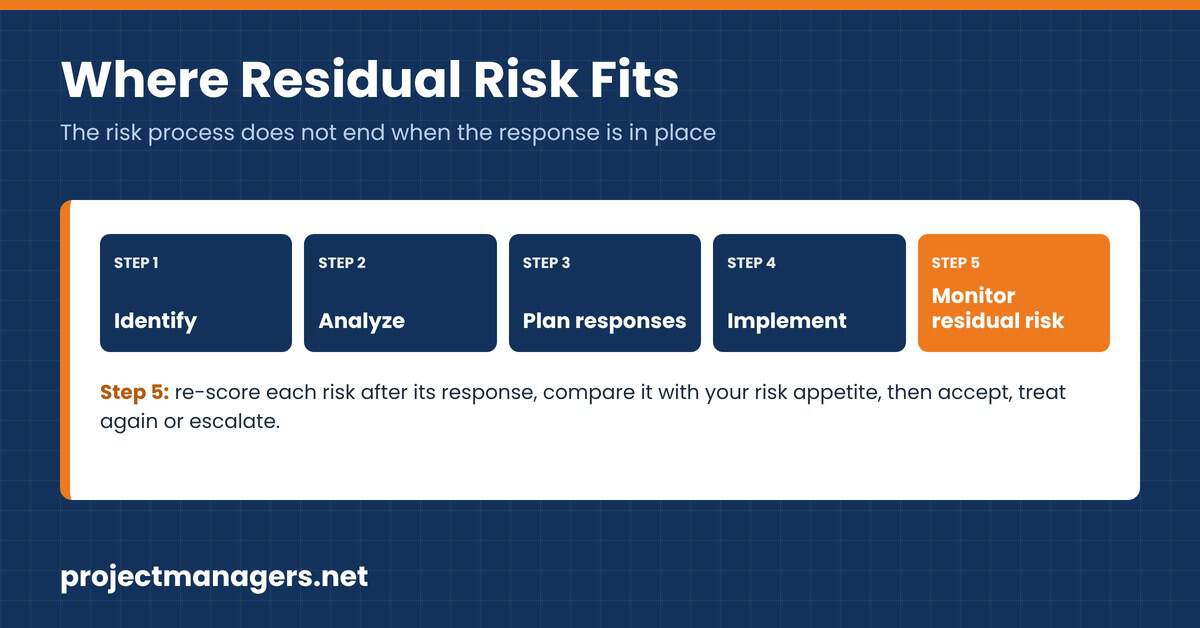
Risk management entails a multi-staged process of “identification, analysis, response planning, and implementing responses to risks on a project.” Project Management Body of Knowledge (6th edition, ch. 11).
But that process does not explicitly account for the residual risks that remain inherent to the project after it is complete. How, then, does one estimate and identify residual risk? To begin with, the process is not significantly different than the steps a project manager takes in tailoring considerations of primary (or inherent) risk exposure to a project’s outcome. Indeed, the two are interrelated.
A determination of residual risk is dependent upon the size and complexity of the project, foremost, and, secondarily, the development approach, along with the overall significance of the project to the organization. Similarly, an effective assessment of residual risk is reliant upon the use of “data analysis techniques” such as “root cause analysis” and “assumption and constraint analysis” as these strategies are defined in the PMBOK®, 6th edition, ch. 11.2.2.3.
Real-life example
Capital One moved to the cloud before its risk process caught up
In 2019 an outsider exploited a misconfigured web application firewall and took data linked to more than 106 million accounts from Capital One’s cloud environment. The bank’s regulator, the OCC, fined it $80 million, pointing to a missing risk assessment before the migration, not to the cloud itself. Without that step, nobody knew how much risk was left after the controls were switched on.
Source: Banking Dive, Capital One to pay $80M penalty
For project managers: add a “re-score after response” step to your risk register and review it at every phase gate, not just at kickoff.
From the source
“failure to establish effective risk assessment processes”
Office of the Comptroller of the Currency, as reported by Banking Dive
By the numbers
- $80Mcivil penalty from the OCC for the risk management failures behind the breach.Banking Dive
- 106M+accounts were affected by the 2019 breach.Banking Dive
Different Types of Risk

Aside from inherent risk, there’s another type of risk that arises after a project manager takes action to reduce inherent (or primary) risk called secondary risk.
Primary Risks = Inherent Risks
Within the project management field, there can be, at times, a mixing of terms. So, to be clear, primary risk and inherent risk are definitionally one and the same.
Secondary Risks vs Residual Risks
Secondary risk, on the other hand, is a risk that emerges as a direct result of addressing an inherent risk to a given project. It is not a risk that results from an initial threat the project manager has identified. Instead, it is a threat that emanates from the risk controls and methods deployed to mitigate primary or inherent risk.
To offer a base example, consider a construction crew that has dug a trench to prevent the encroachment of dangerous animals on their site. There is a secondary risk that the workers may fall into this trench and become injured, but the risk is marginal. This constitutes a secondary risk. Likewise, other more familiar types of secondary risk one might encounter have to do with the recent and significant disruptions to the supply chain.
If a project manager elects to order supplies from overseas to cut costs, there is a secondary risk that those supplies may not arrive on time, extending the project unnecessarily and, thus, eliminating those savings.
| Type of risk | Where it comes from | Trench example | What the project manager does |
|---|---|---|---|
| Inherent (primary) risk | The project itself, before any response | Dangerous animals enter the site | Identify, analyze and plan a response |
| Residual risk | What is left of the original risk after the response | Some animals still get past the trench | Compare with risk appetite, then accept and monitor, treat again or escalate |
| Secondary risk | A new risk created by the response | A worker falls into the trench | Add it to the risk register with its own owner and response |
Real-life example
The CrowdStrike outage: a security tool took down 8.5 million computers
On July 19, 2024, a faulty content update to CrowdStrike’s Falcon sensor, software installed to reduce cyberattack risk, crashed Windows machines at airlines, banks and hospitals. It is a textbook secondary risk: the response to one threat created a new one that had its own likelihood and impact, and few registers listed it.
Source: Microsoft, Helping our customers through the CrowdStrike outage
For project managers: for every response you plan, ask “what new risk does this create?” Staged rollouts and a rollback plan are the usual responses to that secondary risk.
From the source
“the broad economic and societal impacts reflect the use of CrowdStrike”
David Weston, Microsoft vice president of enterprise and OS security, on the Official Microsoft Blog
By the numbers
- 8.5MWindows devices were affected by the faulty update.Microsoft
- <1%of all Windows machines, yet the outage still halted flights and services worldwide.TechCrunch
Examples of Residual Risk
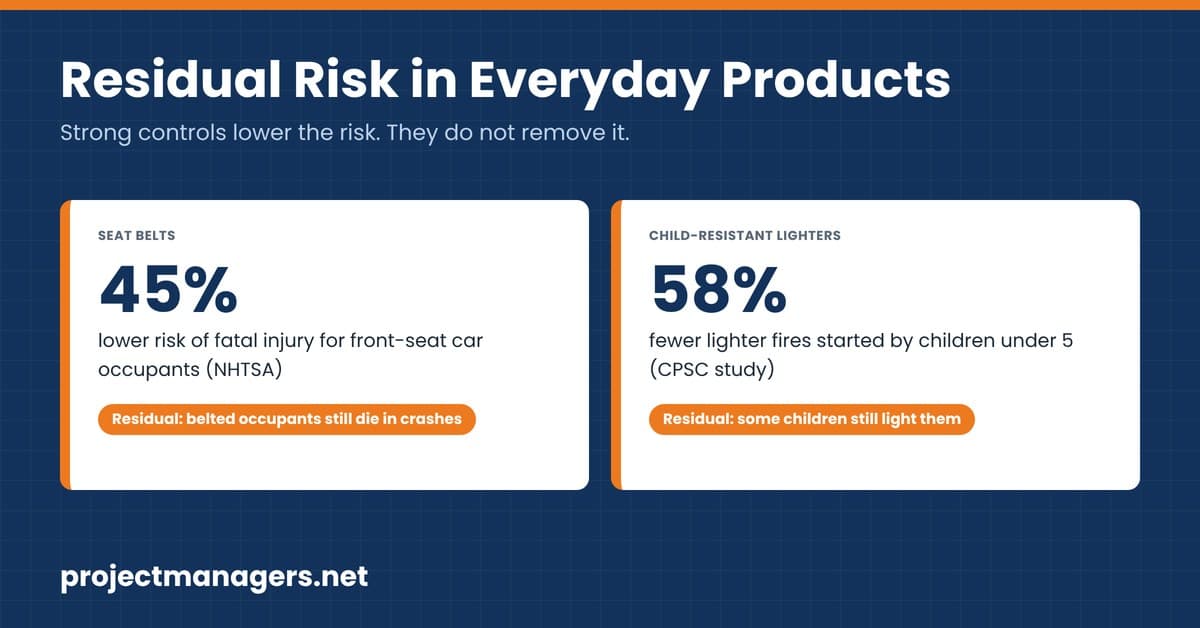
Having clarified how residual risks differ from risks inherent to the development of a project, it’s helpful to discuss a few specific real-world examples of what constitutes residual risk. Let’s take the case of the automotive seatbelt. Cars, of course, are a product of the late-stage Industrial Revolution. As automobile engines became more powerful, accidents associated with driving at speed became more serious. Before 1964, front-seat lap belts were not considered standard equipment on cars.
As substantial consumer product research was generated in the effort to mitigate serious injury in the case of a car accident, it became clear that the use of seat belts is highly effective in helping prevent bodily injury. Now, in the course of the project, an engineer can produce a reliable seatbelt. But they cannot, in the unfortunate event of an accident, prevent all matters of injury to drivers and passengers in a vehicle.
While the prospects of injury were indeed mitigated, they still linger, even as seat belts are properly used. This phenomenon constitutes a residual threat. Or, taking, for example, another scenario: one can design a childproof lighter. However, it’s widely understood that such a design does not prevent every child in the world from igniting such a lighter and causing a hazard.
Therefore, post-development, there will always be an element of residual risk to the outcome of the childproof lighter and its intent.
Real-life example
Child-resistant lighters: fewer fires, not zero fires
The U.S. Consumer Product Safety Commission made disposable lighters child resistant in 1994. A CPSC study later found a 58% reduction in fires started by children under 5, relative to older children, and estimated that the standard prevented about 3,300 fires and 100 deaths in 1998 alone. The control worked, and the agency still told parents to keep lighters out of reach: that advice is how it handled the residual risk.
Source: Smith, Greene and Singh, Injury Prevention (2002)
For project managers: pair every strong control with a second, lighter measure for what it misses, such as a warning, a check or a fallback plan.
From the source
“It means that some kids are going to be able to light the lighter”
Ken Giles, CPSC spokesman, in HealthDay
By the numbers
- 45%lower risk of fatal injury for front-seat passenger car occupants who wear lap and shoulder belts.NHTSA
- 58%reduction in lighter fires started by children under 5 after the CPSC standard.Injury Prevention
Calculating the Residual Risk Formula
This article has discussed how to begin factoring residual risk in the early stages of a project; however, a specified formula exists that project managers can use to help gauge and calculate the overall impact of residual risk after the project development phase is complete.
It’s a simple equation that goes as follows:
Residual Risk = (Inherent Risk) – (Impact of Risk Controls)
To apply this formula, one must have a thorough understanding of what constitutes a project’s inherent risks. In project management, the term “inherent risks” should be regarded as little more than risks that are almost universally present, based on an established precedent, concerning what is already known about the execution of previous similar projects.
While no two projects are exactly alike, the desired outcome for most projects is likely one that has been achieved several times over. Indeed, there will be breakthrough projects for which there is little established precedent, but those kinds of tasks are substantially more uncommon. In other words, the specific nature of the project, in most cases, is already known, and so are the development threats inherent to it.
Adding Risk Controls
Risk controls are the measures taken to reduce a project’s risk exposure. Consequently, the impact (or effectiveness) of your risk controls dictates the mitigation of inherent risk. Once the inherent risk to a project has been fully identified using the steps previously outlined above, the risk controls are determined.
After a project’s resources have been evaluated and its risk controls are selected and put into effect, it will be possible to assess the impact those controls will have on any potential threats. With the inherent risk known and the impact of risk controls evaluated, the above formula can be calculated to show the residual risk that will remain after a project’s development phase has concluded.
Residual Risk Formula Example
To offer an example of how this formula is used in terms of dollars, let’s assume the inherent risk of a project is estimated at $50 million. The risk controls are estimated to reduce that exposure by $45 million. Following the simple equation above ($50 million – $45 million), the estimated costs associated with residual risk will be $5 million.
| Step | What you estimate | Example |
|---|---|---|
| 1. Inherent risk | Expected loss with no controls in place | $50 million |
| 2. Impact of risk controls | The share of that loss the controls remove (not what the controls cost) | $45 million (90% effective) |
| 3. Residual risk | Inherent risk minus impact of controls | $5 million |
| 4. Decision | Compare the residual risk with your risk appetite | Accept and monitor, treat again or escalate |
The cost of a control matters for deciding whether it is worth buying, but it is not part of the residual risk formula.
Real-life example
Breach costs fall when controls work faster
IBM’s 2025 Cost of a Data Breach Report found the global average breach cost fell for the first time in five years, to $4.44 million, mainly because organizations found and contained breaches faster. Organizations that used security AI and automation extensively saved an average of $1.9 million per breach. That saving is the “impact of risk controls” in the formula; what is left is the residual risk.
Source: IBM, 2025 Cost of a Data Breach Report
For project managers: when you put a dollar figure on a control, record where it came from (a benchmark, a vendor claim, your own history) so the residual figure can be challenged.
By the numbers
- $4.44Mglobal average cost of a data breach in 2025, down 9% from $4.88 million.IBM
- $1.9Maverage saving per breach for organizations using security AI and automation extensively, with an 80-day shorter breach lifecycle.Help Net Security
Free Residual Risk Calculator
Use the calculator to apply the formula to every risk on your project. It opens with a cloud migration example so you can see how it works.
- Pick your risk appetite: the highest residual score (1 to 25) your sponsor will accept without more treatment.
- For each risk, rate likelihood and impact with no response in place. That is the inherent score.
- Describe the control or response and rate how well it works. Add the cost if the risk happens to see the formula in money.
- Read the decision for each risk, then copy the summary, download the CSV for your risk register or print the result.
Residual Risk Calculator
Score each risk before and after your controls, compare what is left with your risk appetite, and get a decision for every risk: accept and monitor, treat further or escalate. Secondary risks created by your responses are listed too.
Loading the calculator…
Runs in your browser. Nothing you enter is stored or sent. Control effectiveness is your judgment: test important controls before you rely on them.
Effectively Managing Residual Risk
In project management, the key to mitigating and managing residual risk is determined by how well the risk was assessed overall in the early stages of the project. If all types of risk are well analyzed and addressed at the outset, the project manager is better prepared to minimize the presence of residual risk.
When there are no measures taken to mitigate all risk exposure at the start of a project, this opens the door to high levels of residual risk. Should this situation arise, the project manager must take additional steps to bring the residual risk to a reasonable and acceptable level. To successfully manage residual risk, consider the following suggestions:
- Bolster Cybersecurity: The objective is to eliminate as many privacy risks as possible through individualized encryption keys to protect cloud data.
- Brace for the Unexpected: Evaluate your project from all angles to anticipate surprise changes to ensure you have all the tools you need in the event of a crisis.
- Strong Organizational Communication: Even if the strategies for reducing risk exposure are strong, they won’t be effective without implementing consistent communication with the entire team.
Because there is a tendency among project managers to focus only on inherent risks, it’s not uncommon for residual risks to be ignored entirely. In these situations, a project manager will not have a response plan in place at all. Because secondary and residual risks are equally important, this is a mistake to be avoided at all costs.
If there isn’t an adequate holistic assessment of a project’s risk exposure, this usually spells doom for the success of its outcome. This is precisely why every aspect of risk and each potential threat to a project must be evaluated vigorously at the forefront of every project. Moreover, each risk should be categorized and ranked according to its priority.
If a risk presents as a low-priority risk, it should be labeled as an area to monitor. Should a given risk be deemed a high priority, a clear and direct risk response plan must be set in place to mitigate the threat. If these measures are adhered to strictly, the project manager will be most effective in reducing the presence of residual risk after the development phase of a project comes to a close.
Real-life example
Levees: the classic residual risk that people forget
FEMA tells communities that every levee carries residual risk, because a larger flood can overtop it or the levee can fail. People living behind levees often assume they are fully protected, so FEMA asks local officials to keep explaining the remaining risk, keep flood insurance in place and plan evacuation routes. A residual risk only stays managed if the people exposed to it keep hearing about it.
Source: FEMA, Levee Risk and Mitigation for Community Officials
For project managers: report accepted residual risks in every status report, not only open ones. Sort them with the risk categories so the right stakeholders see the right ones.
From the source
“Levees MAY reduce the risk from flooding events, but they do not eliminate flood risk.”
By the numbers
- 56%of the money at risk on projects (US$75 million of every US$135 million) is at risk because of ineffective communications.PMI Pulse of the Profession
- 1 in 5projects is unsuccessful due to ineffective communications.PMI Pulse of the Profession
Residual Risk Quiz
10 questions on residual risk
Check what you learned. Pick an answer, then open the explanation.
According to PMI, which risks count as residual risks
- AOnly risks nobody identified
- BRisks expected to remain after planned responses, plus risks deliberately accepted
- CRisks created by a response
- DRisks that have already occurred
Show answer
Answer B. The PMBOK Guide, 6th edition, includes both the risk left after planned responses and the risk you chose to accept.
A crew digs a trench to keep animals off the site, and a worker could fall into it. What type of risk is the fall
- AInherent risk
- BResidual risk
- CSecondary risk
- DAccepted risk
Show answer
Answer C. The fall risk did not exist before the response. A new risk created by a response is a secondary risk.
In the same example, some animals still get past the trench. What type of risk is that
- AResidual risk
- BSecondary risk
- CPrimary risk created by the trench
- DAn issue
Show answer
Answer A. It is what is left of the original risk after the response, so it is residual risk.
What is the residual risk formula
- AInherent risk + impact of risk controls
- BInherent risk x likelihood
- CInherent risk – impact of risk controls
- DCost of controls – inherent risk
Show answer
Answer C. Residual risk = inherent risk minus the impact of risk controls.
Inherent risk is $50 million and the controls remove $45 million of it. What is the residual risk
- A$5 million
- B$45 million
- C$50 million
- D$95 million
Show answer
Answer A. $50 million – $45 million = $5 million. Subtract what the controls remove, not what they cost.
Primary risk is another name for
- AResidual risk
- BInherent risk
- CSecondary risk
- DRisk appetite
Show answer
Answer B. Primary risk and inherent risk mean the same thing.
According to NHTSA, by how much do lap and shoulder belts reduce the risk of fatal injury to front-seat passenger car occupants
- A15%
- B30%
- C45%
- D90%
Show answer
Answer C. NHTSA puts the reduction at 45%. The rest of the risk is residual.
A residual risk score is above your risk appetite. What is the best next step
- AIgnore it, the response is done
- BTreat it further or get it formally accepted or escalated
- CDelete it from the risk register
- DDouble the inherent score
Show answer
Answer B. Above-appetite residual risk needs more treatment, or a formal decision from someone with the authority to accept it.
In July 2024 a faulty update to a security tool crashed about 8.5 million Windows devices. In risk terms, the outage was
- AA residual risk of the original cyber threat
- BA secondary risk created by a security control
- CAn inherent risk of Windows
- DNot a project risk
Show answer
Answer B. The security software was a risk response. The outage was a new risk created by that response.
What should happen to a low-priority residual risk
- AIt should be monitored
- BIt should be removed from the register
- CIt needs a full response plan before work continues
- DIt should be escalated to the sponsor
Show answer
Answer A. Low-priority residual risks are labeled as areas to monitor. High-priority ones need a clear response plan.
Video: Residual Risk and Secondary Risk
Mike Clayton explains the difference between residual risk and secondary risk in under six minutes, with examples a project manager can use when filling in a risk register.
Video by Online PM Courses – Mike Clayton on YouTube: Beware! What are Residual Risk and Secondary Risk?
Facts Worth Checking
Each claim is checked against the original source where one exists.
| Claim | Verdict | What the source says |
|---|---|---|
| With enough controls, residual risk drops to zero. | False | FEMA states that levees may reduce flood risk but do not eliminate it, and NIST defines residual risk as the portion that remains after controls. FEMA |
| NIST defines residual risk as the risk remaining after security measures are applied. | True | The NIST glossary gives that definition, citing CNSSI 4009 and NIST SP 800-30. NIST CSRC |
| With $50M of inherent risk and $5M of risk controls, the residual risk is $5M. | False | The formula subtracts the impact of the controls. $5M of impact would leave $45M. This article now uses controls that remove $45M, which leaves $5M. TechTarget |
| Secondary risk and residual risk are the same thing. | False | Residual risk is what is left of the original risk. Secondary risk is a new risk created by the response. Project Management Academy |
| Seat belts reduce the risk of fatal injury to front-seat car occupants by 45%. | True | NHTSA reports 45% for fatal injury and 50% for moderate-to-critical injury. NHTSA |
| Child-resistant lighters are childproof. | False | The CPSC standard cut fires started by children under 5 by 58%, and the CPSC said some children can still light them. Injury Prevention |
| A security control can cause a major outage on its own. | True | A faulty CrowdStrike update affected 8.5 million Windows devices in July 2024. Microsoft |
| Fukushima Daiichi was designed for the tsunami that hit it in 2011. | False | The design basis was 5.4 to 6.1 meters, and the tsunami reached about 13 meters. TEPCO |
| Poor communication puts more than half of project money at risk. | True | PMI found 56% of the money at risk (US$75 million of every US$135 million) is at risk due to ineffective communications. PMI |
| Before 1964, front-seat lap belts were not standard equipment on U.S. cars. | True | U.S. automakers began to provide front-seat lap belts by 1964, and federal standards made belts mandatory in 1968. Prairie Public |
Checked November 12, 2026.
Residual Risks FAQ
How are residual risks identified?
After putting risk controls in place, you should assess the controls and risk responses and try to identify the impacts of these risk responses. Re-score each risk with its response in place: whatever likelihood and impact are left is the residual risk.
What is meant by residual risk?
Residual risks are those expected to remain after planned responses have been taken, as well as those that have been deliberately accepted (PMBOK Guide, 6th edition).
What is an example of residual risk?
A residual risk example is designing a childproof lighter. It’s widely understood that such a design does not prevent every child in the world from igniting such a lighter and causing a hazard. This would be considered residual risk.
What is secondary risk and residual risk?
Secondary risk is a risk that emerges as a direct result of addressing an inherent risk to a given project. Residual risk is what is left of the original risk after the response. Secondary and residual risks are equally important, and risk responses should be created for both.
How do you calculate residual risk?
Use residual risk = inherent risk – impact of risk controls. If a risk would cost $50 million with no controls and the controls remove $45 million of that exposure, the residual risk is $5 million. With scores, multiply likelihood by impact and reduce it by the effectiveness of the control.
Can residual risk be zero?
In practice, almost never. Even strong controls such as seat belts or levees reduce risk without removing it. The goal is to bring residual risk within the risk appetite agreed with your sponsor, then accept and monitor it.
What is the difference between residual risk and risk appetite?
Residual risk is how much risk is left. Risk appetite is how much risk the organization is willing to accept. When residual risk is above the appetite, the project manager treats the risk further or escalates it for a decision.
Suggested articles:
- Risk Acceptance in Project Management
- Managing AI-Specific Cybersecurity Risks in Project Planning and Execution
- Risk Management Process Template for Project Managers
- Free Risk Register Templates
- Common Operational Risks and How to Address Them Effectively

Shane Drumm, holding certifications in PMP®, PMI-ACP®, CSM, and LPM, is the author behind numerous articles featured here. Hailing from County Cork, Ireland, his expertise lies in implementing Agile methodologies with geographically dispersed teams for software development projects. In his leisure, he dedicates time to web development and Ironman triathlon training. Find out more about Shane on shanedrumm.com and please reach out and connect with Shane on LinkedIn.