
A career in project management can take many different forms. Depending on your industry, experience level, and area of expertise, you may find yourself drawn to the Scrum Master role, the Project Manager role, or even both. Each path offers distinct responsibilities and requires a different way of thinking about how work gets done. Understanding what sets them apart is the first step toward making a confident career decision.
This article breaks down the key similarities and differences between these two roles, covering everything from day-to-day responsibilities and salary expectations to certifications and long-term career paths. Whether you are just starting or considering a shift in direction, the comparison below will help you figure out which role fits your goals.
Who Is a Scrum Master?
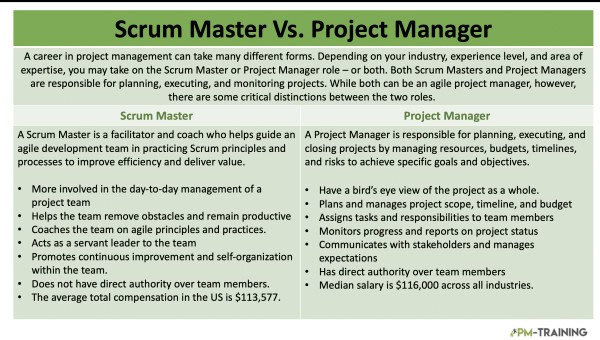
In Agile methodology, a Scrum Master serves as a facilitator and coach for the Scrum Team. The primary responsibility of the role is to ensure the development team follows Scrum principles and practices correctly, with a shared understanding of what those practices require. The Scrum Master also removes any obstacles that prevent the team from meeting their Sprint Goals or maintaining project momentum.
Unlike a traditional software development manager, the Scrum Master holds no direct authority over the team. They guide through influence, communication, and conflict resolution rather than top-down direction. Success in this role depends heavily on interpersonal skills, the ability to read team dynamics, and the capacity to keep work moving without micromanaging how it gets done.
Who Is a Project Manager?
A Project Manager oversees the planning, execution, and completion of a project from start to finish. They are accountable for delivering work on time, within budget, and to the required standard of quality. Strong organizational skills, the ability to communicate across departments, and the capacity to motivate teams under pressure are all core requirements for anyone in this role.
In larger organizations, a Project Manager may oversee several projects at once, coordinating resources and timelines across multiple workstreams. The scope of the role can vary significantly depending on the industry and organization size, but the focus on outcomes, deadlines, and accountability remains consistent regardless of context.
Key Similarities and Differences of the Roles of a Scrum Master and a Project Manager
Both Scrum Masters and Project Managers are involved in planning, executing, and monitoring project work. Both roles require strong communication skills and the ability to manage project teams, and more so, work effectively with cross-functional teams. At the same time, the way each role operates day-to-day and what each person is held accountable for differ quite a bit.
The following points highlight where the two roles align and where they diverge most clearly:
- Day-to-Day Involvement: Scrum Masters are closely embedded in the team’s daily rhythm, facilitating standups, retrospectives, and sprint planning. Project Managers typically maintain a higher-level view, tracking milestones, budgets, and stakeholder expectations across the full project lifecycle.
- Obstacle Removal vs. Delivery Focus: Scrum Masters are specifically responsible for identifying and removing impediments that block team progress. Project Managers focus on ensuring all deliverables are completed on schedule and within the agreed scope and cost.
- Authority and Influence: Project Managers often carry formal authority over project decisions and resource allocation. Scrum Masters lead through facilitation and coaching rather than positional power, which means their effectiveness depends on the quality of their relationships with the team.
- Conflict Resolution: While both roles require diplomacy, Scrum Masters must be especially skilled at conflict resolution within the team itself. Disagreements over process, priorities, or workload distribution frequently arise in Agile environments, and the Scrum Master is expected to address them directly.
- Framework Dependency: The Scrum Master role is tied specifically to the Scrum framework. A Project Manager can work within Agile, Waterfall, hybrid, or other methodologies, making the role more adaptable across different types of organizations and industries.
Scrum Master vs. Project Manager Salary
Salary differences between the two roles are smaller than many people expect. Industry, project scale, and years of experience all influence what either professional earns, and there is significant overlap at mid-career and senior levels. A few key factors shape how compensation plays out in practice.
The following context helps frame salary expectations across both roles:
- Industry Variation: Project Managers in technology and finance tend to earn more than those in construction or retail, and the same pattern holds for Scrum Masters working in software-heavy industries. The sector you work in often matters as much as the title you hold.
- Project Scale: Professionals managing larger, more complex projects generally command higher pay. This applies to both roles, though Project Managers on enterprise-scale initiatives often see the most significant salary premiums.
- Average Compensation: The average total compensation for a Scrum Master in the US sits around $122,565 per year. The median salary for a Project Manager across all industries is approximately $98,286, reflecting a modest difference between the two roles at the midpoint.
- Specialization Premium: Because the Scrum framework requires specific technical knowledge and certification, Scrum Masters with deep Agile expertise can negotiate competitively, particularly in organizations running complex product development cycles.
- Dual-Role Scenarios: In some organizations, one person fulfills both functions. In those cases, compensation typically falls between the two averages and reflects the added scope of responsibility the individual carries.
Project Manager vs. Scrum Master Certifications
Scrum Master Certifications
Earning a formal certification is one of the most direct ways to establish credibility as a Scrum Master. Hiring managers consistently look for recognized credentials as a baseline indicator of knowledge and commitment. Two certifications appear most frequently in job descriptions and are worth prioritizing early in your career.
These are the most widely recognized options for aspiring Scrum Masters:
- Certified ScrumMaster (CSM): Administered by the Scrum Alliance, the Certified ScrumMaster (CSM) is the most commonly requested Scrum certification in job postings. It requires completing a course and passing an exam, making it accessible for those new to the framework.
- Professional Scrum Master (PSM I): Offered by Scrum.org, this Professional Scrum Master (PSM I) certification does not require formal coursework. Candidates study independently and pass a rigorous exam, which appeals to professionals who prefer a self-directed path to certification.
Project Management Certifications
Project management certifications carry weight across virtually every industry, and employers actively seek candidates who hold them. The two most recognized credentials come from the Project Management Institute and are designed to serve professionals at different stages of their careers.
The following certifications are the most common and widely respected in the field:
- Project Management Professional (PMP): The PMP is one of the most recognized credentials in the profession worldwide. Candidates must have at least three years of project management experience before sitting the exam, making it best suited for mid-career professionals looking to formalize their expertise.
- Certified Associate in Project Management (CAPM): The CAPM is designed for those earlier in their careers. Applicants need a secondary school diploma and 23 hours of project management training to qualify, making it an accessible entry point into formal credentialing.
Beyond these two, many other certifications exist, and some organizations have their own internal requirements. Any credential you earn demonstrates a commitment to professional development that can distinguish your application from others at the same experience level.
Project Manager vs. Scrum Master Career
Career Path and Progression
Both roles offer well-defined career trajectories with room to grow into senior and leadership positions. The paths diverge in terms of the skills they reward most and the types of organizations that offer the most advancement opportunities. Knowing where each road leads helps you decide which one to start down.
Here is how career progression typically unfolds for each role:
- Junior Entry Points: Project Managers typically begin as Project Coordinators or Assistant Project Managers, building experience in scheduling, documentation, and stakeholder communication. Scrum Masters often start as Scrum Master Trainees or Product Owners, developing Agile facilitation skills from the ground up.
- Mid-Career Growth: With experience, Project Managers advance to Senior Project Manager or Program Manager roles, taking on larger portfolios and more complex stakeholder environments. Scrum Masters move into Agile Coach or Product Manager positions, expanding their influence across multiple teams.
- Senior Leadership: Experienced Project Managers can transition into management consulting or executive roles such as Chief Operating Officer or Chief Information Officer. Scrum Masters with a track record of organizational change can reach positions like Director of Agile Transformation, driving Agile adoption at scale.
How to Become a Scrum Master or Project Manager?
The first step is deciding which path you want to pursue, and that decision requires honest research into what each role actually involves day to day. Reading job descriptions, speaking with people in each role, and understanding the environments where each thrives will give you a clearer picture before you commit.
Once you have settled on a direction, earning a certification is the most practical next step. Most employers treat certification as a baseline requirement, so getting one early gives you a credible foundation to build from. From there, experience is what separates candidates who stand out from those who simply have credentials on paper.
Building the right skills takes time and focus. The following areas are worth developing regardless of which path you choose:
- Communication Skills: Both Scrum Masters and Project Managers rely on clear, consistent communication across teams and with stakeholders. Written and verbal clarity directly affect how well you build trust and keep projects on track.
- People Skills: Neither role is purely technical. The ability to understand what motivates team members, navigate disagreement, and maintain morale during difficult stretches is something that makes a real difference in both roles.
- Independent Work Ethic: Scrum Masters in particular often drive projects forward with limited top-down oversight. Getting comfortable working autonomously and making judgment calls without waiting for direction is a skill worth building early.
- Networking: Both roles benefit significantly from a strong professional network. Connecting with peers, attending industry events, and staying current with trends keeps you informed and opens doors that certifications alone cannot.
The path to either role is not short. It takes time, repeated experience across different project types, and a genuine willingness to keep learning. The professionals who advance most quickly are those who treat each project as a chance to develop judgment, not just complete a task.
Conclusion
Scrum Masters and Project Managers both play important roles in delivering successful projects, but they do so in different ways and with different skill sets. Scrum Masters operate within Agile frameworks, coaching teams, and removing obstacles. Project Managers take a broader view, managing scope, budget, timelines, and stakeholder expectations across a full project lifecycle. Neither role is more valuable than the other. The right fit depends on your working style and goals.
If you prefer structured delivery accountability and cross-functional coordination, the Project Manager path likely suits you better. If you are drawn to team dynamics, Agile processes, and servant leadership, Scrum Master work may feel more natural. Pursuing a recognized certification from PMI or the Scrum Alliance is a concrete next step that applies to either path, and further study in project management or Agile practice will only strengthen your position over time.
FAQs About Scrum Masters and Project Managers
Can a Scrum Master also be a Project Manager?
Yes, in some organizations, one person fills both roles simultaneously. This is more common in smaller teams or companies transitioning to Agile, where full role separation is not yet practical. The individual typically earns compensation that reflects the broader scope of responsibility they carry.
Which role pays more, a Scrum Master or a Project Manager?
The difference is small. Project Managers have a median salary of around $116,000, while Scrum Masters average approximately $113,577. Compensation in both roles varies considerably based on industry, company size, and years of experience.
Do I need a certification to become a Scrum Master?
No certification is technically required, but most employers look for credentials like the CSM or PSM I as a baseline. Earning one early signals your commitment to the role and gives you a structured foundation in Scrum principles before you take on a team.
What skills are most important for a Project Manager?
Organizational ability, communication, stakeholder management, and budget oversight are the core requirements. Project Managers also need to be comfortable making decisions under pressure and keeping multiple workstreams moving at the same time without losing sight of the overall goal.
How long does it take to become a Project Manager or Scrum Master?
There is no fixed timeline. Most people spend several years building relevant experience before stepping into either role with confidence. Earning a certification can accelerate your path, but practical experience across real projects is what develops the judgment that hiring managers and teams actually rely on.
Suggested articles:
- Scrum Master vs. Product Manager: Roles and Responsibilities Defined
- Scrum Masters Deciding Between PMP vs PMI-ACP Certificate
- 25 Sprint Retrospective Examples for Scrum Masters

Shane Drumm, holding certifications in PMP®, PMI-ACP®, CSM, and LPM, is the author behind numerous articles featured here. Hailing from County Cork, Ireland, his expertise lies in implementing Agile methodologies with geographically dispersed teams for software development projects. In his leisure, he dedicates time to web development and Ironman triathlon training. Find out more about Shane on shanedrumm.com and please reach out and connect with Shane on LinkedIn.