
For project managers weighing their certification options, the choice between the Project Management Professional (PMP) and the PMI Agile Certified Practitioner (PMI-ACP) is one of the most consequential career decisions they will face. Both are globally recognized credentials awarded by the Project Management Institute, and both carry significant professional value. However, they serve different purposes, demand different levels of preparation, and open different doors depending on your career goals.
This article breaks down the key similarities and differences between PMP and PMI-ACP, covering exam structure, preparation time, approach, benefits, and salary expectations, to help you make an informed decision about which certification is the right fit for your organization and your long-term professional goals.
Preparation Time Required
The amount of time needed to prepare for each exam varies depending on your existing knowledge and experience. Still, there are clear differences in the scope of study required for each certification.
- Project Management Professional (PMP)® Certification: Expect to invest between six and eight weeks of dedicated study time. The PMP exam covers a significantly broader range of material, spanning predictive, agile, and hybrid project management methodologies across three distinct domains. The exam itself is also longer, requiring sustained focus and a deep familiarity with how the PMI expects candidates to think and reason through complex scenarios.
- Agile Certified Practitioner (PMI-ACP) Certification: Most candidates can prepare adequately in approximately four weeks. The PMI-ACP has a narrower focus, specifically on agile principles and practices, which makes the study scope more manageable and the preparation process more straightforward for candidates with hands-on agile experience.
If you have the time and resources to pursue both certifications, doing so will provide the most comprehensive foundation for a project management career. If you need to choose one, your decision should be guided by your current role, your organization’s methodology, and where you want your career to go.
Scope of the Exams
Understanding what each exam actually tests is essential for making the right choice and preparing effectively.
PMP Exam
The PMP exam consists of 180 questions combining multiple choice, multiple response, matching, hotspot, and fill-in-the-blank formats. Candidates have 230 minutes to complete the exam, with two scheduled breaks provided. Approximately 50% of the questions cover predictive project management approaches, while the remaining 50% address agile or hybrid methodologies.
Questions are distributed across three domains: People, Process, and Business Environment. The exam is heavily scenario-based, with some questions incorporating animations to test agility, flexibility, and interpersonal skills alongside technical project management knowledge.
PMI-ACP Exam
The PMI-ACP exam contains 100 scored questions and 20 unscored pre-test items, for a total of 120 questions. Candidates have three hours to complete the exam. The unscored items are not identified and are distributed randomly throughout the exam — they are being evaluated for inclusion in future versions.
The PMI-ACP spans multiple agile frameworks, including Scrum, Kanban, Lean, Extreme Programming (XP), and Test-Driven Development (TDD), testing candidates on their ability to apply agile principles across a variety of real-world project scenarios.
Approach and Methodology Focus
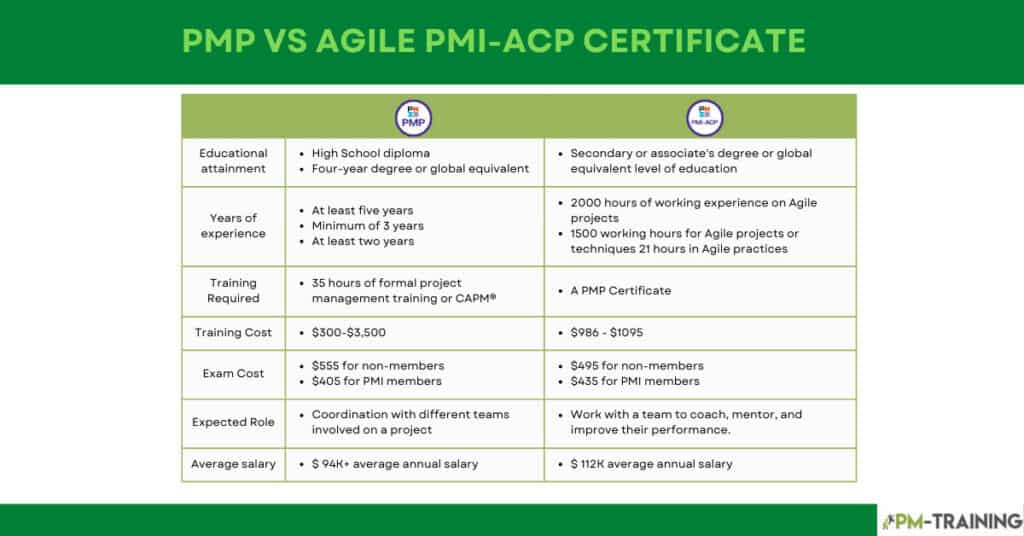
The approach each certification takes to project management reflects its underlying purpose and the type of practitioner it is designed to develop. When preparing for the PMP® exam, be sure to reference PMI’s free PMP Exam Content Outline, which provides the most up-to-date information on what the certification exam covers and is an essential starting point for choosing the right training resources.
- The PMP takes a broad, comprehensive view of project management. It provides deep insight into the full project lifecycle, from initiation and planning through execution, monitoring, control, and closure, and tests your ability to manage projects using predictive, agile, and hybrid approaches. It also covers general risk management, stakeholder engagement, and organizational strategy, making it the stronger choice for project managers who want a well-rounded, universally applicable credential.
- The PMI-ACP, by contrast, is specifically designed for practitioners who work within agile environments. It teaches risk management from an agile perspective, emphasizes iterative delivery, and validates your real-world experience working on agile teams. As a PMI-ACP holder, you are expected to be proficient across multiple agile frameworks, adaptable to change, and skilled at coordinating with cross-functional teams in fast-moving project environments.
What Is PMP?
The PMP is a credential awarded by the Project Management Institute that is widely recognized across industries and geographies as the gold standard in project management certification. It demonstrates extensive experience, education, and the skills required to successfully lead and direct projects of any size and complexity.
Beyond validating technical project management knowledge, the PMP signals to employers that you possess the leadership capabilities, strategic thinking, and methodological fluency needed to deliver results in any environment — making it one of the most versatile and valuable certifications a project manager can hold.
What Is PMI-ACP?
The PMI-ACP is a globally recognized certification that demonstrates a high level of professional competence in agile principles, practices, and project management. It is designed for project management professionals who want to deepen their expertise in agile methodology and for organizations that are currently operating within, or transitioning to, agile frameworks.
The PMI-ACP is particularly valuable for practitioners working in roles such as Scrum Master, Agile Coach, or Agile Project Manager, where fluency across multiple agile approaches is essential to effective performance.
PMP Benefits
- Competitive Advantage: The PMP certification distinguishes candidates in a crowded job market, signaling to employers that they have met a rigorous, globally recognized standard of project management excellence.
- Advanced Project Management Knowledge: PMP equips holders with a comprehensive understanding of project management processes and best practices across predictive, agile, and hybrid methodologies, applicable in virtually any industry.
- Better Compensation and Opportunities: PMP-certified professionals consistently command higher salaries and are more frequently considered for senior roles and promotions, as organizations recognize the direct value the credential brings to project delivery.
- Improved Performance: The depth of knowledge and practical frameworks gained through PMP preparation directly enhance a project manager’s ability to handle complex, high-stakes projects with greater confidence and competence.
PMI-ACP Benefits
- Enhanced Agile Knowledge: The PMI-ACP credential develops both hard and soft agile skills, expanding your understanding of agile tools, techniques, and best practices across a wide range of frameworks and real-world applications.
- Greater Professional Credibility: Passing the PMI-ACP exam establishes a clear professional standard, boosting your confidence and reputation within your organization and the broader agile community.
- Higher Earning Potential: PMI-ACP certified professionals are well-positioned for salary increases and career advancement, with compensation reflecting the specialized expertise the credential represents.
- Global Industry Recognition: The PMI-ACP is recognized worldwide, opening doors to agile project management opportunities across industries and geographies and making your expertise immediately visible to prospective employers.
PMP vs PMI-ACP Salary
Salary expectations for both certifications are strong, reflecting the high value organizations place on certified project management professionals. According to ZipRecruiter data, the average annual salary for a PMI-ACP holder in the United States is approximately $132,505 (PMI ACP Salary ($132,505 – December 2022) ZipRecruiter). PMP-certified professionals similarly command above-average compensation, with salaries varying based on industry, geography, years of experience, and the complexity of projects managed.
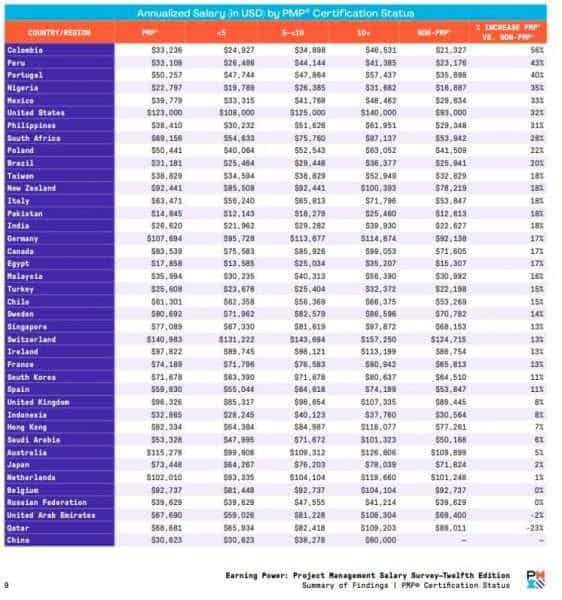
Project Management Salary Survey—Twelfth Edition | Project Management Institute (pmi.org)
PMI’s own Project Management Salary Survey consistently shows that certified project managers earn significantly more than their non-certified counterparts across all regions and industries. It is worth noting that holding both certifications can further strengthen your earning potential and career prospects, as it signals a rare combination of broad project management expertise and deep agile specialization.
Video About Should I do (PMP®) or (PMI-ACP)®
Still unsure which certification is the right fit for you? Watch this helpful video breakdown comparing the PMP® and PMI-ACP® certifications. It covers key differences, career impact, and expert recommendations to help you make a confident, informed decision about your project management path.
Conclusion
Choosing between the PMP and PMI-ACP ultimately comes down to where you are in your career and where you want to go. If your goal is broad, versatile project management expertise that is recognized across every industry and methodology, the PMP is the stronger investment. If your work is deeply rooted in agile environments and you want to formalize and validate that expertise, the PMI-ACP is the right choice.
Both certifications deliver real, measurable career benefits like improved knowledge, stronger credibility, higher earning potential, and greater professional recognition. If circumstances allow, pursuing both will position you as one of the most well-rounded project management professionals in your field. Whichever path you choose, the commitment to certification is a commitment to excellence that will pay dividends throughout your career.
Frequently Asked Questions
Which is harder — PMI-ACP or PMP?
The PMP is generally considered the more challenging of the two exams. It covers a broader range of material, requires more extensive work experience to qualify, and allows less time per question than the PMI-ACP. Candidates who have already passed the PMP typically find the PMI-ACP considerably more manageable by comparison.
Which PMI certification is the most recognized?
The PMP is the most globally recognized project management certification available. It is respected across industries worldwide and validates expertise in agile, hybrid, and predictive methodologies. For project managers seeking the broadest possible career impact, the PMP remains the most universally valued credential they can hold.
What jobs can I get with PMI-ACP?
A PMI-ACP certification opens doors to a wide range of agile-focused roles, including Scrum Master, Agile Project Manager, Agile Trainer, Technical Business Analyst, Business Analyst, Digital Channel Planner, Deputy Project Manager, and Director of Planning and Project Management — among others.
Can I pursue both the PMP and PMI-ACP certifications?
Yes, and doing so is highly recommended if time and resources allow. Holding both certifications provides a comprehensive foundation that covers the full spectrum of project management approaches. Many experienced project managers pursue the PMP first for its broader scope, then add the PMI-ACP to deepen their agile credentials.
How often do PMP and PMI-ACP certifications need to be renewed?
Both the PMP and PMI-ACP require renewal every three years through PMI’s Continuing Certification Requirements program. PMP holders must earn 60 Professional Development Units (PDUs) within each three-year cycle, while PMI-ACP holders must earn 30 PDUs. Renewal ensures that certified professionals stay current with evolving project management practices and standards.
Suggested articles:
- The 5 Scrum Phases and Their Benefits
- 10 PMI Certifications to Boost Your Career in Project Management
- PMP Exam Prep: How to Pass the PMP Certification Exam

Shane Drumm, holding certifications in PMP®, PMI-ACP®, CSM, and LPM, is the author behind numerous articles featured here. Hailing from County Cork, Ireland, his expertise lies in implementing Agile methodologies with geographically dispersed teams for software development projects. In his leisure, he dedicates time to web development and Ironman triathlon training. Find out more about Shane on shanedrumm.com and please reach out and connect with Shane on LinkedIn.