
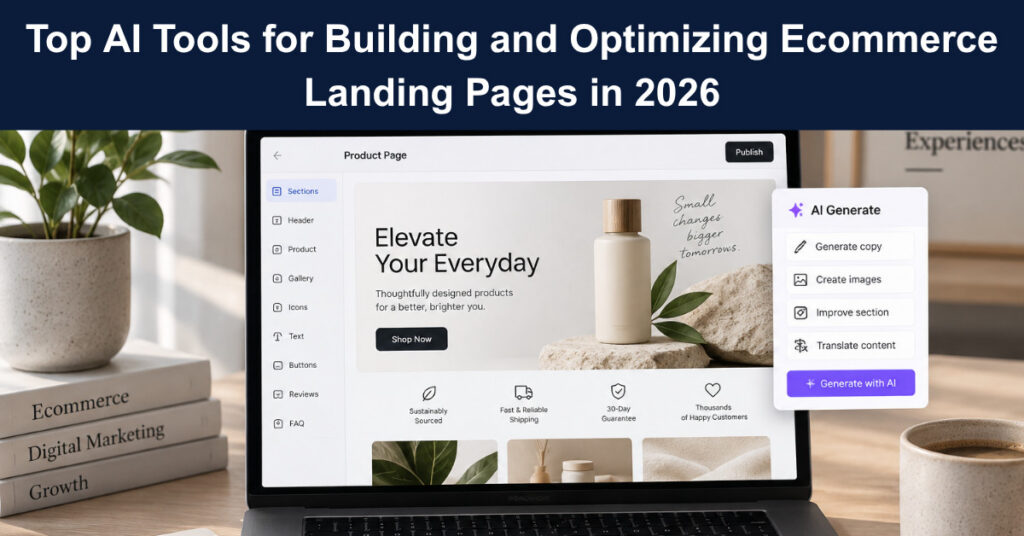
Ecommerce landing pages have to do more than look polished. They need to communicate an offer clearly, work smoothly across devices, connect with the rest of the ecommerce stack, and give teams enough flexibility to test and improve the experience over time. AI is increasingly becoming part of that workflow. Some tools can generate product pages from existing product information, while others use AI to create layouts, rewrite copy, personalize experiences, or direct traffic toward better-performing page variants.
The right choice therefore depends on what you need to improve. Here are seven AI-powered tools worth considering for ecommerce landing page creation and optimization in 2026.
Best AI Ecommerce Landing Page Tools at a Glance
| Tool | Best for | Key capability |
| PagePilot | AI-generated Shopify product pages | Generates editable pages from product URLs |
| GemPages | Flexible Shopify page design | AI-assisted layout creation |
| Instant | Prompt-based Shopify page building | AI agent for creating and editing layouts |
| Replo | Advanced Shopify landing pages | Flexible ecommerce design and Shopify integration |
| Unbounce | Landing page testing and optimization | AI-powered traffic optimization |
| Shopify Magic | Native Shopify AI workflows | AI content, media, and theme assistance |
| Shogun | Ecommerce page building | Visual storefront and page creation |
1. PagePilot — Best for AI-Generated Shopify Product Pages
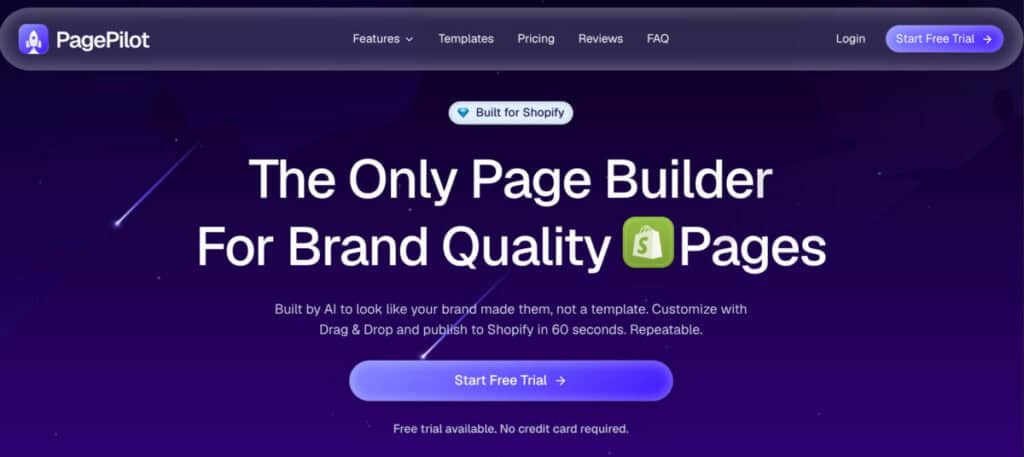
PagePilot is an AI-powered Shopify platform built for merchants who want to reduce the manual work involved in creating ecommerce products and landing pages. Instead of starting with a blank canvas, merchants can paste an existing product URL and use PagePilot to generate an editable Shopify product page with AI-assisted copy and imagery. It supports product sources including Shopify, AliExpress, Amazon, Etsy, and TikTok Shop.
Once the initial page has been created, users can customize it through a drag-and-drop editor. PagePilot provides editable sections and blocks for elements such as product galleries, FAQs, reviews, comparison tables, bundles, trust badges, and sticky add-to-cart bars. Pages can then be published directly to Shopify. PagePilot also includes AI product image generation, AI-assisted copy, customizable cart drawers and upsells, and support for more than 30 languages.
Best for: Shopify merchants, dropshippers, and ecommerce teams that want AI to create the initial product-page structure rather than building every page manually.
Consider: PagePilot is primarily designed for Shopify, so it’s best suited to merchants already using or planning to use the platform.
2. GemPages — Best for Flexible Shopify Page Design
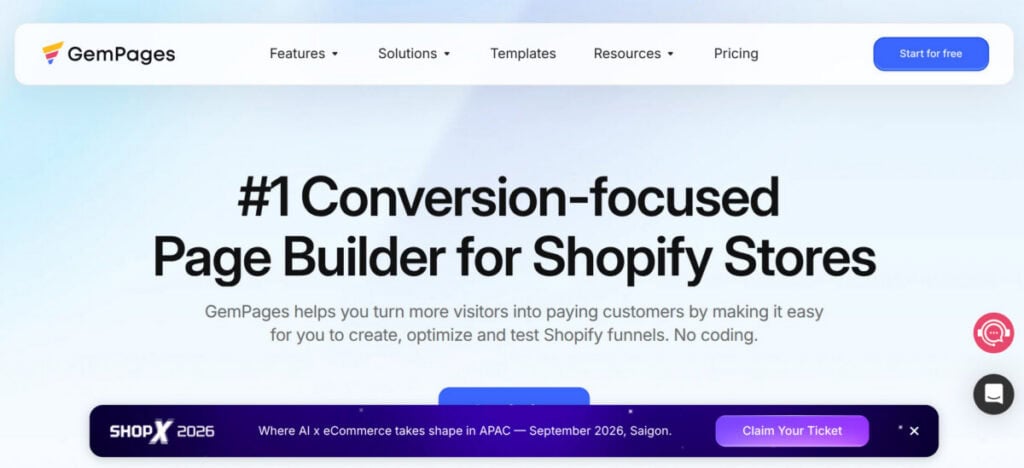
GemPages is a Shopify page builder combining visual page creation with AI-assisted design tools. Its GemAI functionality can transform reference images and URLs into editable layouts, while its editor provides responsive controls and ecommerce-focused elements. GemPages also offers features for sales funnels, theme sections, and landing pages.
This makes it particularly useful when a team wants substantial visual control while still relying on AI to accelerate parts of the design process. Rather than choosing between manual customization and automated generation, teams get both, allowing designers to fine-tune layouts, adjust responsive elements, and maintain brand consistency while AI handles repetitive or time-consuming setup tasks.
Best for: Shopify merchants that want AI assistance without giving up detailed visual customization.
Consider: Teams primarily interested in generating complete product pages directly from product information may prefer a more automation-first workflow.
3. Instant — Best for Prompt-Based Shopify Page Building
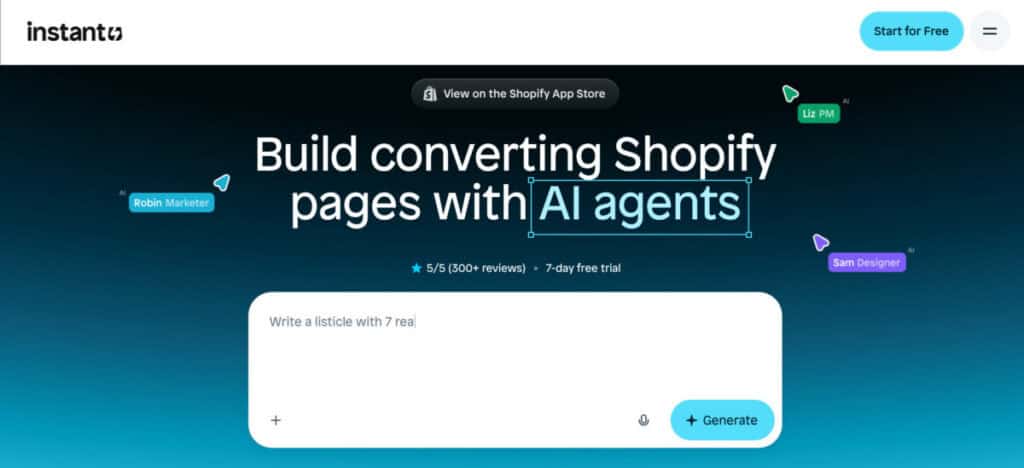
Instant takes a conversational approach to Shopify page creation. Its built-in AI agent can create or modify layouts based on natural-language instructions. Users can ask it to build a landing page or section, restructure an existing layout, rewrite copy, connect Shopify content, or apply a brand kit.
Instant supports a wide range of Shopify page types, including landing pages, homepages, product and collection templates, reusable sections, navigation menus, and carts. Once created or modified, these layouts are published directly into the Shopify theme, allowing merchants to maintain consistency across their storefront while still benefiting from AI-assisted, prompt-based editing throughout the entire build process.
Best for: Shopify teams that want to build and modify storefront layouts through prompts.
Consider: Its workflow remains centered on Shopify rather than cross-platform campaign landing pages.
4. Replo — Best for Advanced Ecommerce Landing Page Design

Replo is designed around ecommerce landing pages, campaigns, and storefront experiences, particularly for Shopify brands. It gives teams granular visual control over page design while connecting pages with Shopify products and cart functionality. Product information can be synced from Shopify, and Replo supports ecommerce components such as buy buttons and variant selectors.
This makes it a strong option for established ecommerce teams that need sophisticated campaign pages, deeper customization, and tighter product integrations rather than primarily AI-generated first drafts. Teams with dedicated designers or developers can take advantage of that flexibility to build layouts tailored to specific campaigns, promotions, or brand requirements.
Best for: Ecommerce brands with demanding design requirements and dedicated growth or creative teams.
Consider: Its flexibility can be more than smaller merchants need when the primary goal is simply to get a new product page live quickly.
5. Unbounce — Best for AI-Powered Landing Page Optimization
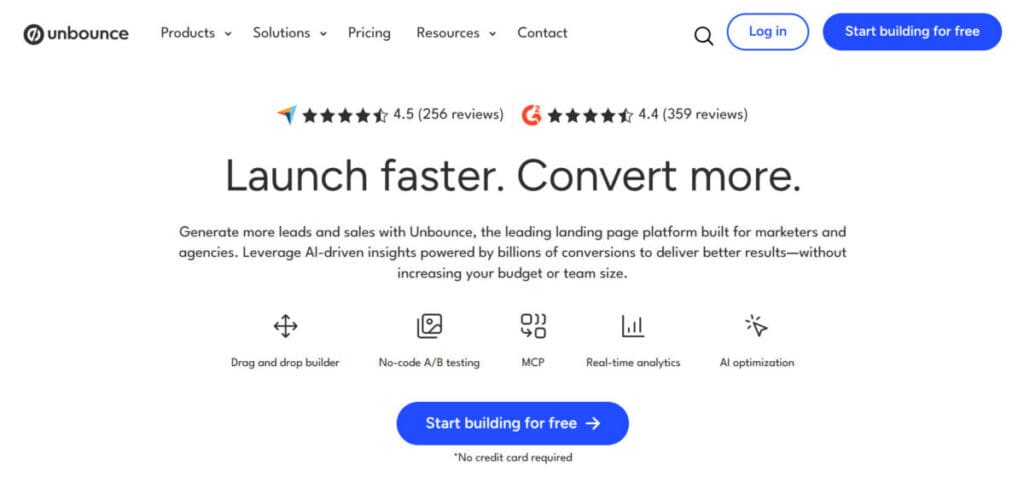
Unbounce differs from Shopify-specific builders because its strongest use case is campaign landing-page experimentation and optimization. Its platform includes a drag-and-drop builder, page variants, no-code A/B testing, and reporting. Its Smart Traffic feature uses AI to route visitors to different page variants based on attributes such as device, location, time zone, browser, and operating system.
Unbounce also includes an AI writing assistant built directly into the page builder, making it easy to rewrite, expand, and refine copy without switching tools. It can help generate new headlines, adjust tone, tighten messaging, or produce alternate variations for testing, which is especially useful for teams running multiple campaign pages at once.
Best for: Marketing teams focused on testing and optimizing paid campaign landing pages.
Consider: It is not primarily a Shopify product-page generator.
6. Shopify Magic — Best for Native Shopify AI Assistance
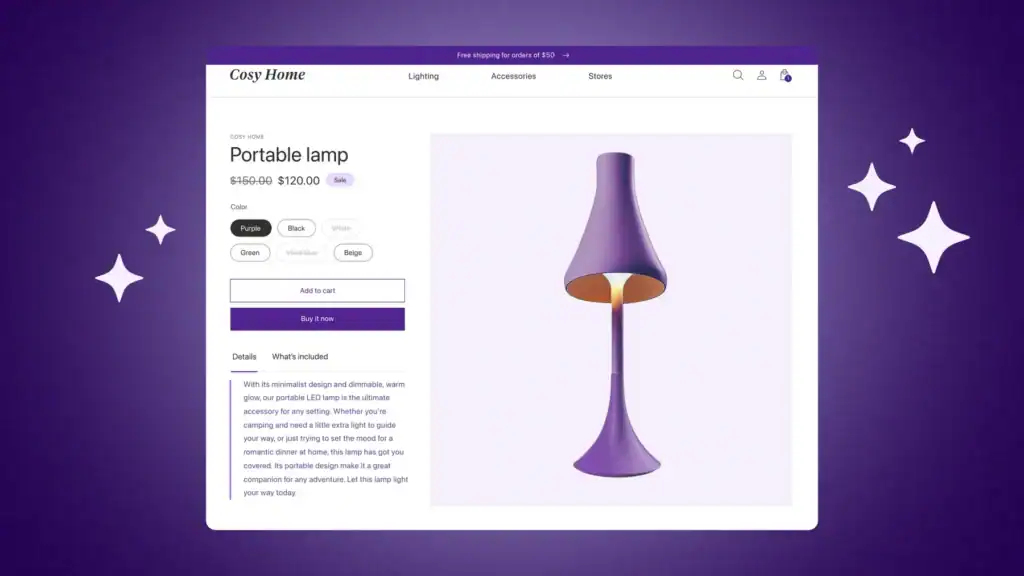
Shopify Magic is a collection of AI features built directly into Shopify rather than a standalone landing page builder. Its capabilities span text generation, media generation, theme generation, theme blocks, customer segmentation, and other Shopify workflows. Shopify also provides Sidekick as an AI assistant within the platform.
For merchants already working entirely within Shopify, these built-in tools can reduce the need to add another platform for basic AI-assisted content, product descriptions, and storefront tasks. This makes Shopify Magic and Sidekick practical choices for smaller teams that want quick AI support without managing separate subscriptions or learning new interfaces.
Best for: Shopify merchants who prefer native AI capabilities within their existing platform.
Consider: It is a broader suite of Shopify AI features rather than a specialized ecommerce landing-page platform.
7. Shogun — Best for Ecommerce Storefront Experiences
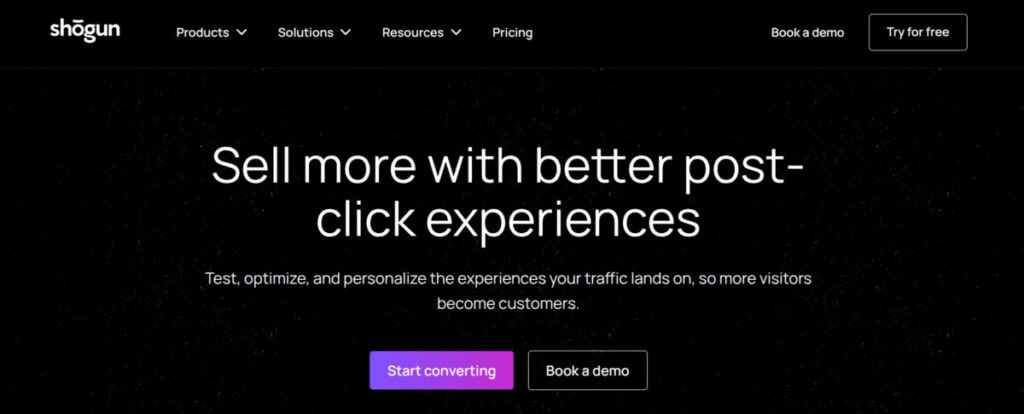
Shogun is an ecommerce page-building platform aimed at brands that want greater control over storefront experiences without relying entirely on developers. Its visual approach makes it suitable for creating landing pages, product experiences, and other branded ecommerce content.
For teams evaluating it against newer AI-first tools, the main distinction is workflow: Shogun is better viewed as an established ecommerce page-building platform than as a tool centered primarily on generating complete product pages from a product URL.
Best for: Ecommerce teams that prioritize visual storefront control and established page-building workflows.
Consider: Merchants specifically looking for an AI-first product-page generation workflow may find tools such as PagePilot more directly aligned with that requirement.
Which AI Ecommerce Landing Page Tool Should You Choose?
There is no single tool that is best for every ecommerce landing-page workflow. For generating Shopify product pages with AI, PagePilot is one of the most directly specialized options. GemPages and Instant provide more design-oriented Shopify workflows with AI assistance, while Replo is better suited to brands that need advanced creative control.
For optimization and experimentation, Unbounce stands out because testing and AI-powered traffic routing are central to the platform. Shopify Magic is a logical option for merchants who want to use AI capabilities already available within Shopify. The important distinction is whether your biggest bottleneck is creating the page, designing it, or optimizing its performance after launch.
Final Thoughts
AI landing-page tools now cover very different parts of the ecommerce workflow. Some automate the initial build, others make visual design faster, and others focus on experimentation after a page is already live. For Shopify merchants who want to turn existing product information into editable product pages with less manual setup, PagePilot is a strong fit.
Brands requiring more advanced design control may prefer GemPages, Instant, or Replo, while optimization-focused marketing teams may get more value from a testing platform such as Unbounce. Choosing based on the specific bottleneck—not simply the longest feature list—is the best way to narrow down the options.
FAQs
What is an AI ecommerce landing page builder?
An AI ecommerce landing page builder uses artificial intelligence to assist with tasks such as generating page layouts, writing copy, creating imagery, or modifying page elements. The level of automation varies considerably between platforms.
Can AI create a Shopify product page?
Yes. Tools such as PagePilot can generate an editable Shopify product page from an existing product URL, while other Shopify builders use AI to assist with layouts, content, or individual page sections.
What is the best AI landing page builder for Shopify?
It depends on the workflow. PagePilot is particularly suited to AI-generated product pages, while GemPages and Instant offer greater emphasis on visual page creation. Replo is designed for more advanced ecommerce landing-page experiences.
Can AI optimize ecommerce landing pages?
Yes, although “optimization” can mean different things. Some platforms help improve copy or layouts, while tools such as Unbounce use AI in experimentation workflows and traffic routing between page variants.
What should ecommerce teams look for in an AI landing page tool?
Consider how well the tool integrates with your ecommerce platform, how much control you retain over AI-generated output, its mobile editing capabilities, publishing workflow, ecommerce-specific elements, and whether you need page generation, design flexibility, or post-launch experimentation.
About the Author: Mika Kankaras is a B2B SaaS writer with over six years of experience covering marketing automation, AI workflows, customer experience software, and business technology. She specializes in testing and evaluating software and translating complex product features into clear, practical insights for business users. LinkedIn: Mika Kankaras on LinkedIn.
Suggested articles:
- A Project Manager’s Guide to AI Content Tools for Ecommerce
- How Project Managers Can Integrate 3D Configurators with E-commerce Platforms
- Project Management Tips for Operating an E-Commerce Website

Daniel Raymond, a project manager with over 20 years of experience, is the former CEO of a successful software company called Websystems. With a strong background in managing complex projects, he applied his expertise to develop AceProject.com and Bridge24.com, innovative project management tools designed to streamline processes and improve productivity. Throughout his career, Daniel has consistently demonstrated a commitment to excellence and a passion for empowering teams to achieve their goals.